Drain-cover buying guide
FRP Drain Cover Grating: What It Is & How to Choose
A drain cover is more than a grating panel cut to size. Start with the opening, the water and debris path, the bearing frame, the traffic load and the way the cover is lifted, then define the finished piece from a measured drawing.
Prepared by
Dengtai Industry
Published
·
Reviewed

A framed-opening installation from our image library. Frame, load and final fit remain project-specific.
Key terms
Drain Cover Terms That Change the Product
The same outside size can describe an open floor drain, a fine-mesh gully cover, a closed service cover or a long trench grate.
- FRP drain cover grating
- A fiberglass-reinforced plastic grating cover over a floor drain, gully, catch basin, sump, pit or other drainage opening. The cover may be open mesh, mini mesh, covered or solid-top, and it works with a frame or bearing ledge.
- Floor drain grating
- A relatively small grating cover over a floor drain or shallow collection point. The clear opening, debris size, cleaning access and load on the surrounding floor govern the finished piece.
- Gully or catch basin cover
- A cover over a roadside, yard or building drainage inlet. The frame pocket, traffic exposure, retaining requirement and lifting method are usually as important as the panel outside size.
- Sump, pit or service cover
- A cover over a pump sump, inspection pit or service opening. It may need a more continuous surface, a lifting point, restraint or a hinged arrangement, separately from water-passing capacity.
- Channel drain and linear trench
- A long, generally one-directional drainage run. This page covers smaller drain openings; long trench and duct runs are handled by the dedicated trench-cover guide.
- Clear opening
- The unsupported distance between bearing edges. It is not the same as the drain outside width, the cover outside size or the frame pocket size.
- Bearing frame or ledge
- The surface on which the cover rests. Its width, level, continuity, material and condition determine whether the piece sits without rocking and whether it can carry load into the structure.
- Open area and net opening
- Open area is the proportion of the cover surface available for flow. Net opening is the measured clear gap between bars. A cover can have high open area but still retain an object depending on its shape and orientation.
- Load class
- A defined performance requirement for a complete cover and frame system, such as a project wheel load or a named standard class. Thickness, mesh or the word heavy duty does not assign a load class by itself.
- Removable or restrained cover
- A cover designed to be lifted for cleaning or access, or held against movement under traffic. Piece weight, handle position, hinge, clip, theft risk and re-seating belong to this decision.
Opening types
Floor Drains, Gullies, Basins and Trenches
Define the opening before choosing a panel, because the frame, water path and access route are not the same.
Swipe horizontally to view all columns.
| Opening type | Typical cover direction | Primary checks | Page boundary |
|---|---|---|---|
| Floor drain | Small open or mini mesh panel, often removable by hand | Net opening, debris size, lift weight, ledge and floor level | Covered on this page |
| Gully / catch basin | Open mesh or mini mesh in a compatible frame pocket | Inlet area, retained objects, traffic, frame fit and theft risk | Covered on this page |
| Sump / service pit | Open, covered or solid-top piece with a lifting or restraint detail | Closure, ventilation, access, lifting and load on the complete cover | Covered where the product is grating-based |
| Linear channel / long trench | Molded, mini mesh, covered or pultruded cover along a channel | Clear span, bar direction, joint layout and piece handling | Use /frp-grating-trench-covers/ |
| Manhole or watertight access cover | A dedicated engineered cover, often not an open grating | Sealing, gas, access, frame and load class | Separate product; not claimed here |
Applications
Where FRP Drain Cover Grating Is Used
Washdown areas, utility covers, service pits and irregular replacement pieces each put a different requirement first.

Car wash and washdown drain
Water, soap, grit and small parts make both drainage and retention important. Mini mesh can reduce what falls through, while the cleaning method, resin and fixing still need their own review.
Flow + fine debris + cleaning

Utility channel and service duct
Long linear runs need a different piece layout and support check from a small local drain. Use the trench-cover guide when the opening runs continuously along a channel.
Long run + joints + cable access

Covered pit or service opening
A covered or solid-top assembly can reduce splash and object fall-through, but it changes drainage, mass and the load path. The top, base, joints and lifting detail belong to one specification.
Closure + drainage + access

Irregular opening and replacement cover
Curves, notches, pipe cut-outs and narrow strips can be factory cut, but removed bars still need support. A replacement should follow the measured opening and frame rather than the old cover outline alone.
Shape + remaining support + edge sealing
Project inputs
What Determines the Finished Drain Cover
The cover is selected from the opening, duty, frame, load, lifting and environment together.
Swipe horizontally to view all columns.
| Drain-cover decision | Ask before the quote | Evidence that closes the choice |
|---|---|---|
| What kind of opening is it? | Is the cover over a floor drain, gully, basin, sump or channel? | Photos with a tape measure, plan and section, and the drain or frame manufacturer where known. |
| What must the cover do? | Drain water, retain debris, close the surface, reduce splash, allow access or support traffic? | A written cover duty with object size, water path, frequency of use and maintenance method. |
| Does it fit the frame? | What are the clear opening, outside size, pocket depth, bearing width and finished level? | A dimensioned drawing and frame photos showing what the cover actually rests on. |
| What load crosses it? | Pedestrian, trolley, equipment foot, vehicle wheel or a named load class? | Load value, contact area, position, dynamic assumptions, deflection limit and the complete frame. |
| Can it be handled safely? | What maximum weight can one or two people lift, and how often will the cover be removed? | Piece split, handle or lifting point, hinge or restraint, and the re-seating method. |
| What is the environment? | Which chemicals, temperatures, UV, fire, slip and colour requirements apply? | Product-specific resin grade, surface, fixing, standard and document scope. |
| What evidence is required? | Is a material report enough, or is a load-class, slip, fire or watertightness certificate required? | The exact test or approval scope and the product plus frame assembly it covers. |
Current supply
FRP Drain Cover Configurations to Review
Panel dimensions are starting points; none is a universal load class or sealed-cover designation.
Request a Project Quote| Specification | Value |
|---|---|
| Standard molded cover | 25 / 30 / 38 mm · 38 × 38 mm mesh Reference masses are 12.5 / 16.5 / 19.5 kg/m². These are configurations, not three load classes. |
| Mini mesh cover | Commonly 19 × 19 mm upper mesh over 38 × 38 mm lower mesh The 25 mm mini mesh row has a 15.5 kg/m² reference mass. Confirm both mesh layers and net opening. |
| Full panel source | 1000 × 4000; 1220 × 3660 mm; selected 38 mm rows 915 × 3050 mm Covers are normally cut from full panels. Nesting and offcut affect the quotation. |
| Floor drain and gully size | Made to the measured opening and frame State clear opening, cover outside size, pocket depth and required running clearance. A nominal 12 × 12 in size is not sufficient by itself. |
| Draining format | Standard open mesh or mini mesh Open mesh favours flow and cleaning. Mini mesh reduces the upper opening but collects more fine debris and adds mass. |
| Closed or covered format | Covered grating or independent solid-top assembly Confirm how water drains, where the top is joined and how the complete assembly is supported and lifted. |
| Pultruded option | I, T or WT bearing bars in a project-specific layout Usually considered for a clearly directional or longer narrow opening when supports and deflection evidence match. |
| Fixing and lifting | Clips, restraint, handles or hinge details by drawing A clip can restrain the piece. It cannot replace the bearing ledge, frame or lifting design. |
| Published panel reference | USD 10.5 / 12.0 / 15.1 per m² EXW for 25 / 30 / 38 mm Plain isophthalic polyester ordinary-environment reference only. Cutting, edges, surface, hardware, packing and freight are separate. |
| Load evidence | Project-specific cover and frame review There is no universal EN 124 or EN 1433 class by panel thickness. A required class must cover the exact cover and frame. |
Suitability check
When FRP Grating Is the Right Drain Cover
Use the checks to separate a draining cover from a watertight, heavy-traffic or engineered access cover.
Specify this if…
- The opening can be described with clear dimensions, frame or ledge detail and photographs.
- The cover has a clear duty such as drainage, debris retention, closure, access, load support or a stated combination.
- The traffic and lifting requirements are known well enough to define the load case and maximum piece weight.
- The project accepts that resin, mesh, top format and fixing are separate choices.
- Any required load class, slip result or certificate names the complete assembly and acceptance method.
Look elsewhere if…
- The request is based only on an outside size copied from an old cover with no frame measurement.
- The buyer wants a standard load class from a photograph or panel thickness without the frame and fixing scope.
- The requirement is a watertight, gas-tight or odour-sealing cover rather than a draining or ventilated cover.
- The opening is a long linear trench and needs a dedicated span and joint layout.
- Severe impact, high temperature, structural fire integrity or unrestricted heavy vehicle traffic makes another material or engineered cover the better starting point.
What FRP Drain Cover Grating Means
FRP drain cover grating is a fiberglass-reinforced plastic panel over a drainage opening. It may cover a floor drain, gully, catch basin, sump, service pit or short channel. The panel can be open mesh, mini mesh, covered grating or part of a solid-top assembly.
The words drain cover, drain grate and grating cover overlap in the market, but they do not define the same finished product. A cover that drains freely has different openings and cleaning needs from one intended to close the surface. A pedestrian cover is different from a cover that must carry a trolley or vehicle. A light removable piece is different from a restrained or hinged cover.
The useful specification therefore begins with four records:
- the opening and bearing frame;
- the water and debris path;
- the cover format and load;
- the lifting, fixing and evidence requirements.
If the outside dimensions are the only information available, the quotation can identify a candidate size, but it cannot confirm fit, drainage or load capacity.
Floor Drain, Gully, Catch Basin and Trench
These names are often used loosely in product listings. For selection, they describe different installation problems.
Floor Drain
A floor drain is normally a small framed opening inside a floor area. The cover may be square, rectangular or round, and it may be lifted by hand for cleaning. The clear opening, debris size, floor level and surrounding drain body control the fit.
A large open panel placed over a small floor drain is not automatically better. Excess unsupported area, a poor bearing surface or a heavy cut piece can make cleaning harder and shorten the useful life of the cover.
Gully and Catch Basin
A gully or catch basin receives water and debris from a yard, road or building edge. The cover often has to retain larger objects while allowing stormwater through. Vehicle traffic, theft risk, frame pocket depth and cleaning access may matter.
The panel’s net opening should be selected against the debris that must remain on the surface. Open area alone is not enough: a cover can be very open and still catch a particular object, or have many holes but drain poorly once fine material blocks part of the surface.
Sump and Service Pit
A sump or service pit is primarily an access opening. The cover may need to reduce fall-through, support people or equipment, provide a lifting point or remain closed most of the time.
An open grating cannot be an odour seal. Covered grating can reduce splash or object fall-through, but joints, handles, edges and the frame still need a deliberate closure and ventilation strategy.
Channel and Linear Trench
A long channel is a different product boundary. Piece layout, support spacing, bearing-bar direction and joint positions run along the opening. Use the FRP trench cover guide when the requirement is a continuous linear run rather than a local drain, gully, basin or pit.

The Cover Must Do More Than Let Water Through
Drainage performance depends on several connected items:
- the inlet or opening area;
- open area and net opening of the cover;
- the depth and capacity of the drain body;
- floor slope and the path water takes to the opening;
- the amount and type of debris;
- the cleaning frequency;
- whether the cover is flat, covered or recessed.
Open area is the proportion of the cover that is not solid. Net opening is the measured gap between bars. They answer different questions. A panel with a high open area may still retain a long object across several bars, while a smaller net opening reduces what passes but collects fine debris more quickly.
For a drain with limited flow, a finer mesh may restrict the effective inlet once oil, grit or leaves cover part of it. For a small-parts wash area, a coarser mesh may pass the very item that had to be retained. Start with the job, then compare the full water path.
Cleaning belongs in the same decision. A cover that requires tools, two people or awkward lifting may not be cleaned as often as a lighter piece with a handle. Poor cleaning reduces drainage even when the panel was correctly sized at installation.
Open Mesh, Mini Mesh, Covered and Solid Top
Open Mesh
Open molded grating offers the simpler drainage path and normally the easiest wash-through. It is a practical starting point for gullies, yard drains and floor openings where the retained object is large or the flow needs a generous path.
The standard molded range in this page uses a 38 × 38 mm mesh. Actual net opening still has to be checked, and the clear span, bearing edges, piece size and traffic load decide whether the panel configuration is suitable.
Mini Mesh
Mini mesh adds a finer upper layer over a wider lower mesh. Our common combination is 19 × 19 mm over 38 × 38 mm. It reduces the upper opening while the panel remains an open drainage product.
Mini mesh is useful where small tools, bolts or debris should not pass, but it is not a solid surface and does not automatically stop odours or water. Fine material can collect in the upper cells, so cleaning and flow need review. The mini mesh guide explains how to specify both mesh layers.
Covered Grating
A covered grating uses a continuous cover layer over a grating base. The assembly can reduce splash and object fall-through, but water no longer passes through the upper surface in the same way.
Drainage must then be provided at edges, openings or another planned route. The cover layer changes mass, load path, joints and lifting weight. Two products with the same outside size may behave differently because the top construction is not the same.
Solid-Top Assembly
A solid-top product can close a service pit or small drainage opening, but a grating cover does not become a watertight or gas-tight manhole cover by adding a plate. Sealing, gaskets, gas control, access and structural certification remain separate requirements.
The covered grating guide explains the construction boundary between a cover layer, patterned plate and independent solid panel.
The Frame and Bearing Edge Decide Fit
The frame is where a drain cover becomes a system. A panel with the correct outside size can still rock, move, crack or bear on only a small part of its edge if the frame is wrong.
Record:
- the clear opening between bearing surfaces;
- the outside size of the frame or drain body;
- the cover pocket and available depth;
- bearing width around the perimeter;
- level at several points;
- cracks, corrosion, repairs, debris or missing material;
- how the cover is restrained;
- whether water has to pass around the cover edge.
A narrow or discontinuous ledge increases local bearing pressure and local bending. A frame that has settled can change the unsupported span even if the visible opening has not changed. Loose material under the cover can hold it above the bearing surface and create a rocking point.
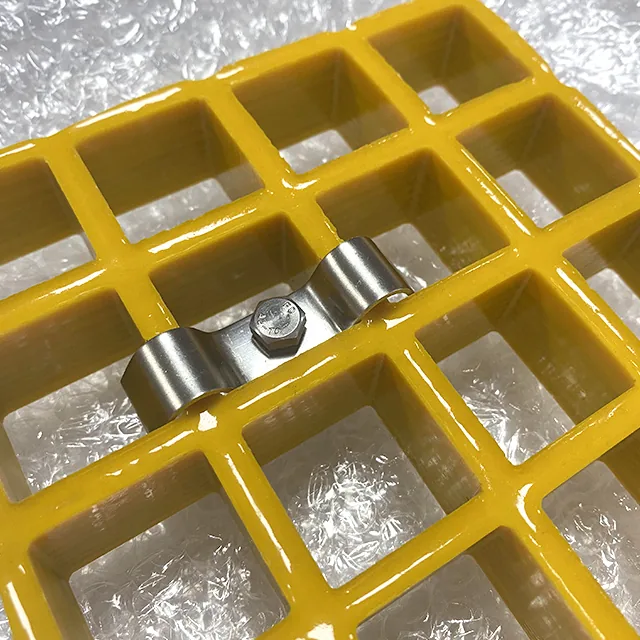
Clips can restrain a well-supported cover or join pieces. They do not create a new bearing ledge. An M, L or C clip selection belongs to the frame drawing; the clip guide explains what each family can and cannot do.
Load, Thickness and the Complete Assembly
A drain cover may see:
- a person walking;
- a maintenance trolley or caster;
- an equipment foot or jack;
- a dropped tool;
- a vehicle wheel;
- a named project load class.
These are different cases. A wheel contact patch concentrates force differently from a pedestrian load. A cover that feels stiff underfoot may still fail a trolley or vehicle requirement.
Thickness and mesh are configuration fields. A 25 mm cover is not automatically a light-duty class and a 38 mm cover is not automatically a vehicle cover. The clear span, frame bearing, contact area, load position, dynamic assumptions, deflection limit and matching evidence determine suitability.
If a project names EN 124, EN 1433 or another class, the requirement applies to the complete cover and frame system under that standard. A generic panel report, a high-load product name or a supplier photograph is not enough. Our quotation can identify what evidence exists for the proposed product; it cannot assign a missing class by description.
The heavy-duty FRP grating guide explains wheel and repeated loads in more detail.
Cleaning, Lifting and Fixing
A drain cover is often removed more frequently than other grating panels. Lifting is part of the product, not an afterthought.
Set a maximum piece weight and decide whether access is by:
- loose lift;
- recessed handle;
- hooks;
- hinge;
- another agreed lifting detail.
For thin covers, a rough area calculation helps set a size limit. A 300 × 1000 mm 25 mm molded panel is about 3.8 kg; a 300 × 1000 mm 38 mm panel is about 5.9 kg before a cover layer or hardware. A 1000 × 2000 mm 38 mm panel is about 39 kg. The example is a handling reference, not a load rating.
Repeated lifting can wear the seating surface. The cover must return to the same level and should not catch on the frame. In traffic areas, restraint against lift or movement may be needed. In public or unsupervised areas, theft and deliberate removal may drive a different fixing.
The approved drawing should show which pieces lift, where the handles or lifting points sit, how the restraint is released, and what mark identifies the correct orientation.
FRP covers are often lighter than comparable metal pieces, and a suitable resin does not need repainting to resist rust. FRP also has little scrap-metal value, which can reduce one incentive for theft. It does not make a cover tamper-proof or maintenance-free: loose pieces still need restraint, and the material still needs inspection. Compare the actual finished-piece mass and fixing rather than treating “lightweight” as a benefit with no handling limit.
Resin, Surface and Fixing Are Separate
A drain cover may be wet, oily, salty, chemical-exposed or cleaned frequently. The word wastewater or industrial does not define the resin grade.
Record the chemical names, concentration, temperature and whether exposure is splash, spillage or immersion. Include the cleaning agents, normal and peak temperature, and any fire, smoke, UV, anti-static or potable-water requirement.
Common resin directions include isophthalic polyester for suitable ordinary environments, vinyl ester where stronger chemical resistance is needed, and phenolic or other systems where a fire-performance requirement is defined. The exact grade and finished product evidence still have to match the service.
Grit can improve walking texture. It does not establish a slip class unless the test method and product result are supplied. For oily wash areas, cleaning is at least as important as the initial surface texture. Review resin selection and surface options before treating either as a generic upgrade.
Measuring an Existing Drain Opening
Photos with a tape measure are useful, but they are not a substitute for dimensions that identify what the numbers mean.
Record the following in plan and section:
- clear opening between bearing edges;
- clear opening at both ends and in the middle;
- outside frame or drain-body size;
- bearing width;
- pocket depth and cover thickness;
- required finished floor level;
- shape, radius, corner condition and skew;
- cracks, corrosion and loose or missing ledge;
- fixing access;
- any obstruction below the cover.
A replacement cover should not be based only on the old cover outline. The old piece may have been cut undersize, damaged, placed on debris or selected for a different frame. Measure the current opening and inspect what the replacement will actually bear on.
For a round or shaped opening, send a template or enough dimensions to recreate the geometry. For a sloped floor, show the high and low sides and whether the cover remains horizontal or follows the surface.
When the task is to survey one framed gully, use the gully cover dimension survey to record the clear opening, bearing ledge, pocket depth, finished level and lift-out clearance on one drawing.
How to Install and Re-Seat a Drain Cover
Installation is the point where the measured drawing becomes a working cover. It is also where several assumptions become visible: a ledge that is not level, a pocket that is too shallow, a clip that does not reach the support, or a cover that catches when it is lifted.
The site sequence should normally include:
- clean the frame and remove loose concrete, scale, debris or failed coating from the bearing surface;
- dry-fit the cover before it is finally fixed;
- check that the piece is supported around the intended bearing faces and does not rock or bridge on debris;
- confirm that joints and edges sit at the required level without an unintended step;
- fit or verify the agreed clips, hinge, handle or other restraint using the approved positions;
- lift and re-seat every removable piece to confirm that it can be removed, cleaned and returned to the correct orientation;
- observe normal drainage and cleaning after installation and record any ponding, bypass flow or movement.
A cover that feels firm under foot is not a load test. If the project requires a proof load, vehicle test or named acceptance method, follow the approved procedure for the exact cover and frame. Do not improvise a site load test against a complete drainage assembly.
The same rule applies to fixing. Tightening a clip harder does not repair an uneven frame, and a clip cannot increase the unsupported span. The FRP grating installation guide explains dry fitting, bearing, clip installation, edge sealing and handover in more detail.
How to Compare Drain-Cover Quotations
Compare quotations on the same table:
| Quote field | What to require |
|---|---|
| Opening and frame | Clear opening, cover size, bearing width, pocket depth and finished level |
| Material and construction | Molded, mini mesh, covered, solid top or pultruded; thickness and mesh |
| Water and debris | Open area, net openings and the retention requirement |
| Load | Pedestrian, point, trolley or wheel case, contact area and deflection limit |
| Lifting | Piece weight, handle, hinge, restraint and piece marks |
| Fixing | Clip family and material, or the explicit exclusion of fixing |
| Resin and surface | Grade, colour, texture and the exposure or test it is intended to satisfy |
| Fabrication | Finished sizes, curves, openings, edge treatment and revision |
| Evidence | Drawing, inspection, material report or load test and the exact scope covered |
| Delivery | Packing, quantity, trade term, destination and date |
A low panel price does not help if the pieces need extra site cutting, a new frame, special lifting equipment or an unstated load approval. Compare the finished covers and the remaining project work.
What We Supply and What Stays With the Project
Our usual supply is the FRP panel, factory cutting and fabrication, agreed edge treatment and selected clips or lifting details. We can review the opening information and state which configuration fields remain unknown.
The drain body, concrete opening, structural frame, bearing capacity of the surrounding floor, drainage design, installation labour and any system certification remain with the project unless the written quotation includes them.
This boundary matters for both safety and clarity. A panel can be correct for its own scope while the surrounding frame is inadequate. The quotation should identify both the product supplied and the assumptions that still require project confirmation.
Our Existing Factory Evidence
Report HZTC/BG-24051102 records a 4 kN/m² equivalent uniform design-load test at a stated 600 mm span and includes material results. It is useful evidence for the sample and material scope it describes.
It does not identify one complete drain-cover model, mesh, resin, frame and installation condition. It is not an EN 124 or EN 1433 class, a vehicle approval or a universal load table for every panel.
The report should be read with the standards and evidence guide. For every project, ask which cover, frame, load, deflection, test method and document scope is being confirmed.
How to Order a Finished Drain Cover
The cleanest order path is:
- measure the opening and inspect the frame;
- define drainage, debris, closure and cleaning;
- choose open, mini, covered or solid-top format;
- state load, traffic and deflection requirements;
- set maximum piece weight and lifting method;
- select resin, surface, colour and fixing;
- approve the finished-cover drawing;
- check the first piece or sample where the shape or fit is critical.
The quote can then follow the finished piece schedule rather than a generic panel rate. Each revision should carry the same opening dimensions, piece marks, frame assumptions and required evidence.
Selection sequence
How We Work Through a Drain-Cover Request
Measure the opening, define the function, check the frame and load, then freeze the finished piece.
Show the clear opening, outside frame, bearing ledge, pocket depth and finished floor level. Take several measurements and note cracks, corrosion, tilt or broken ledges.
State drainage flow, debris that must be kept out, surface closure, odour, cleaning, inspection and lifting requirements. Separate essential duties from preferences.
Compare open mesh, mini mesh, covered grating and solid top against the same opening and water path. Do not treat a finer mesh as an automatic load upgrade.
Confirm the cover rests on a continuous, level surface with enough bearing width. A new panel does not repair a failed frame, narrow ledge or overloaded drain body.
Record pedestrian, trolley, equipment or vehicle load with contact area and position. Add any named standard class and the frame or drainage body that forms the complete tested system.
Set a maximum piece weight, decide between loose, restrained and hinged pieces, and show handle or lifting positions. Confirm who removes the cover and how access is controlled.
Match the resin to the actual chemical, temperature and cleaning regime. Choose slip texture, colour, clip material and edge treatment as one configuration.
Freeze dimensions, mesh, top format, piece marks, lift points, clips, edge treatment and evidence requirements before production.
Claim boundaries
What FRP Drain Cover Grating Does Not Prove
The most common errors come from treating a mesh, thickness or clip as a complete drainage system.
- The opening is not the cover size — The clear opening, outside cover dimension and frame pocket are separate measurements. A cover that fits the old outline may still sit on the wrong bearing surface.
- A smaller mesh is not a higher load rating — Mini mesh adds a finer upper layer and changes drainage, mass and cleaning. Load and deflection still require matching structure, span, support and evidence.
- A clip is not a bearing support — Clips restrain a cover or join pieces. They cannot compensate for a narrow ledge, uneven frame, damaged drain body or excessive clear span.
- A solid top is not automatically watertight — Covered grating may reduce splash or fall-through, but joints, edges, handles and frame interfaces still need a deliberate water and ventilation path.
- Thickness is not a load class — A project may require an EN 124 or EN 1433 class or a stated wheel load. That requirement applies to a complete cover and frame system with traceable evidence.
- Grit is texture, not a certified slip result — A grit surface can improve grip, but a project slip rating needs the stated test method and the exact product result.
- Existing frames need inspection — Corrosion, cracking, movement, debris and missing bearing area can make every new cover unsuitable until the underlying frame is repaired.
- Our usual supply stops at the grating assembly — We supply panels, factory fabrication and agreed clips or lifting details. Drain bodies, concrete, structural design, installation and system certification remain separate unless quoted.
Factory evidence
What the Existing Evidence Can and Cannot Close
Material, fabrication and fixing records support the quotation only within the scope they actually cover.

Load report has a defined scope
HZTC/BG-24051102 records a 4 kN/m² equivalent uniform design-load test over a stated 600 mm span. It does not identify a complete drain-cover model, frame, mesh, resin or installation.
Cutting and piece identity are factory scope
The approved cut list controls finished size, openings, edge treatment and piece marks. A cut edge can be sealed, but sealing does not rebuild a bar removed from the load path.
The fixing must be selected with the frame
M, L and C clips are matched to panel height, bar width and support section. The quotation lists the agreed fixing, but the project confirms frame condition and installation.
RFQ inputs
What to Send for a Drain Cover Quote
A measured opening plus the water, debris, load and lifting requirements is enough to start.
- Opening type — Floor drain, gully, catch basin, sump, service pit, channel drain or other opening.
- Dimensions — Clear opening, outside frame, pocket depth, bearing width, finished level and plan shape.
- Frame condition — Material, continuous bearing, level readings, cracks, corrosion, looseness and obstructions below.
- Water duty — Expected flow, slope, standing water, washdown, spill path and any backup condition.
- Retained objects — Debris or object size, shape and orientation that must not fall through.
- Load — Pedestrian, trolley, equipment foot or vehicle wheel with contact area, frequent route and deflection limit.
- Lifting — Access frequency, maximum piece weight, one- or two-person lift, handle, hinge and restraint.
- Environment — Chemicals, concentration, temperature, UV, fire, slip, anti-static and cleaning requirements.
- Appearance — Colour, texture, existing surface and whether the cover has to sit flush or be visually unobtrusive.
- Documents — Material report, load calculation or test, slip result, fire evidence, inspection record and drawing scope.
Price basis
FRP Drain Cover Price and Scope
The finished piece, not one square-metre panel rate, defines the commercial comparison.
Panel and resin
The base begins with construction, thickness, mesh, resin and source-panel size. The published 25/30/38 mm rows are ordinary-environment molded-panel references, not drain-cover classifications.
Fabrication
Finished size, straight cuts, curves, notches, pipe openings, edge sealing and piece marks are quoted from the cover drawing.
Surface and hardware
Grit, colour, clips, handles, hinges or other lifting details are separate configuration lines and must suit the actual frame.
Evidence and delivery
Inspection, test scope, packing and freight are stated separately so quotations can be compared on the same delivered-cover basis.
The USD 10.5–15.1/m² molded-panel rows are planning references only. A drain-cover quotation follows the measured opening, finished pieces, cut plan, top format, resin, surface, hardware, evidence, packing and delivery scope.
Project review
Send the Drain Opening and Cover Duty
Photos, dimensions and the required function can begin the review; missing frame or load details can be listed before quotation.
- Send the clear opening, outside frame and bearing ledge dimensions
- State what must drain and what must not fall through
- Include the frame condition, load and lifting requirement
FRP Drain Cover Grating Questions
What is FRP drain cover grating?
Is a drain cover the same as a trench cover?
Which mesh is best for a drain cover?
Does mini mesh make the cover stronger?
Can I replace a metal drain cover with FRP?
Can a standard size cover fit my drain?
Do I need a frame with the grating cover?
Can a grating cover stop odours?
Can vehicles or forklifts drive over the cover?
Does the cover have an EN 124 or EN 1433 load class?
What does the existing factory load report cover?
How much does an FRP drain cover cost?
How heavy should one cover piece be?
Can irregular or round drain covers be made?
How should an FRP drain cover be installed and checked?
What information should I send for a quotation?
This content was prepared and reviewed by Dengtai Industry’s technical and production team using the project conditions, available product data and applicable documents. Limits that require design, testing or approval are identified in the content. Content last checked: