Gully cover replacement survey
FRP Gully Cover Dimensions: Opening and Frame Seat Survey
Measure the clear opening, frame footprint, bearing ledge, seat depth, diagonals, finished level and lift-out access. Order the replacement cover from the installed opening rather than the outline of the failed one.
Prepared by
Dengtai Industry
Published
·
Reviewed

The frame and opening are the reference. The old cover is only one clue. Photo: Dengtai Industry.
A replacement gully cover starts with the installed opening, not the old cover. The old piece may have been cut undersize, distorted by use, seated on debris or supplied for a different frame. The surrounding concrete or paving may also have moved. A useful quotation therefore begins with a short survey that separates the clear opening, frame footprint, bearing ledge, seat depth and finished level.
This page is the replacement-survey method for a local gully, catch basin or similar framed drainage opening. The FRP drain-cover guide explains product formats. The load-zone guide handles pedestrian, trolley and vehicle duty. This page concentrates on the dimensions needed to make and fit the replacement.

Why the Old Cover Is Not the Drawing
An old cover can be a useful template only after its relationship to the installed frame is understood. It may sit on only part of the bearing ledge, have been trimmed to clear a pipe, or be bent by repeated traffic. A replacement copied from it can repeat the original defect.
Photograph the opening with a tape or rule in view, but do not stop at the photograph. The framing surface may be hidden by debris. Clean the seat and inspect the whole perimeter. Record the opening in at least three positions along each direction, plus both diagonals and the visible shape at each corner.
Trison’s FRP water-gully reference table usefully lists outer frame, clear opening and cover size as three separate columns. That separation is the key planning idea. Fibera’s installation guide adds the installed-condition checks: level frame bedding, clear opening, a supported frame and a cover that finishes flush with the surrounding surface. Both sources reinforce the same factory review: the replacement cover cannot be defined from the visible top outline alone.
Measure the Clear Opening and Squareness
The clear opening is the span between bearing surfaces, not the distance across the outside of the frame. Measure it front to back and left to right at the beginning, middle and end of the opening. If any edge is damaged, take additional readings beside the damage instead of averaging it away.
Measure both diagonals. Equal or nearly equal diagonals support a rectangular or square plan. Unequal diagonals may indicate a skewed frame, a non-parallel opening or local deformation. Do not force a square cover into a skewed pocket. The drawing needs to show the actual shape, corner radius and usable bearing surfaces.
A long trench belongs in a different layout review. It has repeated supports, multiple pieces and joints along the run. This survey is for a local opening with a frame or defined bearing ring. Use the trench-opening layout guide when the run controls the design.
A round or irregular opening is not described adequately by a rectangle’s length and width. Record the diameter at several directions, the centre relationship to the frame, out-of-roundness and the smallest bearing ledge. For a shaped opening, make a rigid template or a dimensioned tracing and mark the top side. The replacement cover should reproduce the measurable opening, not an assumed “standard gully” shape.

Record the Frame Outside Size and Every Seat Width
The frame outside dimension helps identify the installed frame, the concrete or paving pocket and whether the project needs a cover only or a cover and frame review. It is not interchangeable with the clear opening.
Measure the bearing ledge at the left, right, front and rear. If the ledge is different at one corner, record the smallest usable bearing width and the location. A crack, missing lip or raised mortar bed changes the support condition. A cover that spans the outside dimensions can still rock because only part of its edge touches the frame.
The frame may be recessed, surface-mounted or integrated into a concrete surround. Mark the type. If the existing frame is damaged, do not hide the damage under the replacement quote. State the repair or replacement scope for the frame separately from the cover fabrication.
Seat Depth, Cover Clearance and Finished Level
Measure the vertical distance from the bearing face to the surrounding finished floor. This seat or rebate depth limits cover thickness and the available clearance. It also controls whether the top will finish flush, slightly recessed or proud of the surface.
Do not specify a cover thickness before checking the seat. A thicker piece may have the required load evidence but fail to fit the pocket. A thinner piece may fit but lack the required product support and load evidence. The project should confirm both the vertical build-up and the exact cover assembly.
Record the finished level around the full opening, not only at one corner. A frame can be locally flush and tilted elsewhere. The surrounding floor may also fall toward the drain, creating a deliberate slope. The replacement drawing should state the reference surface and target cover top level.
Plan the Lift-Out Before the Cover Is Made
Cover dimensions also determine handling. A piece that fits the opening can still be too heavy or have no usable grip for routine cleaning. Record the expected lift frequency, available access and cover mass, then decide whether a lifting key, recessed grip, handle or smaller cover is appropriate.
The cover should not trap fingers against the frame. The opening drawing should show the running clearance and any drain depth below the cover. State where the removed cover is placed during service and whether one person or two may handle it. A heavy-duty cover that cannot be removed safely for cleaning is not a successful installation.
The replacement also needs a defined cover form. A simple lift-out cover depends on mass, grip and storage. A hinged cover adds a hinge line, anchors, swing path and perhaps a stay-open condition. A lockable or bolted cover can improve control in a public or unsupervised area, but access must remain practical for cleaning. None of these details is proved by the word “removable”.
Protect the Open State
The survey should name what happens while the cover is removed. A drainage opening can become a foot, wheel or dropped-object hazard, especially during cleaning and inspection. The project must identify the temporary cover, barrier, warning, fall protection and responsible person. These controls stay separate from the finished grating order unless they are expressly specified.
Duty, Environment and Installation Belong in the Same Record
The dimensions define fit, but they do not establish the load class. State whether the area receives pedestrians, trolleys, cars, trucks or another load. For a wheeled area, provide the actual wheel reaction, contact area and support condition. Use the drain load-zone method to separate those duties.
Water, salt, cleaning chemicals and ultraviolet exposure determine the resin and surface review. A cover used in a coastal or road area may need a different exposure record from a sheltered indoor gully. The selected mesh also changes drainage and cleaning. A fine mesh retains smaller objects but may collect hair and silt; an open mesh passes more debris but can allow small objects into the drain.
Our factory review turns the survey into a finished-piece record: cover ID, clear cover dimensions, opening shape, bearing reference, lifting method, hinge or locking scope, surface and required load evidence. When the frame condition, security requirement or finished level is unresolved, we keep that part of the quotation open rather than describing the cover as a complete drainage repair.
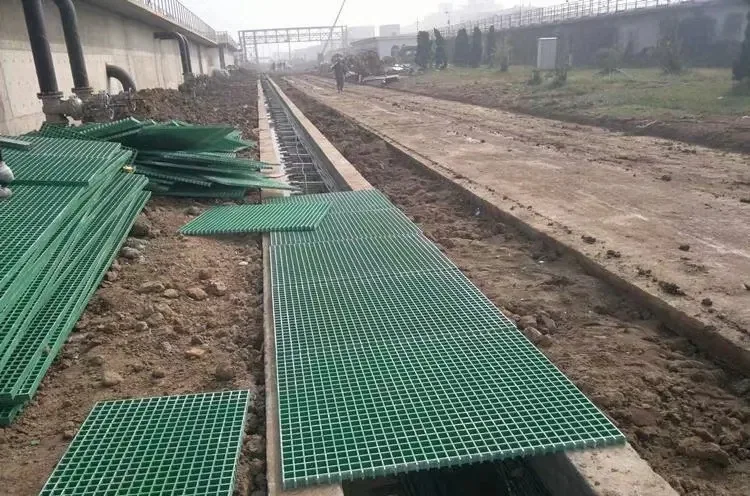
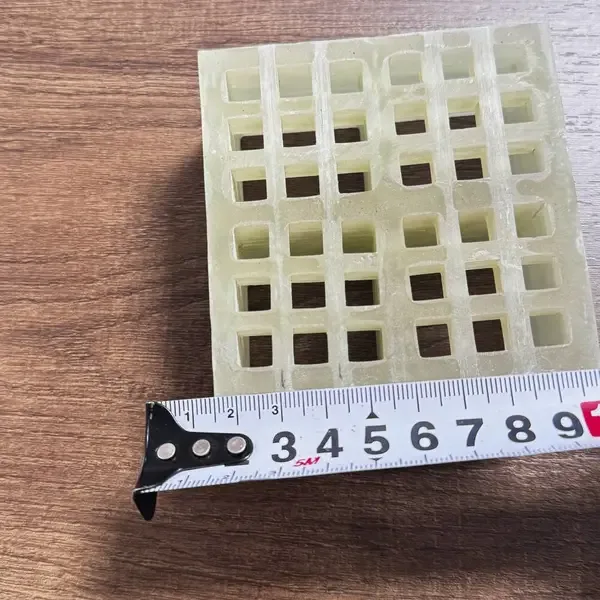
Our Factory View: Measure the Three Boundaries
We review every gully replacement as three connected boundaries: the opening to be covered, the frame or ledge that receives the load, and the surrounding finished surface. If any of those is missing, the quotation is incomplete. This is why the worksheet asks for multiple measurements and a section detail rather than one “width × length.”
The released record lets us cut the cover to the finished outline and preserve its mesh or bar direction, edge treatment, lifting detail and piece ID. Frame bedding, floor repair, load-class assignment and installation remain project responsibilities unless they are explicitly included in the agreed scope.
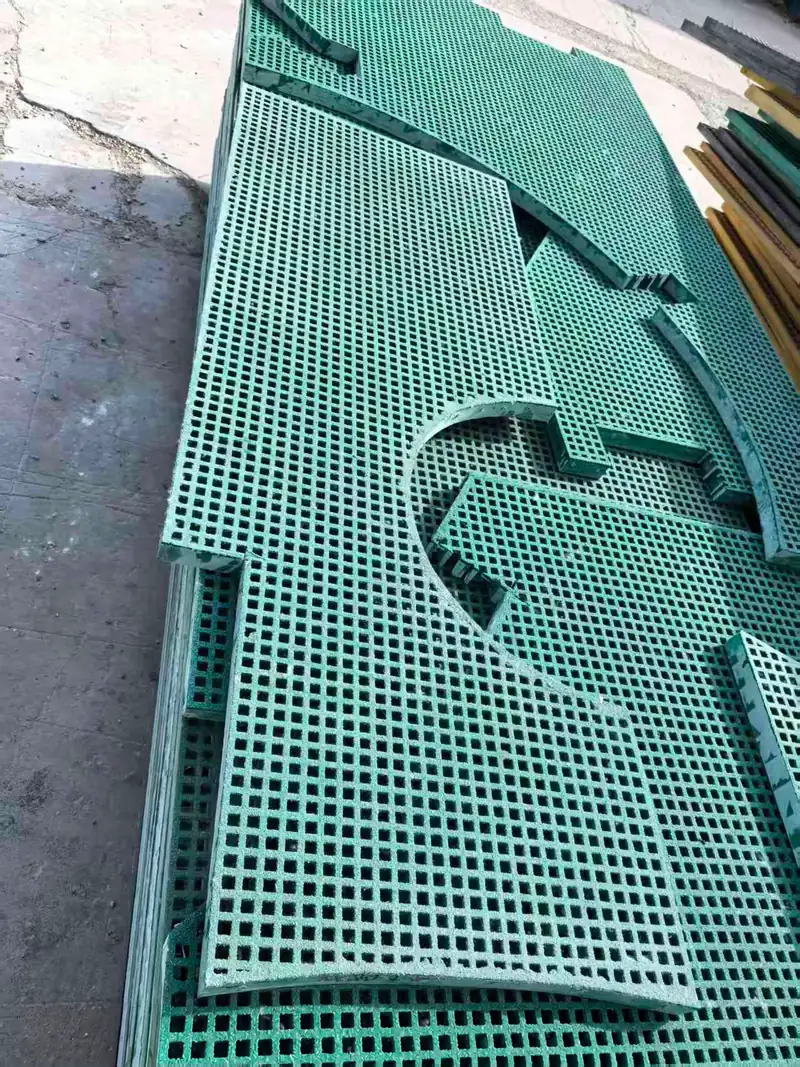
Measurement vocabulary
Gully Cover Survey Terms
- Gully cover
- A removable grating or solid cover over a local drainage collection point. It may fit into an existing frame, a recessed seat or a cover ring.
- Clear opening
- The unsupported opening between the bearing edges that a cover spans. Measure it at several points, because the visible floor outline may be larger than the usable opening.
- Frame outside size
- The outer length and width of the frame or cover ring. It locates the assembly in the concrete, paving or drain body, but does not by itself define the cover that fits inside.
- Bearing ledge
- The horizontal surface on which the cover rests. Record its width around the opening because a rusted, cracked or incomplete ledge can appear in a photograph as if it were continuous.
- Seat or rebate depth
- The vertical recess from the finished surrounding surface to the cover bearing face. It controls cover thickness, running clearance and the finished top level.
- Running clearance
- The small gap required for the cover to be placed, lifted and re-seated without jamming. The project must set the acceptable value; zero visible gap in a dry photograph is not proof of fit.
- Finished level
- The relationship between the installed cover top, the surrounding floor and the drainage fall. A flush-looking local point does not establish a level surface around the whole opening.
- Lift-out access
- The clearance, grip, tool and handling route needed to remove the cover for cleaning or maintenance without trapping fingers or damaging the frame.
- Cover restraint
- A loose lift-out fit, hinge, lock, bolt or other agreed device that keeps the cover positioned in service. Restraint does not replace frame bearing.
- Open-state protection
- The temporary barrier, warning, fall protection or procedure used while the cover is removed and the drainage opening is exposed.
- Circular or irregular opening
- A non-rectangular opening that requires measured diameters or cross axes, out-of-round or skew checks and often a physical template.
Before replacing
When a Gully Cover Needs a Field Survey
Specify this if…
- The installed opening and frame can be inspected and photographed.
- The clear opening is measured in more than one direction.
- The bearing ledge and seat depth can be checked around the full perimeter.
- The surrounding finished level and drainage direction are visible.
- The cover mass and lifting method are practical for the people who clean the gully.
- The intended cover form and restraint are known: lift-out, hinged, lockable or fixed.
- The load and traffic condition can be stated for the surrounding area.
Look elsewhere if…
- The only input is the outside size of the old cover.
- A nominal 300 mm, 12-inch or 450 mm size is assumed to fit.
- The frame is visibly broken, loose or sitting on voids and no repair scope exists.
- The cover cannot be lifted without asking maintenance staff to improvise a tool.
- The gully receives vehicle traffic but no load evidence or project class is stated.
- A photograph without a tape or scale is being used as the only dimension source.
- A circular or irregular opening is being measured with one diameter or a rectangle only.
Measurement boundary
Gully Cover Dimensions That Must Stay Separate
| Measurement | What it establishes | What it cannot replace |
|---|---|---|
| Clear opening length and width | The span the cover must bridge at the measured points | The frame outside size or cover outside size |
| Opening diagonals | Whether the visible opening is square or rectangular in plan | Structural suitability of the drain body |
| Frame outside length and width | The frame footprint and how it fits the surrounding construction | The usable space between bearing ledges |
| Bearing ledge width | Where the cover can transfer load into the frame | That every part of the ledge is sound |
| Seat or rebate depth | Vertical space available for the cover and clearance | The selected cover thickness or load capacity |
| Finished cover level | The target top elevation relative to the surrounding surface | The drainage slope or code compliance of the floor |
| Lift-out clearance | A practical removal and re-seating method | That the cover is safe for one person without an assessed mass limit |
| Cover form and restraint | Lift-out, hinged, lockable, bolted or other agreed retention | Security, accidental opening and maintenance access at the selected piece |
| Open-state protection | Temporary barrier, warning, fall control and responsible person | Makes the drainage opening safe while the cover is removed |
Replacement record
Fields for an FRP Gully Cover Survey
| Survey field | What to record | Why it changes the replacement |
|---|---|---|
| Gully ID | Unique opening ID, location and drawing or photo reference | Keeps measurements and the finished cover connected |
| Opening shape | Square, rectangle, circle or irregular with a sketch | Determines the finished-piece geometry |
| Circular/irregular geometry | Diameter or cross axes, out-of-round or skew and template reference | Prevents a single size from describing a non-rectangular opening |
| Clear opening | Length and width at front, middle and rear; both diagonals | Defines the actual unsupported span |
| Frame outside | Outer length and width; frame type or recessed ring | Locates the assembly in the floor and drain body |
| Bearing ledge | Width left, right, front and rear; sound or damaged | Shows where the cover can actually bear |
| Seat depth | Vertical rebate or pocket depth and debris or mortar buildup | Controls cover thickness, clearance and top level |
| Finished level | Cover top relative to paving, screed or surrounding floor | Prevents ponding, trip lips and incorrect cover build-up |
| Clearance and fit | Target running gap and checked cover outside dimension | Prevents forced fitting and jamming |
| Lifting | Grip or key position, cover mass, clearance and storage | Makes cleaning and removal repeatable |
| Cover form and security | Lift-out, hinge or lock, fixing, tamper exposure and replacement part | Connects access needs to public or unsupervised conditions |
| Open-state control | Barrier, warning, fall control, owner and reinstatement check | Keeps the exposed opening controlled during service |
| Duty and environment | Pedestrian, trolley or vehicle area; water, salt and chemicals | Connects shape to load, resin, surface and fixing review |
Worked example
An Illustrative Gully Replacement Survey
| Illustrative field | Example value | What it controls |
|---|---|---|
| G-01 opening | Rectangular local gully with an existing metal frame | Selects the survey and fabrication route |
| Clear opening | To be measured at three positions and both diagonals | Cover span, squareness and likely edge fit |
| Frame outside | Separate measured length and width | Replacement frame scope or identifying an existing frame |
| Seat depth | Measured from the finished floor to the bearing face | Available cover build-up and running clearance |
| Service access | Two-person lift, hand access or lifting key required | Handling and restraint detail |
Seven-step survey
How to Measure a Gully Cover Opening
Photograph the gully, nearby floor, traffic route and access position before lifting the cover.
Clean enough to see all bearing surfaces, then record cracks, corrosion, voids and loose bedding.
Record length and width at several points, both diagonals and the shape at corners.
Record the outer frame size separately from the clear opening and cover outline.
Measure ledge width and seat depth around the full perimeter.
Relate the bearing face and finished cover top to the surrounding floor and drainage fall.
Add lifting method, mass limit, environment, load requirement and a unique piece ID.
Before quotation
FRP Gully Cover Measurement Checklist
- Opening identity — The gully location and current condition have a unique ID.
- Clear opening measured — Length, width and both diagonals are recorded at multiple positions.
- Frame measured separately — The outside frame size is not treated as the cover size.
- Seat inspected — All bearing ledges are visible, measured and checked for damage.
- Depth recorded — Rebate or pocket depth is measured from a named datum.
- Finished level stated — The target cover top level relates to the surrounding surface.
- Running clearance set — The project states the acceptable fit and lift-out gap.
- Lift method defined — Grip, key, tool, handling route and approximate mass limit are recorded.
- Cover restraint selected — Lift-out, hinge, lock, bolt or another fixing intent is stated and identified.
- Open state controlled — The temporary barrier, warning, fall control and responsible owner are recorded.
- Load and traffic stated — Pedestrian, trolley or vehicle duty and the required evidence are named.
- One revision released — Photos, opening survey and finished-piece dimensions share one revision.
Supply boundary
What a Cover Measurement Can and Cannot Prove

The cover is not the drain body
We can fabricate the finished cover and defined associated parts; the concrete or masonry drain structure remains project scope.
A measured cover is not a load class
Pedestrian, trolley or vehicle duty needs separate load and support evidence for the exact cover and frame.
Frame repair is separate
Broken bedding, loose frames, voids and failed surrounds must be corrected before a new cover is fitted.
Installation level is project-controlled
The site confirms drainage fall, surrounding paving and the final cover level.
Share photos and dimensions
Send the Gully Opening for a Cover Review
- Molded and pultruded grating produced in house
- Full panels or factory cut-to-size pieces
- No fixed minimum order quantity
FRP Gully Cover Dimension Questions
How do I measure a gully cover?
Can I order a replacement from the old cover size?
What is the difference between clear opening and cover size?
Why measure both diagonals?
Does a new cover make a broken gully frame safe?
Can FRP gully covers be used in vehicle areas?
Should the replacement be lift-out, hinged or locked?
How do I measure a round or irregular gully?
This content was prepared and reviewed by Dengtai Industry’s technical and production team using the project conditions, available product data and applicable documents. Limits that require design, testing or approval are identified in the content. Content last checked: