Same-duty material comparison
FRP Grating vs Steel Grating: A Same-Duty Comparison
FRP usually earns its place in wet, corrosive or weight-sensitive access areas. Steel remains the natural answer for many hot, severe-impact or compact high-load duties. Compare the same span, load, support, environment and delivered scope. Our published molded FRP reference is USD 10.5–15.1/m² EXW for isophthalic unsaturated polyester with alumina filler in ordinary environments.

Left: molded FRP panel. Right: steel bar grating. Photo: Dengtai Industry.
Definitions
The Terms That Make the Comparison Fair
Ten material, structural and procurement terms, defined in the way they affect a real project.
- FRP grating
- An open composite panel made from glass reinforcement and resin. FRP, fiberglass-reinforced plastic and GRP describe the same glass-reinforced family. The structure may be a molded integral mesh or a pultruded bearing-bar assembly.
- Steel bar grating
- A metal grating made from load-bearing bars and cross bars, commonly carbon steel, hot-dip galvanized steel or stainless steel. The section weight, bar spacing and coating are part of the product, not just the word “steel.”
- Hot-dip galvanized steel
- Carbon steel with a zinc coating applied after fabrication. It is a common economical steel finish for ordinary outdoor exposure. Coating thickness, cut edges, drainage and later damage all affect the maintenance regime.
- Stainless steel grating
- A steel grating made from a corrosion-resistant alloy. “Stainless” is not one performance level; grade, chloride exposure, temperature and cleaning method have to be reviewed together.
- Same-duty comparison
- Comparing two offers against the same panel size, clear span, load, deflection limit, support condition, environment, finish, fabrication, fixing and delivery scope. Without that common basis, price and performance are not comparable.
- Clear span
- The unsupported distance between the edges of two supports. It is not the distance between support centre lines and not the panel length. A steel grillage can have several different clear spans within one platform.
- Deflection limit
- The maximum permitted movement of a panel under load. A material can be strong enough to avoid failure yet too flexible for the project's serviceability limit, so load and deflection must be checked together.
- Direct replacement
- Using a new material in an existing opening or frame. It still requires a fresh check of panel depth, bearing, span, fixing, edge condition, opening support, load and deflection. Equal outside dimensions do not make the replacement equivalent.
- Fire performance
- A project-specific set of requirements that may include ignitability, flame spread, smoke generation, smoke toxicity, heat release and structural integrity. Steel being non-combustible does not remove its high-temperature strength check; an FRP resin name does not establish a fire class.
- Static dissipation
- The control of electrostatic charge through a specified conductive product and an earthing arrangement. Standard FRP is commonly insulating, so anti-static FRP is a separate configuration. Steel is conductive but still needs its own electrical design.
Side-by-side comparison
FRP and Steel Grating Compared on the Same Duty
Thirteen requirements, with the condition that usually settles each row stated under the label.
| Requirement | FRP grating | Steel grating |
|---|---|---|
| Strength and stiffness What usually decides — the matched product data and the deflection limit, not a general “stronger” claim. | Glass reinforcement carries tensile load and the resin holds the laminate together. Stiffness depends on the molded depth and mesh or the pultruded bar section. | A steel section generally provides high stiffness in a compact depth. Grade, bar depth, bar spacing and connection details determine the actual system. |
| Span and support What usually decides — the clear span, permitted deflection, bearing direction and support condition. | Often needs a deeper section or closer supports than steel for the same duty. Molded mesh distributes load in two directions; pultruded bars span directionally. | Can suit longer or heavier spans with a relatively shallow section, but the support steel, connections and deflection still require design. |
| Mass and handling What usually decides — actual mass per square metre and net piece weight for the two selected products. | Our standard molded 25 / 30 / 38 mm references are 12.5 / 16.5 / 19.5 kg/m². Pultruded series range by section and open area. | Mass follows the bar section and coating. It may be higher than FRP, but the percentage varies by product and cannot be applied as a rule. |
| Corrosion What usually decides — the actual medium, concentration, temperature, contact time and the performance of the complete product. | FRP does not rust like carbon steel, but the resin and laminate must suit the exposure. Cut edges, UV, temperature and fixings still matter. | Galvanized steel sacrifices its zinc coating over time; stainless depends on grade and chloride exposure. Coating damage and trapped moisture shorten service life. |
| Chemical exposure What usually decides — the resin system for FRP or alloy grade for steel, checked against the real duty. | Vinyl ester, epoxy and phenolic are project-specific directions. The published isophthalic unsaturated polyester price is only for ordinary environments. | Carbon steel with a coating is not a chemical-resistant answer by default. Stainless or another alloy may be required, with its own grade and evidence. |
| Fire and temperature What usually decides — the project test criteria and the continuous or short-term temperature, not “non-combustible” versus “fire retardant.” | Standard resin is combustible. Fire-retardant grades and phenolic can be reviewed for specific criteria, supported by finished-product evidence. | Non-combustible, but unprotected steel loses strength at elevated temperature. Fire protection and structural fire design may still be required. |
| Electrical and static What usually decides — whether insulation, earthing or controlled dissipation is the actual requirement. | Standard FRP is commonly insulating. Anti-static or conductive FRP and its earthing detail are a separate configuration. | Conductive in normal use and must be included in the earthing and electrical design. Conductivity is not automatically the same as static dissipation. |
| Impact What usually decides — the object, energy, contact area, support condition and consequence of local damage. | Can deflect and recover from ordinary foot traffic and local impact, but severe impact can crack bars or damage resin. Molded and pultruded structures respond differently. | Generally suitable for severe mechanical impact and heavy traffic, but deformation, coating damage and fatigue still require inspection. |
| Walking surface What usually decides — wetness, oil, cleaning, traffic and the project's slip test criteria. | Concave, grit, inlaid grit, covered and other formats are selected for the route. A surface name is not a certified slip class. | Serrated, gritted or coated steel options are available. The finish and drainage condition still need to match the site. |
| Fabrication What usually decides — the cut layout, hot-work restrictions, coating repair and the remaining site work. | Factory cutting, drilling, piece marks and requested edge sealing reduce site work. No welding; clips or agreed mechanical fixings are used. | Cutting, welding and drilling are routine, but the protective coating must be restored and hot work may need a permit or shutdown. |
| Maintenance What usually decides — the inspection tasks and the cost of keeping the original performance. | Inspect surface wear, exposed fiber, cracks, movement and loose clips. Clean with methods compatible with the resin and finish. | Inspect coating, corrosion, connections and deformation. Repair or recoat damaged areas and replace sections when section loss is significant. |
| Price basis What usually decides — the same delivered and installed scope for both materials. | Molded standard panels have a published USD price basis. Cut pieces, openings, clips, packing and freight are separate; pultruded panels are quoted by section and piece list. | Price follows steel grade, bar section, panel size, edge banding, fabrication, coating, packing and freight. No single area rate covers all steel grating. |
| Service life What usually decides — exposure, coating or resin, cleaning, load, damage and the maintenance actually performed. | No universal year figure. The economical isophthalic unsaturated polyester formulation in our published price has about three years of field experience, with cracking possible from around year one. | No universal year figure. Coating life, environment, abrasion, drainage and recoating determine how long the section remains serviceable. |
Selection
When FRP or Steel Is the Natural Candidate
Five situations where FRP deserves serious comparison, and five where the duty should make the buyer pause.
Specify this if…
- The structure is wet, salty, chemically exposed or difficult to repaint, and the FRP resin can be matched to the actual medium.
- Lifting capacity, access or roof loading makes a lighter finished piece a genuine project advantage.
- The area needs an insulating walking surface, with anti-static or earthing treated as a separate specification where required.
- The existing frame can accept the FRP bearing arrangement, clips and panel depth without hidden modifications.
- A short-lived, economical FRP panel can meet the duty and the buyer accepts the published resin and service-life boundary.
Look elsewhere if…
- The duty is high temperature, severe impact, heavy vehicle traffic or a fire-rated structure where steel or another verified system is more suitable.
- The only comparison is a bare FRP square-metre price against a steel weight or material price.
- The existing steel panel is being copied without checking span, deflection, bearing, fixing and frame condition.
- The FRP resin has not been matched to the chemical, concentration and temperature.
- A supplier promises a universal percentage saving, universal decades of life or “maintenance-free” performance without project evidence.
What Usually Decides the Choice
The decision is not “FRP or steel?” in the abstract. It is whether either material can meet the same structural, environmental and operational requirements, and what each route costs over the period the buyer actually cares about.
FRP grating carries load through glass reinforcement and a resin matrix. It does not rust like carbon steel, and a finished panel can be much lighter than the steel alternative. Those properties are valuable in wet, salty, chemical or weight-sensitive areas. They do not make the composite stronger than every steel section, suitable for every chemical or fireproof.
Steel grating has a mature structural language: bar sections, pitch, span tables, welding and coating systems are well understood. It can provide high stiffness in a compact depth and is often the natural answer for severe impact, heavy traffic, high temperature or a dry structural platform. Its weakness appears where coating maintenance is frequent, access is difficult and corrosion shortens the service interval.
Written by our team and checked against our FRP product schedules, factory records and the limits of the available evidence. Updated 17 October 2026.
The practical rule is therefore conditional: FRP is worth serious comparison where the environment or handling weight changes the life-cycle cost; steel remains the starting point where temperature, impact, compact depth or fire behavior governs. The rest of this page tests that rule rather than assuming it.
Corrosion: FRP Resists Rust, Not Every Chemical
FRP is a strong candidate where carbon steel would need regular coating attention. The composite does not have a steel surface that turns into rust, so it can suit wastewater access, coastal walkways, chemical areas and wash-down routes. That is a material advantage, not a maintenance exemption.
The resin has to match the medium. Isophthalic unsaturated polyester with alumina filler is the economical starting point in our published molded price. It is for ordinary environments. It is not a strong-corrosion resin and it is not vinyl ester. Vinyl ester, epoxy or phenolic are separate directions that have to be checked against the chemical, concentration, temperature, splash or immersion and the required evidence. The resin selection guide and chemical resistance guidance explain those inputs.
Steel has a parallel boundary. Hot-dip galvanizing protects carbon steel for a period that depends on coating thickness, atmosphere, drainage, abrasion and damage. Stainless steel may suit a wet or chemical duty, but “stainless” covers several grades and not every grade suits every chloride level or cleaning regime. A vendor sentence that says “steel corrodes” or “FRP is corrosion-resistant” is the beginning of the question, not the answer.
The fixings need the same review. A galvanized steel support, stainless clip or mixed-metal assembly can become the weak point even when the grating panel itself is suitable. The exposure belongs to the whole installation.
Span and Stiffness: Why Same Thickness Fails
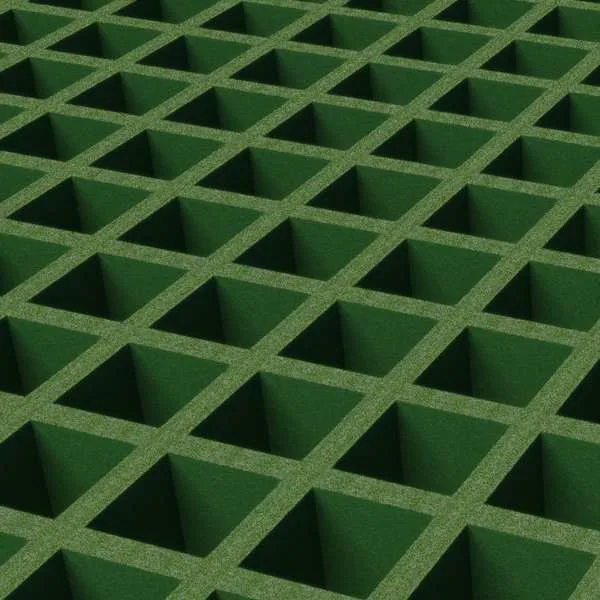
A common replacement mistake is to match the old steel thickness. A 25 mm FRP molded panel and a 25 mm steel bearing bar are different structures, and even two FRP families at the same nominal depth can behave differently. The comparison has to include the actual bar or mesh geometry, support condition, load and deflection limit.
Steel usually provides more stiffness in a compact section. FRP generally needs a deeper section or more support points to meet the same deflection limit, although the exact result depends on the product. Molded FRP distributes load through its integral mesh, which can suit a framed opening. Pultruded FRP carries the principal load along directional bearing bars. Neither fact replaces a load check. See the load and span guidance and the molded versus pultruded comparison.
A usable comparison records:
- The clear span in each direction, measured between the actual support edges.
- Which edges bear and whether the panel is supported on two, three or four sides.
- The panel depth, mesh or bearing-bar section and pitch.
- The load type and value, including point, line, wheel or equipment loads.
- The permitted deflection and any serviceability requirement.
- The location of openings, because a cut changes the remaining structure.
The panel can pass a strength check and still fail the project’s deflection requirement. That is why a “maximum load” figure without a deflection basis is not enough for either material.
Weight and the Cost of Handling
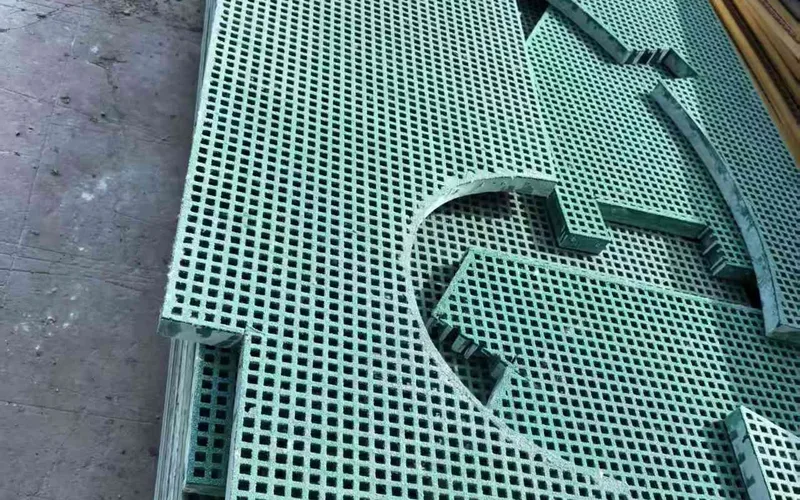
FRP is often lighter than steel for the same panel area, which can reduce manual handling, lifting equipment and temporary support. The benefit is real, but a universal “50%” or “75% lighter” statement is not useful unless both products and the finished piece weights are named.
Our standard molded 25 mm panel is 12.5 kg/m², the 30 mm is 16.5 kg/m² and the 38 mm is 19.5 kg/m² in the published 38 × 38 mm rows. A full 1220 × 3660 mm 25 mm panel therefore weighs about 56 kg before packing. Steel mass can be lower or higher than a casual estimate suggests because it follows the actual bar depth, thickness, pitch and coating. The sizes and weight guide explains the mass comparison.
The delivered piece is what matters. A large panel that is lighter per square metre can still be too awkward to carry through an access hatch. Splitting a platform into more pieces may reduce piece weight but increase joints, clips and installation time. Compare the handling plan, not just the material density.
Fire, Temperature, Static and Electrical Requirements
This is where many material-comparison pages overreach. Steel is non-combustible. Standard FRP is based on a polymer resin and should not be called fireproof. Fire-retardant or phenolic FRP may be reviewed for a project’s specific fire and smoke criteria, but the evidence must apply to the finished product.
Steel’s advantage is not unlimited either. Unprotected steel loses strength when its temperature rises, so a structural fire requirement may still need protection or a fire-engineering check. Temperature, duration and the required structural performance belong to the project.
Electrical requirements need separate language. Standard FRP is commonly insulating, but a conductive or anti-static product with an earthing detail is a separate configuration. Steel is conductive; that does not make every steel installation an adequate static-control system. “Insulating,” “anti-static,” “conductive” and “earched” are not interchangeable words.
For each requirement, ask for the standard, test method, acceptance limit and the exact product supplied. A general oxygen-index result is not a flame-spread class. A resin name is not a smoke approval. A steel certificate is not automatically a fire-rated floor system.
Impact, Wear and Repair
Steel is generally the preferred material for severe mechanical impact, heavy equipment traffic and duties where local deformation is expected. FRP can perform well under normal foot traffic and maintenance contact, but a hard dropped object can crack a bar, chip resin or damage the surface. The consequence of that damage depends on the panel family and support condition.
Molded FRP is often more tolerant of local impact than a thin pultruded bar, but no material should be approved from a generic impact claim. Ask what object, energy and contact area are expected, then inspect the actual panel. A crack in a load-bearing member is not repaired by filling the surface.
Steel also needs inspection. Coating damage, trapped moisture, corrosion at cut edges and deformed bars can reduce the section. Repair and recoating are planned work, not evidence that steel has failed as a material.
Replacing Steel Grating Without Guessing
A replacement project starts with the frame. Measure the actual clear spans, bearing surfaces, height, fixing positions and condition. Do not assume that the old panel’s dimensions describe the structural duty. The steel frame may be corroded, out of level or narrower at one end.
FRP panels are not welded. They are restrained with mechanical clips or other agreed details, and the clip must match the panel height, bar or mesh and support section. Where the existing steel frame is retained, the installation review has to include the frame, clips, bearing and access.
Use these checks before ordering:
- Installation planning for bearing, orientation, joints and fit-up.
- Grating clip selection for the panel height, bar width and support section.
- Cutting and edge sealing for openings and exposed edges.
The same rule applies to openings. A pipe cut may remove part of a molded mesh or a pultruded bearing bar. The remaining structure and edge treatment have to be checked. A cut edge may need resin sealing, but sealing does not restore a missing load path.
How to Compare FRP and Steel Price
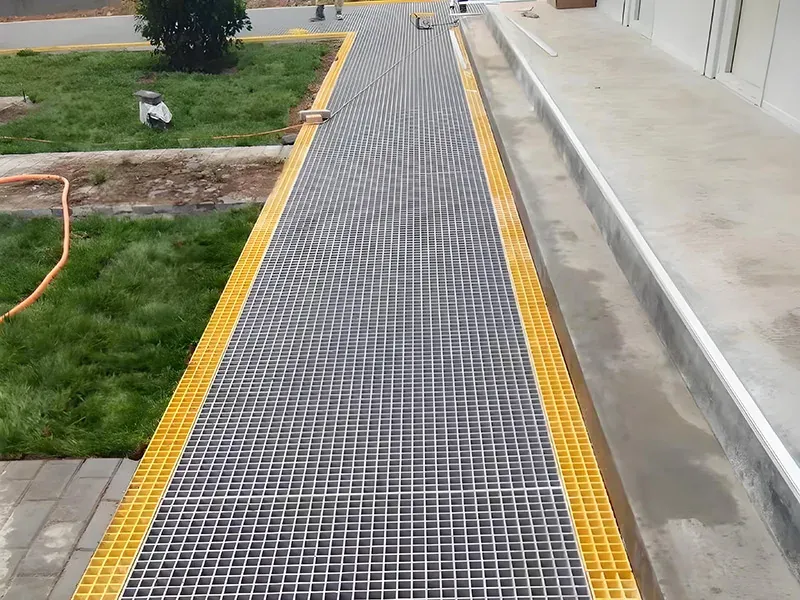
The FRP reference price is transparent because the standard molded configuration is known. A 25 mm, 38 × 38 mm molded panel is USD 10.5/m² ex-works using isophthalic unsaturated polyester with alumina filler. The 30 mm is USD 12.0/m² and the 38 mm is USD 15.1/m². A full 1220 × 3660 mm panel covers 4.4652 m², so the 25 mm panel is about USD 46.9 before cutting, clips, packing and freight.
That is not a universal FRP price. It is not vinyl ester, a special surface or a pultruded assembly. The economical resin has a stated service boundary: about three years of field experience, with cracking possible from around year one, and no strong-corrosion duty. A project that needs a different resin must be quoted as a different configuration. The pricing and quote guide sets out the full FRP cost structure.
Steel has no single honest square-metre rate either. Ask for the grade, bar section, pitch, edge banding, cuts, welding, coating system, packing and freight. A hot-dip galvanized carbon steel quote and a stainless steel quote are not interchangeable products, even if both are called “steel grating.”
Build one cost sheet for the same job:
- Panel, cut pieces and edge treatment.
- Clips, bolts, welds or other fixings.
- Support steel and any changes to beam spacing.
- Lifting, labour and site access.
- Coating or resin scope and inspection.
- Freight, packing and delivery term.
- Expected maintenance or replacement over the period being compared.
A lower panel rate with more supports, more site fabrication, extra coating or difficult lifting is not a lower project cost. Equally, an FRP panel with a shorter resin life or an unsuitable surface is not a saving if it fails early.
When Steel Is the Better Answer
Steel should remain the starting point where the area is dry, the load is very heavy, the available structural depth is fixed, severe impact is expected, or the project requires non-combustible construction with a defined fire strategy. It can also be simpler where local fabrication and welding are available and coating maintenance is manageable.
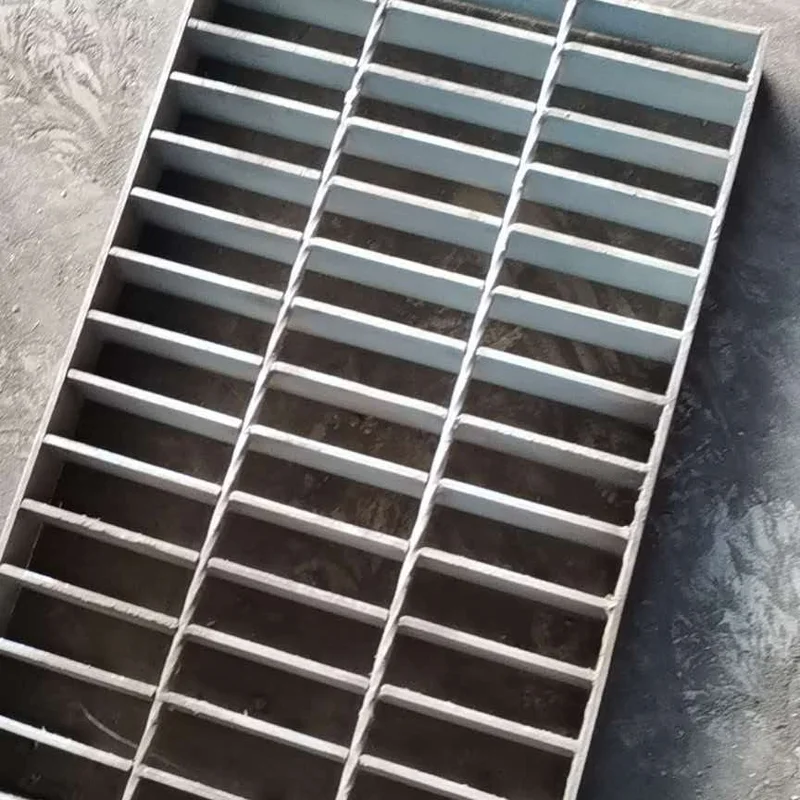
FRP should be compared seriously where the environment attacks carbon steel, access for repainting is poor, the finished panel weight affects the structure or lifting plan, or electrical insulation is a genuine design input. It may also suit temporary or removable access where light panels reduce handling.
The honest answer can be different for two areas inside one plant. A dry equipment platform may remain steel, while a wet trench cover beside it may be FRP. Material selection should follow the duty, not a corporate preference for one product.
Factory Evidence and Its Limits
We manufacture FRP molded panels and pultruded bars at our works in Jingxing Mining District, Shijiazhuang, Hebei. The factory can coordinate cutting, drilling, requested edge sealing and M, L or C clips with the panel order. We do not manufacture steel grating; any steel column on this page is a comparison route, not a product we are trying to sell.
The available 2024 report, HZTC/BG-24051102 dated 17 May 2024, records Barcol hardness 45, water absorption 0.335%, oxygen index 28.5%, tensile strength 74.2 MPa and a design-load test of 4 kN/m² over a 600 mm span. It does not identify the model, thickness, mesh or resin. It is material-level evidence, not a universal load rating, fire class or chemical approval.
Production normally runs 15–30 calendar days from receipt of deposit. Export packing generally uses EPE foam and stretch film, with wooden pallets or iron supports. Trade term, packing, documents, shipment and the final piece list are stated in the quotation.
Manufacturer comparisons such as Fibergrate’s FRP vs steel article, Paige Stainless’s steel-oriented comparison and steelbargrating.org’s material overview show how far vendor conclusions can differ. Use them to identify questions, not as evidence for our FRP or your steel supplier.
Send the support drawing, load and environment and we can compare the FRP route on the same basis as the steel offer.
Product schedule
FRP References and Steel Quote Fields in One View
Published standard FRP prices and mass, beside the data a steel quotation must provide. Geometry and mass are not load ratings.
| Configuration | Reference data | Panel and price basis |
|---|---|---|
| Molded FRP 25 mm | 38 × 38 mm mesh; 12.5 kg/m² | 1000 × 4000 mm; 1220 × 3660 mm; USD 10.5/m² EXW |
| Molded FRP 30 mm | 38 × 38 mm mesh; 16.5 kg/m² | 1000 × 4000 mm; 1220 × 3660 mm; USD 12.0/m² EXW |
| Molded FRP 38 mm | 38 × 38 mm mesh; 19.5 kg/m² | 915 × 3050 mm; 1000 × 4000 mm; 1220 × 3660 mm; USD 15.1/m² EXW |
| Pultruded FRP I25-40 | 25 mm depth; 25 mm pitch; 40% open area; 16.5 kg/m² | Custom width × bearing-bar length; quoted by section and piece list |
| Pultruded FRP I38-40 | 38 mm depth; 25 mm pitch; 40% open area; 23.0 kg/m² | Custom width × bearing-bar length; quoted by section and piece list |
| Hot-dip galvanized steel | Mass follows the selected bearing-bar depth, thickness and pitch | Quote by grade, section, panel size, edge banding, fabrication, coating and delivery |
| Stainless steel | Mass follows the selected section and alloy | Quote by alloy grade, section, fabrication, surface and delivery |
Material selection
FRP Resin and Steel Finish Options
Each option has a duty boundary. A resin or alloy name alone does not establish the finished product's performance.
| Option | When it is the natural candidate | What the quote must confirm |
|---|---|---|
| Isophthalic unsaturated polyester with alumina filler | The economical molded FRP price basis for ordinary environments. This is specifically isophthalic unsaturated polyester, not general-purpose polyester or vinyl ester. | The actual exposure and expected service conditions. It is not a strong-corrosion resin, and our field experience is about three years with cracking possible from around year one. |
| Vinyl ester FRP | Chemical, wastewater, marine or longer-life duties after the medium, concentration and temperature are defined. | The finished resin grade, surface, cut-edge treatment, fixings and configuration-specific evidence. It is quoted separately. |
| Phenolic or fire-retardant FRP | A project where fire, smoke or low-smoke criteria govern the selection. | The required test method, acceptance limit, structural condition and the product form available. |
| Hot-dip galvanized steel | Ordinary outdoor or sheltered access where carbon steel is structurally suitable and the coating can be maintained. | Steel grade, section, coating specification, cut-edge treatment, drainage, maintenance plan and recoating access. |
| Stainless steel | Wet, coastal or chemical duties where a suitable alloy is justified and the project accepts the cost. | Alloy grade, chloride exposure, temperature, cleaning, fabrication method and surface condition. |
Price and cost
FRP vs Steel Grating Price
A published FRP reference, the fields behind a steel quote and a total-cost formula that uses the same scope on both sides.
FRP reference: USD 10.5–15.1/m² EXW
Standard 38 × 38 mm molded FRP panels are published at USD 10.5/m² for 25 mm, USD 12.0/m² for 30 mm and USD 15.1/m² for 38 mm, ex-works, using isophthalic unsaturated polyester with alumina filler. A 1220 × 3660 mm panel covers 4.4652 m², so a 25 mm full panel is about USD 46.9 before cutting, clips, packing and freight. The reference panel masses are roughly 56 kg at 25 mm and 87 kg at 38 mm before packing.
Steel must be quoted as a complete section and finish
There is no honest universal steel-grating rate per square metre. Carbon steel or stainless grade, bearing-bar depth and thickness, pitch, edge banding, cuts, welding, hot-dip galvanizing or paint, packing and freight all change the number. Ask for the actual section drawing and the delivered finish, not a material-only rate.
Compare the installed total, not the panel alone
Use the same formula on both sides: panel + fabrication + fixings + support changes + freight + installation + inspection + anticipated maintenance or replacement. A lighter FRP panel may reduce lifting equipment and structural load; a steel section may reduce the number of supports or suit a smaller depth. Those are project effects, not universal discounts.
Price boundary: the published FRP figure is for isophthalic unsaturated polyester with alumina filler in ordinary environments, not for strong corrosion. Our field experience for that economical formulation is about three years, with cracking possible from around one year. It is not a vinyl ester price. Vinyl ester, phenolic, special surfaces and pultruded configurations are quoted against the actual specification. Simple straight cutting is about CNY 5/m², roughly USD 0.8/m² at USD 1 = CNY 6.5; complex openings, edge sealing, clips, packing and freight are separate.
Applications
Project Situations That Point Toward FRP or Steel
Six duties where the environment, load or support condition changes the starting material.

Wastewater basin and pump access
Wet and chemically variable areas often justify comparing FRP seriously. The resin still has to match the actual medium, and steel supports and clips remain part of the assembly.
Define chemical, concentration, temperature, splash or immersion before selecting the FRP resin.

Coastal or marine access
Salt exposure makes coating maintenance expensive for carbon steel. FRP can be a strong candidate, but fittings, UV, resin and the supporting structure all need their own review.
State salt, wave splash, cleaning, UV and whether stainless hardware is required.

Chemical plant walkway
FRP may be selected for corrosion, but a standard polyester price is not proof of chemical suitability. Steel may remain appropriate where the duty is dry, hot or mechanically severe.
Send the chemical list, concentration, temperature, contact type and required documents.

Dry heavy-duty equipment platform
Steel may be the simpler answer where the duty is dry, the impacts are severe, the available depth is limited or hot equipment is close. FRP should only be used where the actual load, deflection and damage tolerance are demonstrated.
Do not choose FRP from a corrosion argument when fire, impact or temperature governs the duty.

Replacing steel panels on an existing frame
Measure the existing supports, clear spans, bearing width and fixing points. FRP usually changes the depth, weight, clip type and sometimes the support spacing, even when the opening dimensions stay the same.
The old steel drawing and the actual frame condition are more useful than a photograph of the old panel.

Roof and solar maintenance walkway
Weight and handling can matter on a roof. FRP may suit a framed maintenance route, while the support rails, fixing positions, fire requirement and roof loading still decide the design.
Send the roof structure, rail spacing, access loads and maximum acceptable piece weight.
Same-duty workflow
How to Compare FRP and Steel Grating Properly
Seven steps from the existing frame or duty to two comparable quotations.
List panel dimensions, clear spans, support positions, bearing width, openings, fixed height and the acceptable amount of site work.
Pedestrian, maintenance, equipment, point, line, wheel or stored-material load, plus the permitted deflection. The load value alone is not enough.
Chemicals with concentration and temperature, salt, splash or immersion, UV, cleaning method, humidity and any coating or alloy expectations.
State the required test or acceptance criterion. Do not use “fireproof,” “anti-static” or “insulating” as loose descriptions.
Molded FRP for framed two-way layouts; pultruded FRP for a directional span; steel for duties where its temperature, impact or compact structural behavior is required.
Quote panel, fabrication, fixings, support changes, freight, installation, inspection and expected maintenance on the same scope.
Confirm section, resin, surface, piece marks, openings, clip positions and packing. Production normally runs 15–30 calendar days from deposit.
Technical boundaries
Nine Claims Not to Make in a Material Comparison
Common shortcuts that produce a confident choice for the wrong duty.
- Neither material is universally stronger — Steel usually provides more stiffness in a compact section. FRP can distribute load in two directions and resist corrosion, but its stiffness and damage tolerance depend on the product. Compare the matched structures against the same load and deflection limit.
- Equal thickness is not equal performance — A 25 mm FRP molded panel, a 25 mm pultruded bar and a 25 mm steel grating are different structures. Bar depth, pitch, reinforcement, support and connection details belong to the comparison.
- “Lighter” needs a measured comparison — FRP is often lighter, but the saving varies by product. Our standard molded panels range from 12.5 to 19.5 kg/m²; steel mass follows the actual bar section and coating. Compare finished pieces and lifting arrangements.
- FRP is not automatically the fire-safe option — Steel is non-combustible, although unprotected steel loses strength when hot. Standard FRP resin is combustible. Fire-retardant or phenolic FRP needs the required test and finished-product evidence.
- Insulating and anti-static are different requirements — Standard FRP is commonly insulating. Anti-static FRP and its earthing are a separate configuration. Steel is conductive but still needs an intentional earthing and electrical design.
- FRP is not maintenance-free — It does not need paint to resist rust, but the surface, cracks, exposed fiber, fixings and supports still need inspection. A damaged FRP bar is a structural observation, not a cosmetic one.
- The published FRP price has a resin boundary — The USD reference uses isophthalic unsaturated polyester with alumina filler for ordinary environments. It is not a strong-corrosion price or a vinyl ester price, and our field experience for that formulation is about three years with cracking possible from around year one.
- Direct replacement still needs a new design check — The frame, support spacing, bearing, panel depth, fixing method and openings may all change. Measure the actual frame and send the drawing rather than copying the old steel thickness.
- Vendor comparisons are not product approvals — Manufacturer articles and steel-vendor comparisons can explain the category, but their percentages, service lives and test results apply to their own products. They do not establish the performance of our FRP or another supplier's steel.
Manufacturer evidence
What We Can Show from the FRP Factory
Production, fabrication, test evidence and packing — with the limits of each stated.

FRP made in house
Molded panels are cast and pultruded bars are drawn at our works in Jingxing Mining District, Shijiazhuang, Hebei. We supply FRP, not steel; a steel column in the comparison is a benchmark, not a product we manufacture.
Review the FRP factory and production routesFabrication and fixings are coordinated
Factory cutting, drilling, requested edge sealing and M, L or C clips are handled with the FRP order. The support steel may be existing or supplied by the project, and its condition remains part of the installation review.
Review cutting, sealing and fixing scopeMaterial evidence with stated limits
Report HZTC/BG-24051102, dated 17 May 2024 and issued by Hebei Haozheng Testing Services Co., Ltd., records Barcol 45, water absorption 0.335%, oxygen index 28.5%, tensile strength 74.2 MPa and a 4 kN/m² design-load test over a 600 mm span. It does not identify the product model, thickness, mesh or resin, so it is not a load rating or fire class for every panel.
View the 2024 factory test reportPacking and shipment are quoted
Export packing normally uses EPE foam and stretch film, with wooden pallets or iron supports. The quotation states trade terms, packing and freight; packed gross weight is separate from panel mass.
Project inputs
What to Send for an FRP vs Steel Comparison
Ten inputs. The support drawing, load case and environment answer most of the choice.
- Finished panel schedule — Length, width, quantity and piece marks, including every notch, opening and removable cover.
- Support drawing — Bearing edges, support positions, clear spans, beam direction, fixed height and available bearing width.
- Load and deflection — Load type, value, contact area, equipment positions and the deflection limit the project requires.
- Environment — Chemicals, concentration, temperature, salt, splash or immersion, UV, humidity and cleaning method.
- Fire and temperature criteria — Continuous and short-term temperature, required test, smoke limit and structural fire requirement.
- Electrical requirement — Insulation, anti-static dissipation, earthing or no electrical requirement, with the acceptance basis.
- Existing steel information — Grade, coating, bar section, measured panel size, corrosion condition and the frame or support drawing.
- Fixings and site constraints — Clip preference, support section, hot-work restrictions, lifting access and maximum piece weight.
- Delivery and maintenance assumptions — Destination, trade term, packing, required date, inspection plan and the period used for maintenance comparison.
- Drawing revision — Identify the current layout and mark dimensions that cannot change.
Request a comparison
Send the Existing Steel Panel or FRP Duty
We will compare the FRP route against your drawing and clearly separate the FRP scope from the steel or support scope.
- Same-duty comparison against your support drawing
- FRP made in house; steel quote scope clearly separated
- Attach a drawing, BOQ or photograph of the existing frame
FRP and Steel Grating Questions
Is FRP grating stronger than steel grating?
Is FRP grating cheaper than steel grating?
Is FRP grating lighter than steel grating?
Can I replace steel grating with FRP at the same thickness?
Does FRP grating rust?
Can FRP grating handle strong chemicals?
Which resin is included in the published FRP price?
Is FRP grating fireproof?
Is steel grating better in a fire?
Is FRP grating anti-static?
Which material lasts longer?
Which needs less maintenance?
Can FRP grating be welded?
Can FRP grating be used at high temperature?
Which material handles impact better?
Is steel grating always cheaper?
What do you need for a fair comparison?
Do you supply steel grating too?
Can I request a sample?
Content last checked: