Technical reference
FRP Grating Chemical Resistance: How It Is Confirmed
Chemical resistance is a property of a product in a medium, not of a material family. This page explains the values a confirmation needs, and how to read the document that supports it.
Definitions
Four Values a Chemical Resistance Check Needs
Product, grade, exposure type and conditions — remove one and the answer becomes a guess.
- Product object
- The finished item being assessed — panel or pultruded assembly, with its thickness, mesh or bar section, resin, surface and any cover layer.
- Resin grade
- The specific product within a resin family, not the family name. Two vinyl esters can behave differently in the same medium.
- Exposure type
- Splash, spillage, vapor, condensation, immersion, or cleaning with a particular agent. The same chemical is a different requirement in each case.
- Conditions
- Concentration, temperature, duration and frequency. A concentration quoted without a temperature, or a temperature without a duration, is an incomplete requirement.
Process
How Chemical Resistance Is Confirmed for an Order
Six steps, ending with the gaps recorded rather than hidden.
Structure, thickness or bar section, resin direction, surface and any cover, because resistance is confirmed for a configuration rather than for a family.
Chemical names with concentration, and the temperature at which the exposure occurs.
Splash, spillage, vapor, condensation or immersion, plus cleaning agents and their frequency.
Identify what actually covers the combination — a product test, a laminate test, or a resin grade guide — and read its scope and limits.
Note what the document supports, what it does not, and which values are assumed rather than measured.
Where an assumption remains, it is stated as one and confirmed by the project's technical authority rather than absorbed into a quotation.
Reading documents
What Each Type of Document Can Support
The right-hand column is where over-claiming usually starts.
| Document | What it can support | What it cannot |
|---|---|---|
| Resin supplier guide | The behavior of that supplier grade in the media it lists, under its stated conditions | The behavior of our finished panel, or of a different grade in the same family |
| Laminate test data | A specific laminate build-up under the test conditions recorded | A panel with a different reinforcement, surface or thickness |
| Finished product test report | The tests recorded for the sample and configuration stated | Other production batches, or media not tested |
| Internal chemical list | What the plant handles, and where it is used | The exposure each item creates at the grating itself |
| A published compatibility table found online | Useful orientation when the brand and grade are stated | Anything about our product; tables are supplier and grade specific |
Boundaries
Three Boundaries on Chemical Resistance
What we publish, what interacts, and what the surface changes.
- No compatibility table is published for our range — We do not hold a finished-product compatibility table that covers the whole range, and we will not assemble one from other manufacturers' tables. What is published is the method, and what is confirmed per inquiry.
- Load, temperature and the medium interact — A panel under sustained load at elevated temperature in a chemical environment is a harder condition than any one of those factors alone. The structural check and the chemical check are made together.
- The surface can change the answer — A grit surface, a covering layer or a cut edge presents a different material at the exposure than the base laminate. Where the exposure is aggressive, those surfaces are part of the question.
Project inputs
What to Send for a Chemical Resistance Review
Six items, and the first two decide whether the question can be answered at all.
- Product configuration — Structure, thickness or bar section, resin direction, surface and any cover layer, with the quantity involved.
- Chemicals — Names, concentrations and any mixtures, rather than an acidity figure alone.
- Temperature — Normal and peak temperature, and how long the exposure lasts.
- Exposure type — Splash, spillage, vapor, condensation, immersion, or cleaning with a named agent.
- Load and duration — What the panel carries, and whether the load is continuous while exposed.
- Documents required — What the project needs as evidence — product test, laminate data, or a written assessment.
Request a review
Send the Chemicals, Concentration and Temperature
A medium described with its conditions can be checked; a category cannot.
- Molded and pultruded grating produced in house
- Full panels or factory cut-to-size pieces
- No fixed minimum order quantity
Chemical Resistance Questions
Do you have a chemical resistance table for your grating?
Which resin is best against acids and alkalis?
Can you use another manufacturer’s compatibility table?
What if the medium has not been tested for our configuration?
Continue With Chemical Resistance
Resin selection
Resin directions compared by medium, concentration, temperature and exposure.
Wastewater treatment
Zone by zone selection in a treatment plant.
Offshore platforms
Marine exposure where fire and structural criteria also apply.
Quality and documentation
What the factory issues today and what is arranged per project.
Technical resources
The technical material behind this guidance.
FRP grating temperature range options
Service temperature, long-term load and thermal movement, and the values a project has to provide.
FRP Grating Surface Options
Concave, grit, inlaid grit, milled, checked plate and mini mesh surface formats, plus anti-static and UV treatments, selected against wet, oily and…
Why the Question Cannot Be Answered by a Resin Name
Chemical resistance depends on the product, the resin grade, the medium, its concentration, the temperature, and how the exposure happens. Change any one of those and the answer can change. A vinyl ester that performs well in one medium at one temperature may not be the right choice in a different one, and that is a property of the specific grade rather than a criticism of the family.
It follows that the useful question is not “is FRP grating resistant to acid?” but “which configuration, in this medium, at this concentration and temperature, for this exposure type, and on what evidence?” The first question cannot be answered honestly at all; the second can be worked through.
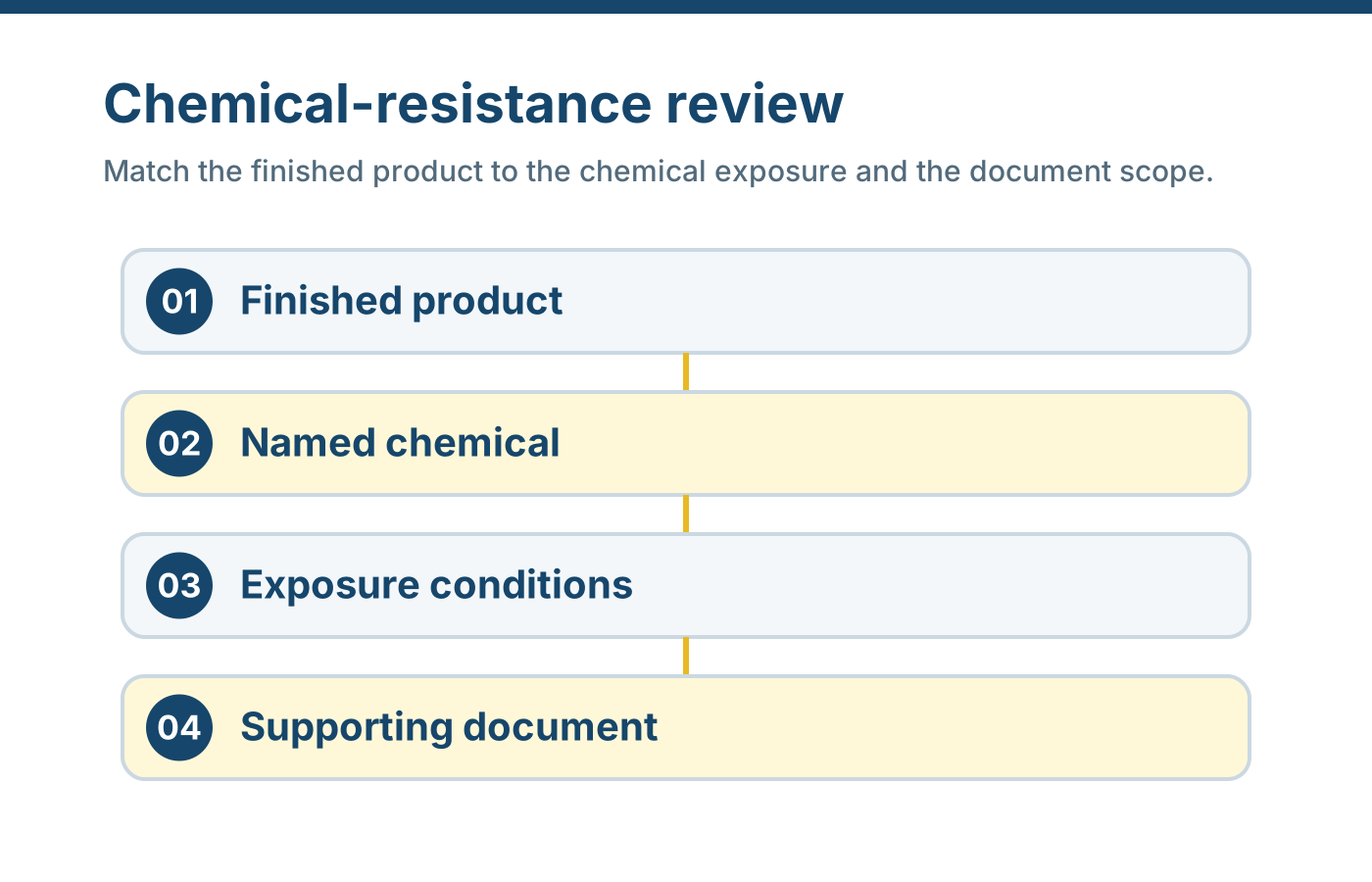
How the Evidence Is Built Up
Three kinds of document appear in this work, and they support different claims. A resin supplier guide describes a specific grade in the media it lists, under its own test conditions — useful for shortlisting and for understanding where the risks are. A laminate or sample test describes a specific build-up under the conditions recorded. A finished product test report describes the item tested, and its coverage of models and configurations is checked against what is being supplied.
Where the combination has not been tested, that is stated. The options then are to choose a more conservative direction, to have a test arranged with the scope, laboratory, lead time and cost agreed, or to have the project’s technical authority accept the exposure with the assumption written down. All three are legitimate; what is not legitimate is filling the gap with a general claim in a quotation.
Load, Temperature and Surfaces
Two further factors are easy to miss. Sustained load and elevated temperature make a chemical environment harder to resist than the same medium at ambient temperature with light loading, so the structural check and the chemical check belong together. And the surface presented to the exposure may not be the base laminate: a grit layer, a covering panel or a cut edge is a different material at that point, and an aggressive environment questions all of them.
That is also why cut edges are sealed at the factory where the order requires it. Sealing protects the exposed laminate at the cut, and it is part of the same conversation about what the panel meets in service.
Technical References and Their Limits
The Scott Bader chemical containment guide publishes resistance guidance for named resin/laminate systems under stated conditions. It is useful for understanding how concentration, temperature and exposure affect a review. It is not a compatibility certificate for Dengtai grating; the finished product and project conditions still need their own confirmation.
Content last checked: