Technical reference
FRP Grating Temperature Range, Creep and Thermal Movement
Three questions arrive together — how hot the grating can work, how it behaves under continuous load, and whether thermal movement needs allowance. They are answered from different data, and a single maximum temperature answers none of them.
Definitions
Temperature, Service Temperature, Creep and Thermal Movement
Four terms that are routinely used as if they were one.
- Heat deflection temperature
- A short-term property of a resin or laminate at a defined load. It describes when stiffness drops in that test, not the temperature a finished panel can work at continuously.
- Continuous service temperature
- The temperature the grating can tolerate in the actual medium, under the actual load, for the intended service. It depends on the resin, the structure, the environment and the loading.
- Creep
- Additional deflection that develops over time under sustained load. A panel that is acceptable under a brief load can continue to deflect if the load stays on it.
- Thermal movement
- Change in panel length with temperature, which matters where the grating is restrained and cannot expand. It is calculated from the coefficient of the actual material and the temperature range.
Questions and answers
Five FRP Grating Temperature Questions and What Answers Them
The right-hand column is where most of the confusion starts.
| Question | What answers it | What does not |
|---|---|---|
| How hot can the grating work? | The actual medium and temperature profile, the resin direction, the structure and the product data for that configuration | A resin supplier deflection temperature, or a fire test result |
| Will it deform under continuous load? | Long-term load data for the matching structure, or an agreed calculation that accounts for sustained load | A short-term allowable load with no duration stated |
| Does a hot area need more span support? | A load and deflection check at the working temperature, using data that applies to it | Extrapolating room-temperature data by an assumed percentage |
| Do we need expansion joints? | The coefficient of the actual panel material, the temperature range, and how the panel is restrained | A generic millimetre figure copied from another product |
| Are cables or pipework expansion joints relevant? | A separate design task for those services | The grating supplier |
Boundaries
Three Boundaries on Temperature and Long-Term Load
What short-term data cannot be stretched to cover.
- Short-term and long-term loads are different questions — A published allowable load generally describes a short-term condition, sometimes with the duration or basis stated in a footnote. Where equipment stands on a platform for years, the additional deflection that develops under that load is a separate check.
- High temperature is not solved by a resin name — Selecting a heat-resistant resin family does not answer a temperature question on its own. The medium, the concentration, the load, the support condition and the product data all belong in the same record.
- No generic expansion gap is published — A gap value depends on the coefficient of the panel material, the temperature range, the restraint and the installation temperature. Without those values, any figure we published would be wrong for most projects, so the calculation is done with the project's data.
Project inputs
What to Send for a Temperature or Creep Review
Six items, and the first two decide the resin direction.
- Temperature profile — Normal and peak temperature, how long the peak lasts, and how often the cycle repeats.
- Medium — What the grating is exposed to at that temperature, including splash, vapor, condensation or immersion.
- Load and duration — What loads the panel carries, whether they are continuous, cyclic or occasional, and the deflection limit.
- Support and restraint — Support positions, clear span, and how the panel is restrained at the edges and fixings.
- Installation temperature — The temperature at installation, which affects any allowance made for movement.
- Documents required — Whether the project needs product data, testing or a calculation for its own approval file.
Request a review
Send the Temperature Profile and the Sustained Load
Duration matters as much as the value in both cases.
- Molded and pultruded grating produced in house
- Full panels or factory cut-to-size pieces
- No fixed minimum order quantity
FRP Grating Temperature Questions
What is the maximum temperature for FRP grating?
Is the heat deflection temperature the service temperature?
Will the grating sag if equipment stands on it?
Do I need to leave gaps for expansion?
Continue With Temperature and Creep
Load and span guidance
What load data covers and which conditions come with it.
Resin selection
Resin direction chosen from the medium, temperature and exposure.
Chemical resistance
How compatibility documentation is checked for a specific product.
Maintenance and service life
How long-term loading and exposure show up in service.
Technical resources
The technical material behind this guidance.
FRP Grating Surface Options
Concave, grit, inlaid grit, milled, checked plate and mini mesh surface formats, plus anti-static and UV treatments, selected against wet, oily and…
Three Questions That Arrive Together
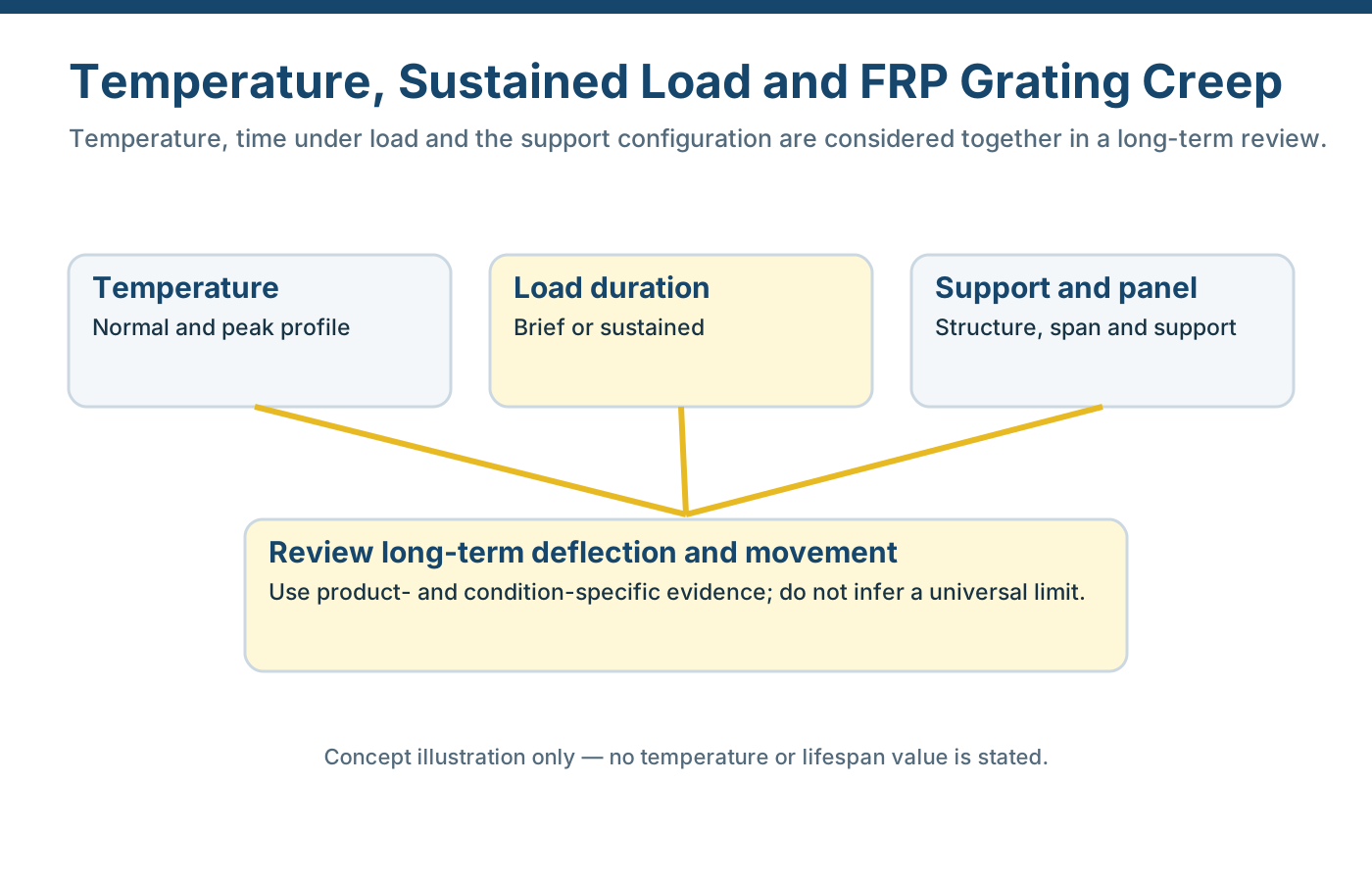
The inquiry usually sounds like one question — “what temperature can this grating take?” — and it contains three. The first is environmental: what the panel is exposed to, at what temperature, for how long. The second is structural: how the panel behaves under a load that stays in place, because sustained load causes additional deflection over time. The third is geometric: whether restrained panels need to move as the temperature changes.
Handling them separately is what makes the answer usable. A panel can be perfectly suitable for a hot medium and unsuitable for a permanent point load at that temperature, and a restrained installation can need movement allowance even where the load is trivial. Each is answered from its own data, and where that data does not exist for the configuration, the honest answer is to say so and agree what has to be produced.
Why Room-Temperature Load Tables Do Not Stretch
Publishing load and deflection data requires stating its conditions. Ours come from an adopted source table for two molded structures, recorded as single-span, untreated panels under superimposed uniform load at room temperature. That is a specific condition set, and it is why the figures are shown with their conditions beside them rather than as a general capacity.
Where a project has a different condition — a higher temperature, a permanent load, a concentrated load or a different support arrangement — the check has to be made for that condition. Sometimes it can be resolved by choosing a different structure; sometimes it needs the project’s engineer to confirm the assumption. What it cannot be resolved by is scaling a room-temperature figure by a percentage, which is the shortcut that produces optimistic specifications.
Movement, Restraint and Installation Temperature
Thermal movement matters most where the grating cannot move. A panel fixed at both ends across a range of temperature change wants to expand and contract; if it cannot, the movement appears as stress in the fixings and the panel rather than as displacement. Whether that is a problem depends on the coefficient of the actual material, the temperature range and how the panel is restrained.
Because those values belong to the specific configuration and project, we do not publish a standard gap or slot dimension. What we do is state what has to be provided — the temperature range, the installation temperature, the restraint arrangement and any data the project has for the material — and then confirm the allowance with the responsible engineer. That is a slower conversation than quoting a number, and it is the one that survives a site inspection.
Content last checked: