Project selection · Molded and pultruded grating
FRP Grating Selection Guide for Your Project
Start with the job the grating must do, then match the resin, support and load, mesh and walking surface. This guide helps you narrow the options and prepare a specification for full panels or factory-cut pieces.

Full grating panels at our factory. Project conditions determine the structure, resin and finished sizes.
Quick selection
Which FRP Grating Route Fits Your Requirement?
Use these starting directions to narrow the range, then check the conditions that could change the choice.
| Requirement | Candidate and Next Check |
|---|---|
| Construction access | Our construction pedestrian starting point is molded grating, 30 mm deep with nominal 38 × 38 mm mesh. Check span, supports, loading and exposure; this is not a load rating. |
| Chemical exposure | Review resin by process area; vinyl ester is common in our chemical and wastewater supply. Confirm the medium, concentration, temperature, contact type and cleaning. |
| Marine access | Consider vinyl ester or phenolic against the actual exposure. Review corrosion, fire and smoke requirements together, alongside loading and the required documents. |
| Small openings | Compare mini mesh and covered formats for small objects or narrow footwear. Check clear openings, joints, drainage, access and local loads. |
| One-way span | Compare pultruded profiles with a suitable molded configuration. Check bar direction, span, available depth, load and matching performance data. |
| Debris control | Consider a covered assembly to reduce debris falling below. Check drainage, joints, added mass, attachment and the complete assembly load case. |
| Tree surrounds | Our molded tree-pit starting point is 25 mm deep with nominal 40 × 40 mm mesh. Actual foot traffic needs a support and load review; this is not a vehicle rating. We do not supply pultruded tree grates. |
How to Choose FRP Grating in Five Steps
Prepared by Dengtai Industry for customers selecting our molded and pultruded grating.
Select FRP grating by checking the application, operating environment, support and loading, opening and surface requirements, then fabrication and supply scope. The result should be a candidate configuration with reasons for the choice and a clear list of unresolved inputs.
FRP, fiberglass and GRP grating refer here to glass-fiber-reinforced resin grating. Molded and pultruded describe different constructions; mini mesh and covered formats describe further choices within a product configuration.
Work through these decisions:
- Define the use and site constraints.
- Shortlist the resin by operating conditions.
- Match the structure and thickness to the supports and load.
- Balance mesh, drainage and walking surface.
- Set the fabrication and delivery scope.
If your configuration is already specified, go straight to the selection brief or send the drawing for review.
1. Define the Use and the Site Constraints
Start with what crosses the grating and what happens beneath it. A maintenance walkway, a trolley route, a removable trench cover and a tree surround need different checks. Include temporary activities such as moving a pump, parking equipment or opening a panel for access.
Then identify what cannot easily change: an existing steel frame, installation depth, pipe positions, doorway levels or the space available to lift a cover. These constraints can rule out a configuration before resin or color is considered.
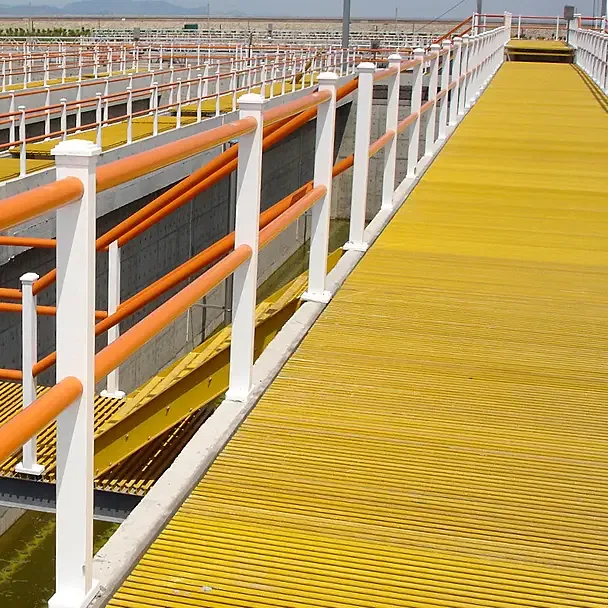
Existing Frame or Replacement Panels
For replacement work, record the clear gaps between supports, bearing surfaces, available seating depth and fixing locations. Measure the actual opening rather than copying the dimensions of the old panel. Replacing steel with FRP at the same thickness does not establish equivalent stiffness or capacity.
If no candidate fits the existing support and height constraints, discuss a revised frame or configuration before fixing the order.
Our starting configuration for construction pedestrian access is 30 mm deep molded grating with nominal 38 × 38 mm mesh. That is a factory application experience, not a recommendation for every walkway. The span, loads, resin and surface still determine whether it fits the particular installation.
New Layout With Adjustable Supports
If the frame can change, compare the grating and supporting structure together. A different panel depth or bearing-bar profile may change the support arrangement, but fewer supports can also increase the demand on each support. Compare the complete proposal before assuming that a thicker panel will save money.
Use a molded-versus-pultruded comparison where the construction is still open. Keep fixed constraints visible throughout the review so a candidate remains practical to install.
2. Shortlist the Resin by Operating Conditions
Choose a resin direction from the chemical or cleaning agent, concentration, normal and peak temperatures, and contact type. Splash, vapor, repeated washing and immersion are different duties. “Outdoor” or “wastewater plant” alone does not describe the exposure.
| Resin direction | When to consider it | What settles the choice |
|---|---|---|
| Polyester | Ordinary access where the operating conditions suit the named grade and formulation. | Water, UV, cleaning agents, chemical contact and the intended configuration. |
| Vinyl ester | Chemical, wastewater or marine duties; a common direction in our supply for these areas. | The actual medium, concentration, temperature and exposure type. |
| Epoxy | Our pultruded supply includes consideration of epoxy for specified strong-corrosion duties. | Chemical compatibility and availability for the requested configuration; it is not universally better than vinyl ester. |
| Phenolic | Projects where fire, smoke or fire-related structural performance governs selection. | The specified test and acceptance criteria, finished-product construction and supporting documents. |
Select by process area where conditions differ. An ordinary access route and a chemical-dosing point in the same plant may justify different material reviews. Assess material compatibility and structural adequacy separately.
Resin family, grade and formulation are separate decisions. Include fire, UV or conductive targets in the specification alongside the operating conditions; the performance-evidence checks below apply to the finished configuration.
Different resins and formulations change the quotation. Material cost is confirmed for the selected configuration and exposure. Use the resin selection guide and chemical-resistance review for the detailed inputs.
3. Match the Structure and Thickness to the Supports and Load
Thickness is one part of the structural choice. A 25, 30, 38 or 50 mm depth does not by itself identify a safe span or load class. Check the mesh or bearing-bar section, reinforcement and material, supported edges, load direction and acceptable deflection against data for the actual construction.
Measure Clear Span, Then Identify the Load Case
Clear span is the unsupported distance between bearing faces. Panel length, frame outside dimensions and support center spacing are different measurements. Mark the supports and dimensions on a sketch so there is no ambiguity about which distance is being checked.
| Loading condition | Information needed | Why it changes selection |
|---|---|---|
| Distributed pedestrian or maintenance load | Design load and unit, supported area, clear span and deflection criterion. | A value spread over an area cannot automatically be used for a local contact. |
| Foot, equipment leg or other point contact | Force, contact footprint and position relative to bars, edges and openings. | Local bar behavior can govern even when the average area load is modest. |
| Trolley or vehicle wheels | Loaded wheel forces, wheel contact, travel direction and operating conditions. | Total vehicle mass divided by panel area does not describe the wheel load case. |
| Equipment left in place | Load, footprint, duration and temperature. | Sustained loading and heat can change long-term deflection. |
Keep panel weight in kg/m² separate from load capacity. Distinguish ultimate failure data from an allowable load and from the load at an agreed deflection. Strength and acceptable movement are separate checks.
The load, span and deflection guide explains the scope of our published reference data. Do not transfer a table row to another mesh, thickness, resin construction, covered assembly or cut panel without confirming that the conditions apply.
Molded or Pultruded: Compare the Load Path
Molded square mesh distributes load in two directions and can be useful for varied panel layouts. Pultruded grating primarily carries load along its parallel bearing bars, so the bar direction must match the designed spanning direction.
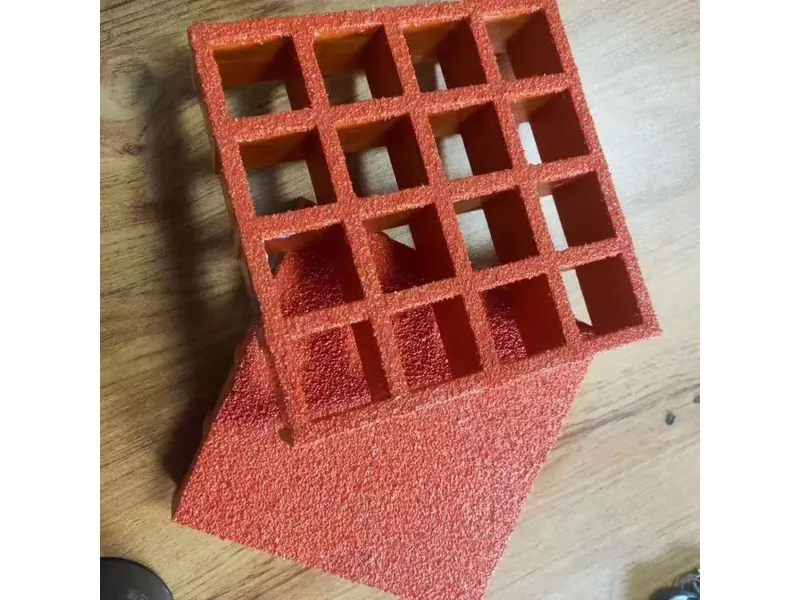
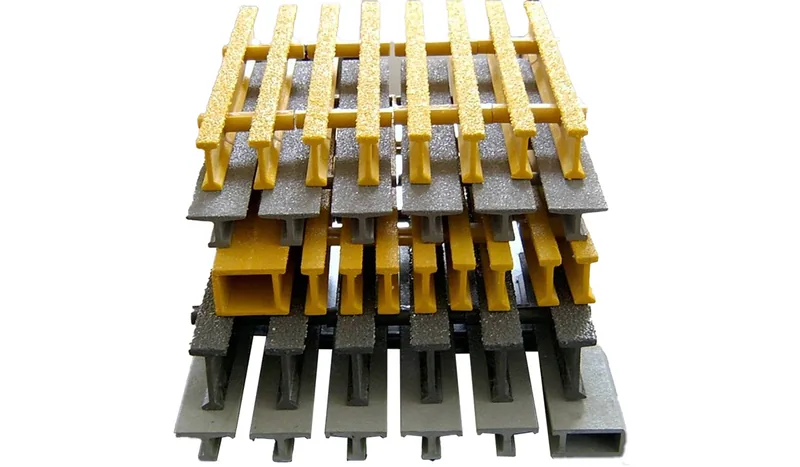
Both types need a suitable support arrangement. Four-edge support is not a universal requirement for every molded panel, and a long span does not automatically approve pultruded grating. Compare the exact candidates at the required load, span and deflection, including any installation-height limit. See pultruded profile options when a directional bearing-bar structure is being considered.
For equipment that remains on the grating, or elevated operating temperatures, also review temperature and sustained-load behavior. Those conditions need more than a short-term room-temperature table.
4. Balance Mesh, Drainage and Walking Surface
Decide what the opening must let through and what it should retain. Drainage, ventilation and light transmission favor an open surface; small objects, narrow footwear or work beneath the platform can lead to closer openings or a covered format. The best choice depends on which requirement governs the location.
Standard Mesh, Mini Mesh or Covered Grating
| Format | Main reason to consider it | Trade-off to check |
|---|---|---|
| Standard open mesh | Open drainage and ventilation for access areas. | Footwear, dropped objects, wheel contact and the actual openings. |
| Mini mesh | Smaller openings while retaining an open walking surface. | Cleaning, blockage, mass and the load data for the specific construction. |
| Covered grating assembly | A continuous top to reduce objects or debris passing below. | Drainage routes, joints, extra mass, cover attachment and assembly performance. |
Our common double-layer molded combination is nominal 19 × 19 mm upper mesh over 38 × 38 mm lower mesh. Those labels do not establish a 19 mm clear opening or an accessibility rating. Check the drawing, bar widths and joints against the actual object or footwear requirement.
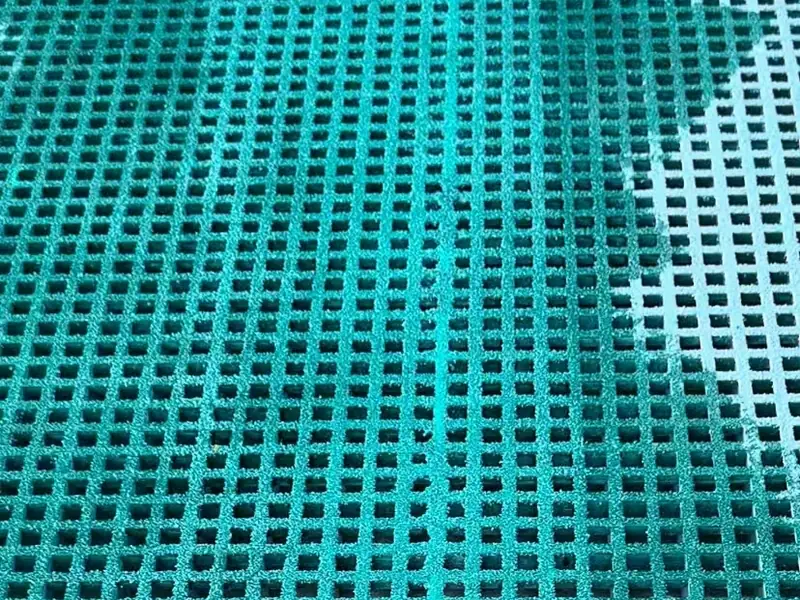
Mesh pitch measures the repeat distance between bars; clear opening describes the gap; open area expresses the proportion open across a defined area. They answer different questions. Use the sizes and mesh guide to keep the dimensions consistent.
Where people work below the platform, state whether the aim is to retain objects, reduce debris or control liquids. Smaller mesh may help retain objects; a covered assembly changes drainage and joint requirements. A covered top alone is not a sealed containment system. Compare the actual covered grating assembly where a closed surface is required.
Choose the Contact Surface for the Actual Traffic
Start with the traffic and contamination, then compare a small number of suitable surface candidates. The contact texture, mesh openings and load-carrying structure remain separate choices.
| Use condition | Compare first | Main trade-off |
|---|---|---|
| Industrial access in work shoes | Concave and gritted surfaces for the available configuration. | Wetness, oil or deposits, cleaning and wear affect the choice. |
| Barefoot or contact-sensitive access | Samples with a texture suited to the specified contact requirement. | Avoid treating sharp concave edges or coarse grit as the default; agree comfort and wet-performance criteria. |
| Trolleys or small wheels | Wheel contact across the mesh and joints; consider a covered format where continuity is needed. | Match wheel diameter, contact width and loads with grip and drainage. |
| Frequent mud or wash-down | Surface texture together with the opening and cleaning method. | Balance clearing deposits with retaining the required contact texture. |
Milling the top of an open panel leaves its openings in place. A cover changes both wheel contact and drainage, so assess the complete assembly. Use samples to compare texture and color, and state any required performance evidence. The surfaces and treatments guide develops these options.
Check Functional and Performance Requirements Early
If the specification requires static dissipation, fire or smoke performance, slip testing or a particular accessibility condition, identify the method and acceptance criteria before the configuration is finalized. Static dissipation needs a conductive path and earthing arrangement; electrical insulation is a separate requirement. Color alone establishes neither.
Ask which finished configuration the evidence covers. A resin data sheet, one sample report or a product-family name does not establish every performance requirement for the quoted panel.
5. Set the Fabrication and Supply Scope
Consider full panels when site cutting is practical and the selected panel dimensions suit the support layout. Confirm the layout and material allowance before ordering. Factory-cut pieces suit projects with agreed finished dimensions and opening positions. Compare handling, material loss and site work as part of the choice.
For full panels, agree panel dimensions and quantities. For cut pieces, supply a dimensioned list or drawing revision with piece identifiers, quantities, opening coordinates and any orientation requirement. State who is responsible for the supports, installation and final fitting.
Openings, Fixings and Cut-Edge Treatment
An opening can interrupt bearing bars or leave a narrow strip with inadequate support. Check its position, the remaining bars and the local support arrangement, not just the opening dimensions. Hold-down clips retain panels; they do not replace load-bearing supports.
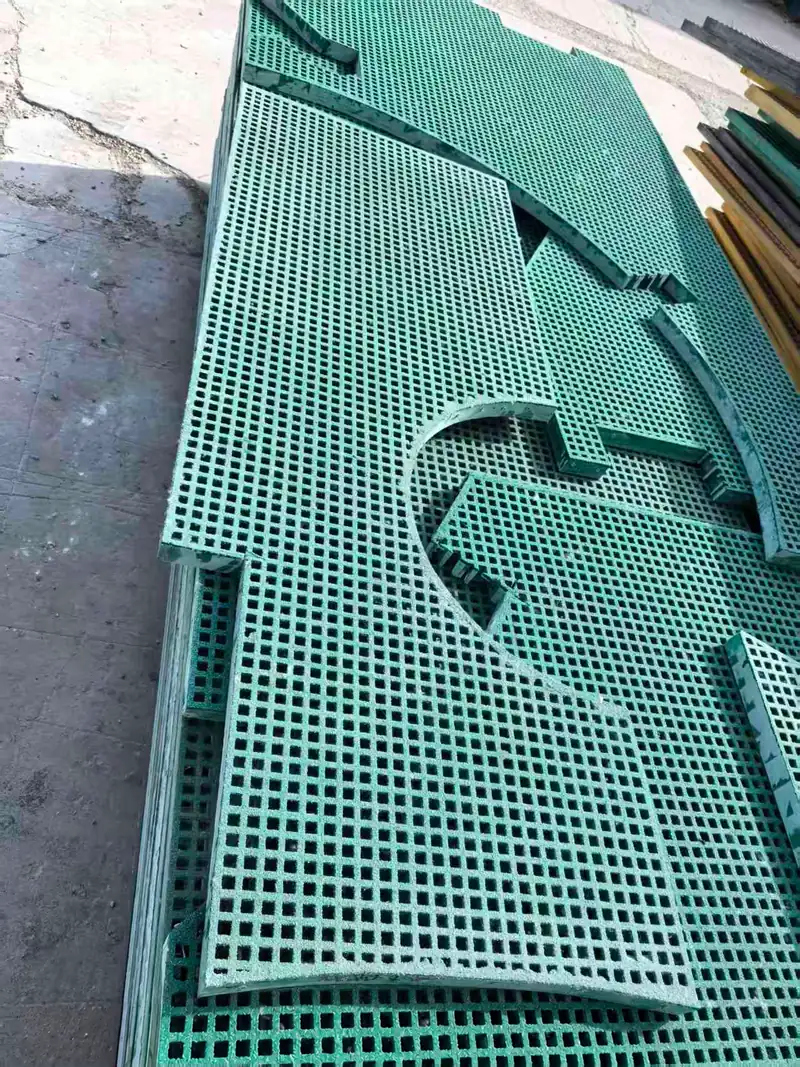
Cut-edge sealing protects exposed cut surfaces when specified. It does not reconnect a severed bearing bar or restore the capacity of an uncut panel. Agree sealing and any additional support or framing separately. See cutting and edge sealing and the installation guide for the next checks.
For removable covers, consider the finished piece mass, hand access, lifting route and fixings. A piece that fits the opening may still be impractical to lift in the available space. Include the access requirement before deciding the split lines.
Compare the Complete Quotation
Compare resin and structure, finished sizes, cutting, openings, edge treatment, fixings, packing, required documents and delivery terms on the same basis. A lower panel rate can lead to a different project cost once those items are included.
Our cut-piece quotations generally use the delivered piece area, with dimensions and loss influencing the rate. The quotation should identify the actual scope; it should not assume a fixed cutting premium or a guaranteed saving against full panels. The price and project-cost guide explains the comparison.
Prepare Your FRP Grating Selection Brief
Copy these fields into your inquiry or attach a marked-up drawing. Write “unknown” where necessary; it is useful to distinguish an open question from a confirmed requirement.
- Application and traffic: users, pedestrian access, equipment, wheels and any work below.
- Site constraints: existing or adjustable supports, available depth, interfaces and access.
- Environment and resin: medium, concentration, temperature, contact type, cleaning and any specified grade.
- Structure and loading: molded or pultruded candidate, thickness or bar profile, clear span, loading and deflection criterion.
- Mesh and surface: nominal dimensions and clear-opening requirement, open or covered format, finish and color.
- Supply and fabrication: full-panel or cut-piece dimensions, quantities, opening positions, orientation and drawing revision.
- Installation and evidence: support scope, fixings, sealing, removable sections and required performance documents.
- Delivery: destination, packing requirements, delivery terms and required date.
If you already have an approved specification, send it for a supply and quotation review. If the configuration is still open, send the application and fixed constraints for an initial shortlist. The agreed order then records the selected configuration and supply scope; structural suitability depends on the project requirements and applicable evidence.
Send your selection requirements.
Technical Reading Behind This Guide
Strongwell’s selection guidance discusses design criteria, constraints and the interaction between grating and supports. Fibergrate’s open-versus-covered comparison explains the practical differences between open and continuous walking surfaces. These manufacturer resources inform the selection questions; their product ratings and certifications do not establish the performance of our supplied grating.
FRP Grating Selection Questions
What if I do not know the span or design load?
Can I choose grating just by its thickness?
Does molded grating need support on all four edges?
Does mini mesh automatically mean heel-safe or ADA compliant?
Is a covered panel the best choice for trolleys?
Can you quote against an existing drawing or specified resin?
Can I compare samples before choosing the surface or color?
Project review
Turn Your Requirements Into a Candidate Configuration
Send the application and the constraints you already know. If you have an approved specification, send it for a supply and quotation review.
- Molded and pultruded grating produced in house
- Full panels or factory cut-to-size pieces
- No fixed minimum order quantity
Content last checked: