Fixings and accessories
Fiberglass and FRP Grating Clips, Hold-Down and Connectors
M, L and C clips for holding panels down onto supports and joining panel edges, in galvanized or stainless steel. Send the panel height, bar width, support section and quantity for a firm clip price.

Terminology
What a Grating Clip Is, and What It Is Not
The words buyers and suppliers use for fixings, defined once, so the clip you order does the job you actually have.
- Grating clip (also called a fixing or a fastener)
- A small metal part that holds a grating panel down onto its support, or joins two panels edge to edge. It is a connection component rather than a structural member, so it transfers the restraint the layout asks for and never adds a bearing support of its own.
- Hold-down clip
- A clip that restrains a panel against a support — the job most people mean when they search for grating clips. It matters where panels can lift, shift or be washed, and where a panel has to stay put on a support it simply rests on.
- Panel connector
- A clip that joins two adjacent panels along their edges so the walking surface stays level and the step at the joint stays small. It does not carry the panel and does not increase the allowable span.
- M clip
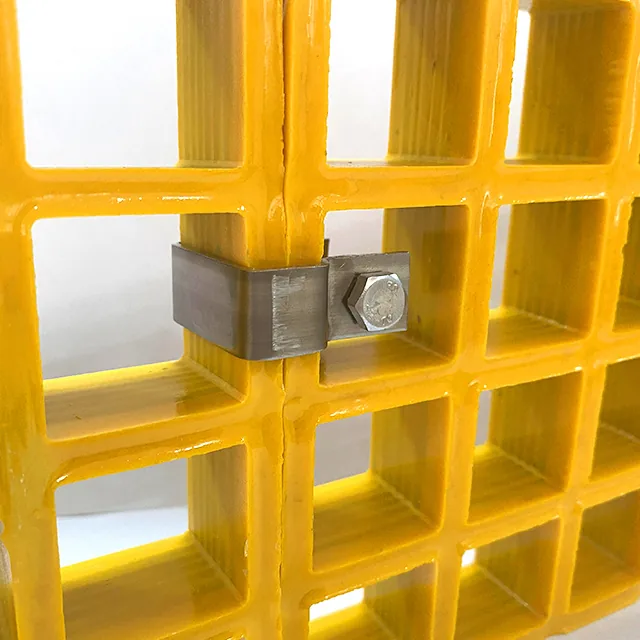
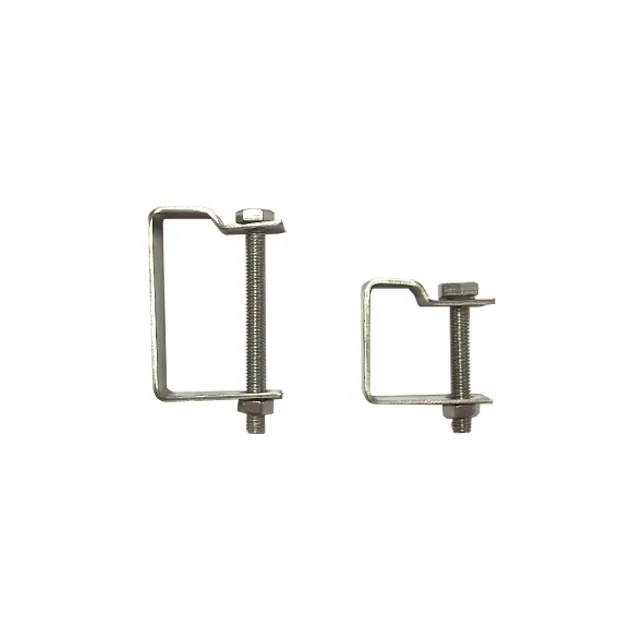
- The usual hold-down shape. It normally spans two adjacent bars and is bolted through the panel to the support below, so the restraint runs from the bars into the support.
- L clip
- A single-bar hold-down used at lighter fixing positions. It bears on one bar, so it is not automatically equivalent to an M clip and should not be swapped on the letter alone.
- C clip
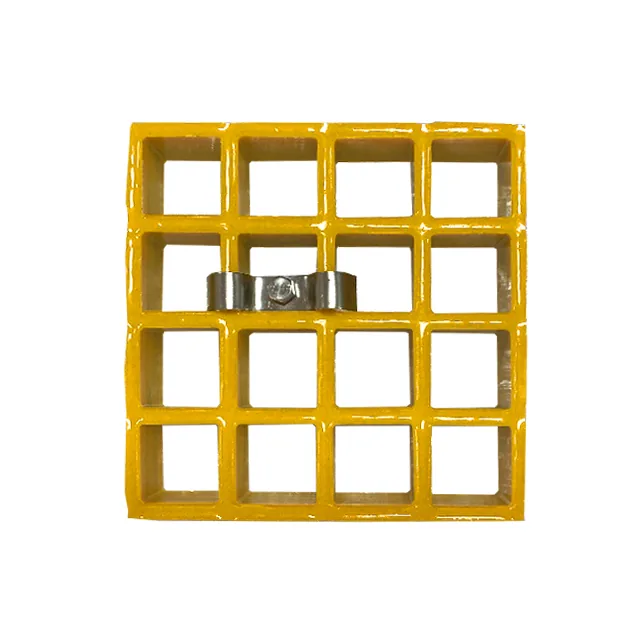
- The common panel-to-panel connector, used at the edge joint between two molded panels. Confirm the thickness of both panels, the edge bar and the support under the joint before ordering.
- Saddle clip, WLP and T clip
- Names used in North American catalogs for particular hold-down and edge shapes. They describe a supplier's geometry rather than a standard, so a replacement is matched on the panel and the support rather than on the name.
- Fixing point
- A position on the support layout where a panel is fastened. The number and position of fixing points come from the drawing, the support spacing and the exposure, not from a fixed clips-per-panel rule.
Fit check
When a Clip Fixing Is the Right Answer
A fixing restrains a panel; it does not carry it. Check which of the two you need before an order goes out.
Specify this if…
- The panels have to be held down rather than simply laid on the support — vibration, wind uplift, wash-down or equipment movement all mean the panel has to be restrained.
- The panels are lifted for maintenance and cleaning, so the fixing has to be releasable and refittable instead of permanent.
- Two panels meet along an edge and the step at that joint has to be controlled before anyone walks across it.
- The support is steel angle, channel, flat bar, a rail or a concrete kerb, and site drilling or welding is to be avoided.
- The layout or specification already calls out M, L or C clips, and the quantity and positions have to be matched to the drawing.
Look elsewhere if…
- A bolted structural connection is needed. FRP cannot be welded, and a clip is a fixing rather than a structural joint.
- The fixing is expected to raise the load capacity or extend the allowable span. Fixings restrain the panel; the span is set by the panel, its bearing edges and the support spacing.
- You are looking for one universal clip that fits every panel. Heights and bar widths differ between panels, so the fit is confirmed against the panel being supplied.
- The joint at the panel edge is expected to carry load. A connector does not create a bearing support, and a joint that needs support has to sit on a support in the layout.
Clip families
M, L and C Grating Clips Compared
The letter describes the shape; the job it does and the fit it needs decide the selection.
| Clip | What it normally does | What we check before it is quoted |
|---|---|---|
| M clip | Usually spans two adjacent bars to hold the panel down onto the support below | Panel height, bar width, support section, and whether the bolt can be reached and tightened from below |
| L clip | Usually holds a single bar down onto the support, for lighter fixing positions | The contact position on one bar and the space available. It is not automatically equivalent to an M clip |
| C clip | Usually joins two adjacent molded panels at the edge and limits the step at the joint | Panel thickness of both panels, edge bar shape, joint position and the support underneath |
| Other catalog shapes | Saddle, WLP, T and recessed square clips, and J-bolts, appear under supplier-specific names in North American catalogs | The drawing or the fixing detail. The jaw is matched to the bar of the panel being supplied and to the support it bolts to |
Fitted on the panel
What M, L and C Look Like on the Grating
The same three types, photographed fitted to a molded panel instead of drawn as shapes.

M clip, spanning two bars
Photographed fitted to a molded panel. The clip crosses two adjacent bars and bolts through to the support below, so the jaw has to clear the bar width and the bolt has to reach the support.

L clip, bearing on one bar
Photographed fitted to a molded panel. It holds a single bar down at lighter fixing positions, so the contact on the bar and the space around the bolt are checked rather than assumed equal to an M clip.

C clip, joining two panels
Photographed at the edge joint. The connector keeps the two surfaces level and limits the step between them; it does not create a bearing support and does not increase the allowable span.
Selection path
How to Match a Clip to Grating and Support
Five checks in order, from the job the fixing has to do to what appears on the approval drawing.
Holding a panel down onto a support and joining two panels are different jobs. Settle which one the fixing has to do before choosing a letter.
The clip has to suit the ordered panel height so the panel is held flat rather than pulled out of shape as the fixing is tightened.
Bar width, support section and access from above or below decide whether the clip seats fully on the bar and can actually be tightened.
Galvanized or stainless steel is agreed from the exposure and the support material, and the number and positions follow the support layout on your drawing.
The clip type, quantity and positions are listed with the panel configuration in the quotation and shown on the drawing before production starts.
Fixing fields
FRP Grating Clip Specification Fields
These are the details a fixing quotation is built from.
Request a Project Quote| Specification | Value |
|---|---|
| Clip types | M, L and C Supplied as standard for molded, pultruded and mini mesh panels. Other catalog shapes are confirmed from the fixing detail you send. |
| Height matching | Matched to the ordered panel height Height is the first check, not the only one. |
| Jaw and bar fit | Checked against bar width and mesh A clip sized for a standard 38 × 38 mm bar may not seat correctly on a small mesh panel. |
| Panel formats covered | Molded, pultruded and mini mesh Pultruded panels are matched on the bearing bar section; mini mesh on the smaller upper mesh. |
| Material | Galvanized steel or stainless steel Both to order. The stainless grade and any coating requirement are confirmed with the order rather than assumed. |
| Bolts and hardware | Agreed as part of the clip assembly Bolt length follows the support thickness and whether the fixing is reached from below. |
| Quantity and positions | From the support layout on your drawing No single clips-per-panel figure is published. The fixing layout follows the supports. |
| Supply | Supplied with the grating order The clip is listed as its own line in the quotation so the type, material and quantity stay visible, but it ships with the panels. Clip-only orders are not shipped. |
Quantity
How the Number of Fixings Is Arrived At
The count follows the supports on your drawing. Here is what decides it, situation by situation.
| Fixing situation | What decides the number | What we need from you |
|---|---|---|
| Panels resting on parallel supports | The number of support lines the panel crosses, and the panel size and orientation | The support spacing and section, with the panel layout |
| Panel edges along a walkway, platform or opening | Whether the edge needs restraint against uplift and movement, or only a trim | The edge detail, and what the edge bears on |
| Panels joined edge to edge | How many joints there are and whether each joint sits on a support | The joint positions marked on the layout drawing |
| Panels lifted for maintenance | How often the panel comes out, and whether it must go back in the same position | The maintenance route, and who checks the fixings afterwards |
| Openings, cutouts and stair treads | The support around the opening rather than the opening itself | The opening size and position, and the frame or support around it |
Price basis
How Grating Clips Are Priced
Per piece, by type and height, with the material as the largest step and the hardware listed separately.
Priced per piece, by type and height
A clip is quoted per piece rather than per square meter. The type and the panel height it has to match set the base, so tell us the panel being fixed rather than only the clip name.
Material is the largest step
Both finishes are made to the order. Galvanized steel covers most general access areas and is the economical choice; stainless steel is a multiple of that price and is quoted against the exposure, and the quotation states the grade being supplied.
Hardware, packing and freight are separate lines
Bolts or screws, any coating beyond galvanizing, packing and freight are shown as their own lines. Export orders are quoted FOB, so the piece price and the delivered cost stay separate.
Clips are a separate line in the quotation so the type, material and quantity stay visible, but they are supplied with the grating order — clip-only orders are not shipped, because the jaw is matched to the panel being made. There is no fixed minimum order on the panels, and the panel price base is published separately in the price schedule.
Material choice
Galvanized and Stainless Steel Clips
Both finishes are made to the order rather than stocked as standard items, so the choice is settled with the quotation. It follows the exposure and the support, not the price alone.
| Fixing option | Where it is used | Confirm before order |
|---|---|---|
| Galvanized steel clip | The ordinary choice for general access areas, indoor walkways, platforms and dry outdoor exposure | Whether the project specifies a galvanizing standard or a minimum coating |
| Stainless steel clip | Considered where the exposure, the cleaning regime or the project specification asks for it — wash-down areas, coastal and process locations | The medium, its concentration and temperature, so the grade offered matches the exposure |
| Stainless grade | The grade is fixed with the order rather than assumed; 304 and 316 cover most project specifications | Any grade named in the specification, and whether it applies to the clip, the bolts or both |
| Bolt and screw hardware | Confirmed with the clip so the fixing arrives as one assembly | Support thickness, access from below, and the hardware material |
| Coatings beyond galvanizing | Quoted where a project asks for a specific finish or an additional coating | The coating, the standard it has to meet, and whether it is applied after fabrication |
Before you inquire
What to Send With a Grating Clip Inquiry
Height alone is not enough to confirm a clip.
- Panel height and format — The thickness of the panel being fixed, and whether it is molded, pultruded, mini mesh or a plate format.
- Bar width and mesh — The jaw has to sit on the bar rather than on its edge, so bar width matters as much as height.
- Support material and section — Steel angle, channel, flat bar, a rail, timber or concrete, with the section size where a bolt is involved.
- Support layout or drawing — The fixing positions follow the supports, so the layout is what turns a clip type into a quantity and a position list.
- Quantity, and whether clips stand alone — How many pieces are needed, and how the fixing positions fall on the support layout. Clips ship with the grating order rather than as their own consignment.
- Environment and exposure — The exposure that decides galvanized or stainless steel, plus any project requirement on the grade or the coating.
- Access for tightening — Whether the fixing can be reached from below the panel or only from above, which decides the bolt length and the assembly.
- Documents required — Any certificate, grade statement or standard the clip has to meet, stated at inquiry so it can be quoted rather than assumed.
Where fixings decide
Grating Clip Applications and Fixing Situations
Six situations where the clip choice is made by the support, the panel and the exposure rather than by the letter.

Walkways and platforms on steel supports
Panels are restrained where they cross the frame members, so the fixing layout follows the frame rather than the panel size.
Confirm the support spacing and section, and whether the edge of the walkway needs its own restraint.

Solar array maintenance walkways
Panels laid on the array's existing rails and connected along their length, so the clip has to suit a rail section the project already has.
Confirm the rail section, the panel height, and how the panels are joined end to end.

Removable covers and trench runs
Where the panel has to come out for cleaning or inspection, the fixing has to be releasable and the panel has to go back in the same place.
Confirm how often the cover is lifted, and whether an edge restraint is needed as well as the fixings.

Panels cut around openings and kerbs
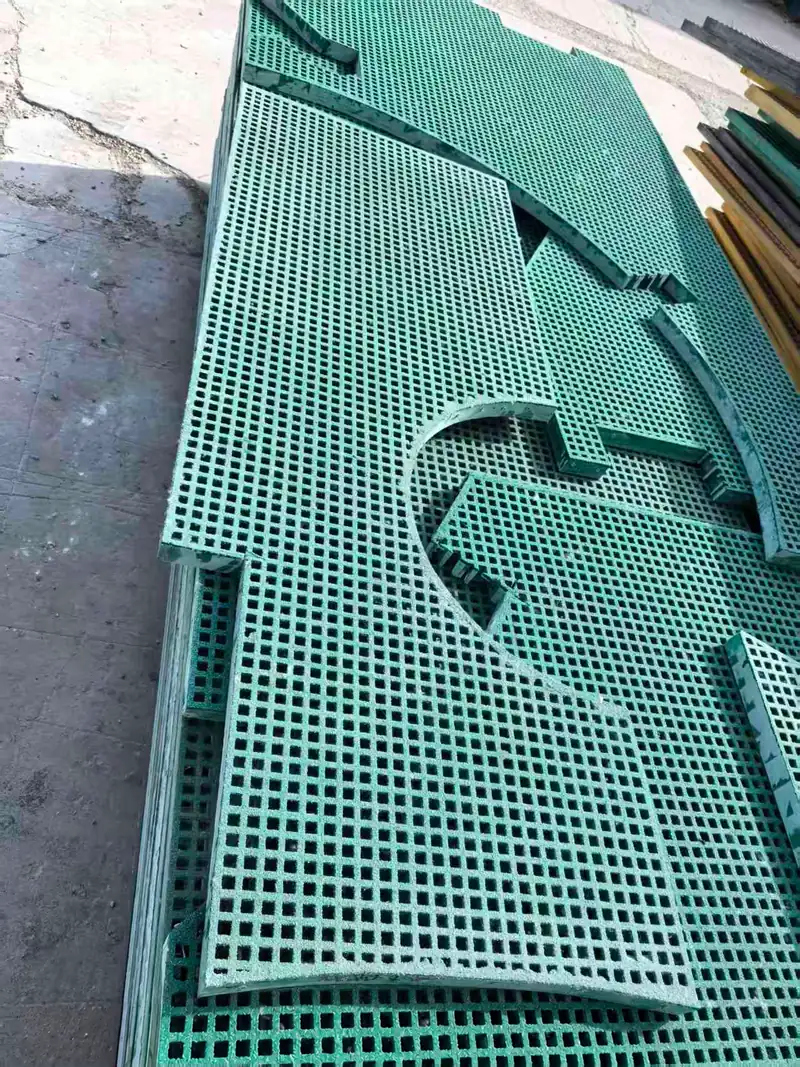
A panel cut around an opening or a tree pit has an unsupported edge, so the edge detail and the fixings around the opening belong with the cut list rather than after it.
Confirm the opening size and position, and what the cut edge bears on.

Mini mesh and small-opening panels
The smaller upper mesh changes the jaw fit, so a clip that seats on a standard 38 × 38 mm bar may not seat on a mini mesh panel.
Confirm the mesh of the panel being fixed, and the bar the clip actually lands on.

Pultruded panels and bearing bars
On a pultruded panel the clip is matched on the bearing bar section rather than on a molded mesh, and the bar is directional.
Confirm the bar series, bar height and pitch, and the cross rod spacing.
From our own orders
M Clips on a Solar Walkway in Indonesia
For a solar array maintenance route in Indonesia we supplied 25 mm molded grating with 38 × 38 mm mesh, cut to 400 × 2000 mm, yellow with a grit surface. The panels were laid on the customer's existing track supports and connected with M clips, so the fixing was chosen to suit a support that already existed rather than a support we designed.
That is the usual shape of a clip decision. The support is already there, the panel is already chosen, and the clip has to match the panel height, the bar and the support section. The quantity and positions came from the customer's layout rather than from a clips-per-panel figure, and the same check applies to a new project — send the support layout with the panel sizes.
The cut sizes, the grit surface and the clips were part of the order rather than left for site work. This record describes a fabrication and delivery for that order; it is not a load rating or a fixing schedule for a different support layout.

Why order fixings here
Why the Clip Is Confirmed With the Panel

The clip is matched to a panel we make
Molded panels are cast and pultruded bars are drawn at our works in Jingxing Mining District, Shijiazhuang, Hebei. The clip is matched to bar dimensions we produce rather than to a nominal size read off a name.
Read about the factoryQuoted and packed with the order
The clip type, quantity and positions are listed with the panel configuration in the quotation, and clips travel in the same consignment as the panels so the delivered set matches the cut list.
See how a quotation is builtWhat we do not publish without checking
We do not publish a clips-per-panel figure, a bolt torque or one stainless grade for every environment. Those are confirmed against your support layout and exposure, and the confirmation is what goes onto the approval drawing.
Documents are agreed at inquiry
Panel orders are supplied with a certificate of conformity and the factory product test report. If the fixing itself needs a grade or coating certificate, state it at inquiry so it is quoted and arranged rather than promised afterwards.
See how order documents are handledOrder path
From Clip Inquiry to Shipped Consignment
Five steps, and what is settled at each one.
Panel height and format, bar width, the support section, the fixing layout or drawing, the quantity and the exposure. A photo of the support is often enough to start.
We confirm the type and size against the panel being supplied and the support it fixes to, and we say plainly where something cannot be confirmed from the details given.
The quotation lists the clip on its own line — type, height, material, hardware, quantity and unit price — with packing and freight kept separate.
Clips are packed with the panels or in their own consignment, and the packing is agreed for that consignment instead of assumed from the panel packing.
Export orders are quoted FOB with the port and scope stated in the quotation, and shipping time is quoted separately from production.
Request a quote
Send Your Grating Clip Requirement
Panel height, bar width, support section and quantity are enough for us to propose the clip and its price.
- Molded and pultruded grating produced in house
- Full panels or factory cut-to-size pieces
- No fixed minimum order quantity
FRP Grating Clip Questions
What is an FRP grating clip?
How do I know which clip I need?
What is the difference between an M clip and an L clip?
How many clips do I need per panel?
Do you supply stainless steel clips?
What do FRP grating clips cost?
Can I buy clips without grating?
Do you have a clip size list or catalog numbers to order from?
Can a C clip replace a support?
Why do clips corrode before the grating does?
Can clips be reused when a panel is lifted for maintenance?
Do you supply the same clips as other manufacturers?
What a Grating Clip Actually Does
A grating clip is a connection component. It does one of two jobs, and installations that run into trouble usually treat those two jobs as one. A hold-down transfers restraint from the panel to the support so the panel stays where the drawing puts it. A panel connector keeps two edges level so the walking surface is continuous and the step at the joint stays small.
Neither job changes the structure. The allowable span and the load the panel carries are set by the panel, its bearing edges and the support spacing, which is why the same panel behaves differently on a 450 mm support spacing and on a 1200 mm one. A fixing cannot borrow capacity from the panel, and a clip placed between two supports holds the panel to nothing. Read the load and span guidance before a fixing is asked to solve a deflection problem.
Because FRP cannot be welded, a panel on a steel frame is either restrained by fixings, retained inside a frame or edge, or left loose on the supports. That decision belongs with the support layout, not with the maintenance team on the day the panels arrive. The installation guide sets out the same checks in the order they happen on site.
M, L and C: What the Letter Tells You
Suppliers use M, L and C to describe clip families, and the letters are understood the same way across the industry — but the letter is a shape, not a fit. Two manufacturers can both list an “M clip” and produce different jaw widths, different bolt centers and different overall heights for the same nominal panel.
Some suppliers publish a clip size list to order against. We do not, because the grating itself is made to the order: the clip is matched to the panel height of the panel being made and supplied with it, so there is no separate size list standing on its own. Send the panel height and format with the panel sizes and the matching clip comes back with the quotation.
What decides whether a clip works is narrower than the name:
- does the jaw sit on the bar rather than on the edge of it;
- does the height suit the ordered panel, so the panel is held flat instead of pulled out of shape;
- can the bolt reach the support and be tightened from where the installer is standing.
That is why we ask for the panel height and the bar width together. A clip that matches the height but carries a jaw sized for a wider bar will sit on the edge of the bar and distort the panel as it is tightened; a clip with insufficient bolt length cannot be fixed from below even though it looks correct in the pack. Panel dimensions and bar pitch are set out on the panel weight and size pages.
Names you will meet in other catalogs
Searching for fixings turns up saddle clips, WLP clips, T clips, G clips, J-bolts and recessed square clips. These are catalog names for particular hold-down and edge shapes, used mainly in North American distribution, and they describe a supplier’s geometry rather than a standard. If your drawing calls one of them up, send the fixing detail rather than the name: the jaw has to be matched to the bar of the panel we are supplying and to the support it bolts to. Where a shape falls outside our standard M, L and C range we say so at inquiry instead of substituting something that looks similar. Send the detail with the panel sizes and it is confirmed before the quotation is issued.
How Many Clips: the Count Comes From the Layout
Most answers to this question give a number of clips per panel. We do not publish one, because it would be wrong on most projects. A panel is restrained where it crosses a support, where its edges are held, and where the exposure lifts it — a fixing placed in the middle of a panel bay, between two supports, restrains nothing at all.
In practice the count comes from four things: the number of support lines the panel crosses, how the panel is cut and oriented, whether the edges need restraint as well as the supports, and how often the panel is lifted for cleaning or inspection. If your layout shows a 1220 × 3660 mm panel carried on support lines at 900 mm centers, the fixings sit at the crossings — the drawing gives the count, not the panel length. Where panels are removable, the same layout also decides which fixings have to be releasable and how the panel goes back.
Galvanized or Stainless: Choose for the Exposure
Galvanized steel is the ordinary choice for general access areas, indoor walkways and dry outdoor exposure. Stainless steel is used where the exposure, the cleaning regime or the project specification calls for it: wash-down areas, coastal and marine locations, and chemical or process areas. The grade is settled with the order, because stainless covers a wide range and one grade does not suit every environment.
The fixing deserves more attention than its price suggests, because it is the steel part of an installation that is otherwise not steel. A galvanized clip in a daily wash-down area, or stainless hardware against a support it is not compatible with, shows the environment long before the panel does. Where the fixing sits on a metal support, the two are considered as one assembly, and the exposure decides the pair. That is where the galvanized-or-stainless decision is actually made, and it is most often made in wastewater treatment areas rather than on a dry indoor walkway. The same logic runs through the chemical resistance pages and the resin selection guidance.
What Clips Cost
A clip is a small share of an order’s value, but it is the item most often left off a first quotation, which is why buyers end up pricing it separately at short notice. The price has a short list of drivers: the type, the panel height it matches, the material, the hardware supplied with it, and the quantity. Galvanized versus stainless steel is the largest single step in that list.
Published distributor prices give a sense of the market. These are list prices for clips sold in the United States, checked in October 2026, and they move with the market. Pack sizes and unit bases differ between listings, so read them as an order of magnitude rather than as a quotation:
| Fixing | Published list price | Basis |
|---|---|---|
| Galvanized hold-down clip | around USD 1 per piece | distributor listing |
| Type-M2 grating clip | around USD 3.50 per piece | distributor listing |
| 316 stainless clip for FRP grating | around USD 3.90 per piece | 25-piece pack at about USD 97 |
Those are distributor prices rather than factory prices, and they are quoted here for context rather than as our offer. Our own clips are priced per piece against the panel you are ordering and the material the exposure needs, with the clip shown as its own line in the quotation so the quantity is visible. Send the panel height and format, the support and the quantity for a piece price; the panel base prices themselves are published in the price schedule.
Installation: What Goes Wrong on Site
The problems that reach us after delivery are rarely about the letter on the clip:
- a fixing tightened while the jaw is only partly on the bar, which pulls the panel out of shape instead of holding it;
- a bolt that cannot be reached from below, so the fixing is left loose or left out;
- a fixing position that lands between support members, where there is nothing to bolt through to;
- a joint connector treated as a support, with the panel edge left to carry load it was never rated for;
- panels left loose along an exposed edge, where the layout had assumed an edge restraint;
- a fixing brought down until the panel visibly deforms. It should seat on the bar and be brought up firmly; crushing the resin around a bar does not make the connection stronger.
Cutting and drilling change the panel as well as the fixing: openings and cut edges belong on the same drawing as the fixing positions, and a cut edge is sealed on request rather than by default. See cutting and edge sealing for what factory fabrication includes.
Maintenance, Replacement and Refitting Panels
Clips are the part of an installation that gets inspected, replaced and refitted, so they are worth recording. Corroded, deformed or loosened clips should be noted and assessed rather than tightened and forgotten, particularly where panels are lifted for maintenance or for access to equipment below.
When a panel goes back, the original fixing arrangement should go back with it. A panel refitted with fewer clips than the layout calls for is no longer the arrangement that was quoted, and the restraint it was designed to give is no longer there. If a clip has to be replaced, match it on the panel and the support rather than on the name: a measured panel height and bar width, plus a photograph of the fixing in place, are enough for us to say whether the clip we supply will fit. The wider inspection routine is set out under maintenance and service life.
Packing, Clips and Shipping
Clips travel in the same consignment as the panels they are matched to, so the fixing count and the panel count arrive together. Panels are wrapped in EPE foam and stretch film, and export orders normally go on wooden pallets with iron supports. We do not ship clip-only consignments: the clip is matched to the panel being made, and the two leave the works together.
Panel orders are supplied with a certificate of conformity and the factory product test report, and third-party testing is arranged per project where the specification asks for it. If the fixing itself needs a material or coating certificate, say so at inquiry so it is quoted and arranged rather than promised afterwards — the approach is the same as for order documents in general. Where a consignment mixes panels, cut pieces and accessories, the packing and the description that go with it are also what the customs classification is built from.
Content last checked: