Grating structure comparison
Molded vs Pultruded FRP Grating: Which Should You Specify?
Start with the support layout. Molded grating is an integral two-way mesh; pultruded grating is built from directional bearing bars. That difference decides how the panel reaches its supports and how openings affect it. Our published 25 / 30 / 38 mm molded reference is USD 10.5–15.1/m² EXW for isophthalic unsaturated polyester with alumina filler in ordinary environments; pultruded panels are quoted by section.

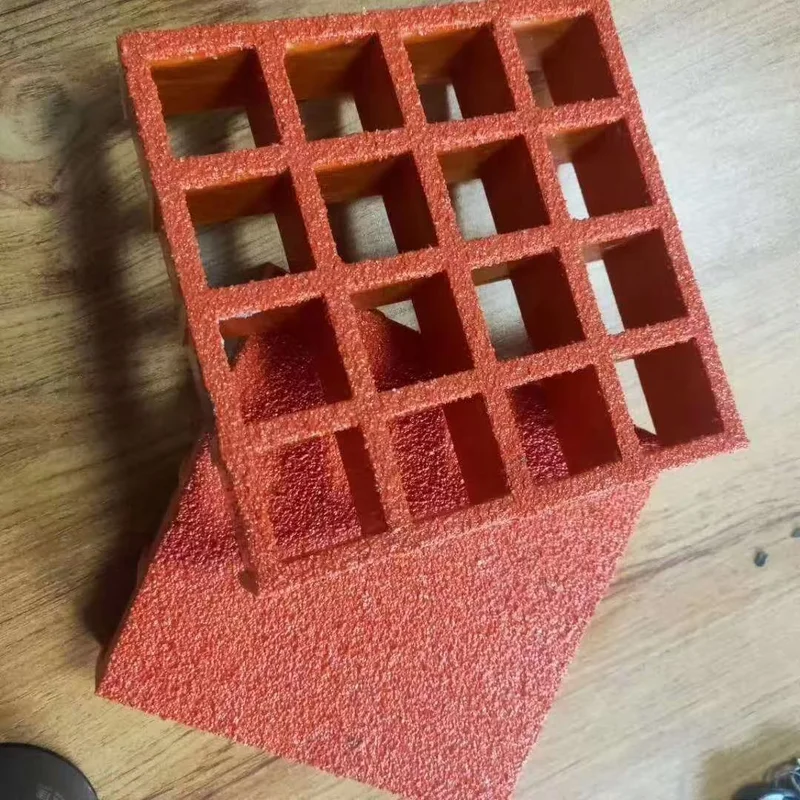
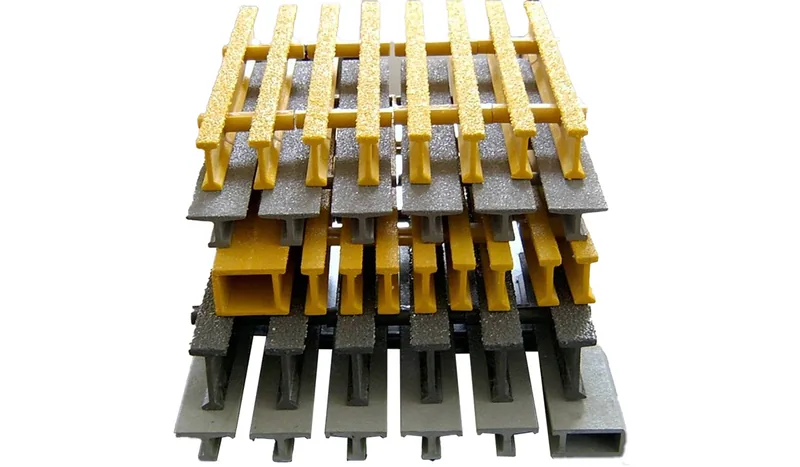
Left: molded grid sample. Right: pultruded bearing bars, cross rods and profiles. Photo: Dengtai Industry.
Definitions
The Terms That Actually Control the Choice
Eight product and structural terms, defined in the way they affect a real quotation and engineering review.
- Molded FRP grating
- A panel formed as one piece in a mold from glass reinforcement and resin. The finished grid is an integral mesh, so the panel commonly carries or distributes load in two directions. Four-edge framing is a common starting point, but the actual span, load, bearing and deflection limit still have to be checked.
- Pultruded FRP grating
- An assembled panel made from parallel glass-reinforced I, T or WT bearing bars, joined by cross rods. The main load path runs along the bearing bars, so the bars have to run from one effective support to the opposite support.
- Bearing direction
- The direction in which the panel was selected to carry its principal load. On a pultruded panel it follows the bearing bars. Rotating a rectangular panel changes which supports its bars reach, even when the outside dimensions stay the same.
- Clear span
- The unsupported distance between the edges of two supports. It is not the distance between support centre lines and it is not the purchased panel length. A panel can overlap a frame generously and still have a different clear span underneath.
- Bearing bar
- The main longitudinal member in pultruded grating. Its profile, height and spacing are part of the structural description. “38 mm pultruded” and “38 mm molded” are not equivalent structures.
- Cross rod
- A transverse rod that connects adjacent pultruded bearing bars. Cross rods help hold the assembly together and distribute local effects; they are not an interchangeable second principal spanning direction.
- Bidirectional strength
- A general description of an integral molded mesh, not a promise that every panel, cutout, frame and load case has equal capacity in both directions. Panel geometry, support and the finished cut layout still govern.
- Product family and configuration
- “Molded” or “pultruded” identifies the product family. The configuration also includes thickness or bar section, pitch, resin, surface, panel dimensions, openings, clips and documentation. Price and performance belong to the configuration, not the family name.
Side-by-side comparison
Molded and Pultruded Grating Compared on Project Conditions
Eleven decision points, with the condition that usually settles each one stated under the row label.
| Selection point | Molded grating | Pultruded grating |
|---|---|---|
| Manufacture What usually decides — the support layout and available configuration, not which process sounds stronger. | Glass reinforcement and resin are laid and cured in a mold as one panel | I, T or WT bearing bars are pultruded continuously, then assembled with cross rods |
| Main load path What usually decides — the direction in which the panel can reach its supports. | Integral grid distributes load in two directions | Bearing bars carry the principal load along their length |
| Support layout What usually decides — which edges actually bear and where the supports sit. | Frequently selected for framed openings and four-edge support | Bars must run from one effective support to the opposite support |
| Long one-way span What usually decides — clear span, load, permitted deflection and the exact section or panel data. | Possible only within the matched molded configuration and load data | Usually the first family to compare when a longer clear span or deeper bearing bar is needed |
| Openings and cutting What usually decides — which members the opening removes and how the remaining panel is supported. | Can be cut to a layout, but the opening still interrupts the grid | Cutting a bearing bar interrupts the main load path and may require support at the cut end |
| Impact and local damage What usually decides — the actual impact, support condition, panel depth and consequence of damage. | The more resin-rich, integrated mesh is often preferred where point impact and dropped tools matter | Higher longitudinal stiffness; local impact and bar damage still require review |
| Surface and appearance What usually decides — wetness, cleaning, traffic and the finish available on the proposed configuration. | Broad molded surface range, including concave, grit, inlaid grit and covered formats | Finish confirmed with the selected bar assembly |
| Resin What usually decides — medium, concentration, temperature, contact type, fire or static requirement. | Selected with the molded panel configuration | Selected with the pultruded section and assembly |
| Panel dimensions What usually decides — transport, handling, frame layout and how the walkway is divided. | Standard molds plus factory-cut pieces | Made to the ordered width and bearing-bar length |
| Price basis What usually decides — configuration and delivered scope; a bare area rate cannot compare both. | Published 25 / 30 / 38 mm standard-mesh reference in USD per square metre | Quoted by bar series, pitch, resin, panel dimensions and piece list |
| Common failure of comparison What usually decides — the actual layout and data, not one adjective. | Assuming “bidirectional” removes the need to review supports, cutouts or deflection | Assuming “unidirectional” means it cannot be used on a four-sided frame |
Selection
When Molded or Pultruded Grating Is the Natural Candidate
Five situations that justify a closer comparison, and four shortcuts that should stop the evaluation.
Specify this if…
- The panel lands on a frame on all four edges, the route changes direction, or the layout contains several openings — molded is the natural family to examine first.
- One clear span direction dominates, the supports already run that way, or a deeper bearing bar is needed — pultruded is the natural family to examine first.
- The project needs many cut pieces or a repeatable panel module, and factory fabrication can be checked against one drawing — compare both on the same piece list.
- The buyer needs a transparent starting price for an ordinary-environment pedestrian area — the published 25 / 30 / 38 mm molded reference gives a useful first budget check.
- The structure is still open and the factory makes both families — ask for a side-by-side review rather than forcing the project into the product that happens to be in stock.
Look elsewhere if…
- The argument is “pultruded is stronger” without the section, pitch, span, load and deflection limit.
- The argument is “molded is cheaper” without the same resin, surface, cutting, fixings and delivery scope.
- The comparison uses equal thickness as if a molded panel and a pultruded bar were the same structure.
- The panel is rotated, cut around a large opening or placed on a changed frame without revisiting the load path.
The Difference That Actually Matters
Molded FRP grating is formed as one panel. The glass reinforcement and resin are placed in a mold, the panel cures, and the finished product is an integral grid. There is no mechanical joint running across the panel between separate bearing bars. That construction allows the grid to distribute or carry load in two directions, which is why framed openings and walkways with changing load directions often begin with molded grating.
Pultruded FRP grating is an assembly. Continuous glass reinforcement is pulled through resin and a heated die to create I, T or WT bearing bars. Holes are made along those bars, cross rods are inserted at intervals, and the bars are fixed together. The principal load path is along the bars. The assembly can be made to the ordered width and bearing-bar length, but the bars must reach supports at their ends.
That is the decision in one paragraph: look at where the panel can reach its supports, then look at the load and deflection limit. “Molded or pultruded?” is not a material-quality question, and one family is not universally stronger, cheaper or longer-lasting.
Written by our team and checked against the factory product schedules and technical records. Updated 17 October 2026. The limits of the available evidence are stated below.
The distinction is also why a page that lists only manufacturing differences is incomplete. The manufacturing process changes what happens at a cutout, what happens if the panel is rotated, how a clip is selected and what the quotation has to include. Those are the buyer’s real decision points, so they are treated separately below.
Load Direction and Support Layout
Start with the frame, not the panel. Mark every edge that actually bears, the unsupported distance between supports, the fixed height and the direction in which a long panel can be carried into the space. A large panel outline does not prove that the panel is supported in the right place.
For molded grating, the integral mesh commonly makes four-edge framing the natural arrangement. The mesh can distribute a local load into adjacent bars in more than one direction. That is an advantage on a framed walkway, but it does not remove the structural review. The panel still needs matched load and deflection data for its thickness, mesh, resin and support condition. A square mesh does not make every cut piece equivalent.
For pultruded grating, the bearing bars must run from one effective supporting edge to the opposite supporting edge. A four-sided frame is not a problem in itself, provided the bars reach the supports and the assembly is suitable for the load. The error appears when a rectangular panel is rotated to fit a space, because the bars no longer run in the direction that was selected. Mark the bearing direction on the drawing and on the delivered piece.
The useful drawing information is therefore not just “platform 3 m × 2 m”. It is the support plan, the clear span in each direction, the panel joint positions, the bearing width and the location of every opening. If those values are not shown, two factories can quote different structures while both believing they have priced the same platform.
How to Compare Spans Without Comparing Thickness
Equal thickness is the most common false comparison in this product category. A 38 mm molded panel and a 38 mm pultruded bar have different profiles, different reinforcement paths and different failure modes. Even a “25 mm pultruded” series can have several pitches and open areas, with different mass and behaviour. The thickness alone does not identify the product.
A usable span comparison needs the same information on both sides:
- The clear distance between the actual supports, using the same definition for both offers.
- The bearing-bar direction and the support condition for each candidate.
- The load type and value: uniform area, point, line, wheel or equipment load.
- The load contact area or position where the case is not uniformly distributed.
- The permitted deflection, including any absolute limit or span fraction.
- The exact molded thickness and mesh, or pultruded series, pitch and bar direction.
- The resin, surface and finished cut layout that will be delivered.
The structural answer is often controlled by deflection before the headline load value is reached. A table that lists only “maximum load” can therefore look more generous than a panel that would visibly sag beyond the project limit. Ask which load produced the listed deflection and whether the table applies to the finished panel, including cuts and openings.
For molded grating, our published load guidance identifies which thickness, mesh and support condition a data row belongs to. For pultruded grating, the proposed I, T or WT section and pitch have to match the table or calculation being used. Neither family can be approved from the weight per square metre; mass is a handling and self-weight figure.
If the project has a long clear span, pultruded grating is usually the first family to examine because the deeper directional bar can be efficient over that span. If the frame is short, heavily divided or carrying cutouts in several directions, molded grating is usually the first family to examine. “Usually” is doing real work in those sentences: the load case still decides.
Openings, Cutting and Edge Treatment
Molded grating can be cut around a pipe, equipment foot or irregular opening, and factory cutting is often preferable to site fabrication. But the phrase “molded grating can be cut in any direction” stops too early. The cut removes part of the grid, interrupts the local load path and exposes a new edge. The remaining panel has to be supported around the opening and handled safely.
For pultruded grating, the cut may remove one or more bearing bars. The remaining bar ends need a support or a designed edge arrangement; sealing the cut surface protects the laminate but does not reconnect the structural path. An opening may also change how a concentrated load is transferred into the adjacent bars. Review the opening on the assembly drawing, not after the panel is cut.
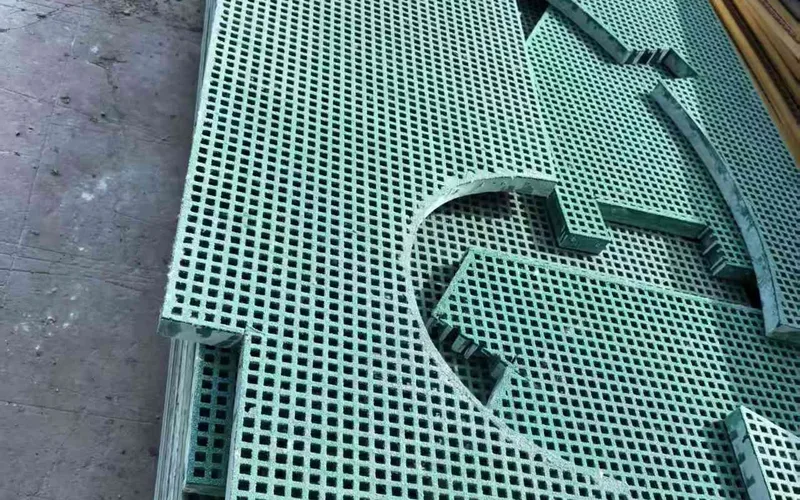
Both products can receive factory-cut pieces, drilling, piece marks and requested resin edge sealing. The difference is what the cut does to the load path. In a molded panel, the remaining grid around the opening is the starting point for the review. In a pultruded panel, the bar ends around the opening are the starting point. Neither review is finished by applying sealant.
Also separate the opening from the fixing. A clip holds the panel down; it does not create a bearing support. If a cut piece rests on a narrow frame or overhangs an opening, adding a clip does not complete the load path. The support detail has to be designed with the cutout.
Impact, Chemicals and Fire Are Separate Questions
The resin-rich molded mesh is often the preferred starting point where dropped tools or local impact are part of normal use. The dense grid can absorb local damage and distribute it into the surrounding panel. That is a useful general distinction, not a guarantee for every impact. A heavy dropped object, a damaged support or a deep cut can still require replacement.
Pultruded grating has a more directional structure and higher stiffness along the bearing bars. A local impact on a bar or cross-rod connection has to be assessed against the section and the consequence of damage. A high longitudinal modulus is not the same as a high tolerance for a point impact.
Chemical performance is not decided by the words “molded” or “pultruded”. It is decided by the resin, laminate, exposure and finished configuration. Isophthalic unsaturated polyester with alumina filler is the economical starting point in our published molded price, but it is for ordinary environments. Vinyl ester, epoxy and phenolic are separate directions, each with its own evidence and commercial scope. A resin name also does not establish a fire class, smoke result or chemical approval for every thickness and panel.
The same separation applies to fire, static, UV and barefoot use. State the standard or acceptance criterion, the concentration and temperature, the contact type and the test method. A report that applies to a material sample may not apply to the finished panel. This is why our 2024 material report is presented as material-level evidence, not as a load rating or fire approval for every product.
Surface, Color and Resin Are Configuration Choices
Molded grating has a broad surface range because the walking surface is formed with the panel. Concave, grit, inlaid grit, milled top, covered and other formats are selected according to the route, cleaning method and appearance. Pultruded grating finishes are confirmed with the bar assembly. A surface selected for one family is not automatically available on the other.
Color is a pigment choice, not a resin rating. Yellow is common where an access route should be visible; green, gray, blue and black are also used. A yellow panel does not prove fire performance, anti-static performance or slip resistance. A grit surface is a texture, not a certified slip class. Ask for the test and acceptance basis that the project actually requires.
For outdoor service, state the UV exposure and appearance expectation. For wash-down areas, include the cleaning chemicals and method. For a route used by small-wheeled trolleys or mobility equipment, describe the wheel and clear-opening requirement as well as the top finish. The same resin and surface combination can be right for a walkway and wrong for a chemically exposed platform.
Our resin selection guide sets out the exposure questions, and the surface and treatment guide separates texture, drainage and functional requirements.
Installation and Fixing: How the Wrong Fit Happens
The first installation check is before dispatch: confirm that the piece marks, dimensions, openings and bearing direction match the approved drawing. A panel can have the correct outside dimensions and still be the wrong piece if the bearing bars run the other way or a pipe opening is on the opposite side.
At fit-up, set the panels in place without fixing first. Check bearing on every intended support, the joints, the cut edges, the top face and the opening clearance. For pultruded grating, confirm that the bearing bars run the way the drawing says. For molded grating, confirm the intended top surface and keep the joint pattern consistent across adjacent panels.
M, L and C clips restrain panels and join adjacent edges. Match the clip to the panel height, bar width and support type. The clip is not a substitute for bearing, and it is not a structural repair for a damaged panel. For removable covers, the lifting method and fixing arrangement also belong to the order review.
For more detailed checks, use the installation guide, the clip guide and the cutting and sealing guide. The installation page explains why a panel that looks level can still be unsupported or incorrectly oriented.
How to Compare the Total Price
The published molded price is a useful reference because it fixes several variables at once. Our standard 38 × 38 mm molded panels are listed at USD 10.5/m² for 25 mm, USD 12.0/m² for 30 mm and USD 15.1/m² for 38 mm, ex-works, using isophthalic unsaturated polyester with alumina filler. A full 1220 × 3660 mm panel is 4.4652 m², so the 25 mm panel starts at roughly USD 46.9 before cutting, clips, packing and freight.
That price is not a universal FRP grating price. It is a molded standard-panel reference in an ordinary environment. It is not the price of vinyl ester, epoxy, phenolic, a special surface or a pultruded assembly. It also carries a service-life boundary: our experience with that economical formulation is about three years of use, with cracking possible from around one year, and it is not intended for strong corrosion. A project that needs a different resin must be quoted as a different configuration.
Pultruded grating does not have one honest area rate. The price changes with the I, T or WT series, bar height, pitch, resin, surface, panel length, cross-rod layout, openings, edge treatment, clips, packing and delivery. Two panels with the same outside size can have different bar spacing and weight. A quotation should identify the actual section and the delivered piece list so it can be compared with another offer.
The next layer is the total installed scope. Pultruded grating may reduce the number of supports or the steel below a long platform. Molded grating may make a complicated cut layout easier to fabricate and fit. Both may require clips and packing; both may need edge treatment and both can be delayed by a drawing that changes after fabrication. Compare the two options with the same support steel, installation assumptions and delivery terms.
The pricing guide explains the molded price schedule in more detail. The cutting and sealing guide explains why a simple cut, a complex opening and an edge seal belong in different lines of the quotation.
Which One Should You Specify?
Use molded grating as the first candidate when the frame supports the panel on all four edges, the route or equipment layout changes direction, the project has several irregular cutouts, or the economical standard-panel range already covers the load and span. Verify the actual mesh, thickness, resin, surface and deflection limit before approving it.
Use pultruded grating as the first candidate when the support beams run one way, the clear span is long enough that a directional bar is useful, the panel length is fixed by the platform layout, or the project needs a custom assembly with a marked bearing direction. Verify the section, pitch, bar direction, cross-rod layout and support at every bar end.
When the frame is a mixed layout, the safest response is not to guess. Prepare one drawing and ask for both families to be checked against it. That lets the supports, load, deflection, resin and delivered scope be compared without turning the decision into a slogan.
Manufacturer Experience and the Limits of the Evidence
We manufacture molded panels and pultruded bars at our works in Jingxing Mining District, Shijiazhuang, Hebei. The factory can coordinate panel production, cutting, drilling, requested edge sealing and clip supply in the same order. A standard 3 × 3 cell sample is available free of charge, with freight paid by the customer; custom resin, color or surface samples are charged.
For example, the available 2024 report, HZTC/BG-24051102 dated 17 May 2024, records appearance, Barcol hardness 45, water absorption 0.335%, oxygen index 28.5%, tensile strength 74.2 MPa and a load test at a design load of 4 kN/m² over a 600 mm span. It does not name the model, thickness, mesh or resin. It therefore supports a material-level discussion, not a claim that every molded or pultruded panel has the same capacity or fire performance.
Production normally runs 15–30 calendar days from receipt of the deposit. Export packing generally uses EPE foam and stretch film, with wooden pallets or iron supports. Trade term, packing, documents, shipment and the final piece list are stated in the quotation. The quality and documentation page explains how to read that evidence without turning a general report into a product approval.
Manufacturer pages such as Bedford’s comparison, Strongwell’s overview and Fibergrate’s older comparison are useful for understanding the general categories. Their structural values, resin systems and certifications apply to their products, not automatically to ours. Use them to frame the questions, then verify our actual configuration.
Send the support drawing and load case and we can identify which family is worth comparing before a quotation is prepared.
Product schedule
Molded Prices and Pultruded Sections in One View
Standard molded references beside four pultruded series. Geometry and mass are not load ratings.
| Configuration | Reference geometry and mass | Panel and price basis |
|---|---|---|
| Molded 25 mm | 38 × 38 mm mesh; 12.5 kg/m² | 1000 × 4000 mm; 1220 × 3660 mm; USD 10.5/m² EXW |
| Molded 30 mm | 38 × 38 mm mesh; 16.5 kg/m² | 1000 × 4000 mm; 1220 × 3660 mm; USD 12.0/m² EXW |
| Molded 38 mm | 38 × 38 mm mesh; 19.5 kg/m² | 915 × 3050 mm; 1000 × 4000 mm; 1220 × 3660 mm; USD 15.1/m² EXW |
| Pultruded I25-40 | 25 mm depth; 15 mm top width; 25 mm pitch; 40% open area; 16.5 kg/m² | Made to ordered width × bearing-bar length; quoted per section and piece list |
| Pultruded I38-40 | 38 mm depth; 15 mm top width; 25 mm pitch; 40% open area; 23.0 kg/m² | Made to ordered width × bearing-bar length; quoted per section and piece list |
| Pultruded T38-50 | 38 mm depth; 25 mm top width; 50 mm pitch; 50% open area; 12.0 kg/m² | Made to ordered width × bearing-bar length; quoted per section and piece list |
| Pultruded T50-50 | 50 mm depth; 25 mm top width; 50 mm pitch; 50% open area; 16.5 kg/m² | Made to ordered width × bearing-bar length; quoted per section and piece list |
Resin selection
Resin Direction in Molded and Pultruded Grating
The resin is part of the finished configuration. It does not transfer automatically between product families or price rows.
| Resin direction | Molded and pultruded route | What the quote must confirm |
|---|---|---|
| Isophthalic unsaturated polyester with alumina filler | The economical published molded price basis for ordinary environments. This is specifically isophthalic unsaturated polyester, not general-purpose polyester or vinyl ester. A pultruded configuration follows its own section and price basis. | The actual resin grade, filler, surface, chemical exposure, temperature and expected service conditions. |
| Vinyl ester | A candidate for both families in chemical, wastewater or marine duties after the operating conditions are defined. | Medium, concentration, temperature, splash or immersion, and supporting data for the finished configuration. |
| Epoxy | A project-specific molded direction; considered for selected strongly corrosive pultruded duties with the actual section and process. | Why epoxy is required, the exposure conditions and the evidence expected for the finished part. |
| Phenolic | Reviewed in either family when fire and smoke criteria govern the selection. | The required test method, acceptance limit, structural condition and the documents supplied. |
Price basis
Molded vs Pultruded Grating Price
A transparent molded reference, a configuration-based pultruded quotation and the boundaries that keep the comparison honest.
Molded reference: USD 10.5–15.1/m² EXW
For standard 38 × 38 mm molded panels, the published starting prices are USD 10.5/m² at 25 mm, USD 12.0/m² at 30 mm and USD 15.1/m² at 38 mm. The basis is isophthalic unsaturated polyester resin with alumina filler for ordinary environments. A 1220 × 3660 mm panel covers 4.4652 m², so a 25 mm full panel starts at about USD 46.9 before cutting, clips, packing and freight.
Pultruded is quoted from the section and piece list
There is no honest single square-metre price for every pultruded panel. I, T or WT series, bar height, pitch, resin, surface, panel length, cross-rod layout, openings, edge treatment, fixings and packing all change the quotation. Send the drawing or piece list so each line describes the delivered part and the remaining site work.
Compare the same installed scope
Add panel, factory cutting, edge sealing, clips, packing and freight to both options. Then compare the supporting steelwork and installation labour. A pultruded panel may remove an intermediate support; a molded layout may reduce fabrication and fitting. The quotation only supports a fair decision when both columns cover the same job.
Price boundary: the published molded figure is for isophthalic unsaturated polyester with alumina filler in ordinary environments, not for strong corrosion. Our field experience for that economical formulation is about three years of use, with cracking possible from around one year. It is not a vinyl ester price. Vinyl ester, epoxy, phenolic, special surfaces and pultruded configurations are quoted against their actual specification. Simple straight cutting is about CNY 5/m², roughly USD 0.8/m² at USD 1 = CNY 6.5; complex openings, edge sealing, clips, packing and freight are separate.
Applications
Project Situations That Point Toward One Grating Family
Six layouts where the support condition gives a clear starting direction — not a substitute for the load check.

Framed pedestrian walkway
A walkway supported on four edges, with changes of direction or several service openings, is a natural molded starting point. Match the mesh, thickness, resin and surface to the traffic and exposure, then check the actual frame and deflection limit.
Molded 25–38 mm standard panels are the first price comparison; the final thickness follows the layout.

Long one-way industrial platform
A platform whose steelwork already runs in one direction, or whose clear span is too long for the molded candidate, should be checked as a pultruded assembly. The bearing bars, cross-rod positions and end bearings form the load path.
Send the bar direction, clear span, load and deflection limit with the panel outline.

Trench cover with several openings
A short supported cover with pipe penetrations or changing shapes often starts with molded grating because the panel can be cut around the layout. Every opening still interrupts the grid, and vehicle loading is a separate structural case.
Mark every opening, support edge and lifting point before cutting.

Wastewater or chemical access
Both structures can enter a wastewater area, but the resin is decided from the actual chemical, concentration, temperature and splash or immersion. A vinyl ester panel is not automatically a suitable answer until the finished configuration is checked.
Define the exposure first; then compare molded and pultruded layouts.

Solar maintenance walkway
The rail spacing is the deciding geometry. Closely framed, low-level routes may suit molded panels; long straight runs between rails may suit pultruded panels. The bearing direction still has to match the rails.
Send rail spacing, panel direction, module layout and maintenance access needs.

Replacement on an existing frame
Measure the existing bearing edges, clear spans, openings and fixed height. Do not transfer the old material or the old thickness automatically. If the frame runs one way, compare pultruded; if it is a supported frame with many cuts, compare molded.
A photograph of the old panel is useful, but the supporting frame drawing is more important.
Selection sequence
How to Choose Between Molded and Pultruded Grating
Six steps from the drawing to a quotation, arranged in the order the decisions actually need to be made.
Draw every bearing edge, support centre line, clear span, panel joint and opening. State whether the frame bears on two edges, four edges or a combination.
Pedestrian, maintenance equipment, stored material, point load, wheel load or another case; include the load value, contact area and permitted deflection.
Molded is the natural candidate for a framed two-way layout with many cuts; pultruded is the natural candidate for a directional span. Keep both open when the drawing is ambiguous.
Molded needs thickness, mesh, panel size and resin. Pultruded needs the I/T/WT series, pitch, bar direction, cross-rod layout and custom piece dimensions.
Select resin and surface from the medium, temperature, wetness, cleaning and any fire or static requirement. Confirm the combination on the proposed product.
The quotation should identify panel, cutting, edge treatment, clips, packing, trade term and freight. Production normally runs 15–30 calendar days from receipt of deposit.
Technical boundaries
Eight Things Not to Assume in a Grating Comparison
Common shortcuts that produce a confident answer to the wrong problem.
- “Stronger” is not a product-family specification — A pultruded panel may be stiffer along its bars, while a molded panel may absorb local impact better. Neither statement gives an allowable load for a particular frame. Compare the finished configuration against the same clear span, load and deflection limit.
- Equal thickness is not equal structure — A 38 mm molded mesh and a 38 mm pultruded bar describe different geometry. Bar profile, pitch, cross-rod positions or mesh layout all belong to the comparison, along with support and load data.
- Bidirectional does not mean “any support will do” — An integral mesh can distribute load in two directions, but openings, panel aspect ratio, bearing edges and the permitted deflection can still change the result. Four-edge support is a starting point, not a completed structural check.
- A four-sided frame does not exclude pultruded grating — The question is whether the bearing bars run from one effective support to the opposite support. Cross rods are not a second main span direction. Rotate the panel and the load path changes.
- An opening changes the finished panel — Cutting is normal, but an opening removes part of the load path. Review the remaining bars or mesh, support around the opening, edge sealing and whether the piece is still safe to handle.
- Price per square metre is only one layer — A lower panel rate can leave more cutting, clips, supports or labour in the project. Compare delivered pieces, support steel and installation on the same scope.
- Resin is not implied by “FRP” — The published molded price uses isophthalic unsaturated polyester with alumina filler. Vinyl ester, epoxy, phenolic, fire-retardant grades, anti-static grades and special surfaces have their own scope and evidence.
- No universal service-life figure is claimed — Life depends on resin, environment, cleaning, UV, load and damage. For the economical isophthalic unsaturated polyester formulation used in the published price, our field experience is about three years with cracking possible from around one year; that formulation is not for strong corrosion.
Manufacturer evidence
What We Can Show from the Factory
Production, fabrication, test scope and packing — with the limits of each document stated.

Both families made in house
Molded panels are cast and pultruded bars are drawn at our works in Jingxing Mining District, Shijiazhuang, Hebei. The comparison is not limited to products bought from separate suppliers.
Review the factory and production routesThe same order can include fabrication
Cutting, drilling, requested edge sealing and M, L or C clip supply are coordinated with the grating order. Pieces can be marked against the drawing instead of being cut from standard panels on site.
Review factory cutting and sealingMaterial evidence with stated limits
Report HZTC/BG-24051102, dated 17 May 2024 and issued by Hebei Haozheng Testing Services Co., Ltd., records Barcol 45, water absorption 0.335%, oxygen index 28.5%, tensile strength 74.2 MPa and a 4 kN/m² design-load test over a 600 mm span. It does not identify the model, thickness, mesh or resin, so it is not a load rating for every panel or a fire class.
View the 2024 factory test reportPacking matched to the piece list
Export packing normally uses EPE foam and stretch film, with wooden pallets or iron supports. The quotation states the agreed packing, trade term and shipment scope; packed gross weight is separate from panel mass.
Project inputs
What to Send for a Molded vs Pultruded Comparison
Ten inputs. A support drawing, piece list and load case answer most of the decision.
- Support drawing or sketch — Bearing edges, support positions, clear span, beam direction, fixed height and panel joints.
- Panel schedule — Length, width, quantity and piece marks. Include every opening, notch and irregular shape.
- Load case — Pedestrian, maintenance, equipment, point, line, wheel or stored-material load, with values and units.
- Deflection limit — Any span-to-deflection limit or absolute limit imposed by the project. If none is known, say so.
- Environment — Chemicals with concentration, temperature, splash or immersion, salt, UV, cleaning method and humidity.
- Resin and surface preference — What is already specified, or the conditions the resin and walking surface need to satisfy.
- Fixing condition — Support type, panel height or bar width, clip preference and whether panels must be removable.
- Fire, static or other acceptance criteria — Required standard, test method and acceptance limit; these are not established by a general product report.
- Delivery and documents — Destination, trade term, packing requirement, required date and the documents the project will inspect.
- Drawing revision — Identify the current revision and flag any dimension that cannot change. This prevents a clean quotation for the wrong layout.
Request a comparison
Send the Frame, Load and Panel List
We will identify whether the support layout points toward molded or pultruded, then quote the delivered configuration.
- Both molded and pultruded production are in house
- Support layout and bearing direction reviewed together
- Attach a drawing; unknown values can be clarified with the quote
Molded vs Pultruded FRP Grating Questions
Which is stronger, molded or pultruded FRP grating?
Is pultruded grating always more expensive than molded grating?
What does bidirectional strength mean for molded grating?
Does pultruded grating always span farther?
Can pultruded grating be used on a four-edge frame?
Can molded grating be used over a long one-way span?
How can I tell molded and pultruded grating apart?
Which type is better around pipe openings and cutouts?
Which type handles impact better?
Which resin is included in the published molded price?
Is the published price also valid for vinyl ester or a special surface?
How long does each type last?
Can I swap molded for pultruded late in the project?
Can I rotate a pultruded panel to make it fit?
What do you need to compare the two products?
Are both products made by Dengtai Industry?
Is there a minimum order or can I request a sample?
Content last checked: