Wastewater treatment plants
FRP Grating for Wastewater Treatment Plants
Our usual resin direction is vinyl ester, selected per process zone rather than for the whole plant. Start with 25 mm, 38 × 38 mm molded grating for light inspection routes, then confirm the medium, clear span, walking surface and fixing. The published USD 10.5–15.1/m² rows are a polyester reference only; vinyl ester is quoted against the actual duty.

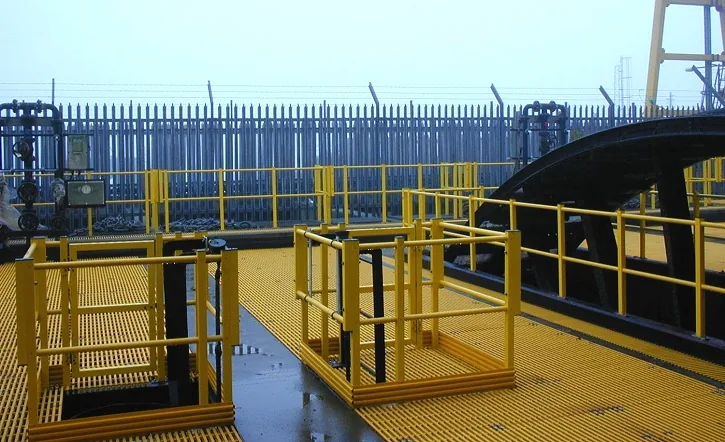
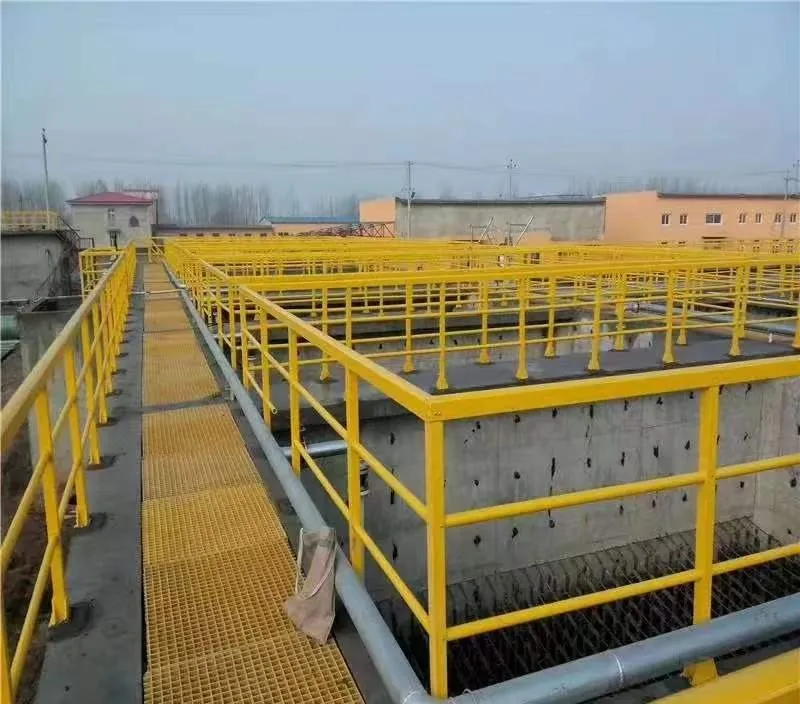
A treatment-plant walkway over process basins. Photo: Dengtai Industry.
Terms
Wastewater Grating Terms Used on This Page
These distinctions matter because a treatment plant is a collection of different exposures sharing one site.
- FRP, GRP and fiberglass grating
- Different regional names for a composite panel made from glass reinforcement and a cured thermosetting resin. Molded grating has an integral mesh; pultruded grating uses parallel bearing bars tied by cross rods.
- Wastewater treatment plant
- A municipal or industrial plant that treats wastewater before discharge or reuse. A water treatment plant producing drinking water is a different duty, with its own certification and contact requirements.
- Process zone
- One part of a plant with its own medium, temperature, cleaning method and load. Headworks, aeration, dosing, disinfection, sludge handling and drainage trenches are not one chemical environment.
- Vinyl ester grating
- Grating made with a vinyl ester resin system. Vinyl ester is a resin family; the specific grade, formulation, reinforcement and cure still have to match the medium and the finished product.
- Epoxy vinyl ester
- A vinyl ester chemistry modified with epoxy. It remains a vinyl ester and is not the same as the separate epoxy resin system we may consider for pultruded high-corrosion work.
- Splash, spillage, vapor and immersion
- Four different exposures. A chemical that is harmless as occasional splash can be a different question as continuous vapor, repeated wash-down or immersion.
- Trench cover
- A panel over a channel or opening. It may need to drain water, retain small objects, close the surface or be lifted for maintenance; those are different products.
- Clear span and bearing
- Clear span is the distance between the edges of two supports. Bearing is the width of contact between the panel and those supports. A long panel can have a short clear span; a short panel can sit badly if only one edge bears.
- Potable water contact
- Contact with drinking water is a separate certification question. A project may require NSF/ANSI/CAN 61 or another standard; a corrosion-resistant resin name does not establish that approval.
Plant zones
Where FRP Grating Is Used in a Treatment Plant
Eight process areas, each with its own medium, cleaning method, support and load.
Headworks and grit channels
Headworks remove rags, grit and debris before primary treatment. Access covers and walkways here see abrasive grit, wet surfaces and frequent hosing. Open mesh drains, but the net opening has to be checked against the debris and the cleaning method; mini mesh or a covered format may be considered where small objects must not pass.
Send the channel opening, cover size, debris type, cleaning method and pedestrian or trolley load.
Aeration basins and biological treatment
Walkways around aeration basins are long, wet and often exposed. Spray and condensation affect the underside as well as the top, so the resin and clip material are reviewed together. A textured surface is common, but the slip requirement still needs a stated test method if the project has one.
Send the basin layout, walkway width, support spacing, splash exposure, cleaning method and any fall-protection requirement.
Clarifiers and sedimentation tanks
Clarifier walkways and weir access combine wet edges with maintenance loads. Grating may be used for walkways, stair treads and platform infill; handrails, weirs and scum baffles are separate items. The panel has to bear on a frame, not on a pipe or a weir edge.
Send the tank diameter, access route, support ring or frame, clear span, load and any opening positions.
Chemical dosing and storage areas
A dosing area is defined by the chemical, not by the word wastewater. Sodium hypochlorite, ferric chloride, alum, caustic, polymer and anti-scalant have different concentration, temperature and contact profiles. Splash, spillage, vapor and immersion are separate cases, and the resin grade is checked against the actual medium.
Send the chemical names, concentration, temperature, contact type, spill history and cleaning agents.
Disinfection and chlorination
Chlorination and UV areas may combine wet surfaces, chemical vapor and electrical equipment. FRP is non-conductive, but that does not remove the need for earthing, bonding and electrical clearances. Vinyl ester may be the resin direction and stainless clips may be considered, but the grade and fixing are confirmed for the exposure.
Send the disinfection method, chemical and concentration, electrical classification, cleaning method and support material.
Sludge handling and dewatering
Sludge thickeners, digesters and dewatering areas can combine organic load, grit, polymer and wash-down. Access platforms may need heavier maintenance loads and removable sections. The structural review starts with the equipment route, not only the pedestrian load.
Send the equipment loads, access route, support layout, cleaning method, gas or odor exposure and removable pieces.
Pump, valve and blower access
Pump, valve and blower platforms are often retrofits into existing structures. Pultruded grating may suit long, straight runs where the bearing bars follow the supports; molded grating may suit cut pieces and multi-directional layouts. The support steel and clip compatibility are part of the review.
Send the existing frame drawing, support spacing, pump or maintenance load, vibration, pipe openings and removal route.
Process trenches and drainage covers
Process trenches and drainage channels need a cover that drains, retains objects, closes the surface or lifts for access. These are four different jobs. The clear width, frame bearing, piece weight and any wheel load decide the cover, not the panel name.
Send the trench drawing, clear width, frame detail, debris size, lift frequency and load.
Configuration
Wastewater Grating Sizes and Starting Points
Start with the panel, then confirm the resin, support, load and exposure. Mass and reference price are not ratings.
Request a Project Quote
| Specification | Value |
|---|---|
| Usual resin direction | Vinyl ester; grade and formulation confirmed per zone Our wastewater starting point, not a universal grade. The medium, concentration, temperature and contact type decide whether vinyl ester, an epoxy direction or another system is reviewed. |
| Molded starting points | 25 / 30 / 38 mm; 38 × 38 mm mesh; 12.5 / 16.5 / 19.5 kg/m²; USD 10.5 / 12.0 / 15.1/m² EXW reference Light inspection routes start at 25 mm; 30 mm and 38 mm may be considered where the supported run or foot traffic calls for more stiffness. Thickness alone is not a load rating. The reference rows use economical isophthalic polyester in an ordinary environment, not vinyl ester wastewater duty. |
| Pultruded option | I- or T-section bearing bars; made to project dimensions The main load path runs along the bearing bars. It can suit long, straight platforms when the support direction, bar depth, span and deflection limit match. |
| Full panel sizes | 1000 × 4000; 1220 × 3660 mm Other full-panel formats depend on the mold. Cut pieces are normally taken from these panels, so the cut plan and offcuts affect the material charge. |
| Cover formats | Open mesh; mini mesh; covered or solid top Chosen by the job the cover does. Drainage, object retention, surface closure and lifting are separate requirements. |
| Surface and color | Concave standard; grit, inlaid grit and color to order Grit adds walking texture. It is not a slip rating unless the project's test method and report are supplied. |
| Fixing | M, L and C clips; galvanized or stainless steel The clip is matched to panel height, bar width and support section. The fixing count and positions come from the support drawing. |
| Load data | Adopted values for two 6 × 38 mm bar structures The available table covers 38 mm and 19 mm pitch under stated conditions. It is not a rating for every wastewater panel or a wheel-load approval. |
Panel format
Open Mesh, Mini Mesh, Covered and Pultruded Grating
The format decides drainage, object retention, load direction and how the piece is fixed.
| Panel format | What it does well | Where it fits a treatment plant | What to confirm |
|---|---|---|---|
| Open molded grating | Drains freely, is light to handle and can be cut into pieces | Walkways, inspection platforms and trench covers where debris and water can pass | Net opening, open area, support span, load, surface and fixing |
| Mini mesh grating | Smaller openings while the panel remains open | Areas where small tools or debris must not fall through, but drainage still matters | Upper and lower mesh, net opening, drainage, cleaning and load data |
| Covered or solid top | Produces a more continuous walking or covering surface | Areas where objects, liquid or odor have to be kept below the surface | How the cover is joined, how joints drain, added mass and the assembly load basis |
| Pultruded grating | Carries the main load along parallel bearing bars | Long, straight platforms and equipment access where the supports run in one direction | Bearing-bar direction, support spacing, panel depth, span and deflection limit |
Project conditions
Wastewater Conditions and What Each One Needs
Nine conditions that decide the resin, structure, surface or fixing.
| Plant condition | How we approach it | What we need from you |
|---|---|---|
| Pool edge and inspection walkway | Vinyl ester direction, with the surface and fixing reviewed for splash and wash-down | Water quality, cleaning method, clear span, maintenance load and any fall-protection requirement |
| Chemical dosing and storage | Resin checked against the named chemical, concentration, temperature and contact type | Chemical list with concentration and units, normal and peak temperature, splash or spillage history |
| Splash, vapor or immersion | Contact type changes the review; immersion is not assumed from a splash-area description | Duration, frequency, drainage, temperature and whether the panel is continuously wet |
| Trench and drainage cover | Open, mini mesh or covered format selected from the job the cover has to do | Clear width, frame bearing, debris size, lift frequency and any wheel load |
| Pump and equipment platform | Molded or pultruded panel reviewed against the support layout and the real maintenance load | Support drawing, equipment load, point loads, openings and the route for removing equipment |
| Removable access section | Piece weight, marking and fixing decided before production rather than on site | Which pieces lift, how often, who handles them and how they are restrained when closed |
| Fire, smoke or static requirement | Phenolic or a functional formulation considered only against a named requirement | Test standard, target classification, report scope, earthing and continuous conductive path |
| Potable water contact | Certification treated as a product-specific requirement, not a resin-family claim | The standard, contact scope, test evidence and any approval the project requires |
| Retrofit to an existing steel frame | Clip and support materials reviewed together, including thermal movement and bolt access | Frame condition, steel grade, support spacing, fixing positions and available tool clearance |
What FRP Grating Does in a Wastewater Plant
FRP grating is an access surface before it is a corrosion product. In a treatment plant it carries people, tools and maintenance equipment along basins, around pumps and over trenches. It is light enough to lift in sections, does not rust like steel and can be cut around pipes and existing structures. Those are practical reasons it appears in headworks, aeration, clarification, dosing, disinfection and sludge areas.
The open mesh also changes how the surface behaves. Water, spray and debris pass through instead of sitting on a solid plate. That helps drainage, but it does not make the surface self-cleaning. Biofilm, grease, grit and chemical deposits can still collect on the bars, and the cleaning method has to suit both the soil and the resin.
FRP is also non-conductive, which is useful around electrical equipment, but non-conductivity is not an electrical installation. Earthing, bonding, clearances and the classification of the area remain project requirements. The same caution applies to fire: a polyester or vinyl ester panel may have a fire-retardant formulation, but the project’s acceptance criteria and test report decide whether it is suitable.
The material is not maintenance-free. It does not need repainting to resist corrosion, but grit wears, surface layers can bloom, clips loosen and bars can be cracked by impact. A treatment plant should plan inspection the same way it plans inspection of the support frame and handrails.
Prepared by Dengtai Industry from our factory’s grating, resin and fabrication experience. Where a project condition is not documented, the limit is stated rather than filled with a general claim.
Why “Wastewater” Is Not a Resin Specification
A treatment plant is a collection of chemical environments that happen to share a site. A walkway along an aeration basin sees spray, condensation and weather. A dosing area sees the chemical being dosed, at the concentration and temperature the process uses. A trench cover may see spills, wash-down and grit. A sludge area may see organic load, polymer and cleaning agents. Designing all of them as one “wastewater grating” specification either over-spends on the mild areas or under-specifies the aggressive ones.
The useful description has four parts:
- The medium. Chemical names and mixtures, not only the word acid, alkali or wastewater.
- The concentration. A percentage or another stated unit, with the temperature at which it applies.
- The contact type. Splash, spillage, vapor, condensation or immersion.
- The duration and frequency. Continuous exposure, repeated wash-down or a rare spill.
A pH value alone is not enough because it does not identify the chemicals in the mixture. Reviewing separate ingredients also does not automatically establish how the mixture behaves. The chemical resistance review explains how the medium, concentration, temperature and contact type are checked against a product. Where the composition is uncertain, send the process data or safety data available and mark what is unknown.
This is why the plant schedule should be organized by zone. A general access route and a dosing point can share a panel size and still need different resin, surface or fixing decisions. Keeping them separate makes the quotation easier to compare and prevents a mild area from being priced as if it were the most aggressive area on site.
Resin Selection: Vinyl Ester First, Then the Grade
Our usual direction for wastewater areas is vinyl ester. That is a starting point, not a certificate. Vinyl ester is a family of resin systems, and different grades can behave differently in the same medium. The finished panel also depends on the reinforcement, laminate build-up, surface and cure. A quotation that says only “vinyl ester” is less informative than one that names the grade and the configuration. The resin selection guide compares the resin families and the questions each one has to answer.
The first comparison is against the actual duty. A dosing area handling sodium hypochlorite at one concentration and temperature is not the same as a basin walkway seeing dilute splash. A trench cover seeing occasional spillage is not the same as a panel that remains wet. Send the chemical list, concentration, temperature and contact type together, and the resin direction can be reviewed against the finished product rather than against a generic claim.
Vinyl Ester and Epoxy Are Different Names
Epoxy and vinyl ester are separate resin systems in our quotations. An epoxy-based vinyl ester is still a vinyl ester; the word epoxy in its description does not turn it into the separate epoxy system. This distinction matters when a project specifies a material by family, or when a supplier offers a substitution. Use the full resin description and grade, not a shortened trade name.
We consider epoxy for pultruded grating where the corrosion target is high. That is a direction for a specific configuration, not a statement that epoxy is always better than vinyl ester. The medium, temperature, structural requirements and available product form still decide.
Where Polyester Fits, and Where It Does Not
Isophthalic polyester is a candidate for milder duties where better water resistance than a general-purpose system is enough. General-purpose polyester is for ordinary areas that are genuinely outside chemical contact. A walkway beside a tank often is not outside chemical contact, even if it looks like a simple access route.
The published price rows on this page use an economical isophthalic polyester with alumina filler. They are useful for understanding the panel-price arithmetic, but they are not a vinyl ester price and they are not suitable for strong corrosive service. Our experience with that formulation is about three years, with cracking from about one year. For a wastewater duty with chemical exposure, a longer service-life target or a strong corrosive medium, the resin direction is quoted separately.
Phenolic, Fire and Smoke
Phenolic is a candidate where fire and smoke requirements govern the selection. Polyester and vinyl ester can also have fire-retardant formulations. The useful question is which finished product has evidence for the required test method and acceptance criteria. Separate flame spread, smoke generation, smoke toxicity and structural performance during a fire; a result for one does not establish the others.
Surface, Cleaning and Slip Resistance
Corrosion resistance is the environmental question; the walking surface is a separate one. Concave is the standard molded surface. Grit adds a rougher texture for wet, oily or washed areas. Inlaid grit and other formats are available, and color can improve visibility. None of those names is automatically a slip rating. The surfaces and treatments guide compares the formats and their maintenance implications.
In a treatment plant, the surface may be wet most of the time. Biofilm, grease, grit and cleaning residue change how it behaves underfoot. A coarse grit surface can help, but it can also trap debris and make cleaning harder. The surface decision therefore belongs with the cleaning method, not only with the word “non-slip”.
If the project requires a slip test, state the test method, the acceptance value and the test conditions. A supplier’s generic statement that a surface is anti-slip is not the same as a report for the supplied panel. The same discipline applies to high-pressure washing: pressure, nozzle distance and angle can remove the surface layer if the method is not matched to the product.
Colour is a visibility choice, not a UV rating. Outdoor exposure can change the appearance of a colored panel, and color retention is separate from structural performance. UV exposure is addressed through the resin system and any specified protection. Tell us the location and the expected appearance life if color matters to the project.
Walkways, Platforms and the Load Path
The first structural question is not “which thickness?” but “what does the panel land on?” Mark the supports, the bearing width, the clear span and every opening. A 2000 mm piece can sit on supports 600 mm apart, or on two supports near its ends with a much longer unsupported middle. The piece length is not the clear span.
Then define the load. One person walking is a different case from two people with tool bags, a pump component, a trolley or a ladder foot. A point load from a tool box is different again. State the load case the project wants the panel checked for, including any concentrated load and the deflection limit that matters to the users.
Thickness is not a load class. A 25 mm panel, a 30 mm panel and a 38 mm panel are configurations, not three guaranteed grades. The bar geometry, support condition, span, load and deflection limit have to match before a figure can be used. Our adopted load values cover two 6 × 38 mm bar structures under stated conditions; they are not a rating for every panel in the size table. The load and span guidance explains what the table covers and which values the project still has to provide.
Molded grating carries load in two directions because the mesh is integral. Pultruded grating carries its main load along parallel bearing bars, so it is directional. Pultruded can suit long, straight platforms when the supports run the right way, but it is not automatically stronger. The support direction, bar depth, span and deflection limit belong to the comparison.
Trench Covers, Drainage and Removable Sections
A trench cover is not one product. It may need to let water through, stop small objects falling in, close the surface, reduce odor or be lifted for maintenance. Those jobs lead to different formats:
- Open mesh drains and allows inspection, but the net opening has to suit the debris and the cleaning method.
- Mini mesh reduces the opening while keeping the panel open, but it can block more easily and needs a different cleaning routine.
- Covered or solid top creates a more continuous surface, but drainage and ventilation become a separate design question.
- Removable sections need pieces light enough to handle, marks so they return to the same place and a fixing that releases and refastens reliably.
Most cover problems are frame problems. A frame that is not level along its length leaves one piece bearing and the next rocking. A bearing edge that is narrower than expected concentrates the load on a small part of the cover. A joint that lands where no frame exists becomes a step that grows with traffic. Mark the clear width, bearing edges, joint positions, piece lengths and lift points on one drawing.
A clip does not create a support. C clips join panel edges and reduce the step between them; if a joint needs bearing, the frame has to provide it. Wheel loads are a separate structural case. A pedestrian cover is not a vehicle rating, and a trolley or pallet truck needs its own load, contact area and dynamic check.
The trench cover guidance sets out the four cover jobs, the frame dimensions and the removable-piece decisions in more detail.
Fixings and the Steel in a Non-Steel Installation
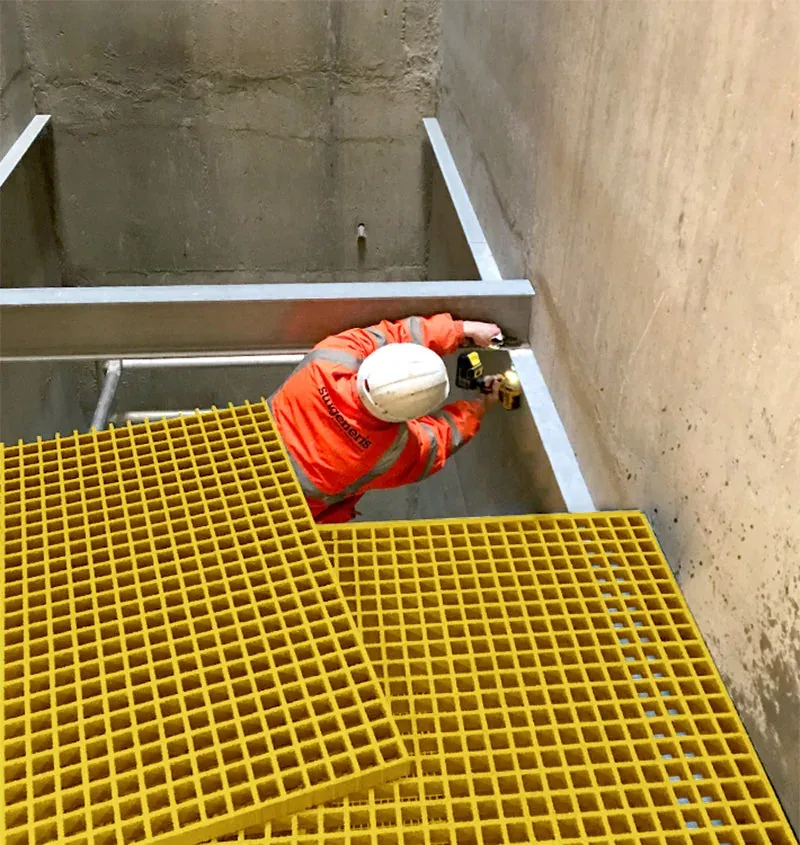
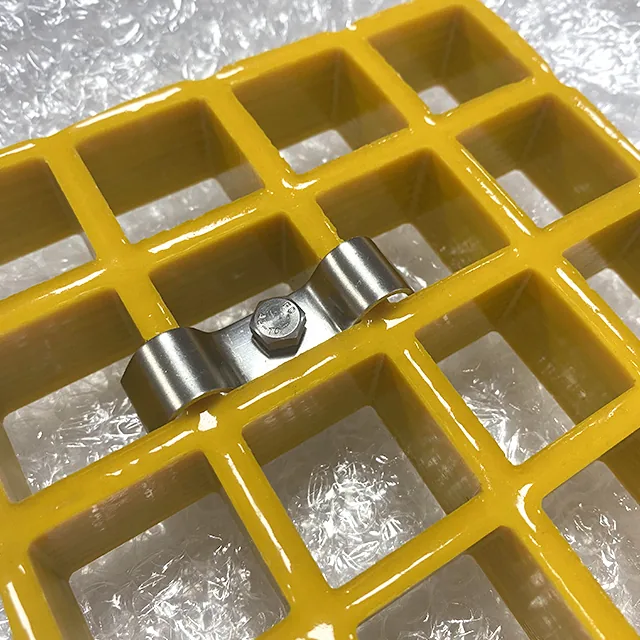
The fixing is the steel part of an installation that is otherwise not steel. M clips normally span two adjacent bars and are bolted through the panel to the support below. L clips bear on a single bar at lighter fixing positions. C clips join adjacent panel edges. The letter describes a shape, not a fit: the jaw width, bolt centre and overall height have to match the panel and the support.
The fixing layout comes from the support drawing. Support spacing, wind or vibration, edge zones, removable pieces and the need to reach the bolt from below all change the number and position of the fixings. We do not publish a universal clips-per-panel figure or a universal bolt torque. Those values are confirmed for the project and recorded on the approval drawing.
Galvanized steel is the economical choice for ordinary access areas. Stainless steel may be considered for chemical, wash-down or coastal exposure, but “stainless” covers a wide range of grades. Tell us the exposure and the support material so the clip and the panel are reviewed together. Where the support is also metallic, the pair is considered as one assembly. The clips and fixings guide explains the M, L and C families and the fit checks.
Movement has to be allowed for where panels are restrained and the temperature range is significant. The allowance depends on the panel, the temperature range, the installation temperature and the restraint, so it is calculated for the project rather than copied as one gap. A panel refitted after maintenance with fewer clips is no longer the arrangement that was designed, even if it still feels firm.
Cutting, Openings and Factory Fabrication
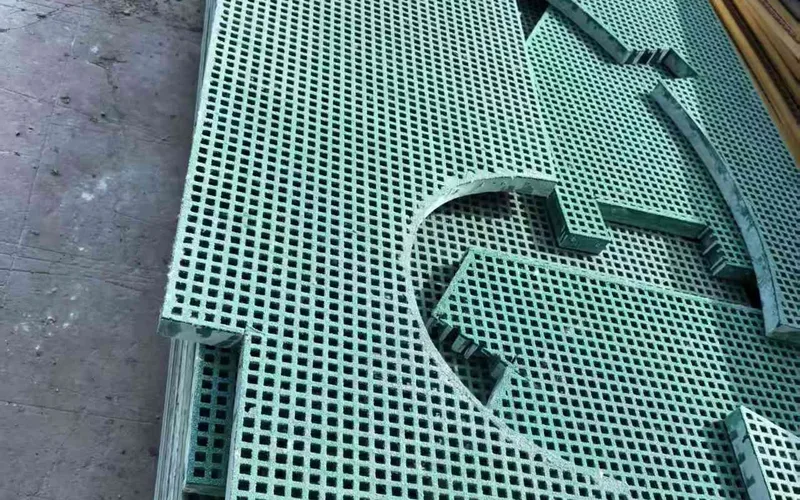
Treatment plants rarely have a clean rectangular layout. Pipes, valves, handrails, stair stringers and equipment supports interrupt the walking surface. A panel may need a notch, a rectangular opening or a set of holes, and each one changes the cut plan.
Cut bars need support around the opening. A hole is not a substitute for a bearing edge, and sealing the cut face does not restore the section that was removed. Where an opening is large, the remaining bars and the frame around it have to be reviewed as part of the panel support. Send the opening position, size and the drawing revision.
Factory cutting is normally preferred for repetitive pieces, pipe openings and removable covers. The cut edges and drilled faces can be sealed where the order requires it, the pieces can be marked to the installation drawing and the packing list can carry the same marks. Site cutting is possible, but it moves the edge treatment and dimensional check to the site. The cutting and sealing guide covers the tools, edge treatment and opening support.
Cutting is priced on delivered area with the actual sizes and nesting loss. A narrow strip contains less area than the full sheet it came from, and the offcut still has a cost. A quote that compares only the panel rate can miss the difference between a layout that uses the sheet well and one that produces a large amount of waste.
Installation and Handover
Good installation starts before delivery. The support frame should be checked for level, bearing width and fixings, and the panel layout should be dry-laid where the site allows. Pieces should be carried by two people or with suitable lifting equipment, not dragged across a finished surface. The installation planning guide covers the support, fixing and handover checks in sequence.
During installation, check that each panel has full bearing, that joints are level and that the agreed clips can be reached with the tools on site. Do not force a clip to pull a panel onto a support it does not reach, and do not use a pipe, handrail or weir edge as an improvised support. Where a panel is removable, confirm that it can be lifted, marked and refitted without disturbing the adjacent pieces.
At handover, inspect for rocking, joint steps, missing hardware, cracked bars, cut-edge condition and access around removable pieces. Record the drawing revision, any site deviation and the positions of the fixings. That record is what makes the next inspection or replacement piece meaningful.
Maintenance and Service Life
Cleaning depends on the soil. Loose debris is removed first. Ordinary dirt is cleaned with water, a mild detergent and a soft brush, then rinsed. Oily or unknown deposits should be identified before a cleaning agent is chosen, because the wrong solvent can attack the resin or a functional surface layer. High-pressure cleaning needs a method confirmed for the panel and surface.
Inspection should cover the surface and the structure. Look for worn grit, exposed fiber, color change, cracks in bars, deformation, loose clips and corrosion of the steel support. A crack in a bearing bar is a structural observation; it is not fixed by filling and painting over it. Restrict use, assess the panel and replace or repair it under an engineered method. The maintenance and service-life guide explains how to triage surface damage, bar cracks and loose fixings.
Our service-life experience is conditional. Better resins such as vinyl ester have lasted more than ten years in some duties. The economical polyester formulation may crack from about one year and last around three years in demanding conditions. Those examples do not carry a documented structure, medium or report, so they guide the resin direction rather than promise a period. Service life, design life and warranty are different things.
Potable Water, Fire and Other Project Requirements
Drinking water contact is a separate question from wastewater corrosion. If a panel or cover comes into contact with potable water, the project may require NSF/ANSI/CAN 61 or another approval for the product and contact scope. We do not claim that approval automatically. State the standard, the surfaces that contact drinking water and the evidence the project requires.
Fire performance is also product-specific. ASTM E84 flame spread, smoke generation, smoke toxicity and structural fire performance are different criteria. A phenolic resin name does not establish a class, and an oxygen-index result is not an ASTM E84 result. If the project has a fire requirement, send the test method and acceptance criteria before the panel is selected.
Static dissipation, UV protection, food contact and electrical insulation are other separate requirements. A dark color does not prove static dissipation, and a color choice does not prove UV performance. Each requirement needs its own product evidence and, where relevant, its own installation detail.
What the Factory Can Confirm
The factory can confirm the panel configuration, the appearance check, the cut list, the edge treatment and the packing list. It can provide packing photographs and the order certificate of conformity. The independent material report we hold describes the samples tested, not every thickness, mesh or resin in the range.
That distinction is useful at quotation stage. If the project needs a configuration-specific load, slip, fire, potable water or third-party report, name the standard and the acceptance criteria. The scope, laboratory, lead time and cost can then be agreed before production rather than after the panels are made.
Price basis
FRP Grating Price for Wastewater Treatment
The panel rate is one line. Resin, cut plan, surface, clips, packing and delivery determine the usable project price.
The published rows start at USD 10.5/m² EXW
The schedule lists 25 mm, 38 × 38 mm molded panel at USD 10.5/m², 30 mm at USD 12.0/m² and 38 mm at USD 15.1/m² ex-works for our economical isophthalic polyester with alumina filler. A full 1220 × 3660 mm sheet is 4.4652 m², so its 25 mm plain-panel amount is about USD 46.9 before cutting, treatment, clips, packing and freight. A 1000 × 4000 mm sheet is 4.0 m², or about USD 42.0 on the same basis.
These are not vinyl ester wastewater prices
The published rows cover an ordinary-environment polyester formulation. Our experience with that formulation is about three years of service, with cracking from about one year. It is not suitable for strong corrosive service, and it should not be used as the price of a vinyl ester dosing-area or basin walkway. Vinyl ester is a different resin system and is quoted by grade against the medium, concentration, temperature and contact type.
Resin and size set the base; fabrication and delivery are separate
Once the resin direction and panel size are fixed, the base panel value can be calculated. Factory cutting is priced on delivered area with the actual sizes and nesting loss; there is no universal cutting surcharge per square metre. Grit, color, edge sealing, clips, packing and freight are separate lines. Ask whether a quotation uses piece area or sheet area and whether offcut is included.
Price basis: 17 October 2026, with a fixed planning conversion of USD 1 = CNY 6.5. An issued quotation confirms the current price, currency, scope and validity. The USD 10.5–15.1/m² rows are plain polyester panel references only; they are not a vinyl ester price, a project load rating or a chemical-compatibility approval.
Quote anatomy
What Changes a Wastewater Grating Quote
Compare the same resin, panel configuration, cut plan, fixing and delivery scope before comparing the rate.
| Quote item | Published or usual basis | What changes it |
|---|---|---|
| 25 mm molded panel | USD 10.5/m² EXW; 12.5 kg/m²; 38 × 38 mm mesh | Full-panel format, mold, mesh, bar geometry and selected resin |
| 30 mm molded panel | USD 12.0/m² EXW; 16.5 kg/m²; 38 × 38 mm mesh | Supported run, foot traffic, deflection limit and selected mold |
| 38 mm molded panel | USD 15.1/m² EXW; 19.5 kg/m²; 38 × 38 mm mesh | Longer or heavier pedestrian use, support spacing and load case |
| Vinyl ester direction | Quoted per grade and configuration; no single published row | Medium, concentration, temperature, contact type, service-life target and supporting data |
| Surface and color | Concave is standard; grit, inlaid grit and color are quoted | Wet or oily use, cleaning method, visibility and any test requirement |
| Factory cutting | Priced on delivered area with actual sizes and nesting loss | Number of sizes, narrow pieces, offcuts, pipe openings, sealing and piece numbering |
| Clips and hardware | M, L and C clips in galvanized or stainless steel, listed separately | Panel height, jaw fit, support section, fixing count and exposure |
| Packing and delivery | EPE foam, stretch film and wooden pallets or iron supports; export quotes usually FOB | Piece size, quantity, loading port, destination and agreed delivery scope |
| Worked example | 20 pieces at 1000 × 2000 mm = 40 m²; at the 30 mm polyester row, USD 480 of plain-panel value | Resin (vinyl ester if required), cut plan, edge sealing, surface, clips, packing and freight |
| Sample and production | Standard 3 × 3 cell sample free with customer-paid freight; no fixed minimum order | Custom sample, panel configuration, order quantity; production normally 15–30 calendar days from deposit |
Project sequence
How a Wastewater Grating Order Is Worked Through
Map the zones, record the exposure, confirm the structure, then select, fabricate and install.
Mark every walkway, platform, stair, trench cover and equipment access point. Give each area its own line in the schedule, because a general access route and a dosing area rarely share one resin requirement.
For each zone, record the chemical or process stream, concentration and units, normal and peak temperature, and whether contact is splash, spillage, vapor, condensation or immersion. Add the cleaning agents and frequency. pH alone does not describe a mixture.
Mark the supports, bearing width, clear span, panel direction, openings and the load the area actually sees. Separate pedestrian use from tools, trolleys, equipment and wheel loads. State the deflection limit if the project has one.
Choose molded or pultruded structure, mesh, resin, surface and color as one configuration. Then match the clip to the panel height, bar width and support. A resin change is a configuration change, not a line-item swap.
Cut pieces to the approved list, form pipe and valve openings with support around the remaining bars, and seal cut edges and drilled faces where required. Mark each piece to the layout and carry the same marks into the packing list.
Dry-lay where possible, check full bearing and level joints, and fit the agreed clips without forcing the panel onto a support it does not reach. Check rocking, missing hardware, cracked bars, cut-edge condition and access around removable pieces before handover.
Responsibility boundary
Where a Wastewater Grating Supply Stops
Clear limits keep a panel quotation from being mistaken for a resin approval or structural design.
- Wastewater is not a resin specification — The plant name does not tell us the chemical, concentration, temperature or contact type. A vinyl ester direction is a starting point; the grade, formulation and finished panel still have to be checked against the actual duty.
- Panel thickness is not a load class — 25 mm, 30 mm and 38 mm are configurations, not three guaranteed load ratings. Span, support condition, bar geometry, load and deflection limit decide whether a panel is suitable.
- A clip does not create a support — M, L and C clips restrain a panel or join edges. They do not increase the allowable span and do not turn a pipe, weir or handrail into a bearing support.
- FRP grating is not maintenance-free — The material does not need repainting to resist corrosion, but grit wears, biofilm and deposits accumulate, fixings loosen and bars can be damaged. A maintenance plan is still required.
- Potable water, fire and static need their own evidence — NSF/ANSI/CAN 61 contact, ASTM E84 flame spread, smoke criteria and static dissipation are separate requirements. A resin name, color or oxygen-index result does not establish them. State the standard and acceptance criteria for the supplied configuration.
- Our supply stops at the panel, fabrication and agreed fixings — We supply the panel, cut pieces, edge treatment and agreed clips. The support structure, tank or trench frame, guardrails, fall protection, lifting plan and structural approval remain project responsibilities unless they are separately specified in writing.
Factory evidence
What We Can Confirm Before Shipment
Manufacturing, cutting and packing are factory scope; the material report is evidence at the level it actually covers.

Material test report, with its limit
Report HZTC/BG-24051102, issued on 17 May 2024 by Hebei Haozheng Testing Services Co., Ltd., records appearance, Barcol hardness 45, water absorption 0.335%, oxygen index 28.5%, tensile strength 74.2 MPa and a load test at a design load of 4 kN/m² over a 600 mm span. The report does not name the model, thickness, mesh or resin, so it is material-level evidence rather than a rating for a specific wastewater panel. An oxygen index is not an ASTM E84 flame-spread class.
Factory cutting and piece marking
A checked cut list is the normal route for pipe openings, removable covers and replacement pieces. Pieces are cut, cut edges and drilled faces are sealed where required, and marks are carried through to the packing list. An opening still needs support around the remaining cut bars.
Read the cutting and sealing guidePacking and loading record
Export orders are usually packed with EPE foam, stretch film and wooden pallets or iron supports. We can provide packing photographs and the packing list; a project-specific inspection or third-party certificate is quoted separately when required.
Review quality and documentationProject inputs
What to Send for a Wastewater Grating Quote
Ten items give enough information to review the zones and price the actual supply scope.
- Plant and location — Municipal or industrial, indoor or outdoor, and any coastal, arid or cold-climate exposure.
- Process zone — Headworks, aeration, clarifier, dosing, disinfection, sludge handling, pump area or trench, with a marked drawing.
- Chemicals and mixtures — Names, concentrations and units, rather than a pH value alone.
- Temperature and contact — Normal and peak temperature, peak duration, and whether exposure is splash, spillage, vapor, condensation or immersion.
- Cleaning — Cleaning agents, dilution, temperature, frequency and rinsing method, including wash-down that reaches the underside.
- Support drawing — Support material, layout, bearing width, clear span, panel direction and every opening.
- Load and deflection — Pedestrian, tool, trolley, equipment or wheel load, with value and contact area, and any deflection limit.
- Piece list — Length × width and quantity for each piece, pipe and valve openings, removable sections and piece marks.
- Surface and fixing — Concave or grit, color, slip-test requirement, clip type and galvanized or stainless hardware.
- Documents and delivery — Potable water, fire, static or third-party requirements, destination, trade term and required date.
Request a quote
Send Your Zone, Chemicals and Support Details
Chemical names with concentration and temperature are more useful than the plant type.
- Molded and pultruded grating produced in house
- Full panels or factory cut-to-size pieces
- No fixed minimum order quantity
FRP Grating Wastewater Treatment Questions
What is FRP grating used for in wastewater treatment plants?
Which resin do you use for wastewater grating?
Is vinyl ester always required in a wastewater plant?
Is vinyl ester resistant to every chemical in a treatment plant?
What thickness should a wastewater walkway use?
Can FRP grating replace steel grating in a treatment plant?
How much does FRP grating for wastewater treatment cost?
Why is there no single vinyl ester price on this page?
How are trench covers in a treatment plant quoted?
Can grating covers carry vehicles or trolleys?
Does a grit surface make the walkway slip-resistant?
Can panels be cut around pipes, valves and equipment?
How is FRP grating fixed in a wet treatment area?
Does FRP grating need maintenance?
How long does FRP grating last in wastewater service?
Is FRP grating suitable for potable water contact?
Does FRP grating meet fire or smoke standards?
What should I send for a wastewater grating quotation?
Content last checked: