Trench covers
FRP Grating Trench Covers for Drainage and Access
Open mesh, mini mesh, covered and solid-top fiberglass trench covers made to the trench drawing. We confirm the clear opening, bearing edge, load and lifting method before quoting. The published 25 mm, 38 × 38 mm molded panel reference is USD 10.5/m² EXW for an economical isophthalic unsaturated polyester; vinyl ester and other duties are quoted separately.

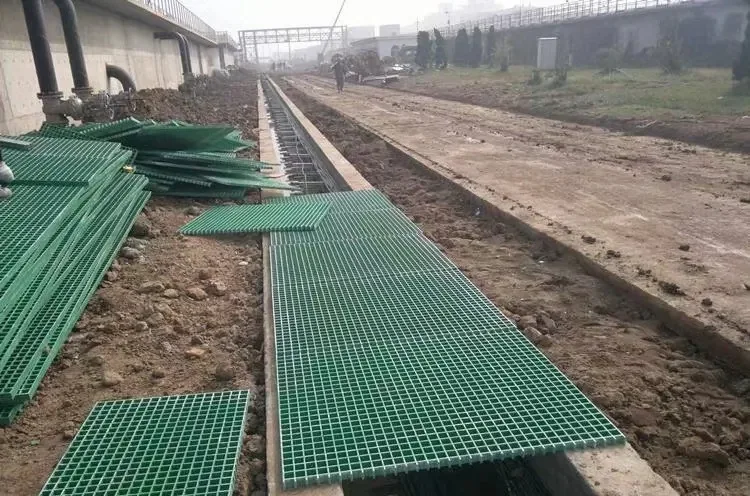
A framed opening being fitted with factory-cut FRP covers. Photo: Dengtai Industry.
Terms
Trench Cover Terms Used on This Page
An FRP trench cover is a fiberglass-reinforced plastic panel over a drainage channel, cable trench or pit. Open mesh drains, mini mesh retains small objects, and a covered or solid top closes the surface. The format, clear span, bearing, load and fixing are then confirmed for the actual trench.
- FRP trench cover
- A panel made from fiberglass-reinforced plastic (FRP), also called glass-reinforced plastic (GRP), that spans a drainage channel, cable trench, service duct or pit opening. It may be open grating, mini mesh, a covered panel or a solid plate, so the format has to be stated before the size means anything.
- Trench cover and drain grate
- A trench drain grate cover is selected mainly for water passage and is one form of trench cover. A trench cover may also have to retain small objects, close the surface, reduce splash or be lifted for maintenance. Those are different products even when the outside dimensions match.
- Channel drain grate
- A relatively narrow grate that fits a manufactured drainage channel. It is normally bought by channel width, length and load requirement, and the frame or channel system is part of the fit.
- Pit cover and utility cover
- A cover over a sump, pit, cable joint or service opening. It often needs a closed surface, a lifting point and a frame, rather than free drainage through the panel.
- Clear opening
- The internal distance between the two bearing edges. It is the span the cover works over, not the outside width of the trench, the cover or the frame.
- Bearing edge
- The surface on which the cover rests. Its width, level, continuity and condition decide whether the cover sits still or rocks, especially when the trench is an existing one.
- Load class
- A project designation for the load a cover and frame are required to carry, such as an EN 1433 class or a stated wheel load. Panel thickness alone does not assign a load class.
- Removable cover
- A cover intended to be lifted for cleaning, inspection or access. Piece weight, lifting point, marking, restraint and the route for lifting are part of the design.
- Resin system
- The thermosetting resin used with the glass reinforcement. Isophthalic unsaturated polyester, vinyl ester, epoxy and phenolic are different systems; the grade and formulation are checked against the actual exposure.
Cover formats
FRP Trench Cover Formats Compared
The job the cover does decides the format; the frame, span and load decide whether that format can be used.
| Cover format | What it does best | Typical trench use | What still has to be checked |
|---|---|---|---|
| Open molded grating | Drains freely, is light to handle and can be cut into pieces | Drainage channels, plant trenches, pedestrian crossings and general access covers | Net opening against debris, support and bearing, load, surface and fixing |
| Mini mesh grating | Reduces what falls through while keeping an open draining surface | Car wash bays, service trenches, small-tool areas and fine-debris locations | Upper and lower mesh, actual net opening, drainage, cleaning, mass and load |
| Covered or solid-top grating | Produces a more continuous surface and can reduce splash or object fall-through | Cable trenches, utility pits, process areas and covers that must be closed | How the cover is joined, where water drains, added mass and the load basis of the assembly |
| Pultruded bar grating | Carries the main load along parallel bearing bars over long straight runs | Long drainage runs and equipment platforms where supports follow one direction | Bar direction, support spacing, panel depth, clear span and deflection limit |
| FRP cover plate | Gives a closed plate surface for a pit, sump or small opening | Small utility covers, inspection openings and locations needing a solid top | Plate thickness, support, load test, lifting point and edge treatment |
Applications
Where FRP Trench Covers Are Used
Eight trench types, each with a different balance of drainage, closure, access and exposure.
Roadside and municipal drainage
Roadside channels and municipal drainage runs need a cover that passes water, sits flush with the surrounding surface and can be lifted for cleaning. Pedestrian and occasional vehicle access are separate load cases, and the frame or concrete ledge has to be sound before a new cover is ordered.
Send the channel drawing, clear width, length, frame or ledge detail, debris type and the load the surface actually sees.
Industrial plant and process trenches
Plant trenches may carry wash-down water, process spillage, grit or chemical residue. Open grating is common, but the resin and the fixing are selected for the actual medium. A trench that looks dry most of the time can still see repeated spills or cleaning chemicals.
Send the chemical names, concentration, temperature, cleaning method and whether exposure is splash, spillage, vapor or immersion.
Cable and utility trenches
Cable trenches and service ducts often need a closed or covered surface to keep water, dust and small objects out. A solid cover does not make the trench watertight by itself; joints, drainage and ventilation still need a detail. Cable access and lifting frequency decide the piece layout.
Send the duct drawing, required surface closure, cable clearance, lifting frequency, earthing requirement and any ventilation detail.
Car wash and washdown bays
Car wash and washdown areas combine water, soap, oil, grit and repeated cleaning. Mini mesh can retain small items while still draining, and a textured surface may be requested. The cleaning method and the slip-test requirement matter as much as the mesh.
Send the bay layout, flow direction, debris size, cleaning agents, slope, load and any slip-test standard.
Wastewater treatment plants
Treatment plants use trench covers at headworks, around process tanks, in chemical dosing areas and along drainage runs. Each area has its own medium and cleaning regime, so a plant-wide “wastewater” specification can over-specify mild areas and under-specify aggressive ones.
Send the process zone, chemicals, concentration, temperature, contact type, support drawing and load.
Chemical and dosing areas
A dosing area is defined by the chemical, not by the word industrial. Sodium hypochlorite, ferric chloride, alum, caustic and polymer solutions have different concentration, temperature and contact profiles. Vinyl ester may be the starting direction, but the grade and the finished panel are confirmed for the duty.
Send the chemical list with units, normal and peak temperature, spill history, cleaning agents and the support material.
Food and beverage production
Food and beverage areas often combine washdown, organic soil, cleaning chemicals and a need for a cleanable surface. Open mesh drains, but the underside and the support also need cleaning access. A closed cover may be preferred where product or small parts must not fall into the trench.
Send the cleaning protocol, chemicals, temperature, object size, load and any hygiene or documentation requirement.
Pedestrian crossings and public areas
Public and pedestrian areas put the cover on show as well as underfoot. Flush fitting, a level joint, a consistent color and a walking surface that works when wet matter more than a heavy industrial look. The cover still has to bear on a proper frame and be restrained.
Send the finished level, paving or kerb detail, walking surface, color, load, lifting method and any anti-theft requirement.
Configuration
FRP Trench Cover Sizes and Starting Points
Start with the panel and the piece layout, then confirm the resin, support, load and fixing.
Request a Project Quote
| Specification | Value |
|---|---|
| Molded standard mesh | 25 / 30 / 38 mm; 38 × 38 mm mesh; 12.5 / 16.5 / 19.5 kg/m² Light inspection covers normally start at 25 mm; 30 mm and 38 mm may be considered where the supported run, traffic or piece size calls for more stiffness. Thickness is not a load class. |
| Published panel reference | USD 10.5 / 12.0 / 15.1 per m² EXW for the 25 / 30 / 38 mm rows Plain isophthalic unsaturated polyester with alumina filler, ordinary-environment reference only. Not a vinyl ester price and not a project load rating. |
| Mini mesh | 19 × 19 mm upper mesh over a wider lower mesh; 25 mm row at 15.5 kg/m² Reduces what falls through while keeping an open surface. Upper mesh, lower mesh, net opening and drainage are confirmed together. Quoted per configuration. |
| Full panel sizes | 1000 × 4000; 1220 × 3660; 38 mm also 915 × 3050 mm Covers are normally cut from full panels. The cut plan and offcut affect the effective material charge, especially on narrow pieces. |
| Cut-to-size covers | Made to the trench width, length and piece layout Piece size is also a handling decision. A 300 × 1000 mm 25 mm panel is about 3.8 kg; the same piece in 38 mm is about 5.9 kg, before any cover layer or frame. |
| Covered and solid-top options | Covered grating, patterned flat plate and independent solid panel These are different constructions. Confirm how the cover is joined, how water drains and what the load basis of the assembly is. |
| Pultruded option | I- or T-section bearing bars; made to project dimensions The main load path runs along the bars. It can suit long, straight runs when the support direction, bar depth, span and deflection limit match. |
| Surface and color | Concave standard; grit, inlaid grit and color to order Grit adds walking texture. It is not a certified slip rating unless the project’s test method and report are supplied. |
| Fixing and lifting | M, L and C clips; galvanized or stainless steel; lifting points shown on the drawing The clip is matched to panel height, bar width and support. The fixing count and positions come from the support drawing. |
| Load data | Project-specific; no universal cover class by thickness Send the point load or wheel load with contact area, the clear span, the bearing detail and any deflection limit. A load class is confirmed against the exact cover and frame. |
Project conditions
Trench Conditions and What Each One Needs
Twelve conditions that change the cover, the frame or the fixing.
| Trench condition | How we approach it | What we need from you |
|---|---|---|
| Pedestrian footpath or plaza | Open or mini mesh cover, with a flush walking surface and a restraint that stops movement | Finished level, paving or kerb detail, clear opening, piece size and any slip-test requirement |
| Trolley or maintenance cart | The cover and frame are reviewed for the trolley wheel load and the actual contact area, not only for foot traffic | Loaded trolley weight, wheel size and contact patch, route, clear span and support drawing |
| Occasional car or light vehicle | Treated as a separate vehicle case; the frame and bearing conditions are part of the review | Wheel load, contact area, frequency, dynamic effect, cover size and frame material |
| Truck, forklift or heavy wheel load | A project-specific structural review; a standard pedestrian panel is not offered as a heavy vehicle cover | Axle or wheel load, tyre contact area, impact, speed, frame drawing and required test standard |
| Existing concrete trench with uneven bearing | Measure the ledge along its length and review whether the frame needs repair, packing or a new bearing angle | Photos, level readings, ledge width at several points, cracks, repairs and the required finished level |
| Narrow channel or linear drain | A narrow cover or bar grate matched to the channel width and the load, with the piece length planned for lifting | Internal channel width, outside frame width, length, load, debris size and the channel manufacturer if known |
| Wide trench requiring several pieces | A piece layout across the width and along the length, with joints landing on supports and a handling weight agreed per piece | Trench width and length, support grid, maximum piece weight, lifting method and joint positions |
| Cable or utility trench needing a closed top | Covered or solid-top format, with the joint, drainage, ventilation and lifting detail resolved as an assembly | Cable clearance, required closure, water path, ventilation, access frequency and earthing requirement |
| Chemical or washdown exposure | Resin, surface and fixing selected together for the medium, concentration, temperature and cleaning method | Chemical names and units, normal and peak temperature, contact type, cleaning agents and spill history |
| Frequent inspection access | Smaller removable pieces, lifting points, marking and a restraint that can be released and refitted | Which pieces lift, how often, who handles them, maximum piece weight and how the opening is controlled |
| Retrofit over a damaged frame | The existing frame is reviewed before a cover is sized; a new cover does not repair a failed bearing ledge | Frame photos, material, corrosion or cracking, bolt access, support spacing and the interface you expect us to supply |
| Sloped or curved trench | The cover is set out from the actual geometry, with the high and low sides and any curved edge shown on the drawing | Plan and section dimensions, slope, curve data, finished level and how the pieces are marked for refitting |
How to Measure a Trench Before Choosing a Cover
Most cover problems start with a dimension that was measured in the wrong place. The drawing does not have to be elaborate, but it has to show what each number refers to.
Measure the clear opening, not the outside of the frame
The clear opening is the distance between the two bearing edges. Measure it at both ends and in the middle, because an existing concrete trench is rarely perfectly parallel. If the three readings differ, the cover has to be sized for the actual opening and the variation has to be shown on the drawing. The outside width of the old cover is not a substitute: it may have been overlapped, cut short or bedded on mortar.
Check the bearing ledge along its whole length
Record the width of the ledge, whether it is continuous, and whether it is level. A ledge that is wide at one end and narrow at the other concentrates the load on a small area. A ledge that has been repaired with mortar may look sound but crush under a clip. Photograph cracks, spalled edges and any previous packing. If the frame is steel, note corrosion, bolt condition and whether the top is level.
Record the length direction and the piece layout
Decide which direction the covers run and where the joints fall. A joint between two covers is not automatically a support. If the joint needs bearing, the frame has to run under it. The piece length also sets the handling weight: a long cover may be light enough per square metre and still too awkward to lift in one piece. Mark the pieces so they can be returned to the same position after cleaning.
Photograph what the drawing does not show
A photo with a tape measure is useful for obstructions, pipe entries, cable trays, drainage outlets and the finished floor level. It does not replace the drawing, but it often explains why a nominal dimension will not work. Take one photo looking along the trench, one across it and one close to each end. If the trench is deep, include a photo showing the bearing ledge from above.
Open Mesh, Mini Mesh or Covered: Decide by the Job
Open molded grating is the usual starting point for a drainage trench. Water passes through the mesh, the panel is light, and it can be cut into pieces without losing the basic structure. The net opening still has to be checked against the debris the trench carries. A 38 × 38 mm mesh that passes water freely may also pass bolts, small tools or coarse grit into the channel below.
Mini mesh reduces what falls through while keeping an open surface. A 19 × 19 mm upper mesh over a wider lower mesh is the combination the factory uses most often. It is heavier than standard mesh at the same thickness, and the finer surface can be harder to clean if the debris is sticky or fibrous. The actual net opening, not the nominal mesh name, decides whether a particular object passes.
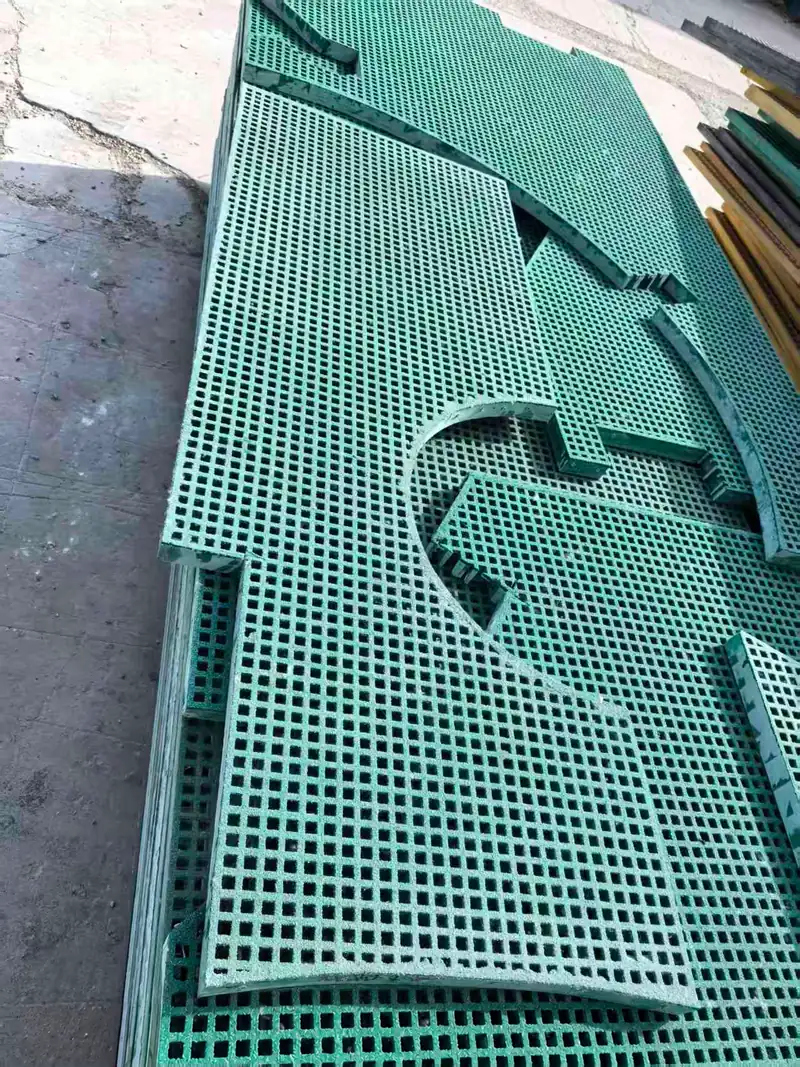
Covered grating and solid-top panels close the surface. They are useful where small objects must not fall in, where splash or odour has to be reduced, or where a more continuous walking surface is wanted. They do not make the trench watertight. Water still has to go somewhere, and the joints, edges, lifting holes and frame need a drainage and ventilation detail. The added cover layer also increases the mass and changes the load basis of the assembly.
Pultruded grating is a different structure rather than a different mesh. The main load path runs along parallel bearing bars, so it suits long, straight runs where the supports follow the same direction. Molded grating has an integral mesh and can be cut in two directions, which is often more practical for small covers, curved openings and pieces that have to fit around existing equipment.
Load, Span and Deflection: What a Cover Needs to Be Checked Against
A trench cover is a structural element, even when it is sold as a standard panel. The check starts with the clear span and the support, not with the thickness alone.
Clear span is not cover width
The clear span is the distance between the bearing edges. The cover width includes the bearing overlap on each side, so a 500 mm cover may span only 400 mm or less. If the cover is wider than the opening, the extra width is useful only if it actually bears on a sound ledge. Overhang without bearing adds weight and can create a trip edge.
Point loads and wheel loads need contact area
A pedestrian load is usually described as a distributed load or a point load, while a trolley or vehicle load is a wheel load with a contact patch. The same total load applied through a small wheel can be more severe than a larger foot or a spreader plate. Send the load value, the contact area, the frequency and any dynamic effect. For a vehicle, also state the speed, the route and whether the load is occasional maintenance access or regular traffic.
A load class is a project requirement, not a thickness
Projects may reference EN 1433 classes such as A15, B125, C250, D400, E600 or F900, or they may state a wheel load directly. Those are designations for a cover and frame system, not labels that can be assigned from a panel thickness. If a class is required, the exact cover, frame and fixing have to be tested or assessed against it. Do not accept a quotation that says “Class C” without saying which product and which test evidence support the claim.
Deflection is part of serviceability
A cover can be strong enough without being stiff enough. Excessive deflection makes the surface feel unsafe, can open joints and can damage the frame. If the project has a deflection limit, such as L/200 or L/300, send it with the span. If there is no stated limit, describe the use and the expected feel of the surface. A light inspection cover and a trolley route should not be judged by the same deflection criterion. Temperature and load duration also affect creep; the temperature and creep guide explains what to send.
Frame, Bearing and Fixing
The frame does the work the clip cannot
A clip holds the cover down; it does not create a bearing surface. If the frame is uneven, the cover will rock no matter how many clips are fitted. If the ledge is too narrow, the clip can pull the cover against a small contact area and crack the edge. The frame review comes before the clip count.
For an existing trench, check the frame material, the bearing width, the level and the condition. For a new trench, the frame drawing should show the bearing surface, the joint positions and the fixing points. A steel angle, a concrete ledge and a proprietary channel seat behave differently, and the clip has to suit the support section as well as the panel.
Clips restrain; they do not support
M clips usually span two bars and hold the panel down onto a support. L clips hold a single bar at lighter fixing positions. C clips join adjacent panels and limit the step at the joint. The letters describe shapes, not a universal capacity. A replacement clip is matched to the panel height, bar width and support, not chosen by name alone.
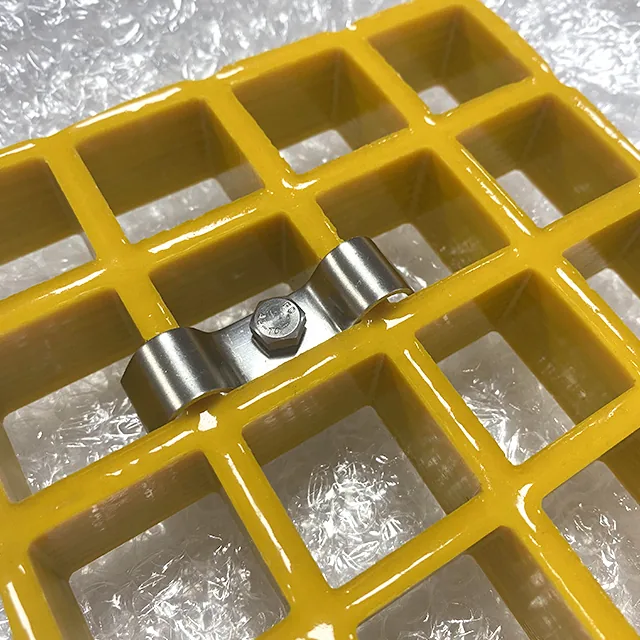
Galvanized and stainless steel clips are both available. The choice depends on the exposure, the support material and the project’s maintenance expectations. Stainless is often specified in wet or chemical areas, but the grade still has to suit the environment. The fixing count and positions come from the support drawing and the load case; there is no universal clips-per-panel figure.
Removable covers need a lifting plan
A cover that is lifted for cleaning needs a piece weight that suits the people and equipment available. It also needs a lifting point, a mark that tells the fitter where it belongs, and a restraint that releases without damaging the panel. If the cover is in a public area, the fixing may also need to resist casual removal. These are design decisions, not site adaptations after delivery.
For a large opening, the layout can use several smaller pieces instead of one large cover. The trade-off is more joints, more clips and more pieces to handle. The right answer depends on how often the trench is opened and who does the lifting. Tell us the maximum weight one person should handle and the route the cover will take when it is removed.
Drainage, Debris and Cleaning
Open area is the first drainage question, but it is not the only one. Water has to reach the openings, pass through them and leave the channel. If the surface is flat or the channel is blocked, a high open-area panel will still pond. The trench should have a fall, and the cover should not create a dam at a joint or against a frame.
Debris decides the mesh more than the flow rate does. Fibrous material, leaves, grit, food waste and small parts behave differently. A fine mesh that stops small objects may also blind more quickly. A coarse mesh that drains well may pass the objects that cause the blockage downstream. The practical answer is often a compromise, with a removable section at the point where cleaning is easiest.
Cleaning access is part of the layout. If the cover is heavy or fixed, the trench will be cleaned less often. If the pieces are small enough to lift, the cleaning can be done in sections without opening the whole run. For a covered or solid-top trench, provide a separate access point and a water path; a closed cover should not be the only route for water to leave the surface.
Resin, Colour and Environment
The resin system is selected against the medium, not against the word “industrial”. Isophthalic unsaturated polyester is a useful economical starting point for ordinary environments. Vinyl ester is the usual direction where chemical exposure, wastewater or a longer service-life target calls for it. Epoxy and phenolic directions are considered for specific duties. The grade, formulation, reinforcement and cure are confirmed with the finished panel.
Colour is a pigment choice, not a chemical rating. A colour can improve visibility or match the surrounding work, but it does not make a standard polyester panel suitable for a strong chemical. In the same way, a grit surface is a texture, not a certified slip class. If the project names a test method, send the method and the acceptance value.
UV exposure can change the appearance of an FRP surface over time. The structural selection still depends on the resin and the load. For outdoor covers, state whether the colour has to remain stable and whether a UV-stable pigment or surface is required. For fire, static or potable-water contact, state the standard and the product scope; a resin name or an oxygen-index result does not establish those approvals.
Why Resin and Size Come Before the Price
The price of a trench cover is built in the same order as the product. First the resin system, then the panel thickness and mesh, then the full-panel size and the cut plan. The published reference rows on this page are for an economical isophthalic unsaturated polyester with alumina filler in an ordinary environment. They are useful as a starting point for a mild drainage cover, not as the price of a vinyl ester chemical-duty cover.
The 25 mm, 38 × 38 mm molded panel is USD 10.5/m² EXW; the 30 mm row is USD 12.0/m² and the 38 mm row is USD 15.1/m². A 1220 × 3660 mm sheet contains 4.4652 m², so the plain 25 mm panel is about USD 46.9 per sheet. That number is the panel only. Cutting, edge treatment, surface, clips, packing and freight are separate.
Our experience with the economical polyester formulation is around three years of service in ordinary environments, with cracking possible from about one year. It is not suitable for strong corrosive service and should not be used as a long-life target. If the trench sees chemicals, continuous moisture, wastewater gases or repeated wash-down, the resin direction has to be confirmed before the price means anything.
Installation and Handover
Dry-lay the covers before fixing where possible. Check that each piece bears on the full ledge, that the joints are level and that the cover does not rock. Fit the agreed clips without forcing the panel onto a support it does not reach. If a clip pulls the cover out of shape, the frame or the panel is wrong; adding more clips will not correct it.
Check the openings, cut edges and lifting points. A cut edge should be sealed where the specification requires it, and the seal should cover the cut rather than the surrounding surface. Pieces should be marked to the layout and the marks should match the packing list. After installation, check the cover for movement, gaps, missing clips and any sharp edge that could catch a foot or a wheel.

Handover should include the installed layout, the fixing positions and the maintenance expectations. If the trench is cleaned with a high-pressure washer, confirm the method and the nozzle distance with the resin supplier. If the cover is removed regularly, keep a sketch of the piece positions so it can be refitted the same way.
How to Compare Two Trench Cover Quotations
Compare the same resin, panel, mesh, thickness, cut plan, edge treatment, fixing and delivery scope. A lower rate per square metre can be misleading if one quotation charges piece area and the other charges sheet area, or if one includes edge sealing and the other does not. Ask for the quotation to state the basis.
Check whether the cut plan uses the full panel efficiently. A narrow cover can leave a large offcut, and the effective material cost may be higher than the rate suggests. Ask whether the offcut is included, whether it can be used for another piece, and whether the quoted quantity is the number of covers or the number of sheets.
Finally, compare the evidence. A material test report is useful, but it is not a load rating for the exact cover. Ask which product, thickness, mesh, resin and test standard the report covers. If the project requires a load class, a fire rating or a potable-water approval, put that requirement in the inquiry rather than assuming it from a data sheet.
What We Supply and What Stays With the Project
We supply the panel, cut pieces, edge treatment and agreed clips. We can review the trench drawing and the load information, propose a configuration and quote the factory scope. We do not design the concrete trench, the steel frame, the civil works, the lifting plan or the installation method unless that scope is separately agreed in writing.
The project remains responsible for the condition of the existing structure, the bearing ledge, the connection to the surrounding floor, the guardrails or fall protection, and the structural approval of the installed system. If the trench is in a public area, the project also decides the anti-theft and access-control requirements. Clear scope at inquiry stage avoids the most common dispute: a panel that fits the opening but was never intended to carry the load or close the trench in the way the site expected.
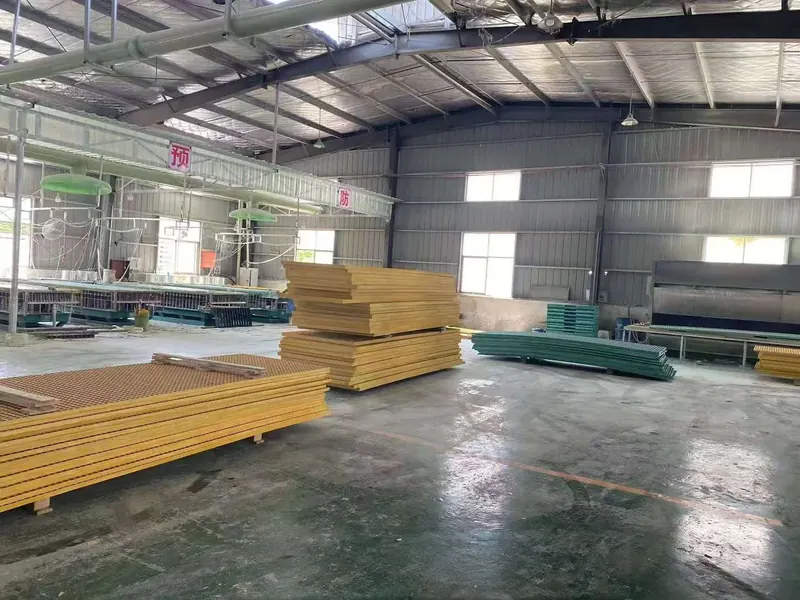
Prepared by Dengtai Industry from our factory’s grating, resin and fabrication experience. Where a project condition is not documented, the limit is stated rather than filled with a general claim.
Price basis
FRP Trench Cover Price
Resin and size set the base; cutting, edge treatment, surface, clips, packing and freight are separate lines.
Resin and cover size set the base
First the resin system, then the panel thickness, mesh and full-panel size. On the 1220 × 3660 mm sheet basis used here, the schedule rows are CNY 58 / 68 / 88 per m² for 25 / 30 / 38 mm. The planning basis adds CNY 10/m² and converts at USD 1 = CNY 6.5, giving USD 10.5 / 12.0 / 15.1 per m² EXW in a 38 × 38 mm molded mesh. A full sheet is 4.4652 m², so the plain 25 mm panel is about USD 46.9 before cutting, edge treatment, clips, packing and freight.
The reference resin is not a chemical-duty resin
The published rows use an economical isophthalic unsaturated polyester with alumina filler for ordinary environments. Our experience with this formulation is around three years of service, with cracking possible from about one year. It is not suitable for strong corrosive service and is not a vinyl ester price. Vinyl ester is quoted by grade against the medium, concentration, temperature, contact type and service-life target.
Cutting and finishing are separate lines
Simple straight cutting has been quoted at about CNY 5/m² (USD 0.77/m² at the planning rate) when the cut plan is straightforward. Complex openings, angles, notches, edge sealing and piece marking are quoted from the drawing. Clips, surface treatment, packing and freight are separate. Ask whether the quotation charges piece area or sheet area and whether offcut is included.
Price basis: 17 October 2026, with a fixed planning conversion of USD 1 = CNY 6.5. An issued quotation confirms the current price, currency, scope and validity. The USD 10.5–15.1/m² rows are plain isophthalic unsaturated polyester panel references only; they are not a vinyl ester price, a project load rating or a chemical-compatibility approval.
Quote anatomy
What Changes a Trench Cover Quote
Compare the same resin, panel, cut plan, fixing and delivery scope before comparing the rate.
| Quote item | Published or usual basis | What changes it |
|---|---|---|
| 25 mm molded panel | USD 10.5/m² EXW; 12.5 kg/m²; 38 × 38 mm mesh; 4.4652 m² per 1220 × 3660 mm sheet | Panel size, mold, mesh, bar geometry and selected resin |
| 30 mm molded panel | USD 12.0/m² EXW; 16.5 kg/m²; 38 × 38 mm mesh; about USD 53.6 per full sheet | Supported run, traffic, deflection limit and selected mold |
| 38 mm molded panel | USD 15.1/m² EXW; 19.5 kg/m²; 38 × 38 mm mesh; about USD 67.4 per full sheet | Longer or heavier use, support spacing, piece size and load case |
| CNY schedule basis | CNY 58 / 68 / 88 per m² for 25 / 30 / 38 mm on the 1220 × 3660 mm sheet basis | Add CNY 10/m² for the quoted resin and filler basis, then convert at USD 1 = CNY 6.5 |
| Mini mesh | 19 × 19 mm upper mesh at 25 mm is 15.5 kg/m²; quoted per configuration | Upper mesh, lower mesh, panel size, resin, surface and load case |
| Vinyl ester direction | Quoted per grade and configuration; no single published row | Medium, concentration, temperature, contact type, service-life target and supporting data |
| Simple straight cutting | About CNY 5/m² (USD 0.77/m²) as a planning example | Number of sizes, strip width, nesting loss, piece length and whether the cut is straight |
| Openings and edge treatment | Quoted from the drawing | Pipe or cable openings, curved cuts, notches, sealing method, colour and piece marking |
| Surface and colour | Concave is standard; grit, inlaid grit and pigment are quoted | Wet or oily use, cleaning method, visibility and any slip-test requirement |
| Clips and lifting hardware | M, L and C clips in galvanized or stainless steel, priced per piece | Panel height, bar width, support section, fixing count, lifting point and exposure |
| Packing and delivery | EPE foam, stretch film and wooden pallets or iron supports; export quotes usually FOB | Piece size, quantity, loading port, destination and agreed delivery scope |
| Worked example | 24 pieces at 300 × 1000 mm = 7.2 m² piece area; two 1220 × 3660 mm sheets = 8.9304 m² | At USD 10.5/m², the 25 mm plain-panel value is USD 75.6 on piece area or USD 93.8 on sheet area, before cutting, edge treatment, clips, packing and freight |
| Sample and production | Standard 3 × 3 cell sample free with customer-paid freight; production normally 15–30 calendar days from deposit | Custom sample, panel configuration, order quantity and agreed inspection or documentation |
Project sequence
How a Trench Cover Order Is Worked Through
Measure, confirm the job, check the structure, then select, fabricate and inspect.
A plan and section are more useful than an outside dimension. Include the clear opening, bearing ledge, length direction, frame material and any obstruction below the cover.
Decide whether it has to drain, retain small objects, close the surface or be lifted for access. A combination is possible, but each requirement has to be stated rather than assumed from the product name.
Separate pedestrian use from trolleys, equipment and vehicles. Record the point or wheel load with its contact area, the clear span, the bearing width and any deflection limit. The frame is reviewed with the cover.
Choose the resin against the medium, concentration, temperature and contact type. Then select the walking surface, colour, clip type and material as one configuration, not as independent upgrades.
Check piece sizes, joint positions, openings, lifting points and marks against the drawing. A standard sample can confirm the mesh and surface; a custom sample is quoted when the configuration is new.
Cut and treat the pieces, carry the marks through to the packing list, and check the appearance, dimensions and fixing fit before shipment. Packing photographs can be provided with the dispatch documents.
Responsibility boundary
Where a Trench Cover Supply Stops
Clear limits keep a panel quotation from being mistaken for a load approval or a civil-works scope.
- A trench cover is not automatically a load class — Thickness, mesh and panel size describe a configuration, not a certified load. A project that names a load class or wheel load needs the exact cover and frame checked against it.
- A clip does not create a bearing support — M, L and C clips restrain the cover or join pieces. They do not turn a pipe, a narrow ledge or a damaged frame into a proper bearing edge, and they do not increase the allowable span.
- A solid cover does not make the trench watertight — A covered or solid-top panel closes the surface, but joints, edges, lifting holes and the frame still have to be detailed. Water, odour and ventilation need their own path.
- Grit is texture, not a slip rating — A grit surface improves grip underfoot, but a certified slip result depends on the test method and the exact product. State the standard and acceptance value if the project has one.
- FRP is not maintenance-free — The material does not need repainting to resist corrosion, but grit wears, deposits collect, clips loosen and bars can be damaged. Inspection of the cover and its supports is still part of the installation.
- Our supply stops at the panel and agreed fabrication — We supply the panel, cut pieces, edge treatment and agreed clips. The trench, frame, civil works, lifting plan, installation labour and structural approval remain project responsibilities unless they are separately specified in writing.
Factory evidence
What We Can Confirm Before Shipment
Cutting, marking and packing are factory scope; the material report is evidence at the level it actually covers.

Material test report, with its limit
Report HZTC/BG-24051102, issued on 17 May 2024 by Hebei Haozheng Testing Services Co., Ltd., records appearance, Barcol hardness 45, water absorption 0.335%, oxygen index 28.5%, tensile strength 74.2 MPa and a load test at a design load of 4 kN/m² over a 600 mm span. The report does not name the model, thickness, mesh or resin, so it is material-level evidence rather than a rating for a specific trench cover. An oxygen index is not an ASTM E84 flame-spread class.
Factory cutting and piece marking
A checked cut list is the normal route for trench covers with openings, curves and removable pieces. Pieces are cut, cut edges and drilled faces are sealed where required, and marks are carried through to the packing list. An opening still needs support around the remaining cut bars.
Read the cutting and sealing guidePacking and loading record
Export orders are usually packed with EPE foam, stretch film and wooden pallets or iron supports. We can provide packing photographs and the packing list; a project-specific inspection or third-party certificate is quoted separately when required.
Review quality and documentationProject inputs
What to Send for a Trench Cover Quote
Ten items, mostly from the trench drawing and a few photos.
- Trench drawing — Plan and section with the clear opening, outside dimensions, length direction and finished level.
- Bearing detail — Frame or ledge material, bearing width, level along the length, and any cracks, repairs or obstructions.
- The job the cover does — Drainage, object retention, surface closure or lifting access, stated explicitly and in combination if needed.
- Load and deflection — Pedestrian, trolley, equipment or wheel load with value and contact area, plus any named load class or deflection limit.
- Piece layout — Length × width and quantity, joint positions, maximum piece weight and how the pieces will be lifted.
- Openings — Pipe, cable, valve or drainage openings with position, size and the support available around the cut.
- Environment — Chemicals with concentration and temperature, cleaning method, indoor or outdoor exposure, and any fire, static or potable-water requirement.
- Surface and colour — Concave, grit or inlaid grit, colour, slip-test requirement and whether the surface has to match existing work.
- Fixing — Clip type, material, support section, fixing positions and whether the cover must be removable or restrained.
- Documents and delivery — Test reports, inspection, packing photographs, destination, trade term and required date.
Request a quote
Send Your Trench, Frame and Load Details
Clear width, bearing edges, the job the cover does and the lifting limit are the starting points.
- Molded and pultruded grating produced in house
- Full panels or factory cut-to-size pieces
- No fixed minimum order quantity
FRP Trench Cover Questions
What is an FRP grating trench cover?
What is the difference between a trench cover and a drain grate?
Which is better: open mesh, mini mesh or covered?
What sizes can you make?
Can you cut covers to my trench width?
How much does an FRP trench cover cost?
Why is the published price only a reference?
Is the USD 10.5/m² price for vinyl ester?
How do you calculate how many sheets I need?
Can FRP trench covers carry cars or trucks?
Can FRP trench covers replace steel or concrete covers?
What load information do you need?
How do I measure an existing trench?
How are trench covers fixed?
Do covers rattle or lift?
Can one person lift the cover?
Can you make covered or solid-top covers?
Are FRP trench covers slip-resistant?
How long do FRP trench covers last?
Can FRP covers be used in chemical or wastewater service?
Do you provide test reports?
What is the lead time and minimum order?
Can you supply replacement pieces?
Content last checked: