Product
Covered Fiberglass Grating and Solid-Top Panels
Covered grating describes several different constructions — an open mesh base panel with a cover layer, a patterned flat plate, or an independent solid panel. They are not interchangeable, and this page is a configuration review rather than a stock list.
Definitions
Covered Grating, Flat Plate and Solid Panel Defined
Four products that share a name in conversation and behave differently in service.
- Open mesh grating
- The standard molded or pultruded panel, where the walking surface is the mesh itself and water passes through the openings.
- Covered grating
- A base grating panel with a cover layer bonded or fixed to it, producing a more continuous walking surface while the base panel keeps its structure.
- Patterned flat plate
- A flat molded plate with a pattern on the surface, such as a checked or flower pattern. The plate itself is the product, rather than a cover added to a mesh panel.
- Independent solid panel
- A solid composite panel used as a walking or covering surface in its own right. Its load behavior comes from the plate, not from a grating base.
Configuration fields
Covered FRP Grating Specification Fields
The fields a covered assembly order is built from.
Request a Project Quote| Specification | Value |
|---|---|
| Base panel | Molded, pultruded or mini mesh The base panel structure, resin, thickness or bar section and its load data are stated separately from the cover. |
| Cover layer | Patterned or grit flat format The patterned and grit flat molds are confirmed; the specific combination of base panel and cover is confirmed against the order drawing. |
| Connection to base | Confirmed per assembly How the cover is bonded or fixed, and how the joint behaves, is part of the assembly rather than a property of either part. |
| Overall mass | Base panel plus cover layer The combined mass per unit area is higher than the bare panel; it is not calculated by adding full panel and full plate figures independently. |
| Drainage | Decided by the assembly A cover closes the surface, so where water has to drain, the detail has to be designed rather than assumed. |
| Fixing | M, L and C clips for the base panel Cover-specific fixings are confirmed with the assembly; the standard clips hold the base panel to its support. |
| Cut edges | Sealed on request Cut edges, including edges through the cover layer, are sealed at the factory where the order requires it. |
Availability
What Is Confirmed for Covered FRP Grating
What the factory works with today, and what is defined per order.
| Item | Status | What has to be confirmed |
|---|---|---|
| Patterned flat and grit flat molds | Confirmed as formats the factory works with | The plate thickness, pattern and surface for your configuration |
| Base panel range | Molded, mini mesh and pultruded structures | Which base panel suits the span, support and load |
| Combined assembly | Quoted per order from a drawing | How the cover is joined, how joints drain and how pieces are fixed |
| Load data | Held for two molded structures as open panels | Whether that data applies to the covered assembly, or what else is needed |
| Cover fixings and accessories | Standard M, L and C clips confirmed for panel fixing | Any cover-specific fixing or edge trim required by the assembly |
Boundaries
Three Boundaries on Covered FRP Grating
The assumptions that turn a cover into a leak or a load problem.
- Molds confirmed is not the same as assemblies supplied — The patterned and grit flat molds are confirmed as formats the factory works with. That is not a statement that every combination of base panel and cover has been supplied before, so each assembly is reviewed against the order drawing.
- Covering the mesh does not make the joints liquid tight — A cover layer closes the openings in the panel; it does not seal the joints between panels or the perimeter. Where liquid or odour has to be contained, that is a sealing design with its own detail.
- Added mass does not mean added capacity — A covered assembly is heavier than the bare panel and is not automatically stronger. Where load data exists for the base panel, it applies to the base panel with the conditions stated for it, not to the covered assembly by default.
Project inputs
What to Send for a Covered Grating Review
Six items, and the first one decides the rest.
- What the cover has to do — Reduce objects falling through, create a continuous walking surface, reduce liquid or odour passage, or provide a specified appearance.
- Base panel and cover — Structure and thickness of the base, plus the cover format, thickness and surface.
- Support and load — Support layout, clear span, load type and value, and any deflection limit.
- Drainage and cleaning — Where water goes, how the surface is cleaned, and whether debris must be removed from the top surface.
- Removal and access — Whether panels or covers are lifted for maintenance, and how they are secured when closed.
- Edges and openings — Cut sizes, openings, edge trim and whether cut edges need sealing.
Request a review
Tell Us What the Cover Has to Do
Drainage and access are as important here as the size.
- Molded and pultruded grating produced in house
- Full panels or factory cut-to-size pieces
- No fixed minimum order quantity
Covered FRP Grating Questions
What does covered FRP grating mean?
Do you supply covered grating?
Will a covered panel hold water?
Can I use the base panel's load data for the covered assembly?
Continue With Covered Grating
Product types and configurations
The base panels a covered configuration is built on.
Mini mesh grating
The alternative when the openings must be smaller but the mesh stays open.
Surfaces and treatments
Walking surfaces and functional formats, chosen separately from the mesh.
Installation planning
Supports, fixings and openings checked before delivery.
Trench covers
Covers that drain, retain objects or lift for access.
Understanding fiberglass grating stair treads
Load-bearing treads against tread covers, with nosing and side support confirmed from the stair drawing.
FRP grating product overview
Review the factory's molded and pultruded grating range, sizes and supply options alongside covered assemblies.
Pultruded FRP Grating
Pultruded FRP grating made from I and T bearing bars assembled with cross rods, for spans that run in one direction.
Start With What the Cover Is For
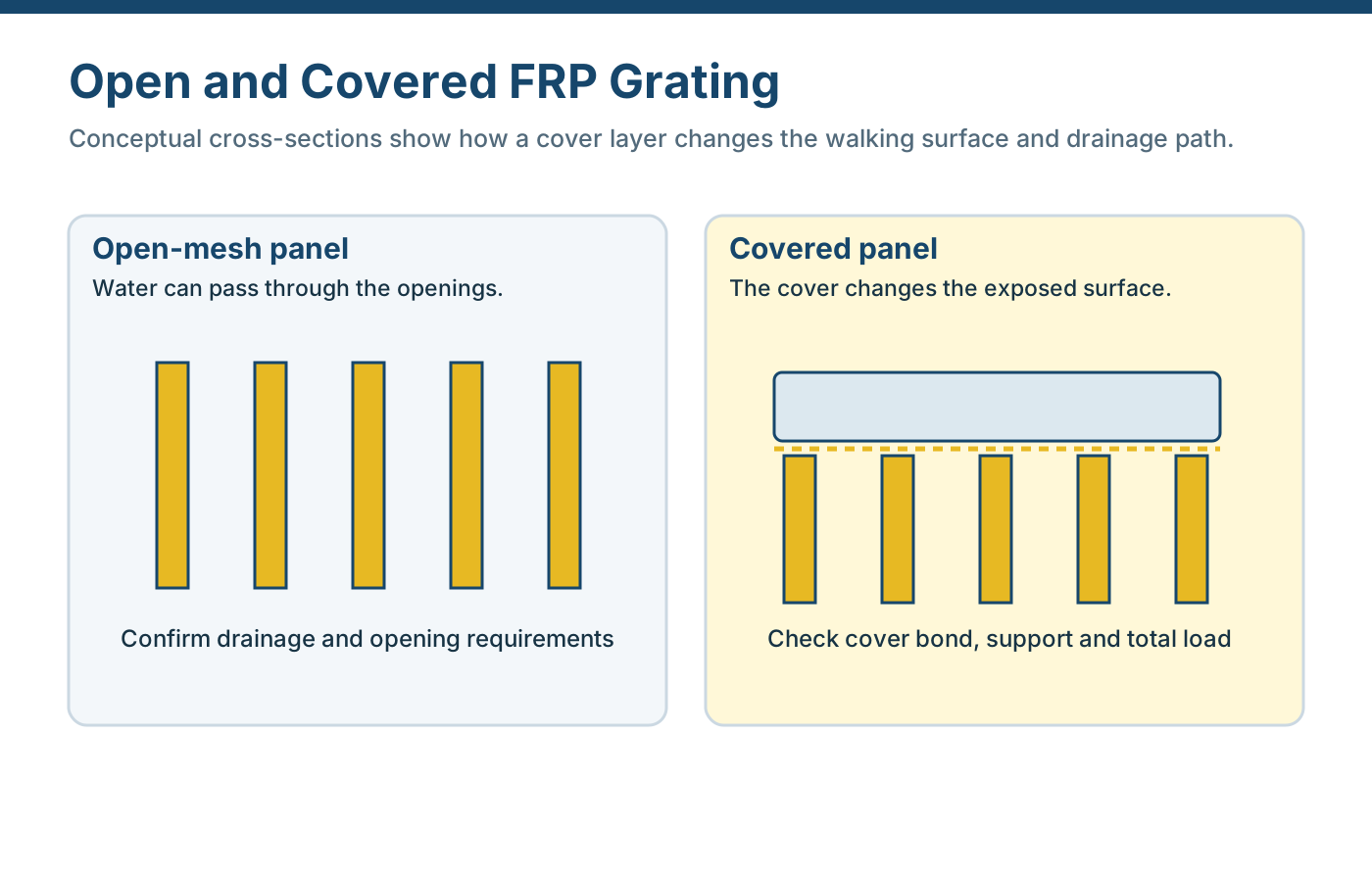
A cover is chosen for one of four reasons: to stop small objects falling through the mesh, to give a more continuous surface underfoot, to reduce liquid or odour passing through the openings, or to achieve a specific appearance in a visible location. Each reason points at a different construction, and two of them are frequently confused. A patterned flat plate is a solid molded product; a covered grating is a base mesh panel with a layer on top. The first carries load through the plate, the second through the base panel.
Because the cover changes the surface, it also changes what happens to water, debris and cleaning. Where the covered area has to drain, the water now has to reach an edge, a joint or a defined opening rather than passing through the panel. That detail belongs in the design from the start, because retrofitting a fall or an edge scupper after the panels are installed is expensive on a site that is already working.
What the Factory Confirms and What Is Defined Per Order
The patterned flat and grit flat formats are confirmed as molds the factory works with, and the base panel range covers molded, mini mesh and pultruded structures. What is not fixed is the assembly: how the cover is joined to the base, how the joints between panels are finished, how the piece is fixed down, and what the combined structure can carry.
That last point is where a covered configuration differs from an open panel order. For two molded base structures we hold adopted load and deflection data with their conditions — for the open panel. A covered assembly is a different structure, so its basis is confirmed with the assembly drawing rather than taken from the open panel data.
Fixings, Edges and Removal
The standard M, L and C clips remain the way the panel is held to its support, and clips are matched to the panel height, bar width and support section as usual. Where the cover needs its own edge trim, fixing or interlock, that is confirmed with the assembly. Cut edges — including the edge through the cover layer — are sealed at the factory on request, which matters more here than on an open panel because there are two layers to protect.
If panels are lifted for maintenance, the assembly has to be built for it: a piece that one person can handle, a cover that stays attached when the panel is lifted, and a fixing arrangement that can be repeated. Those are inquiry-stage decisions, and they are cheaper to make before the covers are bonded than after.
Content last checked: