Application
FRP Tree Grates and Tree Surrounds
Our usual starting configuration for tree pits is 25 mm thick, 40 × 40 mm mesh in isophthalic unsaturated polyester resin with alumina filler, which the factory describes as not load-bearing. The tree opening, outer shape and support come from your drawing.

Tree-surround application photograph supplied for this page; dimensions and supports follow the site drawing.
Usual configuration
FRP Tree Grate Specification Fields
The fields a tree surround order is placed on.
Request a Project Quote| Specification | Value |
|---|---|
| Usual thickness | 25 mm The thickness we normally start from for tree surrounds. |
| Usual mesh | 40 × 40 mm Mesh is given as center-to-center pitch; net opening is a separate dimension. |
| Usual resin | Isophthalic unsaturated polyester resin with alumina filler The economical formulation, for outdoor surroundings without chemical exposure. It is the isophthalic resin, not general purpose polyester; strong corrosive exposure and a longer service life are quoted in another resin direction. |
| Load position | Not load-bearing The factory describes tree surrounds as not load-bearing. Where people or equipment load the area, the support and structure are reviewed as a new condition. |
| Cutting | Outer shape and tree opening cut to drawing Cut-to-size work is priced on the delivered area with the specific sizes and loss. |
| Edge sealing | On request Cut edges can be sealed with resin at the factory; sealing protects the edge and is not structural reinforcement. |
| Colors | Yellow, green, blue, gray, black, plus custom The color reference is confirmed with the order; color is not a performance property. |
Drawing inputs
What a Tree Grate Drawing Has to Show
Six items, each of which changes what the factory cuts and how it is supported.
| What the drawing has to show | How it is dimensioned | Why it decides the panel |
|---|---|---|
| Outer shape | Length and width, or the boundary of an irregular shape, and how many pieces it is split into | Decides the nesting, the number of pieces to handle and where the joints fall |
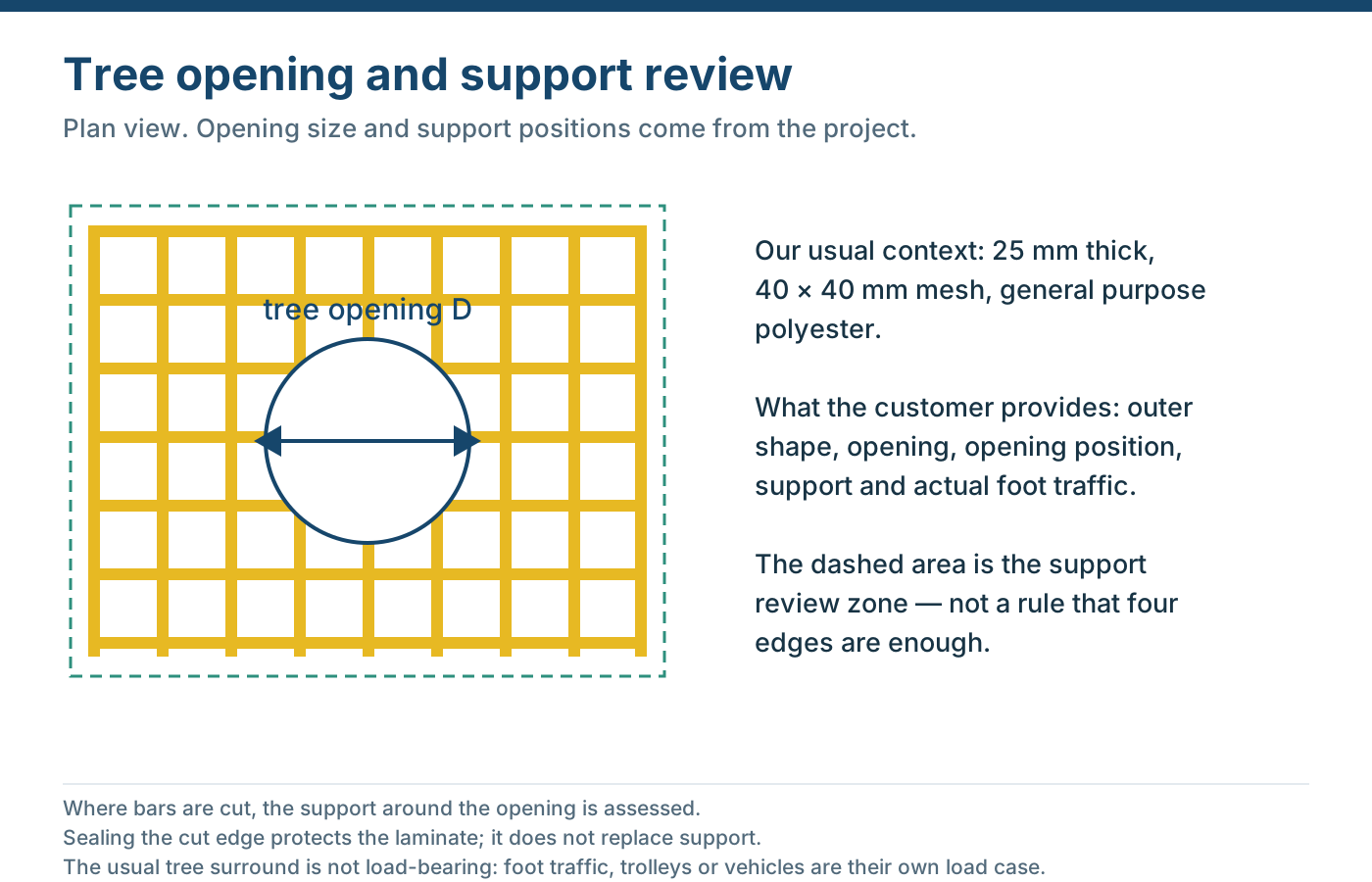
| Tree opening | Opening shape, size, and its distance from the panel edge or center | Decides which bars are cut and how much continuous structure is left around the opening |
| Clearance around the trunk | The opening size required, including any allowance for growth | The allowance is the project landscape designer’s decision, not a factory default |
| Support | Frame, kerb or bearing positions, and where the opening sits relative to them | The panel edge and the remaining structure after cutting have to land on something that bears |
| Use of the area | Whether people walk on it, whether trolleys or cleaning equipment cross it, and whether the surround is lifted for maintenance | Changes the load case, and with it the thickness and support |
| Environment and appearance | Sun, rain, soil and leaf litter, cleaning method, color and surface | Resin direction, UV and surface format are confirmed from these conditions |
Boundaries
Three Boundaries on Tree Grate Selection
The assumptions that turn a simple surround order into rework.
- Not load-bearing is a description, not a design approval — The factory describes its usual tree surround configuration as not load-bearing. That does not mean no support is needed, and it does not cover a surround that vehicles or cleaning equipment cross — those are separate load cases.
- Sealing the opening does not restore the cut bars — Resin sealing protects exposed laminate at the cut edge. Around a small tree opening this is usually all that is needed; around a large opening that severs several bars, the remaining structure and its support still have to be assessed.
- Color and surface are appearance choices — Standard colors and custom colors are available, and concave or grit surfaces can be discussed for pedestrian contact. Neither choice proves UV performance or slip resistance.
Project inputs
What to Send for a Tree Grate Quotation
A dimensioned plan view answers most of these at once.
- Plan view with dimensions — Outer outline, tree opening, and the dimension datum used on the drawing.
- Support arrangement — Kerb, frame or bracket positions, and how the panel edge bears on them.
- Quantities — Number of surrounds, and whether each one is identical or follows its own opening size.
- Loading — Whether the area is only planted, or also walked on, crossed by equipment or driven over.
- Surface and color — Concave or grit finish, color reference, and whether a sample is needed first.
- Maintenance access — Whether any piece has to be lifted to reach the pit or the roots.
Request a quote
Send Your Tree Opening and Outline
The opening and the support positions are the two dimensions that matter most.
- Molded and pultruded grating produced in house
- Full panels or factory cut-to-size pieces
- No fixed minimum order quantity
FRP Tree Grate Questions
What is your usual tree grate configuration?
Can a tree surround be driven over?
How is the opening made?
Can the surround be lifted for root access?
Are the pieces sealed after cutting?
Continue With Tree Grates
Applications directory
The other applications we can describe from our own supply experience.
Grating selection guide
Work from the application and conditions to a candidate configuration.
Cutting and sealing
Cut lists, openings, factory cutting and edge sealing.
Surfaces and treatments
Concave, grit and other walking surfaces.
Product types and configurations
Thicknesses, meshes and panel sizes available.
FRP Grating Solar Walkways
Planning FRP grating walkways for solar arrays, with cut sizes, support rails, load, surface and fixing details checked before quotation.
FRP Grating Construction Walkways
Ground-level FRP grating walkways for construction sites — our usual 30 mm, 38 × 38 mm polyester starting point, and the point where a walkway stops…
A Paving Element, Not a Platform
Tree surrounds sit in the gap between hard landscaping and structure. They are bought on appearance and fit, they are cut around openings, and in most schemes nobody stands on them for long. That is why our usual configuration is a modest one — 25 mm thick with a 40 × 40 mm mesh in isophthalic unsaturated polyester resin with alumina filler — and why the factory describes it as not load-bearing rather than quoting a capacity figure.
The moment the brief changes, the product has to change with it. A surround that cleaning equipment crosses, or one that carries a bench, or one that has to support a planter, is a different load case and needs a different structure and support. Saying so at inquiry stage costs nothing; discovering it after the pieces are cut costs a new order.
Getting the Opening and the Outline Right
Most tree grate problems are geometric rather than structural. The opening is drawn at one size on the landscape plan and one size on the kerb detail; the trunk allowance is left undecided; the piece is dimensioned from the outer edge on one side and the center on the other. The result is a surround that has to be cut again on site, where edge sealing is much harder to do properly.
Two habits prevent it. First, dimension everything from a single stated datum, and show the opening position relative to the support as well as the outline. Second, decide the trunk allowance before ordering — the opening has to clear the trunk and any root flare now, and some schemes want an allowance for growth. Neither of those is a factory default, because the right answer depends on the tree, the soil and the landscape design.
Finishing and Aftercare
Cut edges are sealed with resin at the factory when requested, which is the more reliable place to do it. Surface finish is chosen for how the area is used: a concave surface is the standard walking surface, while a grit surface is considered where the surround is wet or where pedestrians step on it regularly. Standard colors are yellow, green, blue, gray and black, with custom colors available, and a sample can be compared before the order is placed.
Once installed, the surround should be checked the way any grating is checked: any step at the kerb, any piece that rocks, fixings that have loosened, and debris or soil blocking the opening. Lifting a piece for root work should follow the original fixing arrangement, and any crack at a bar is a structural observation rather than something to fill and forget.
Content last checked: