Application
FRP Grating Offshore and Marine Platforms
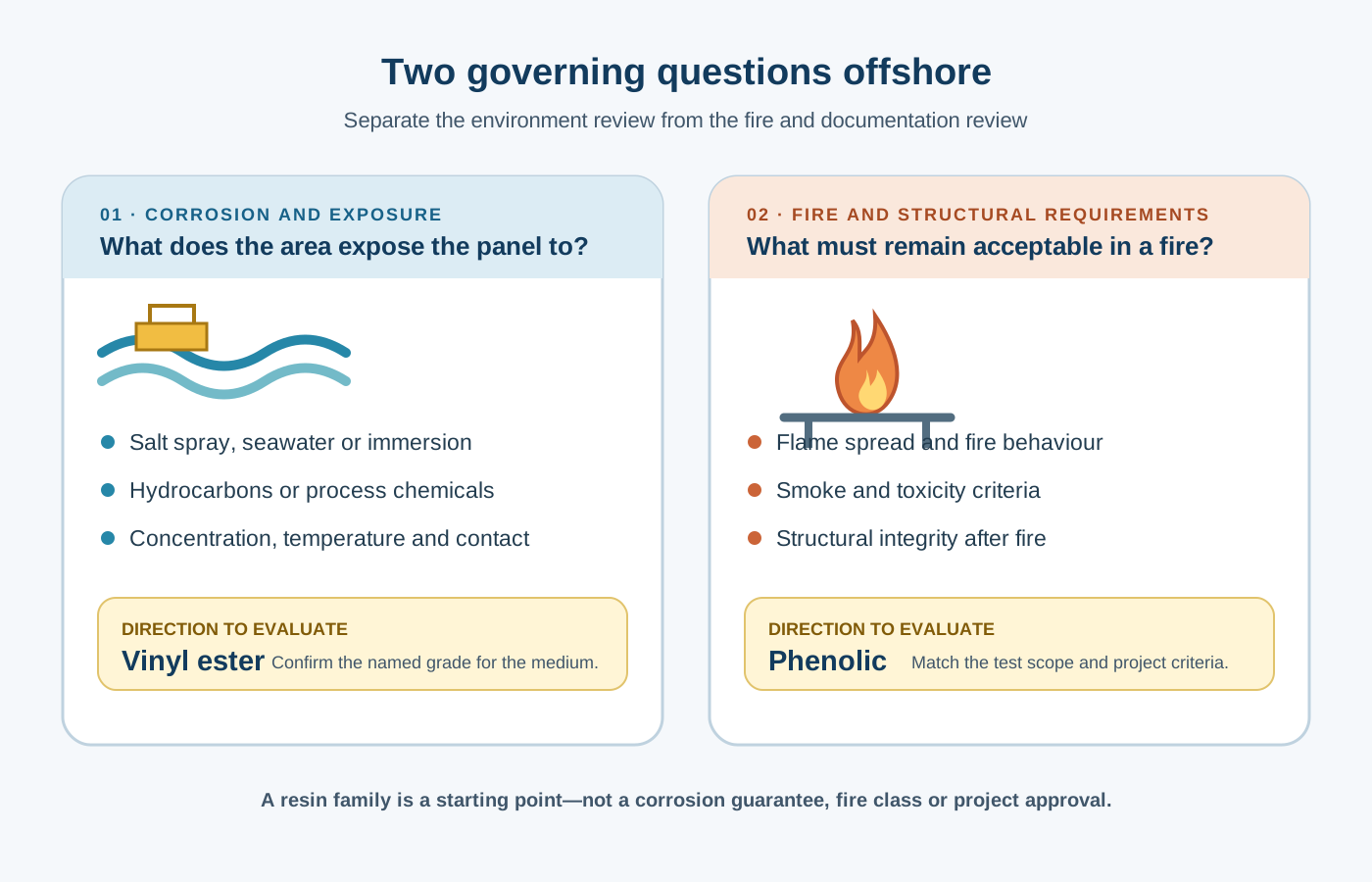
Vinyl ester and phenolic are the two directions we work with offshore, chosen by what governs the area: corrosion, or fire and smoke. This page separates those requirements, because a corrosion resin does not answer a fire question.
Resin directions
Resin Directions for Offshore and Marine Platforms
Candidate, where it is used, and the condition that still has to be confirmed.
| Resin direction | Used when | What has to be confirmed |
|---|---|---|
| Vinyl ester | Marine exposure, salt, hydrocarbon contact and chemical service are the governing conditions | Medium, concentration, temperature, contact type, and the documents the classification society or client requires |
| Phenolic | Fire, smoke, toxicity or structural fire integrity are acceptance criteria | The standard, the acceptance criteria, the test method and the report that has to be produced |
| Epoxy | Where the corrosion target is set high and the project accepts the associated cost and repair method | The project requirement, and how the panel would be repaired in service |
| General purpose or isophthalic polyester | Considered only for areas genuinely outside chemical and fire scope, such as internal non-exposed access | Confirmation that the area really is outside the governing requirement |
Fire and corrosion
Six Offshore Requirements and What Each One Needs
The right-hand column is the assumption that causes the most trouble.
| Required performance | What has to be checked | What does not substitute for it |
|---|---|---|
| Surface flame spread | Test method, sample and surface, and the result recorded in the report | How long the structure keeps carrying load in a fire |
| Smoke density | The smoke parameter, the test conditions and the product tested | Toxicity, or any claim that a space can be evacuated safely |
| Smoke toxicity | The project indicator and the scope of the test | An assumption that low smoke means low toxicity |
| Structural integrity in fire | The offshore or marine requirement, the product structure, and the test or approval scope | A fire-retardant formulation, or a resin supplier datasheet |
| Continuous service temperature | The actual operating condition, long-term loading and the product data | A deflection temperature or a fire test result |
| Corrosion resistance | Resin grade against the medium, concentration, temperature and exposure type | The resin family name, or one grade standing for the group |
Boundaries
Three Boundaries on Offshore FRP Grating
Written down because each one is a common shortcut from other suppliers' documentation.
- No fire class is transferred from another supplier — Other manufacturers publish fire and structural integrity statements for their own phenolic products. Those statements belong to their products, and we do not attach their class or approval to ours.
- The documents decide the offer — The original material test report and the order certificate of conformity are available, but the report does not provide product-specific fire, smoke or structural approvals. Offshore projects usually need documents beyond it, so the required scope is agreed before production rather than after.
- Fire is not one requirement — Flame spread, smoke density, toxicity and structural integrity in fire are separate properties with separate tests. A project that needs all four has to state all four, and each is checked against the product evidence available.
Project inputs
What to Send for an Offshore Grating Review
Six items, and the document list often decides the offer.
- Area and function — Where on the platform the grating goes, what it carries and whether it is an escape route.
- Environment — Salt, hydrocarbon, chemical and temperature exposure, including wash-down and splash zones.
- Fire and smoke criteria — The standard or client requirement, the acceptance criteria and the report format expected.
- Load and support — Support layout, clear span, load type and value, and any deflection limit.
- Documents — Which reports, certificates or approvals have to be provided, and at what stage.
- Fixings and surface — Clip material and grade for the exposure, and the walking surface required in wet conditions.
Request a review
Send the Area, Environment and Document List
Acceptance documents change the product, so they belong at the start of the inquiry.
- Molded and pultruded grating produced in house
- Full panels or factory cut-to-size pieces
- No fixed minimum order quantity
Offshore FRP Grating Questions
Which resin do you use offshore?
Can you supply fire-rated grating?
Do you have classification society approval?
Is vinyl ester suitable for seawater?
Continue With Offshore Platforms
Resin selection
Resin directions compared by medium, concentration, temperature and exposure.
Chemical resistance
How effective compatibility documentation is checked for a specific product.
Temperature and creep
Service temperature, long-term load and thermal movement.
Quality and documentation
What the factory issues today and what is arranged per project.
Technical resources
The technical material behind this application.
GRP riser grating
Service shafts where pipes pass through the grating and access has to be planned on one drawing.
Fiberglass dock grating
Barefoot, permanently wet walkways where grip, drainage and chlorine or salt exposure are decided together.
FRP Grating Applications
FRP grating applications we can describe from our own supply experience — walkways, tree surrounds, wastewater areas, solar walkways and trench covers.
Two Different Offshore Questions
Offshore inquiries usually arrive with one of two governing conditions, and they need different answers. In the first, the platform is wet, salty and often hydrocarbon-exposed, and the question is how long a panel survives without corroding and how its fixings behave in that environment. Vinyl ester is the direction we start from there, confirmed against the specific medium, temperature and exposure.
In the second, the governing condition is fire: flame spread, smoke, toxicity or the ability of the structure to keep working for a defined period. Phenolic is the direction considered for that, but the answer is not a resin name — it is a test scope. A project that requires a specific class, a specific test method or a specific approval is asking for documentation, and the documentation has to be matched to the product and the configuration before anything is offered.
Where the Evidence Has to Come From
Our position is deliberately plain. The original material test report HZTC/BG-24051102 and the order certificate of conformity are available, and further testing can be arranged. The published report covers submitted material samples and does not provide a product-specific fire, smoke or structural approval for every model. Other manufacturers publish fire and structural integrity statements for their own phenolic products, and those are useful for understanding what the market offers — they are not evidence about ours.
So an offshore inquiry that needs fire or structural documentation is answered in two steps. First, the requirement is read: which property, which standard, which acceptance criteria. Then the available evidence is checked against it, and where something is missing, the testing scope, laboratory, lead time and cost are agreed before production. That is a slower start than quoting a class from a brochure, and it is the only version that survives a client audit.
Temperature, Load and Fixings
Marine environments also bring temperature and long-term load into the picture. Panels that sit in sun, over hot equipment or under continuous equipment weight behave differently from panels loaded briefly by people walking. The service temperature and the long-term deflection are confirmed from the actual condition and the product data, not from a fire test result or a datasheet deflection temperature.
Fixings are part of the same decision. Galvanized and stainless clips are both available, and the grade is agreed for the exposure — a splash zone, a deck exposed to salt spray and an internal space have different demands. The clip has to match the panel height and bar width as usual, and the support section has to be capable of taking the fixing, because offshore structures rarely allow new holes to be drilled at will.
Content last checked: