Stair retrofit scope decision
FRP Stair Nosing vs Tread Covers: Which Retrofit Scope Fits?
A worn front edge does not always require a full cover, and a loose or failed tread cannot be repaired with either one. Inspect the substrate, wear field, finished geometry, fixing and landing transitions before choosing the route.
Prepared by
Dengtai Industry
Published
·
Reviewed

The existing step, edge, fixing condition and landing all belong to the retrofit decision. Photo: Dengtai Industry.
FRP stair nosing and a tread cover solve different amounts of the same problem. A nosing addresses the front edge people approach. A full tread cover renews the walking surface across the tread. A replacement tread becomes the load-bearing stair member. The correct route starts with the existing stair condition, not with the smallest product in a catalogue.
This page is the retrofit-scope decision. The tread-cover guide explains how to specify a full cover. The nosing guide details separate and integral edge products. The measurement guide records dimensions. This page asks which of those routes is justified in the first place.

Start With the Existing Tread, Not the Nosing
Walk the complete flight and inspect more than the worn front edge. Look for movement, cracks, corrosion, crumbling concrete, delamination, missing support, loose fasteners and local patches. A tread can look sound from above while the structural edge or carrier has failed.
Record the substrate because it controls the attachment route. A cover fixed to a steel step, a concrete step and a timber step does not share one fixing assumption. The substrate survey in the tread-cover guide expands those checks. A product selected before this inspection may hide the defect it was meant to solve.
Match the Repair Scope to the Wear Field
If wear is concentrated at the front edge and the rest of the tread is sound, a separate nosing or edge repair may be enough. If the entire walking surface is polished, chipped or worn, a full cover may be more coherent. The difference is not price alone; it is where the failed function exists.
The wear field should be marked in plan and section. Include grit loss, coating wear, corrosion staining, impact dents and damaged edges. Where the damage crosses the support or end connection, return to the structural review instead of covering it.
A Full Cover Renews the Surface but Adds Height
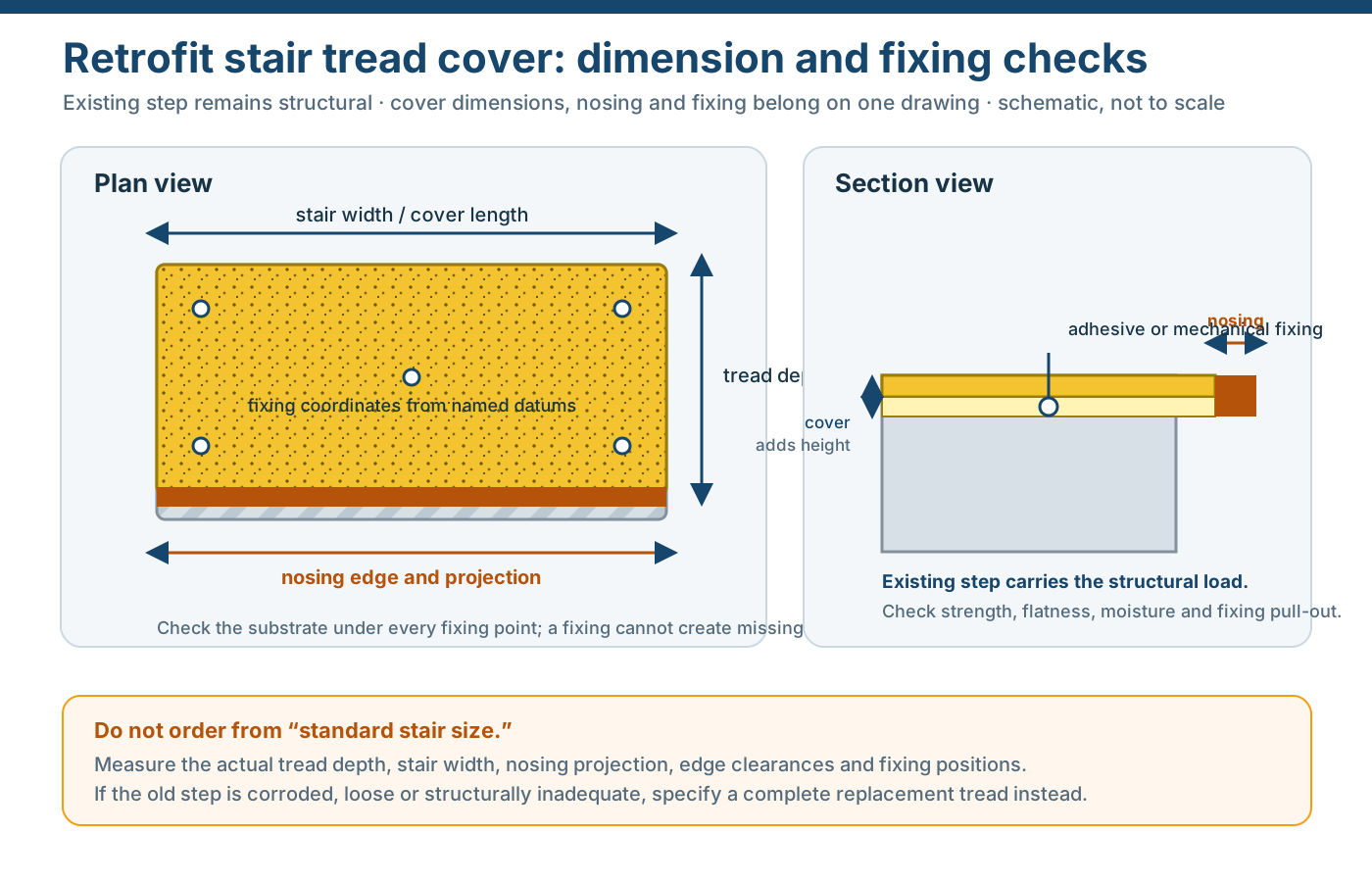
National Grating’s stair-cover article presents covers over existing metal, wood or concrete steps and distinguishes them from replacement stair treads. That is a useful product boundary: the cover can renew safety, visibility and appearance while the existing step remains structural.
The cover still changes the finished stair. JINGLUE’s tread and cover product comparison lists full treads and thin retrofit covers with different depth and nosing values. Even if those example sizes fit one supplier’s range, the project must check the finished rise, tread depth, nosing projection, fixing and top and bottom landings for the actual stair.

The Nosing Has Structural and Visual Functions
The front edge may be a formed part of a load-bearing tread, a return formed by the cover, a separate profile fixed to the existing base or a visual contrast band. These are different products. Colour can improve visibility, but it does not create slip resistance or restore a broken edge.
For an edge-only repair, measure the receiving surface, profile, width, projection, fixing access and finished step geometry. For a cover with a returned edge, identify how the return is produced and supported. The separate or integral nosing guide carries the product detail beyond this scope decision.

Check the Whole Flight After the Retrofit
Measure the existing first, last and typical treads before choosing the scope. Then add the proposed cover or nosing to the section and compare every finished rise. Check headroom, doors, rails, stringers and the top and bottom landing transitions. A repair can work on the middle of the flight and fail at the ends.
If a full cover adds too much height or cannot transition safely at a landing, a separate nosing or replacement tread may be a better route. The finished-height guide explains the installed geometry check in greater depth.
Decide How the Repair Is Fixed
A bonded cover or nosing can spread attachment across the substrate, but it requires a compatible adhesive and a clean, sound, suitably dry surface. The approved method should state preparation, adhesive, coverage, open time and cure before the stair returns to service. A mechanical fixing is easier to inspect and replace, but it still needs a drillable substrate, correct hole size, edge distance, washer and sealed penetration.
Do not compare the two by whether one “sticks harder.” They create different inspection and maintenance access. A failed substrate, loose delamination or wet concrete can undermine a bonded system, while a thin or cracked steel section can leave too little material for a reliable fastener. The product pages carry the detailed adhesive and fastener requirements; this scope page should keep them in the comparison.
Outdoor Drainage and Stair Downtime
For an exterior or wash-down stair, compare open and closed surfaces before choosing the cover. Open treads let much of the water and debris pass through, while a closed cover relies on its joints, slopes and edge path to clear water. Snow, ice and freeze-thaw can change both grip and the risk of water standing against a trim or landing.
The complete decision also includes downtime. Preparation, dry fitting, drilling or bonding and adhesive cure can keep the flight out of service longer than the product installation time alone suggests. Compare the finished repair on material, labour, access, cure, inspection and future maintenance rather than using the piece price as the only proxy.
Our Factory View: Quote the Piece, Not the Hidden Structural Repair
Our review starts with two photographs: the complete flight and the substrate or fixing area. A close-up of the worn nose alone cannot show whether the tread is loose or whether a full cover will fit. We ask for the wear field, dimensions, substrate, finished levels and intended repair route before treating the quotation as complete.
We can fabricate a separate nosing, a cover, or a load-bearing tread to an approved drawing. We cannot turn a failed structural tread into a sound one by supplying a surface product. Keeping that boundary explicit protects the customer from buying the wrong scope and protects the installation from hiding a condition that should have been repaired.
Scope vocabulary
Stair Nosing and Tread Cover Retrofit Terms
- Nosing
- The front edge of a stair tread approached when climbing. A nosing may be formed into the tread, produced by a cover return or supplied as a separate profile.
- Nosing repair
- Work limited mainly to the front-edge walking surface and its attachment. It can renew wear or visibility while leaving the main tread surface in place, provided the base remains suitable.
- Stair tread cover
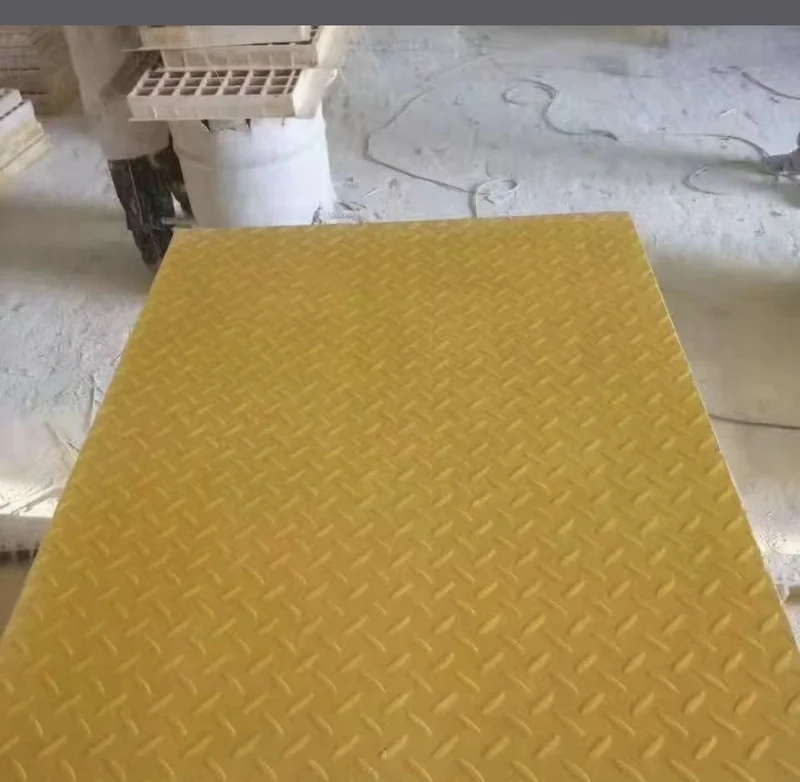
- A relatively thin FRP walking surface fixed over an existing step. It renews the upper surface and edge but does not replace the structural tread.
- Replacement tread
- A load-bearing stair tread that spans between stair supports. It is used when the old tread or its support condition cannot remain in service.
- Substrate
- The steel, concrete, timber or existing FRP step receiving the nosing or cover. Its condition, flatness, moisture and fixing capacity are part of the selection.
- Wear field
- The part of the walking surface showing abrasion, polishing, coating loss or damage. Edge-only wear and broad surface wear lead to different scopes.
- Finished rise and going
- The installed vertical and horizontal stair geometry after the retrofit. Added cover thickness and nosing projection can change both.
- Retrofit scope
- The amount of stair work being proposed: edge repair, full-surface cover, selected component replacement or complete tread replacement.
- Open or closed tread
- The walking-surface format after repair. An open grating tread passes water and debris through; a cover or closed tread requires a defined edge, joint or drainage path instead.
- Adhesive fixing
- A bonded attachment whose suitability depends on substrate, moisture, cleanliness, adhesive compatibility, coverage and cure.
- Mechanical fixing
- Screws, bolts or another removable fastener whose substrate, edge distance, hole preparation, washer and sealing condition must be defined.
- Stair downtime
- The time the flight must remain out of service for preparation, dry fit, fixing, adhesive cure and post-installation inspection.
Before choosing a product
When an Edge Repair or Full Cover Is Appropriate
Specify this if…
- The existing tread and surrounding stair can be inspected.
- The wear pattern can be located on plan and in section.
- The substrate is capable of receiving the proposed fixing.
- The adhesive, mechanical or combined fixing route can be inspected and maintained.
- Finished rise, nosing projection and landing transitions can be checked.
- The project can define grip, visibility, drainage and maintenance requirements.
- The expected stair downtime and access restriction are acceptable.
- The buyer can distinguish surface renewal from structural replacement.
Look elsewhere if…
- The stair is moving, cracked, corroded through or structurally loose.
- The repair is selected from a photograph of the top surface only.
- A full cover is proposed without checking thickness at the top and bottom landings.
- A separate nosing is expected to repair a failed tread base.
- An outdoor cover is proposed without a defined water, ice and cleaning path.
- The tread support or carrier condition is unknown.
- Colour or grit appearance is the only requirement.
Repair boundary
Nosing, Tread Cover and Replacement Tread
| Repair scope | Best fit | What must still be checked |
|---|---|---|
| Separate nosing repair | Local wear, low grip or visibility problem at the front edge | Base soundness, fixing, projection, step rise, gaps and edge support |
| Integral nosing on a new tread | The original tread is being replaced | End support, load, span, tread depth, finished nose and installation |
| Full tread cover | Broad walking-surface wear, appearance or grip renewal over a suitable base | Cover thickness, base preparation, fixing, drainage and both landing transitions |
| Cover with returned edge | A continuous covered surface with a defined front-edge detail | Whether the return is part of the cover, how it is supported and how the finished nose is fixed |
| Replacement tread | A failed base, excessive build-up or new structural requirement | Carriers, clear span, tread load and all stair-landing geometry |
| Open tread | Water, debris and snow can pass through the panel | Mesh, dropped objects, cleaning and open-edge detail |
| Closed or covered tread | A more continuous walking surface over the base | Drainage path, added mass, joints and freeze-thaw conditions |
| Fixing route | Adhesive, mechanical or combined attachment | Substrate preparation, moisture, edge distance, cure and future removal |
Field record
Fields for a Stair Retrofit Scope Survey
| Survey field | What to record | Why it changes the repair scope |
|---|---|---|
| Stair and step ID | Flight, level, step number and drawing revision | Keeps repeated-looking steps individually controlled |
| Existing substrate | Steel, concrete, timber, FRP or other; condition and thickness | Determines fixing and whether the base can remain structural |
| Wear field | Edge-only, full surface, local patch or physical damage | Separates nosing repair from full cover or replacement |
| Tread geometry | Clear width, front-to-back depth, going, thickness and support ends | Defines the product piece and structural scope |
| Nosing geometry | Existing profile, projection, corner returns and visible contrast | Controls trip risk, appearance and product detail |
| Finished rise | Added thickness, step-to-step consistency and headroom | A full cover may not fit even where it is technically suitable |
| Landings | Top and bottom transitions, door clearance and first/last tread details | Prevents a repair that works mid-flight from failing at the ends |
| Fixing | Adhesive, mechanical, through-fix or combined attachment with access | Must suit the substrate and remain inspectable |
| Moisture and curing | Substrate moisture, surface preparation, adhesive open time and cure | Prevents a bonded or covered repair trapping water or opening under traffic |
| Drainage and cleaning | Open or solid surface, debris, freeze-thaw and cleaning method | Changes product format and trap/ponding risk |
| Cost and downtime | Material, preparation, fixing, access, labour, cure time and future inspection | Compares complete retrofit routes rather than one piece price |
| Acceptance | Grip, visibility, flatness, fixing, finished geometry and owner | Makes the retrofit criterion explicit |
Worked examples
Three Illustrative Stair Retrofit Decisions
| Illustrative stair | Observed condition | Possible scope before measurement |
|---|---|---|
| ST-01 | Steel tread sound; grit worn mainly at the front edge | Separate nosing repair may fit, subject to fixing and geometry |
| ST-02 | Concrete step sound; broad surface polished and chipped | Full tread cover may fit if added build-up and landings allow |
| ST-03 | Existing tread loose and end carrier corroded | Replacement tread review; cover or nosing alone is not a repair |
Seven-step survey
How to Choose the Retrofit Scope
Check repeated treads, stringers, carriers, landings, rails and surrounding clearances.
Separate edge wear from broad surface wear, cracks, movement and missing material.
Record substrate condition, fixing capability and any structural concern for project review.
Record width, tread depth, going, thickness, support ends and all variations.
Check added cover height, nosing projection, finished rise and landing transitions.
Use edge repair, full cover or replacement only after the condition and geometry agree.
Define surface, edge, fixing, piece ID and installation acceptance for the chosen scope.
Before quotation
Stair Nosing or Tread Cover Checklist
- Substrate condition recorded — The existing tread can or cannot remain in service.
- Wear field mapped — Edge, surface, local or structural damage is distinguished.
- Every tread measured — Width, depth, going, thickness and variations are recorded.
- Finished rise checked — The proposed build-up is evaluated across the flight.
- Nosing projection checked — Existing and proposed front-edge geometry are recorded.
- Landings included — Top and bottom transitions, doors and headroom are reviewed.
- Fixing route defined — Attachment suits the substrate and installation access.
- Moisture and cure checked — Adhesive preparation, substrate moisture and return-to-service time are stated.
- Surface duty defined — Grip, visibility, drainage, cleaning and environment are stated.
- Outdoor drainage checked — Water, ice, snow and freeze-thaw have a defined path after the retrofit.
- Downtime included — Preparation, fixing, cure and inspection time are included in the repair comparison.
- Repair scope matches damage — A cosmetic product is not used to conceal a structural defect.
- One stair schedule released — All pieces and fixings share one revision and step ID.
Structural boundary
What the Cover or Nosing Does Not Repair

A nosing is not a coating over a failed edge
A separate profile still needs a suitable base and fixing; it does not repair a loose tread.
A cover is not a structural tread
The existing step remains the structural member unless a new load-bearing tread is designed and supplied.
Added thickness changes the stair
Every riser, top and bottom landing and headroom relation must be checked with the finished retrofit.
Colour is not the anti-slip result
Surface texture, test method and contamination condition remain separate from visibility.
Show the base and finished geometry
Send the Existing Stair and Repair Goal
- Molded and pultruded grating produced in house
- Full panels or factory cut-to-size pieces
- No fixed minimum order quantity
Stair Nosing and Tread Cover Questions
Should I choose a nosing or a full tread cover?
Can a stair tread cover repair a loose tread?
Does a full cover change stair height?
Is a contrast strip an anti-slip nosing?
Can I cover only the worn front edge?
When should the complete tread be replaced?
Is an open or closed tread better for an outdoor stair?
How do adhesive and mechanical fixings compare?
This content was prepared and reviewed by Dengtai Industry’s technical and production team using the project conditions, available product data and applicable documents. Limits that require design, testing or approval are identified in the content. Content last checked: