Trolley route transition survey
FRP Grating for Trolley Wheels: Open, Mini-Mesh and Solid-Top Routes
Check the smallest wheel and individual wheel load separately, then inspect every panel joint, surface change, threshold and turn. Finish with a loaded route trial on the exact proposed construction.
Prepared by
Dengtai Industry
Published
·
Reviewed

The smoother field is only one part of the route. Photo: Dengtai Industry.
FRP grating for trolley wheels should be selected from the smallest wheel and the real transitions before comparing panel names. Open grating, mini mesh and solid top change how a wheel meets the panel field, but every piece still meets panel joints, edges, drains, ramps and the adjacent floor. The route can appear continuous in a catalogue and stop in service at one poorly aligned joint.
This page is the route-survey method for trolleys, carts and other small-wheeled equipment. The solid-top trolley guide compares the three broad product families. The mini-mesh wheelchair and cart guide handles a related passage-and-load method. This page focuses on mixed surfaces and the interfaces between them.

Start With the Trolley Route, Not the Panel Catalogue
Mark how the trolley enters, where it turns, what it crosses, where it stops and how it leaves. Add drains, service covers, thresholds, ramps, door tracks and adjacent floor materials. These features can create a wheel impact even when the main grating field is continuous.
Measure the smallest wheel diameter and width, then list every wheel type on the trolley. A fixed caster and a swivel caster approach a joint differently. A hard small wheel may catch or vibrate where a larger soft wheel rolls through.
Record wheel material and hardness as well as size. Nylon or steel wheels can create a different impact and rolling feel from rubber or polyurethane tyres. A gritted or patterned solid top can help grip while increasing effort or vibration for some wheels. The same surface is not automatically the best compromise for grip, cleaning and rolling resistance.
Unicomposite’s solid-top sizing guide separates cart passage, point-load deflection, bar depth and clip density. It makes an important point: a solid top can smooth the panel field, while the structural span and local wheel load still need their own review. We use that distinction, not a generic “cart-rated” label.
Draw Every Open-to-Mini-to-Solid Transition
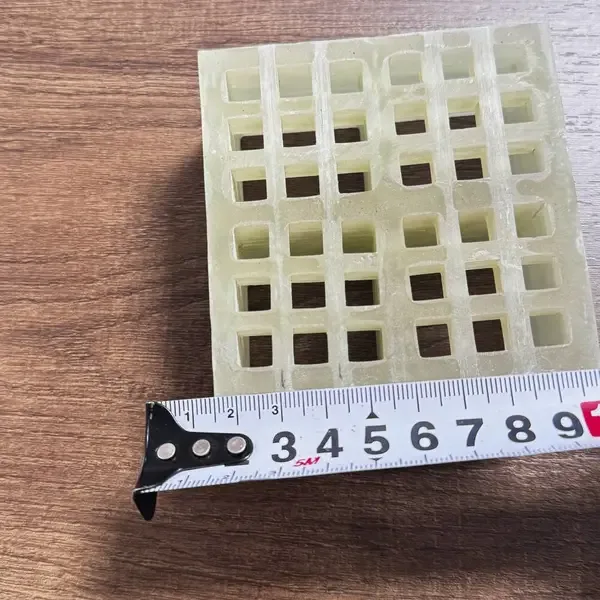
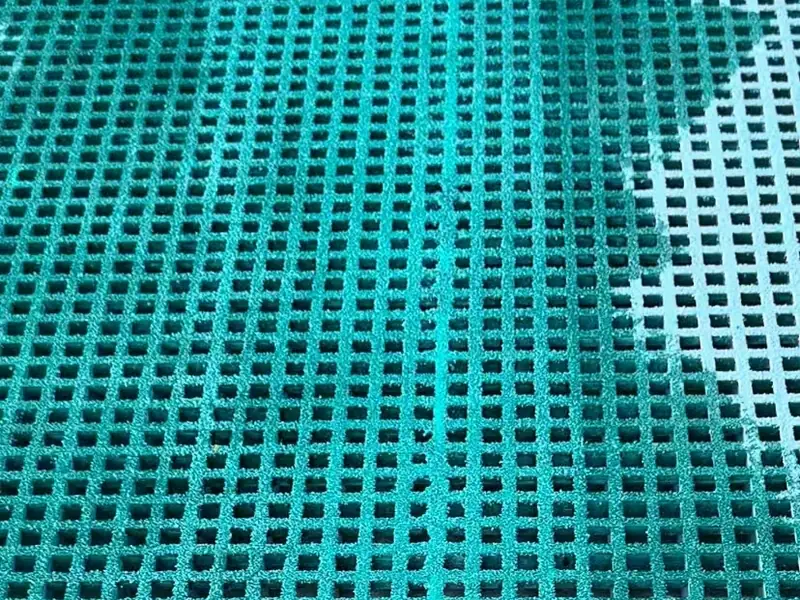
Mixed routes are common. A walking area may use open grating, a cart crossing may use mini mesh, and a dispenser or wet zone may use a solid top. Each change creates at least three questions: does the wheel meet a new opening pattern, does the panel height change, and how is the boundary supported?
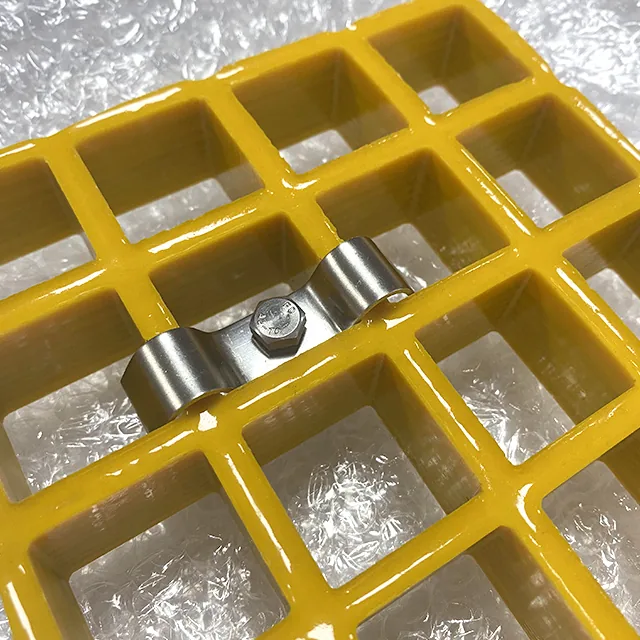
The plan should identify the exact panel types on each side, finished top level, joint gap, edge treatment and bearing condition. A C clip or hold-down clip can join or restrain panel edges, but it does not create a bearing beneath the transition. If a level change exists, use the separate edge-transition method to define a trim, ramp or deliberate step.
Separate the Passage Check From the Load Check
Passage asks whether the wheel can cross the measured opening and every joint without dropping, jamming or unacceptable impact. Load asks whether the complete panel and frame can carry the moving wheel reaction over the actual clear span and meet the project deflection criterion.
A route can pass the first check and fail the second. A small wheel can cross a fine mesh smoothly while its hard contact creates a concentrated load between supports. A solid top can provide a continuous surface while the grating base still deflects too much. Keep the two records separate and use the same route ID.
Dynamic movement is a third route condition. Turning can apply lateral force, braking can transfer load forward, and a sloped or uneven approach can change which wheel carries the governing reaction. Record how the trolley is operated, not only its parked mass. A long wheelbase, a high payload or a swivel caster can behave differently at a threshold even when the panel field passes a static check.
Run the Loaded Wheel Through the Real Route
Use the actual trolley, or a representative load and wheel arrangement, at the proposed product and transition detail. Run straight, turn and stop/start paths. Cross every joint type and the entry and exit thresholds. Record jamming, bouncing, vibration, noise, visible deflection, rolling effort and any measurement required by the project.
The trial should identify the product, panel revision, joint, support and route tested. A pass on one smooth sample does not cover a different mesh, edging, height or wheel. Fibergrate’s grating edge-ramp product illustrates that the transition is a designed accessory with a depth, surface, length and fixing condition, rather than a line on the drawing saying “ramp”.
For thresholds, send the finished surface on each side, actual rise, available run, route width, wheelbase, door or rail clearances and whether the transition is fixed or removable. A ramp or trim that works for a single foot may still catch a small caster or intrude into the trolley’s turning path.
Include Cleaning, Drainage and Removable Pieces
The route’s surface choice also changes cleaning. Open grating passes more water and debris. Mini mesh retains smaller objects but can collect hair or fibrous material. A solid top requires an outlet or drainage detail and may show surface film differently. The trolley route should not solve passage at the cost of an unmaintainable floor.
Removable covers and panels are separate from ordinary joint transitions. They need a bearing seat, a lifting method, a stored position and a repeatable reinstatement. The removable panel restraint guide explains how to keep the closed and open states attached to the correct piece.
Our Factory View: One Route Can Contain Several Evidence Boundaries
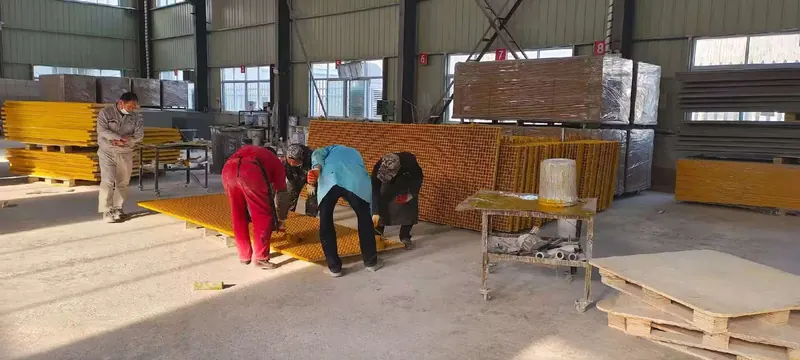
Our quotation review looks for a continuous route record across the pieces. If the survey shows open grating, mini mesh and solid top on one path, we keep them as separate product rows and connect them to transition IDs. We can fabricate the pieces and supply agreed edge or clip components; we cannot invent the trolley load, approve the supporting frame or certify the route without the actual inputs.
This is also where piece identity matters. Mixed panels can look similar after cutting and finishing. A packing list that says only “grating panels” makes installation and later replacement difficult. Route, panel type, joint ID, panel revision and installation position should survive fabrication and packing.
Survey vocabulary
Trolley Route and Grating Transition Terms
- Trolley route
- The complete path travelled by a loaded trolley, including entry, straight runs, turns, joints, ramps, drains, door thresholds and stop positions.
- Wheel envelope
- The wheel diameter, width, tread profile and contact footprint that meet the grating. The smallest wheel is normally the first passage check.
- Wheel material and hardness
- The caster or tyre material, tread profile and relative hardness. These affect impact, rolling resistance, grip and how the wheel meets a joint or textured surface.
- Wheel reaction
- The load delivered through an individual wheel or axle. Total trolley mass is not enough when payload position or wheel arrangement can create an uneven reaction.
- Grating transition
- A change between open grating, mini mesh, solid top, solid floor, a ramp, an edge trim or a removable cover. The walking surface and support path can change at the same boundary.
- Panel joint
- The gap or interface between adjacent grating pieces. It can affect wheel passage even when each panel field uses the same product.
- Threshold
- A change in level or surface at a door, floor, ramp or edge. A small lip can stop a caster that crosses the panel surface easily.
- Loaded route trial
- A controlled run with the actual or representative trolley over the proposed product, joints, transitions and turns, recording jamming, vibration, deflection and rolling effort.
- Rolling resistance
- The effort needed to move the loaded trolley over the actual grating texture, joints and transitions. It may govern usability before structural strength does.
Before selection
When a Trolley Route Needs a Transition Survey
Specify this if…
- The smallest wheel and its loaded route can be measured.
- Wheel material, tread shape and hardness are recorded for the smallest and governing wheels.
- The trolley or equipment supplier can provide wheel or axle loads.
- The route can be marked from entry to destination, including turns and stops.
- Every panel joint, surface change and threshold is visible on the plan.
- Clear spans and support positions are available.
- Slope, braking, turning and threshold conditions are stated where they apply.
- The project can perform a trial with the actual or representative loaded trolley.
Look elsewhere if…
- The only trolley information is total loaded mass.
- The route is selected from a photograph without measuring the smallest wheel.
- A solid-top label is treated as a trolley or structural rating.
- Panel joints and floor transitions are omitted from the layout.
- The product cannot be checked on the actual support and deflection condition.
- The route has a hidden step, soft trim or opening that the buyer expects the panel to solve by itself.
Surface boundary
What Open, Mini-Mesh and Solid Top Change
| Surface route | What it changes | What still must be checked |
|---|---|---|
| Open grating | Through drainage and airflow; the wheel meets visible open cells | Wheel size versus both mesh directions; joints, surface and structural span |
| Mini mesh | A smaller upper grid while keeping the panel open | Upper and lower openings, joints, cleaning and wheel load |
| Solid-top grating | A more continuous rolling field over the grating base | Support and deflection, panel joints, texture, drainage and mass |
| Open-to-solid transition | A change in wheel contact, drainage and often panel construction | Finished level, gap, bearing and edge support at both sides |
| Panel-to-panel joint | A repeated interruption even where the panel product is unchanged | Joint gap, alignment, edge condition and bearing beneath |
| Ramp or floor threshold | A change from grating to another walking surface or level | Rise, length, wheelbase, support, fixing and surface continuity |
| Wheel material and tread | Nylon, polyurethane, rubber, steel or another actual material with tread shape | Impact, vibration, grip and rolling resistance on the proposed surface |
Route schedule
Fields for a Trolley Grating Route Record
| Route field | What to record | Why it matters |
|---|---|---|
| Route ID | Unique route and drawing revision | Keeps wheel, product and trial records connected |
| Trolley and payload | Trolley type, loaded mass and payload position | Provides the starting load case |
| Wheel geometry | Smallest diameter, width, tread and swivel/fixed arrangement | Controls passage through openings and joints |
| Wheel material and hardness | Actual wheel or tyre material, tread profile and relative hardness | Changes impact, grip and rolling resistance on a gritted or patterned top |
| Wheel load | Individual wheel or axle reaction, contact area and location | Separates rolling from structural capacity |
| Route and turns | Entry, direction, turning points, stop/start and destination | Shows where dynamic contact can shift |
| Dynamic condition | Speed, braking, turning, slope and possible load shift | Converts a static trolley mass into a route loading condition |
| Product map | Open, mini mesh, solid top, chequer cover or mixed arrangement | Prevents one product name from hiding different interfaces |
| Joints and thresholds | Gap, level change, trim, ramp, edge support and alignment | Finds the stop point that a panel-only comparison misses |
| Support and deflection | Clear span, bearing, frame and required deflection limit | Ties wheel load to the actual installed structure |
| Trial condition | Loaded/unloaded state, repetitions, route and observed behaviour | Makes acceptance repeatable |
| Acceptance owner | Person who accepts passage, deflection, noise, drainage and maintenance | Prevents the supplier from inventing the route criterion |
Worked example
An Illustrative Mixed-Surface Trolley Route
| Illustrative item | Example value | Why it is recorded |
|---|---|---|
| TR-01 trolley | Four-wheel service cart; loaded mass and payload position to be supplied | Defines the moving equipment |
| Governing wheel | To be measured; include swivel and fixed wheels | The smallest wheel governs passage, while the most heavily loaded wheel governs structure |
| Route surfaces | Open grating at entry, mini mesh at crossing, solid top at dispenser | Creates two transitions that need separate details |
| Interface | Joint gap and finished level to be measured | A caster can catch before the structural panel is challenged |
| Load evidence | Wheel or axle reaction plus clear span and deflection criterion | Connects the route to the exact panel and frame |
Seven-step method
How to Survey a Grating Route for Small Wheels
Draw entry, straight runs, turns, stop points, drains, thresholds and destination.
Measure diameter, width and tread for every wheel type that uses the route.
Obtain the governing reaction and payload position from the real trolley or supplier.
Show open, mini mesh, solid top, covers, joints and adjacent floors.
Record clear spans, bearing, frame conditions and all rises or gaps.
Run the real or representative trolley through turns and interfaces and record behaviour.
Tie product IDs, transitions, fixing, packing and acceptance records to the same revision.
Before quotation
Trolley Grating Route Checklist
- Route marked end to end — Entry, turns, stops, drains, thresholds and destination are visible.
- Smallest wheel measured — Every wheel type is checked, including swivel casters.
- Wheel material and tread recorded — The actual caster or tyre material, shape and hardness are included.
- Wheel loads available — Individual or axle reactions are stated where practical.
- Product map drawn — Open, mini mesh, solid top and adjacent surfaces are identified.
- Panel joints recorded — Gap, alignment, edge condition and bearing are shown.
- Thresholds and ramps recorded — Finished levels, rise, length and fixing are defined.
- Dynamic conditions stated — Slope, braking, turning, speed and load shift are recorded where relevant.
- Support and deflection referenced — The exact panel, clear span and project limit are attached.
- Handling approved — Removable pieces have mass, lift points, storage and reinstatement.
- Loaded route trial completed — The real wheel crosses every representative interface under load.
- Evidence owner named — One party accepts the route, trial and finished installation.
Evidence boundary
What a Grating Supplier Can and Cannot Approve

The product is not the route
A panel field that is easy to roll across can still fail at a joint, threshold or adjacent floor.
The cover is not the wheel load
Load evidence must match the exact grating, frame, support, span and wheel condition.
A trial is not a universal certification
The trial record applies to the wheel, load, product, route and revision tested.
The factory cannot invent traffic data
We need the actual trolley and route inputs, or the affected zone remains a project review item.
Show every interface
Send the Trolley, Wheel and Route
- Molded and pultruded grating produced in house
- Full panels or factory cut-to-size pieces
- No fixed minimum order quantity
Trolley Grating and Wheel Transition Questions
Is solid-top grating always better for trolleys?
Is mini mesh a solid surface for small wheels?
Can an open-grating route work for a trolley?
Can I divide the trolley weight by four to get wheel load?
Does smooth solid top remove deflection?
What should a trolley route trial record?
Which wheel property matters most?
This content was prepared and reviewed by Dengtai Industry’s technical and production team using the project conditions, available product data and applicable documents. Limits that require design, testing or approval are identified in the content. Content last checked: