Dropped-object path review
Dropped-Object Risk: Mini Mesh or Solid-Top Grating?
Start with the object that may be released and every path through the installed surface. Mini mesh retains objects above its measured opening; solid-top grating removes the through-panel opening but changes drainage, cleaning, mass and access.
Prepared by
Dengtai Industry
Published
·
Reviewed

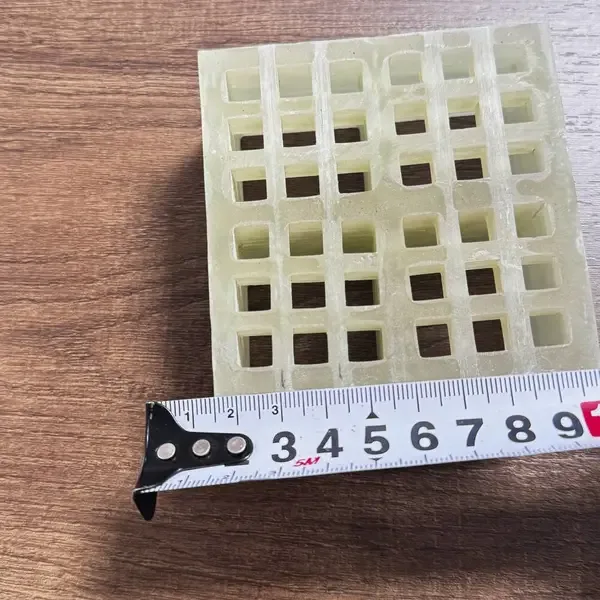
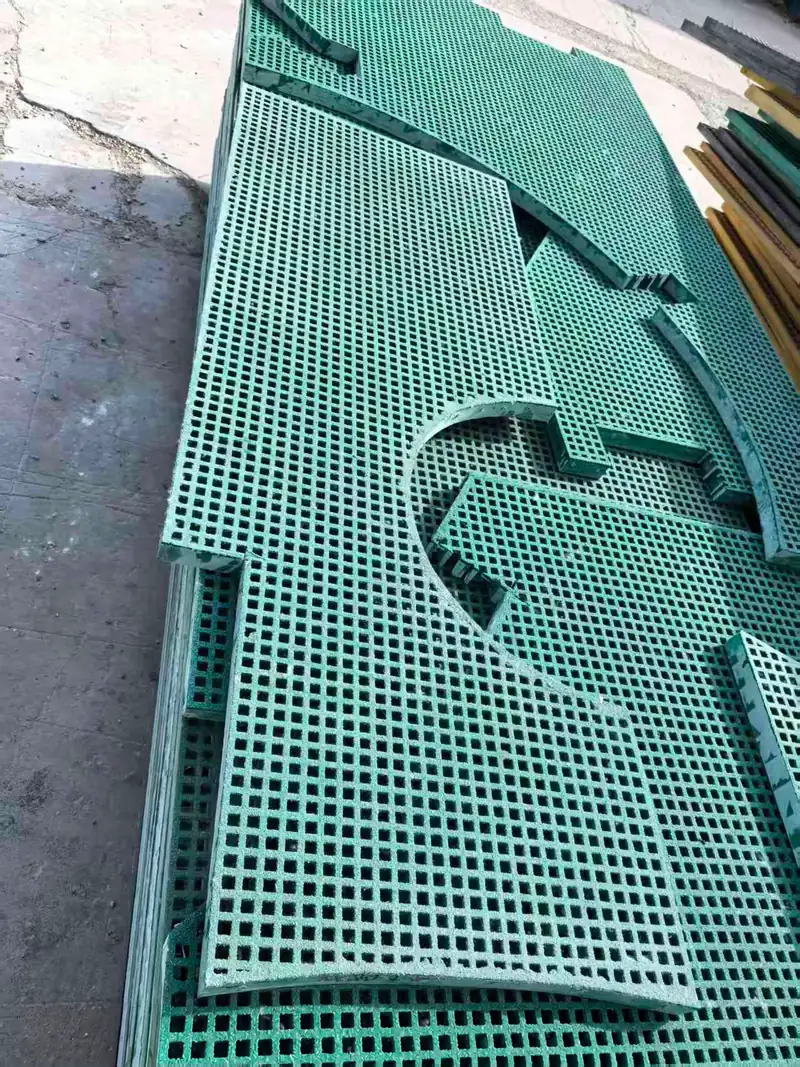
The upper opening is visible, but joints, lower mesh and service openings can create different paths. Photo: Dengtai Industry.
Dropped-object control starts with what can be released, not with the label “anti-drop grating.” The task is to compare the object envelope with every available route in the installed surface: the top mesh, lower grid, panel joints, perimeter gaps, service cutouts, cover seams and removable pieces. Only then can mini mesh or a solid top be selected responsibly.
This guide is prepared and reviewed by Dengtai Industry’s FRP grating and fabrication team. It applies to the product geometry and finished-piece scope we can document. It does not replace the site’s dropped-object programme, structural design, fall-protection design or exclusion procedures.

Start With a Real Object and Its Worst Orientation
“Small debris” is not a test condition. A nut, washer, bolt, drill bit, cable tie, hand tool, wrapper and offcut have different shapes. A long narrow object may enter a small grid edge-on; a flexible object may fold or bend. Mass and drop energy affect the consequence but do not describe whether the object can pass.
Record:
- the object name and where it comes from;
- smallest rigid dimension;
- length, width and thickness;
- flexibility and the worst credible orientation;
- approximate mass and expected drop source;
- area, person, equipment or process below;
- whether the task requires retention, reduced loss or a defined impact control.
Photograph the object with a ruler and keep it with the marked plan. If several objects are used, select the item that creates the most difficult passage condition rather than averaging their sizes.
Compare the object with the actual clear opening
Pitch is centre-to-centre. Clear opening is the unobstructed gap between bar edges at a defined measuring plane. Our mini mesh product page lists the current upper and lower mesh rows, but the project should still measure a sample or approved drawing.
For the current 19 x 19 mm upper row with a 6.5 mm nominal bar width, the approximate arithmetic is:
19 mm pitch - 6.5 mm bar = about 12.5 mm clear gap
That result ignores bar taper, surface grit, manufacturing tolerance and the lower grid. It is not a universal object limit. The 11 x 11 mm row with an 8.0 mm nominal bar gives an approximate 3 mm upper gap, but the much finer grid creates a different cleaning and drainage burden.
Review a falling-ball or drop-through test claim
A supplier may describe a mini-mesh product as passing a 15 mm falling-ball or drop-through test. That can be useful evidence, but it does not answer every dropped-object question for the installed platform. The number describes a defined test condition, not a universal maximum object size or a guarantee that the whole walkway is closed.
Before accepting the claim, ask for:
- the exact test standard and edition;
- ball diameter, mass and drop height;
- the tested product family and row, including mesh, depth and surface;
- specimen size, support, orientation and boundary condition;
- number of drops and the pass/fail criterion;
- whether joints, perimeter gaps, service cutouts, cover seams and removable pieces were included;
- whether impact, local damage or permanent deformation was assessed.
For our order review, the test result and the project application are recorded separately. A report for a loose panel does not automatically qualify the installed assembly. It also does not cover a long object passing edge-on, a flexible object, a missing access cover or a personnel fall-protection requirement. The project must decide whether the tested condition represents the actual object and every route on the platform.
Check all possible routes, not only the mesh
Walk the surface and mark:
- centre mesh openings in both directions;
- panel-to-panel joints;
- perimeter gaps at walls, curbs and rails;
- cutouts around pipes, columns and equipment;
- removable and hinged access pieces;
- cover seams where a solid top is present;
- damaged or missing edge closures.
A covered panel whose centre has no through-opening can still pass a bolt at a joint or service opening. The platform cutout guide is the next check when equipment and maintenance access create those routes.
What Mini Mesh Can and Cannot Control
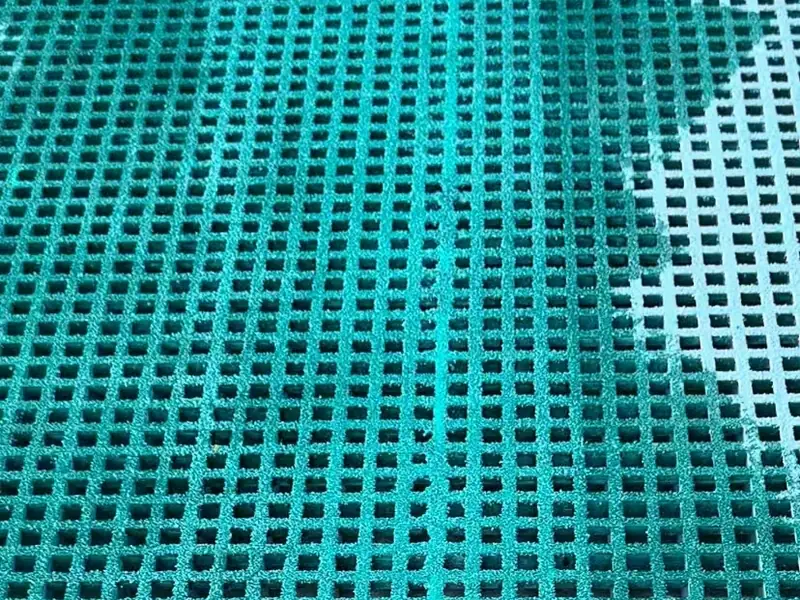
Mini mesh uses a finer top grid over a wider lower grid. It keeps the walking surface open while reducing what can fall through the upper layer. It is a strong candidate when:
- water, air or visibility must continue through the platform;
- the real object is larger than the measured opening in every credible orientation;
- cleaning can remove debris from the fine grid;
- the lower grid and joints do not create a wider bypass;
- support, load and fixing are already reviewed for the complete row.
It is not a closed surface. Fine grit, food residue, fibres, wrappers and leaves can lodge near the top. Fluid flow slows as debris bridges across the openings. The product can reduce a drop route while making housekeeping more demanding.
The wider mini mesh versus covered grating guide compares the complete product formats. This page focuses on the safety and procurement task: prove what is being retained and where passage can still occur.
What a Solid Top Changes
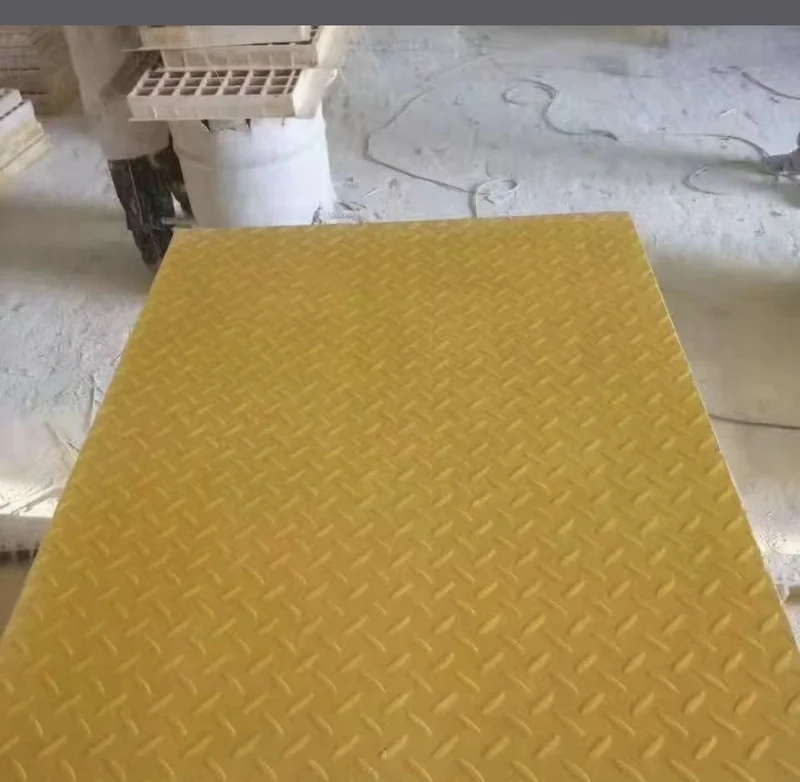
A solid-top assembly can mean a cover bonded or fixed over a grating base, a patterned flat plate, or an independent composite panel. These are different structures. The project should identify which one is quoted.
A continuous top removes the through-surface mesh path. It also:
- changes total mass;
- changes the structural load basis;
- requires joints and perimeter gaps to be controlled;
- removes through-flow, so water needs falls, channels or edge outlets;
- traps debris and contamination on top;
- complicates inspection of the space below;
- changes lifting and access requirements.
The covered grating product page and assembly guide explain the construction variants. A covered top is not automatically watertight, airtight, stronger or suitable for every maintenance cover.
Joints, Perimeter Gaps and Service Openings Decide the Weakest Point
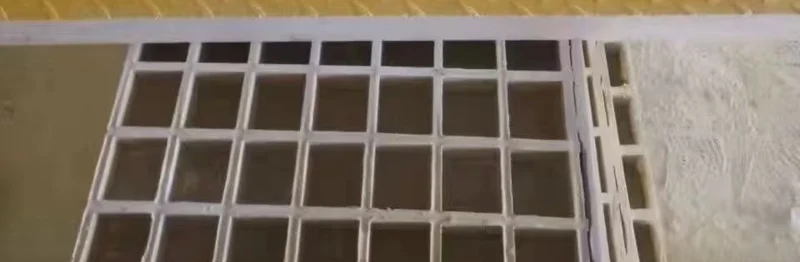
A product-opening check at the middle of a sample can pass while the installed platform still allows the object through elsewhere.
Panel joints
Record nominal joint width, alignment tolerance, side trim, covers and any movement gap. A joint can be wider than the mesh opening and creates a continuous linear path.
Perimeter and wall interfaces
Check the gap between the panel and wall, curb, frame or guardrail. A toe board or edge trim may reduce a route, but it must be continuous and compatible with the actual edge detail. See platform edge transitions.
Service cutouts
Pipes, cables, valves, drains and equipment supports interrupt the surface. Show the actual opening and any cover or infill. The drainage-opening layout guide connects the low point and water route to the cutout geometry.
Removable access
A removable piece is a controlled opening when it is out of position. Define the lift method, restraint, hinge or storage location, closed-state locking and reinstatement. The temporary access panel guide covers the complete operating cycle.
When a Removable Control Layer Makes Sense
Peer suppliers offer temporary mats or rolls for existing grating. These can be useful where the grating cannot readily be replaced or where a work area needs secondary control for small tools and fasteners.
They are different from selecting a grating product:
- the mat is an overlay, not the structural panel;
- it needs perimeter tie-down or other restraint;
- it changes cleaning and access;
- heat, chemicals and inspection conditions must match the product;
- the manufacturer’s stated object and use limits still apply.
Eagle Industries, for example, describes its drop-prevention mat as a small-object and debris control rather than a personnel safety net or a large/heavy-debris system. That is the correct level of claim for this kind of product. A removable overlay can supplement a control plan; it does not make the platform “fall-proof.”
Do Not Let the Opening Choice Bypass Structure
The top mesh or cover is one part of the panel selection. The project still needs support layout, clear span, load, deflection and fixing data for the selected construction.
Mini mesh is not stronger merely because it is finer. A covered assembly does not gain capacity because it is closed. A removable mat adds load and changes access. Review the exact panel configuration before comparing the opening result.
Drainage and cleaning belong in the comparison
If a mini mesh is chosen, define brushes, wash-down and access to the upper grid. If a covered surface is chosen, define falls, outlets, perimeter drainage and removal of retained debris. A surface selected for dropped-object control but impossible to clean will lose performance in service.
The covered grating joints and drainage guide shows why the water path must be designed after the top is closed.
A Practical Dropped-Object Review
- List the objects that can be released.
- Record the area below and the consequence.
- Measure the object’s worst passage envelope.
- Map the mesh, lower grid, joints, perimeter, cuts, cover seams and removable pieces.
- Decide whether through-flow must remain.
- Compare mini mesh and solid top on the complete construction.
- Define cleaning and maintenance access.
- Check support, load, deflection and fixing.
- Record other tool, edge, containment and exclusion controls.
- Freeze the product, drawing and acceptance record.
Our factory can document the offered mesh, cover construction, fabrication and dimensional scope. The project remains responsible for approving the installed route, supporting structure, dropped-object programme and fall-protection system.
Get a Quote
Get a Dropped-Object Risk: Mini Mesh or Solid-Top Grating? Quote
- Provide the actual object and scale
- Mark joints, cuts and perimeter gaps
- State other dropped-object controls
Surface options
Compare Mini Mesh, Solid Top and Removable Overlays
Each closes or reduces a different part of the dropped-object route.
| Option | Object-control effect | Drainage and cleaning | Key limitation |
|---|---|---|---|
| Mini mesh FRP grating | Reduces the upper opening while remaining an open grid | Water and air can pass, but fine debris may lodge | The opening alone does not cover joints, cuts or perimeter gaps |
| Covered FRP grating | Adds a continuous layer over a base grating | Through-mesh drainage is removed; joints and outlets must be planned | Mass, assembly load and cover attachment change |
| Patterned flat plate | A solid walking face with no through-surface grid | Needs falls, outlets or another drainage route | The plate carries load through its own section, not a hidden grating |
| Removable drop-prevention overlay | A temporary mat can cover an existing grating | Cleaning, lifting and refitting become part of use | Must remain secured, inspected and within the maker's stated limits |
Object record
What to Record Before Selecting a Grating Surface
The physical object and the installed route turn a vague anti-drop request into a checkable brief.
| Audit field | Record | Why it matters |
|---|---|---|
| Object ID | Name and purpose of the tool, fastener, debris or package | A generic phrase such as small parts is not measurable |
| Smallest passage dimension | Width, thickness, diagonal or flexible bundle | The object can enter edge-on even when its largest face looks bigger than the opening |
| Orientation | Falling, sliding, rolling or being knocked | The worst credible orientation governs |
| Drop source | Work area, tool exchange, storage, vibration or loose fixture | Shows where a physical control may be more effective than a finer grid |
| Area below | Person, equipment, process, traffic or access route | Defines the consequence and whether an exclusion or secondary control is needed |
| Installed route | Mesh, joint, perimeter, cutout, cover seam or removable panel | A smaller product opening can be bypassed elsewhere |
| Flow requirement | Water, air, light, wash-down and debris | Determines whether a closed top is credible |
| Access requirement | Inspection, lifting, maintenance, pipe removal and storage | Explains the size, mass and restraint of removable pieces |
Fit check
When a Dropped-Object Grating Choice Is Ready to Review
Object, flow, opening, access and supporting controls must be known.
Specify this if…
- A representative object and its worst credible orientation are known.
- The actual clear opening can be measured on a sample or drawing.
- Joints, perimeter gaps, cutouts and removable pieces can be shown.
- The area below and the required consequence controls are defined.
- Mini mesh drainage or cleaning is acceptable.
- A solid top includes a workable drainage, lifting and reinstatement plan.
- Support, load, deflection and fixing are reviewed for the selected construction.
Look elsewhere if…
- The request uses only the words small debris or anti-drop.
- A nominal mesh pitch is treated as the installed clear opening.
- A covered panel is assumed to close the entire platform.
- The product is expected to replace toe boards, tool control, netting or fall protection.
- Drainage cannot be resolved with a closed top.
- A fine grid is selected without a cleaning method.
- A removable overlay has no perimeter restraint or inspection plan.
RFQ checklist
What to Send for a Dropped-Object Review
A photograph with scale and a marked plan are more useful than a generic product name.
- Object list — Tools, fasteners, washers, cutoffs, wrappers, debris and any item introduced during maintenance.
- Worst orientation — State how the object can enter the opening, not only its largest dimension.
- Surface route — Mark top opening, lower mesh, joints, perimeter, cuts, covers and removable pieces.
- Area below — Identify people, equipment, processes and access routes that passage could affect.
- Flow and cleaning — State required drainage, airflow, visibility, wash-down and cleaning tools.
- Access — Explain who lifts or opens the surface, how it is restrained and where it is stored.
- Structure — Provide supports, clear spans, load, deflection and fixing requirements.
- Other controls — State tethering, toe boards, netting, protected storage, exclusion zones and procedures already used.
Dropped-Object Grating Questions
Is mini mesh better than solid-top grating for dropped objects?
Does a 19 x 19 mm mini mesh mean a 19 mm opening?
Does a covered panel stop every object?
Is a drop-prevention mat equivalent to covered grating?
Can grating replace tool tethering or toe boards?
Does mini mesh improve load capacity?
Does solid-top grating need drainage?
Can a covered board be removed for maintenance?
How should I test whether my object will pass?
Does a 15 mm falling-ball test prove that nothing can fall through?
Do you certify dropped-object or fall protection?
Safety boundary
What the Grating Product Can and Cannot Control
The selected surface is one engineering control, not the whole safety system.
- Product boundary — We supply the grating, cover or agreed fabricated piece. We do not certify the complete work-at-height or dropped-object system.
- Open-path evidence — Record the measured opening and every joint, perimeter and service route. The centre of one panel does not represent the installed surface.
- Temporary mat reference — Eagle Industries describes its drop-prevention mat as suitable for small objects and debris only, not personnel fall protection or large/heavy debris. Review the temporary drop-prevention mat limits
- Platform-control reference — Real Safety separates engineering barriers, containment, tool control, housekeeping and exclusion from the choice of a single product. Review the platform dropped-object controls
This content was prepared and reviewed by Dengtai Industry’s technical and production team using the project conditions, available product data and applicable documents. Limits that require design, testing or approval are identified in the content. Content last checked: