Terms, applications and selection
FRP Mesh Grating: What It Is and How to Choose the Right Opening
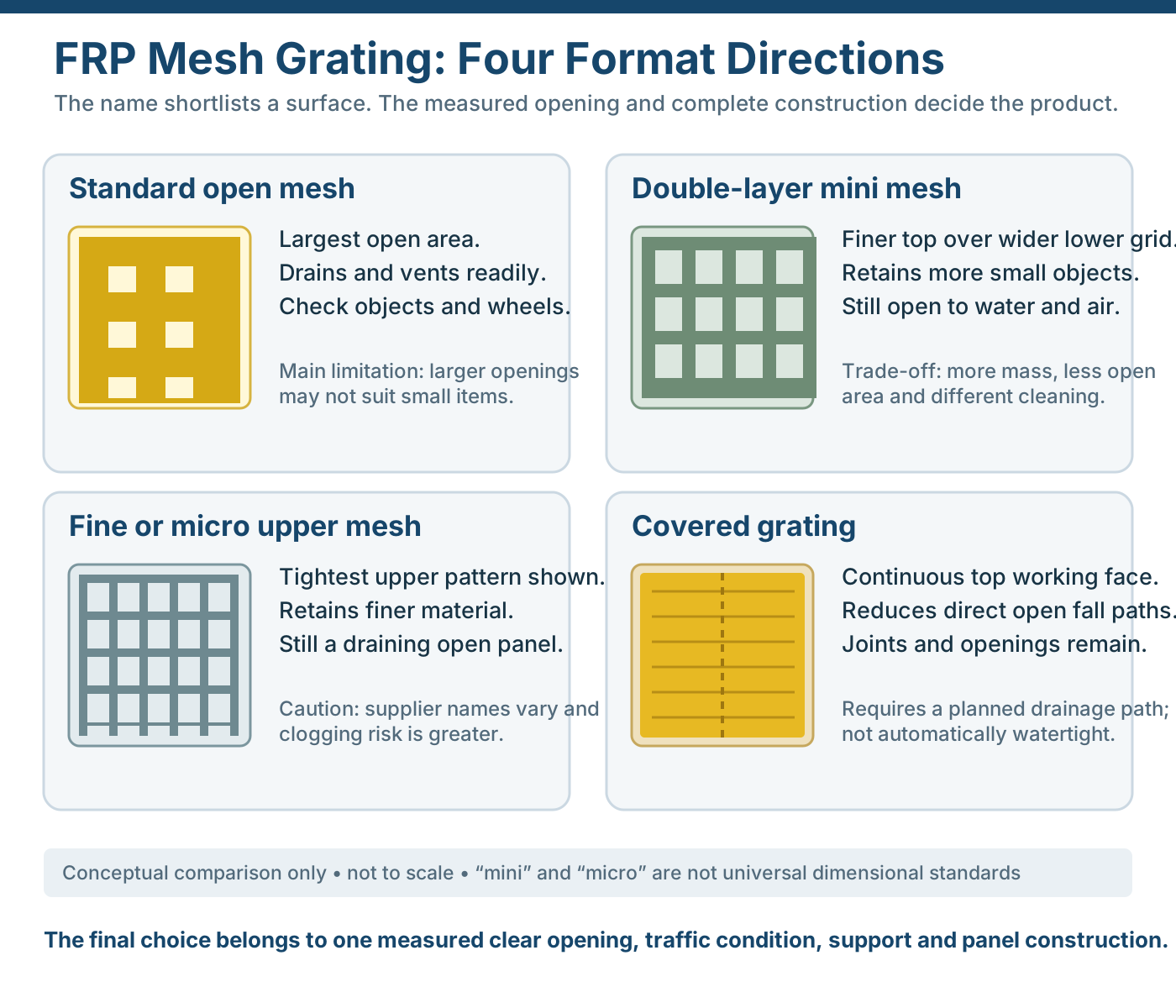
In grating, FRP mesh describes the open grid formed by reinforced plastic bars. The product name does not define the clear opening, so compare standard, mini, micro and covered formats by what must be retained, how the area drains and cleans, and how the panel is supported. Our supply includes molded panels, agreed cutting, edge treatment, surfaces and clips unless another scope is quoted.

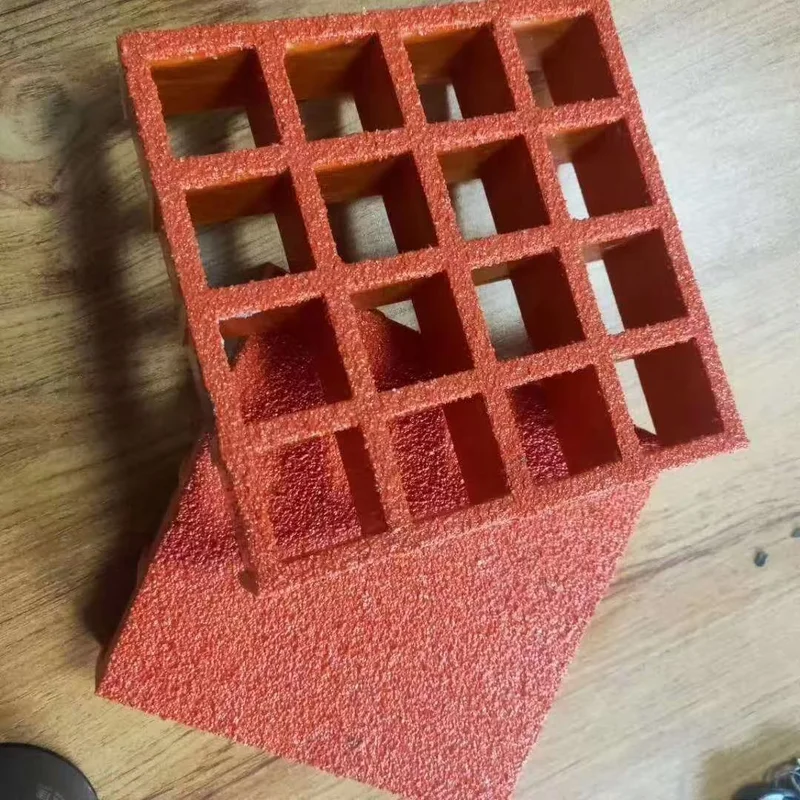
A mini mesh sample from our factory range. The drawing states both mesh layers, bar dimensions and the actual clear opening. Photo: Dengtai Industry.
Key terms
What Does FRP Mesh Mean in Grating?
The word describes an open grid, not one fixed opening size. These terms separate the product family from the measurements that determine traffic, drainage and dropped-object performance.
- FRP mesh grating
- A structural grating whose walking surface is an open grid of glass-fiber-reinforced resin bars. In molded grating, the mesh is formed as an integral panel. FRP mesh may also be used loosely for a finer mini or micro upper grid. It should not be confused with flexible fiberglass reinforcement cloth, plaster mesh or wire mesh.
- Mesh pitch or spacing
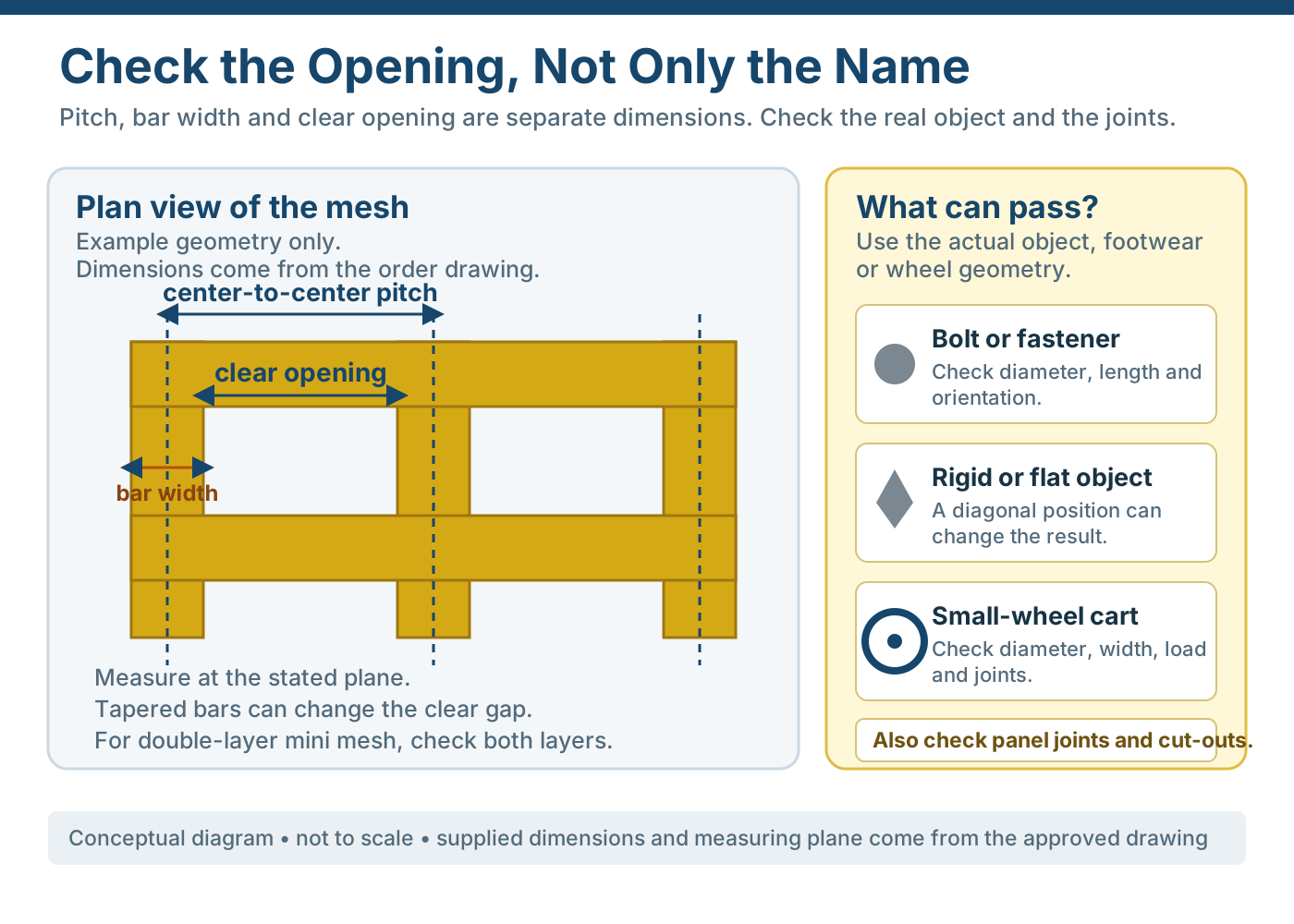
- The center-to-center distance between corresponding points on adjacent bars. Catalog names and product tables commonly use pitch, but pitch is not the distance through which an object can fall.
- Clear opening or net opening
- The unobstructed gap between the inner edges of adjacent bars at the measuring plane. This is the dimension used to check what may fall through, provided the object shape, orientation and footwear or wheel geometry are also considered.
- Bar width
- The width of the load-bearing or top bar that forms the opening. Two panels can share the same pitch but have different clear openings when their bar widths differ.
- Open area
- The percentage of the panel surface that remains open. Open area helps compare drainage, airflow and light, but it does not by itself establish which object can pass through an individual opening.
- Upper and lower mesh
- A double-layer mini mesh panel has a finer upper grid and a wider lower grid. Both layers belong to the ordered configuration; describing only the upper pitch leaves the lower opening and structure unresolved.
- Mini and micro mesh
- Common product descriptions for small-opening grating, but not universal dimensional standards. Suppliers use the names differently, so the drawing, clear opening, bar width, depth and panel construction decide the product.
- Covered grating
- A base grating combined with a continuous top or cover layer. It reduces direct open pathways through the walking surface, but joints, edges, openings and drainage still require detail. It is not automatically a watertight or airtight system.
- Reinforcement mesh
- A flexible glass-fiber cloth, grid or fabric used inside render, concrete, coatings or composite laminates. It is a different product from a rigid, load-bearing FRP grating panel.
Suitability check
Is FRP Mesh Grating Right for Your Application?
Use this screen to separate a structural grating request from reinforcement cloth and to identify when the mesh question is not yet specific enough to quote.
Specify this if…
- You need a rigid, walkable open panel and must decide what should pass through or remain above it.
- Small tools, fasteners, debris, footwear, cart casters or equipment below make the actual clear opening important.
- You need to compare standard open mesh with a finer mini or micro upper grid while retaining drainage.
- You can provide the support layout, traffic, known load, environment and a photograph or drawing of the current panel.
- You need factory-cut pieces, shaped openings, edge sealing, a surface treatment, clips or a sample for review.
Look elsewhere if…
- You need a flexible fiberglass cloth or roll for concrete, render, stucco, EIFS or composite reinforcement.
- You need a complete structural floor design, support frame, foundation, guardrail or fall-protection system.
- You need a watertight, airtight or sealed tank cover rather than an open grating assembly.
- Only a product name is available and nobody can state the required opening, traffic, support or cleaning method.
- A project-defined slip, fire, ADA, load or chemical result is required but its test method and product scope have not been identified.
Product directions
Which FRP Mesh Format Should You Compare?
Start with open, mini, fine or covered, then verify the actual openings and support for the finished panel.

Standard open FRP mesh
The general starting point for drainage, ventilation and access. Compare the actual opening with footwear, small objects and wheels rather than assuming the common nominal pitch is suitable.
Double-layer mini mesh
A finer upper mesh over a wider lower mesh. Our common combination is 19 × 19 mm upper over 38 × 38 mm lower; both layers, the clear opening and the finished panel size are confirmed together.

Fine or micro upper mesh
A still smaller upper opening can be considered for very small objects or fine debris. The term “micro” varies between suppliers, and the tighter grid generally adds mass and changes cleaning and drainage.

Covered or solid-top grating
Choose this direction when a continuous top is needed to reduce direct fall paths or provide a different walking surface. Check drainage, joints, cover attachment and the load basis of the assembly.
Standard vs mini vs micro
How Do Standard, Mini, Micro and Covered Mesh Compare?
Names help shortlist a format. The final decision depends on the measured gap, traffic, drainage, cleaning and the structure carrying the panel.
Swipe horizontally to view all columns.
| Decision point | Standard open mesh | Mini mesh | Fine or micro mesh | Covered grating |
|---|---|---|---|---|
| Surface construction | Integral single grid | Integral molded panel with a finer top layer | A still finer top grid, with supplier definitions varying | Base grating plus continuous cover or solid-top construction |
| Visible opening | Largest of the four | Smaller upper opening over a wider lower grid | Finest open pattern, subject to the actual drawing | No continuous open pathway through the top surface |
| Drainage and airflow | Highest open area | Reduced open area but still open | Lower open area and more potential for clogging | Depends on slopes, edge outlets, joints and cover design |
| Small-object retention | Limited by the actual clear opening | Improved while leaving a draining surface | Can retain finer objects but the name alone proves nothing | Reduces direct fall paths; edges, joints and openings remain |
| Wheels and casters | Check wheel diameter, width and opening orientation | May improve small-wheel contact but joints still matter | Can improve contact for very small wheels but is not a continuous deck | More continuous contact, with joints, grip and wheel loads to check |
| Cleaning | Open grid can be flushed where the drainage path permits | Fibrous debris may be held by the finer top | Tighter openings may need more deliberate cleaning | Top surface and drainage points both require a cleaning plan |
| Load basis | Exact thickness, mesh, resin and support | Exact double-layer construction and support | Exact fine-mesh construction; mass may be higher | Load data for the complete covered assembly |
| Main limitation | Larger openings may not suit small objects or casters | Reduced drainage and higher mass | Naming and cleaning risks are greater | Not watertight or self-draining automatically |
Factory range
FRP Mini Mesh Sizes and Mass per Unit Area
These verified rows connect thickness, upper mesh, panel size, bar width and mass. The approved drawing controls the lower mesh and clear opening.
Swipe horizontally to view all columns.
| Thickness | Upper mesh pitch | Lower mesh starting point | Panel sizes | Bar width | Mass per unit area |
|---|---|---|---|---|---|
| 14 mm | 20 × 20 mm | 40 × 40 mm | 1247 × 4007 mm | 7.0 mm | 9.5 kg/m² |
| 22 mm | 20 × 20 mm | 40 × 40 mm | 1007 × 4047; 1247 × 4047; 1527 × 4047 mm | 7.0 mm | 14.5 kg/m² |
| 25 mm | 19 × 19 mm | 38 × 38 mm | 1220 × 3660 mm | 6.5 mm | 15.5 kg/m² |
| 30 mm | 20 × 20 mm | 40 × 40 mm | 1007 × 4007; 1247 × 4007 mm | 7.0 mm | 17.5 kg/m² |
| 30 mm fine mesh | 11 × 11 mm | To be confirmed on the drawing | 1000 × 4000 mm | 8.0 mm | 21.5 kg/m² |
| 38 mm | 20 × 20 mm | 40 × 40 mm | 1007 × 4007 mm | 7.0 mm | 21.5 kg/m² |
| 38 mm | 19 × 19 mm | 38 × 38 mm | 1220 × 3660 mm | 6.5 mm | 22.5 kg/m² |
| 60 mm | 19 × 19 mm | 38 × 38 mm | 1220 × 3660 mm | 7.0 mm | 35.5 kg/m² |
FRP mesh grating is a rigid structural panel with an open grid made from glass-fiber reinforcement and cured resin. In a molded panel, that grid is formed as one piece. “Mini mesh” and “micro mesh” are commonly used for finer upper-grid products, although the names are not universal dimensional standards. The number that matters when checking dropped objects, tools, footwear or small wheels is the actual clear opening, not the marketing name or nominal pitch.
This guide answers two connected questions: what FRP mesh grating is, and how to choose the right opening for a dock, walkway, drainage area, maintenance platform or equipment access route. It compares standard, mini, fine and covered formats, gives the verified mini mesh rows we work from, and explains where drainage, cleaning, support, load, fixings and the complete panel construction change the answer.
The first useful decision is to confirm that the request is for a rigid grating panel and not for flexible reinforcement cloth. Fiberglass mesh used in render, concrete, stucco, EIFS or composite laminates is a different product. It is supplied as a roll or sheet to embed in another material. It does not carry a person as a walkable grating panel.
What Is FRP Mesh Grating?
An FRP grating has a structural grid and open spaces between its bars. The grid lets people walk on it while allowing water, air and some debris to pass. The composite material can be useful where corrosion, weight, wet service or cutting flexibility make a coated steel surface difficult to maintain.
The word “mesh” is used in several ways:
- It can mean the integral grid of a standard molded grating.
- It can describe the finer top layer of a double-layer mini mesh panel.
- It can be a loose market description for micro or fine-opening grating.
- It is also used by other industries for flexible fiberglass reinforcement fabric.
Those meanings are not interchangeable. A buyer who asks for “FRP mesh” may need a walkable panel, a liner for a concrete repair, a protective screen or a composite reinforcement grid. A useful supplier response starts by identifying the intended function and checking a photograph, drawing or use description.
FRP mesh grating also should not be confused with a perforated plate, expanded metal, a covered deck board or a complete engineered platform. The grating is one component. Supports, fixings, guardrails, drainage and the structural design may belong to other scopes.
For a rectangular molded mesh, the direction of the long opening and the supporting structure become additional order fields. See square versus rectangular molded FRP grating for the drawing and piece-mark checks.
Mesh Pitch Is Not the Clear Opening
Catalog descriptions often give a mesh such as 19 × 19 mm, 38 × 38 mm or 50 × 50 mm. That figure commonly describes pitch: the center-to-center distance between bars. The opening a small object actually passes through is the clear gap between bar edges, and it is smaller than the pitch.
The difference matters. Two 20 × 20 mm panels can have different bar widths and therefore different clear openings. A tapered bar can create an opening that varies between the top and bottom measuring planes. A double-layer mini mesh panel has a small upper opening and a wider lower grid, so a single number cannot describe both.
For dropped-object control, start with the object. A 10 mm bolt, a 15 mm nut, a cable tie and a small tool do not behave the same way. A rigid square object may fit through a smaller gap when turned diagonally. A flexible object may pass through differently. A wheel has diameter, width and load, and a joint between two panels can be more important than the opening in the middle of either panel.
How to Choose FRP Mesh Grating in Six Steps
The optimum mesh is not the smallest available. It is the most suitable balance of retention, drainage, cleaning, traffic, mass and structural performance for the actual location.
1. State the Application Before the Mesh
Describe what the panel is for: a public dock, a chemical access walkway, a car-wash drain, a removable cover, a stair landing, a rooftop service route or a machine guard. The application determines the likely loads and the consequences of a dropped object, but it does not determine a product by itself.
Also describe the people and equipment using it. Work boots, bare feet, bicycle wheels, trolley casters and maintenance equipment create different contact conditions. State whether anyone or anything sensitive is below the panel.
2. List What Must Stay Above
Create a short list of the smallest objects that must not pass through. Add each object’s approximate dimensions. State whether the item is rigid, flexible, long, flat or round. If the requirement is a maximum clear opening, give that value and the measuring plane.
This turns a vague request for “small mesh” into a comparison. It also shows when no open mesh will be enough and a covered surface should be considered.
3. Check Drainage and Cleaning as One System
Smaller openings reduce open area. That may be useful for retention, but it leaves less room for water and air. Fibrous debris, leaves, packaging fragments, grease and grit may lodge closer to the walking surface. The cleaning method must be able to reach the grid and whatever sits below it.
Open mesh can move spray, water and debris downward. If this creates a hazard for people or equipment below, the requirement is not solved by choosing a slightly smaller hole. A covered assembly, local drip tray, drainage channel or different platform detail may be needed.
4. Match Thickness to the Support and Load
Mesh selection and structural selection are separate. A smaller mesh adds material and mass, but it does not automatically make a panel stronger. The allowable load and deflection still depend on the exact construction, thickness, resin, support layout, clear span and load case.
Panel length is not clear span. A long delivered panel may sit on several closely spaced supports, while a shorter panel may bridge a larger unsupported gap. The bearing width and condition also matter. Keep mass per square metre separate from load capacity.
5. Review Openings, Joints and Fixings
Every cut-out interrupts the mesh. Removed bars may need additional support around the opening or a revised panel split. Adjacent panels may need a supported joint and a C clip, not just an edge-to-edge connection. A hold-down clip restrains the panel to a structure but cannot create bearing, reduce a span or replace a missing support.
Fixings for a fine mesh deserve an additional check. A clip jaw designed around a wide standard bar may not seat correctly across a small upper mesh. The bar width, panel depth, support section and tightening access all belong to the fixing review.
6. Freeze the Drawing and Sample
The final drawing should identify:
- the product construction;
- thickness and both mesh layers;
- bar width and required clear opening;
- panel sizes, quantities and joints;
- opening positions and edge treatment;
- resin, surface and color;
- clips and fixing positions;
- drawing revision and identification marks.
A sample can confirm what the grid and surface look and feel like. It can also let the buyer compare a proposed opening with an object or wheel profile. A sample does not prove that the delivered panel meets a load, fire, chemical, slip or accessibility requirement.
What Changes When the Panel Uses Mini Mesh?
Mini mesh is still an open grating. It adds a finer upper layer to reduce the top opening, but water and air can still move through the panel. The lower grid carries the wider structural pattern.
Our common factory combination is nominal 19 × 19 mm upper mesh over 38 × 38 mm lower mesh. Other rows use 20 × 20 mm upper mesh over a wider lower grid, and a 30 mm fine-mesh row uses an 11 × 11 mm upper pitch. Those labels do not establish the clear opening. The drawing has to state the bar dimensions and the measuring plane.
Use the mini vs micro name guide when another supplier’s label has to be translated into dimensions, and the mini-mesh thickness guide when the support, load and depth must be chosen together.
The practical trade is easy to remember:
- Smaller opening: more surface coverage and potentially better retention.
- Lower open area: less direct drainage and airflow.
- Higher mass: more material at a comparable thickness.
- Different cleaning: debris may collect closer to the top.
- More fixing sensitivity: a small bar may need a different clip jaw.
- No automatic load benefit: the structural data for the exact panel still governs.
This is why the existing mini mesh product page provides the detailed product rows while this page handles the choice between mesh families.
Open Mesh, Mini Mesh and Covered Grating Are Different Answers
An open mesh panel lets material pass through the grid. A mini mesh narrows the upper opening while preserving an open surface. A covered grating changes the walking surface to a continuous top.
The covered option can reduce direct pathways through the panel, but it does not remove every route for a dropped object. Panel joints, cut-outs, removable sections and the platform edge remain. It also changes where water goes. The project needs a slope, outlet, channel or collection point so the cover does not simply turn drainage into standing water.
Similarly, a covered panel is not automatically watertight, airtight or fire-resistant as a partition. Those are different requirements. If the intent is containment, liquid collection or fire separation, state that requirement instead of using “covered grating” as a substitute.
For the specific covered construction made from a structural base and a raised chequered plate, compare the FRP grating with chequered plate guide.
Load, Drainage and Accessibility Are Separate Checks
A common mistake is to use one product label for several different performance questions:
- Load: Is the exact panel suitable for the support span, load and deflection limit?
- Drainage: Can the expected liquid, debris and cleaning water follow a workable path?
- Dropped objects: Does the clear opening, joint or edge allow the relevant item to pass?
- Walking contact: Does the surface suit the footwear, barefoot use, wheel or trolley?
- Accessibility: Does the complete route and installed product meet the applicable local rule?
- Fire or chemical duty: Does the exact resin and panel construction have the required evidence?
No mesh name answers all six. The mesh affects some of them directly and another product choice may be needed for the rest.
This caution matters for ADA and similar accessibility claims. A small nominal mesh is not automatically compliant. The applicable requirement may refer to clear openings, the ball test, joints, level changes, route width or other installation conditions. The same attention applies to heel safety and barefoot use. Ask for the exact criterion and compare it with the delivered panel.
Where FRP Mesh Grating Is Used
The application should narrow the product, but it should not be allowed to hide a missing measurement.
Docks, Marinas and Poolside Routes
A fine upper mesh can reduce what passes through and may feel more comfortable underfoot. Water and air can still move through the panel. The resin, cut-edge treatment and fixing grade must suit salt or permanent moisture, and the walking surface must suit barefoot, footwear or mixed use. A product for a sheltered freshwater dock is not automatically a marine specification.
Industrial Platforms and Maintenance Routes
Workers may carry tools, fasteners and small parts over equipment or process areas. A finer mesh can reduce a direct fall path. Standard open mesh may remain preferable where drainage and wash-down dominate. The review should include the support layout, load, chemicals, cleaning and any work below.
Car-Wash, Wash-Down and Drainage Areas
The panel needs enough open area to pass water and debris while resisting blockage. A tighter grid may retain fibrous material or slow cleaning. The drainage path below, tray or channel, cleaning frequency and removable-panel weight are as important as the opening.
Equipment and Personnel Below the Surface
A smaller open mesh reduces some fall paths but does not close the surface. When the requirement is continuity, compare covered grating and inspect the joints and cut-outs as well as the panel field. A cover does not eliminate a maintenance opening, cable penetration or missing edge detail.
Carts, Trolleys and Mobility Equipment
The risk is not only whether a wheel falls through the opening. A wheel can bump at a bar, drop partly into a joint or experience high local load. Record wheel diameter, width, material and load. A covered top may be more continuous, but the complete assembly still needs a load check and practical grip.
Which Resin Should an FRP Mesh Grating Use?
Mesh size does not determine chemical resistance. Resin selection depends on the actual process medium, concentration, temperature, splash or immersion, cleaning chemicals and required evidence.
- Isophthalic unsaturated polyester with alumina filler is our published economical molded reference for ordinary inland environments.
- Vinyl ester is a common project direction for stronger chemical, wastewater or salt exposure.
- Epoxy may be reviewed where the chemical duty points that way, subject to the product configuration.
- Phenolic is a project-review direction when fire and smoke performance is a stated requirement.
The same environmental question also affects the fixing material. A corrosion-resistant grating panel can be undermined by an unsuitable standard steel clip in a wet or salt location. Review the edge finish, clip grade and support material together.
Color and surface are separate. A green or yellow panel is not automatically a chemical grade, and a grit surface is not automatically a slip class. For project requirements, name the test method and acceptance value.
From a Sketch to a Factory Quotation
A marked photograph is enough to begin a replacement discussion. Measure the opening, the old panel thickness, the support positions you can reach and the fixing locations. Mark what is confirmed and what still needs checking. Add the use of the area and what must not fall through.
For a new layout, provide a plan showing the panel sizes, support direction and any openings. State the load and deflection requirement if available. A supplier can shortlist the mesh and structure from that information, but the responsible designer still needs to approve the complete platform.
The best quotation connects the mesh to the delivered item. It should state the panel construction, both mesh layers where relevant, thickness, resin, surface, panel or piece sizes, cutting, edge treatment, clips, sample and documents, rather than quoting “FRP mesh” as an undefined square-metre price.
Send your mesh, opening and support information to start the project review.
Applications
Where Is FRP Mesh Grating Used?
Docks, industrial walkways, drainage areas, equipment access, carts and stairs place different demands on the mesh and the panel beneath it.

Docks, marinas and waterside walkways
A finer upper mesh may reduce what passes through and feel more comfortable underfoot, while an open panel still allows water and air to move. Salt exposure, resin, fixings, deliberate cleaning and the actual smooth or textured contact surface must still be selected for the location.
State salt spray, freshwater, barefoot use, footwear, cleaning method, support material and fixing grade.

Industrial walkways and maintenance access
Tools, bolts, packaging and spills are practical reasons to compare a smaller opening. Standard open mesh may remain preferable where drainage and cleaning are more important than retaining small objects.
Describe who crosses the walkway, what they carry, what may fall below, how spills drain and how debris is removed.
Car-wash, drainage and wash-down areas
Water, grit, foam and fibrous debris can behave differently in a tighter mesh. The mesh has to pass the expected flow while remaining cleanable, and the whole drainage path below the panel still needs design.
Provide flow, debris type, cleaning frequency, water chemistry, panel removal needs and the location of drains.
Areas below equipment or people
A smaller open mesh can reduce some fall paths but does not close the panel. A covered assembly may be needed when the operating requirement is a continuous surface. Joints, cut-outs and maintenance openings must be reviewed separately.
State what must not fall, its size and shape, work below, liquid path, cover continuity and edge-opening details.
Small-wheel carts and mobility equipment
The wheel diameter, wheel width, load, speed and direction of travel determine whether an opening is a problem. A smaller mesh may improve contact, while panel joints, surface texture and the complete support still affect movement.
Send the wheel contact dimensions, individual wheel load, total equipment mass, travel route and acceptable deflection.
Stairs, landings and maintenance treads
Mesh selection is only one part of a tread or landing. Nosing, side support, tread depth, fixing and the walking direction must be coordinated with the stair drawing.
Provide a tread drawing, stair width, nosing, support, traffic, load and preferred surface.
Selection matrix
How to Choose FRP Mesh by Requirement
Match the operating requirement to a starting format, then check the exact opening, load and support.
Swipe horizontally to view all columns.
| Requirement | Starting mesh direction | What usually decides the result |
|---|---|---|
| Maximum drainage and airflow | Standard open mesh | Open area, debris, cleaning method and the drainage path below |
| Stop small bolts or tools | Mini or fine upper mesh | Actual clear opening, object shape and orientation, joints and working plane |
| Keep a draining surface | Mini mesh before covered grating | Whether retained debris still allows water and air to move |
| Support very small casters | Fine mini mesh or covered format | Wheel dimensions, joint width, wheel load, grip and allowable deflection |
| Close the walking surface | Covered or solid-top assembly | Cover continuity, joints, slope, outlets, cleaning and combined load capacity |
| Public accessibility requirement | Compare measured clear openings and joints | Applicable local rule, exact test method, installation and complete walking route |
| Chemical or salt exposure | Same mesh shortlist, resin reviewed separately | Medium, concentration, temperature, contact type, coating and fixing compatibility |
| Frequent wash-down | Standard or mini mesh after a cleaning trial | Flow, spray direction, debris, surface texture and access below the panel |
| Fire or smoke requirement | Mesh does not decide the fire result | Resin system, complete construction, standard, test method and required evidence |
| Replacement of an existing panel | Match the support first, then compare mesh | Measured clear spans, bearing, height, fixing positions, traffic and old panel damage |
Resin and environment
Which Resin and Surface Should FRP Mesh Use?
Mesh size does not select the resin. Exposure, cleaning and required evidence determine the material direction, while traffic determines the surface.
Swipe horizontally to view all columns.
| Service condition | Starting resin direction | Surface and fixing consideration | What must be confirmed |
|---|---|---|---|
| Ordinary inland access | Isophthalic unsaturated polyester with alumina filler | Concave or grit surface; galvanized clips where suitable | The exposure is genuinely outside strong chemical, fire and high-temperature duty |
| Coastal salt and spray | Vinyl ester project review | Corrosion-compatible edge treatment and stainless fixing grade considered | Salt concentration, washing, metal grade, UV and required evidence |
| Wastewater or chemical splash | Vinyl ester or another project-reviewed resin | Surface selected with deposits, cleaning and grip | Medium, concentration, temperature, splash or immersion and cleaning chemicals |
| Fire or smoke criteria | Phenolic project review | Resin, laminate, cover and fixings treated as a package | Standard, limit, product tested and the report required |
| Oily or sticky debris | Mesh shortlisted after a cleaning review | Tighter grids may retain more material; surface texture may increase cleaning work | Cleaning method, access, residue and acceptable downtime |
| Outdoor visible finish | Pigmented resin with UV stabilizer or protective treatment where available | Standard or agreed custom color; grit is separate from color | Color reference, chalking expectation, batch appearance and cleaning |
Surface and fixing
FRP Mesh Grating Surface, Fixing and Fabrication Options
Texture, color, clips, cutting and edge treatment are separate configuration choices from the mesh pattern.
Concave walking bars
A shallow channel runs along the top of common molded bars. It can help general drainage and contact, but it is not a slip rating unless a stated test method and result support that requirement.
Grit or inlaid grit surface
Mineral grit adds texture for wet or contaminated routes. It can also trap debris and change cleaning, so footwear, contaminants and access should be described with the surface preference.
Standard or custom color
Color helps identification, visibility or landscape coordination. It does not establish resin duty, slip resistance, fire performance or clear-opening suitability.
M, L and C clips
M or L clips can restrain panels to supports, and C clips can join edges. Check the jaw against the actual bar width in a fine mesh panel; a clip does not create bearing or shorten a clear span.
Factory cutting and edge sealing
Finished pieces can follow a marked layout with agreed openings and edge treatment. Cutting removes bars and may change the local load path, so the support around each opening must also be reviewed.
Panel sample
A sample can confirm appearance, mesh pattern, scale and contact texture. It does not replace load, chemical, fire, slip or project-compliance verification for the delivered configuration.
Configuration facts
FRP Mesh Grating Specifications
The product name is only the beginning. These verified fields show what a complete mesh-grating configuration includes.
Request a Project Quote| Specification | Value |
|---|---|
| Product description | Standard, mini, fine-upper-mesh and covered FRP grating directions For a rigid grating panel, not flexible reinforcement cloth or roll goods. |
| Common mini mesh combination | 19 × 19 mm upper over 38 × 38 mm lower The drawing states both layers; the nominal upper label is not the clear opening. |
| Upper mesh range | 11 × 11 to 20 × 20 mm Availability depends on thickness, panel size and construction. |
| Mini mesh thickness | 14–60 mm Thickness is a configuration field and not a load class. |
| Mini mesh mass | 9.5–35.5 kg/m² across the listed rows Mass belongs to the thickness and mesh row; it is not a capacity figure. |
| Panel sizes | 1000 × 4000 to 1527 × 4047 mm across the range Finished cut pieces follow the approved layout. |
| Resin directions | Polyester, vinyl ester, epoxy and phenolic project review Selection follows exposure, required evidence and the product being supplied. |
| Surfaces | Concave, grit, inlaid grit, milled and covered formats Texture is not a performance class without a defined test and result. |
| Fixings | M, L and C clips in galvanized or stainless steel Grade, jaw, height and support position are confirmed for the actual panel. |
| Fabrication | Cutting, shaped openings, edge sealing and piece marking Sealing protects the cut edge and does not restore removed structural bars. |
RFQ inputs
What to Send for an FRP Mesh Grating Quote
A useful inquiry connects what must be retained, the panel layout, support, load and cleaning requirement.
- Application and traffic — Name the walkway, platform, dock, drain, stair or equipment area and who or what crosses it.
- What must stay above the mesh — Give the dimensions and shape of tools, fasteners, debris, footwear or wheel contact that must not pass through.
- Opening requirement — State the maximum clear opening and measuring plane. Mark whether the figure is pitch, bar width or net gap.
- Panel or cut-piece layout — Provide length, width, quantity, joints and opening positions, with the drawing revision.
- Support and load — Show support spacing, bearing direction, clear span, load and the project deflection limit.
- Environment and cleaning — Describe salt, water, chemicals, temperature and the method used to remove debris.
- Surface and fixing — State footwear, barefoot or cart traffic, preferred texture, color, support material and fixing access.
- Performance evidence — Name any ADA, slip, fire, load or chemical test requirement, standard and acceptance criterion instead of using a general label.
Selection steps
How to Choose FRP Mesh Grating
Work from the retained object and traffic to the opening, drainage, support, fixing and delivered drawing.
Put the nominal mesh name beside the actual pitch, bar width and clear opening. If those values are not known, the selection is not yet complete.
Consider the smallest dimension of the retained object and how it can turn. For wheels, include diameter, width, load and direction; for footwear, include the actual sole and a representative sample.
A smaller mesh reduces open area. Confirm that water, airflow and debris can still follow a planned path and that the screen, tray or area below can be cleaned.
Choose thickness with the mesh, resin, support and span. A tighter mesh adds material and mass but does not establish a higher allowable load.
Cutting removes bars. Check the remaining grid, perimeter support, changes in level, clip locations and whether a removable piece remains practical to lift.
A standard clip jaw may not suit a small upper mesh. Confirm bar width, panel height, support section and access before fixing positions are released.
Record both mesh layers, clear opening, thickness, resin, surface, color, panel sizes, fixing package, cut edges and required documents on the approved order drawing.
Factory workflow
From Mesh Requirement to Packed Grating
The order becomes traceable when the material choice, both mesh layers, fabrication and checks belong to one drawing revision.
Establish whether the request is for structural grating, a fine upper mesh, a covered panel or flexible reinforcement material.
Compare standard, mini, fine and covered formats against the same traffic, drainage and support assumptions.
Record thickness, both mesh layers, bar width, clear opening, panel sizes, joints, openings and drawing revision.
Review exposure and cleaning with the walking surface, color and fixing material as one configuration.
Manufacture the selected panel, form the approved pieces and check dimensions, appearance, openings and edge treatment.
Where agreed, issue a sample and follow piece identification through the inspection and packing records.
Price basis
How Is FRP Mesh Grating Priced?
Standard molded panels have a published base; mini, fine and covered configurations are quoted from their actual construction and fabrication.
Standard and mini mesh have different quote bases
The published plain molded panel reference is USD 10.5/m² for 25 mm, USD 12.0/m² for 30 mm and USD 15.1/m² for 38 mm EXW in a standard 38 × 38 mm mesh with isophthalic polyester and alumina filler. Mini mesh and covered assemblies depend on both mesh layers or the complete cover construction and are quoted separately.
What changes a mesh-grating quotation
Vinyl ester or phenolic resin, custom color or surface, fine upper mesh, covered construction, factory cutting, shaped openings, edge sealing, clips, samples, piece marks, packing and freight are added from the actual scope.
Compare the complete delivered item
Confirm whether the offer uses full panels or delivered piece area, which edge treatment and clips are included, and what load or material documents apply. A lower square-metre rate is not comparable when the scope is different.
We quote the mesh, thickness and panel construction as one configuration. A nominal “mini mesh” name is not used as a substitute for the actual clear opening or drawing.
Factory evidence
What the Factory Can Verify for FRP Mesh Grating
Samples, drawings and records are useful when their limits are stated. No product name replaces project evidence.

Measure the mesh against a real sample
A sample can make pitch, bar width, upper and lower layers and contact texture visible. The final clear opening is then checked on the order drawing.
Confirm small-mesh tooling and clip fit
Fine upper bars can change which clip jaw fits. The fixing is checked against the actual panel rather than selected from panel depth alone.
Review clip and fixing selectionKeep the material report within scope
Report HZTC/BG-24051102 records material-level results for the submitted sample. It does not identify every mini mesh, thickness or panel configuration and is not a universal product load rating.
Read the original factory test reportUse photographs as references
The application and factory images show product type, mesh appearance or fabrication context. They are not presented as project compliance evidence or proof of a specific load or chemical result.
Request a quote
Send Your FRP Mesh and Opening Requirements
State what must not fall through, the traffic and support you know, and any current panel photograph or drawing. Unknown values can be marked for review.
- State what must not fall through and its approximate size
- The nominal mesh name does not replace the clear opening
- Attach a sketch, existing drawing or photograph of the current panel
FRP Mesh Grating Questions
What is FRP mesh grating?
Is FRP mesh the same as fiberglass reinforcement mesh?
Are standard, mini and micro mesh standard dimensions?
Is a 19 × 19 mm mesh a 19 mm clear opening?
Does a smaller mesh have a higher load capacity?
Which mesh is best for docks, walkways or carts?
Is mini mesh ADA compliant?
When should I choose covered grating instead?
Can FRP mesh grating be cut to size?
What should I send for a mesh-grating quotation?
This content was prepared and reviewed by Dengtai Industry’s technical and production team using the project conditions, available product data and applicable documents. Limits that require design, testing or approval are identified in the content. Content last checked: