Dropped-object control
Mini Mesh or Covered Grating for Dropped-Object Control?
Mini mesh reduces the open area but keeps the surface permeable. A cover or solid plate closes through-surface openings but changes drainage, cleaning, mass, load and access. Select the construction, not just the product label.
Prepared by
Dengtai Industry
Published
·
Reviewed

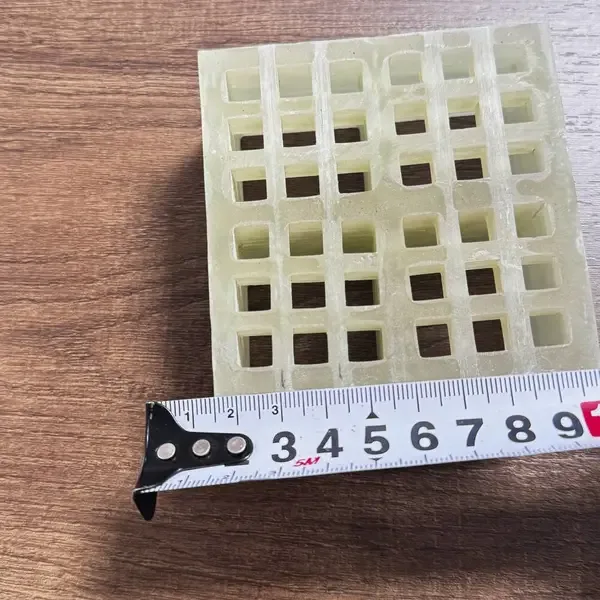
The upper opening controls what can pass, but the lower mesh, joints, drainage and structure remain part of the choice. Photo: Dengtai Industry.
Definitions
Mini Mesh, Covered Grating and Solid Plate Are Different Constructions
Object control is only the first part of the dropped-object decision.
- Dropped-object requirement
- The size, shape and orientation of the object that must remain above the walking surface, together with how often it may be dropped and what is below.
- Clear opening
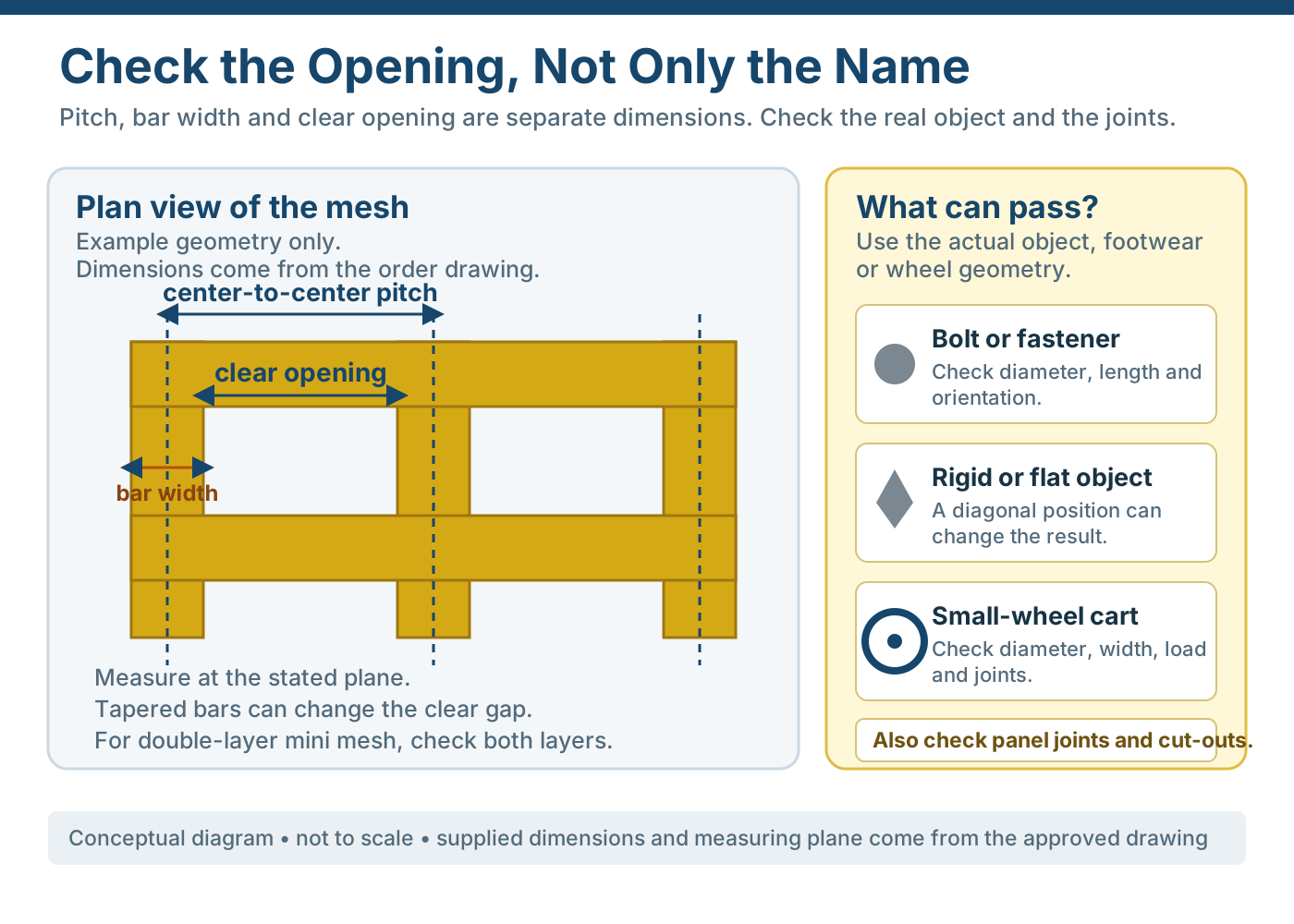
- The unobstructed gap at the finished walking plane. It is smaller than the nominal mesh pitch and can differ at joints and cuts.
- Mini mesh
- A double-layer molded grating with a finer upper grid over a wider lower grid. Water and air remain able to pass through.
- Covered grating
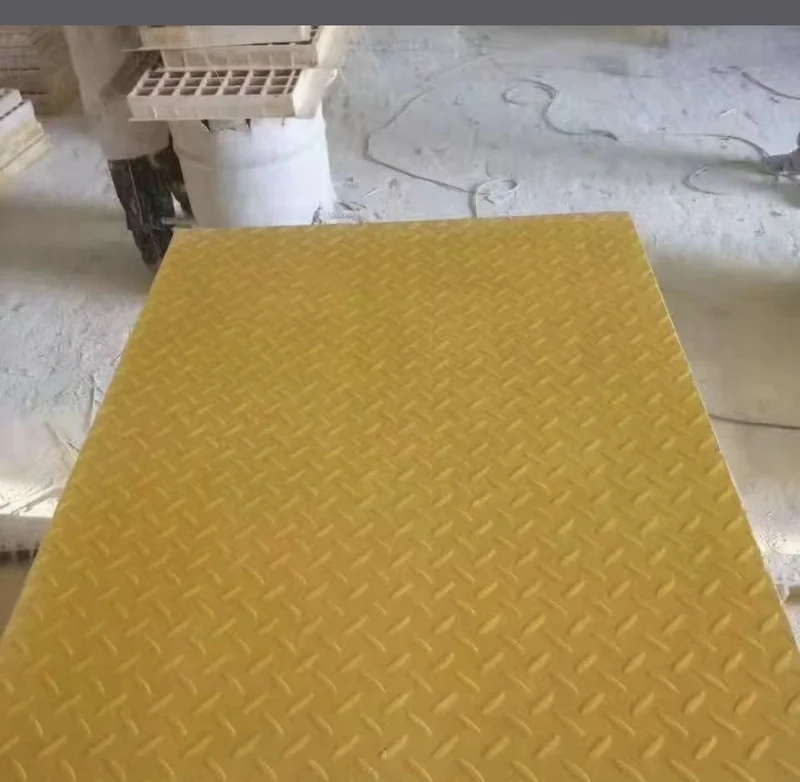
- A base grating panel with a patterned or flat cover layer attached to it. The walking surface becomes continuous, while the base remains structural.
- Patterned flat plate
- A solid molded plate with a raised or checked pattern. The plate itself carries the load; it is not a cover bonded onto a grating base.
- Independent solid panel
- A solid composite panel selected in its own right as the walking or covering surface.
- Through-surface path
- The route by which water, air or a dropped object can pass directly through the walking product. Perimeter and joint gaps are separate paths.
- Access and removal
- The way panels are lifted, replaced and secured when equipment, drains or service spaces below need inspection.
Construction comparison
Open Mini Mesh vs Covered Grating vs Solid Plate
Compare the walking surface, through-surface path, drainage, cleaning and load path.
Swipe horizontally to view all columns.
| Requirement | Mini mesh | Covered grating | Patterned flat or solid plate |
|---|---|---|---|
| Through-surface opening | Smaller mesh remains open; the measured gap controls retention. | Closed by a separate cover layer over a base panel. | Closed because the plate itself is continuous. |
| Drainage and airflow | Both can pass through, reduced by the finer mesh and debris. | Through-surface drainage is closed; edge or joint drainage must be designed. | No through-surface drainage or airflow. |
| Object control | Retains objects larger than the actual opening, including joints and cuts. | Removes the through-surface opening but not perimeter gaps. | Removes through-surface openings; edge gaps still need closure. |
| Cleaning | Fine debris can lodge in the upper grid. | Top is easier to sweep but underside and drains may need access. | Top can be cleaned as a plate; water must not pond at edges. |
| Structure | Base geometry, support, span and deflection belong to the exact mesh row. | Base-plus-cover assembly requires matching assembly evidence. | Plate construction, support and fixing define the load path. |
| Mass and handling | More material than standard mesh at a similar depth. | Base plus cover is heavier than the bare base. | Plate mass depends on its construction and thickness. |
Selection boundary
When Mini Mesh or Covered Grating Is the Better Candidate
Start with the object and what must still pass through the surface.
Specify this if…
- You need to retain a stated object while keeping water or air flowing.
- The actual opening, including joints and cut-outs, can be checked.
- A continuous surface is needed because a through-mesh gap is not acceptable.
- The drainage path can be maintained by falls, channels, edge openings or a separate system.
- Access, lifting, support and load evidence can be included in the same drawing.
Look elsewhere if…
- A mesh is accepted from its name without measuring the opening.
- A covered assembly is assumed to seal joints or make a liquid-tight tank.
- A solid plate is being called covered grating without identifying the construction.
- Drainage and cleaning are omitted because the top looks solid.
- Added cover mass is assumed to increase structural capacity.
Opening math
Mini-Mesh Opening and Approximate Open Fraction
Use the calculation as a screen, then measure the finished sample and complete installation.
Swipe horizontally to view all columns.
| Upper pitch | Published bar width | Nominal clear gap | Approximate open fraction | Use note |
|---|---|---|---|---|
| 11 × 11 mm | 8.0 mm | About 3.0 mm | About 7% | Very fine retention with a stronger debris and cleaning question. |
| 19 × 19 mm | 6.5 mm | About 12.5 mm | About 43% | Common starting point for fine-object control while retaining useful open area. |
| 20 × 20 mm | 7.0 mm | About 13.0 mm | About 42% | Check the finished gap and project criterion; nominal arithmetic is not approval. |
Project inputs
Eight Fields for Dropped-Object Control
The object, surface duty, joints and structure must be compared together.
Swipe horizontally to view all columns.
| Selection field | What to record | Why it changes the surface |
|---|---|---|
| Object envelope | Size, shape, orientation, mass, likely drop height and frequency. | A thin tool and a round fastener interact differently with the same gap. |
| Area below | People, equipment, drains, electrical services or an enclosed void. | The protection target and access requirements change the risk. |
| Through-surface duty | Must water or air pass, or must the surface close? | This is the primary choice between open mesh and cover. |
| Joints and edges | Panel gaps, cover seams, perimeter trim, removable pieces and cut-outs. | Small gaps outside the mesh can bypass the product opening. |
| Drainage and cleaning | Water, oil, wash-down, debris, falls and cleaning method. | Clogging and ponding are opposite failure modes. |
| Construction | Upper and lower mesh, cover type, plate type, total depth and assembly. | Different products have different mass and load paths. |
| Structure and access | Support, span, load, deflection, fixing and lifting. | A cover does not create capacity and can increase weight. |
| Evidence | Measured opening, product drawing, assembly detail, load basis and inspection record. | The evidence must match the exact construction. |
“Dropped-object control” is not the same as “closed surface.” Mini mesh reduces the opening while keeping water and air moving. Covered grating puts a cover over a base panel. A patterned flat plate or independent solid panel closes the walking surface and carries load in a different way.
The correct choice starts with three questions:
- What object or class of object must stay above the surface?
- Must water, air or light continue to pass through?
- Can the installation provide the required drainage, cleaning, support, load, fixing and removal?
Once those answers are on the table, “mini mesh or covered grating?” becomes a construction decision rather than a vocabulary test.

Start With the Real Object, Not “Small Debris”
An object is not defined by the word “small.” A 12 mm bolt, a 15 mm cable tie, a thin wrench, a food wrapper, a screw, a coin and a flexible piece of wire can behave differently against the same opening. Shape, orientation and flexibility matter.
Record:
- the smallest rigid dimension;
- the longest and narrowest shapes;
- whether the object can land edge-on;
- expected mass and drop height;
- frequency and source of the object;
- what or who is below the surface; and
- whether the requirement is retention, reduced nuisance, or protection from a defined impact.
For the factory and project team to review the same condition, the object envelope belongs with the drawing. “Nothing should fall through” is a goal; it is not a measurable opening requirement.
Measure the Opening and All Its Bypasses
The retention surface is not the mesh alone. Check the upper clear opening, lower mesh, panel joints, perimeter gaps, removable covers, service cut-outs and cover seams.
A mini-mesh panel with a 12.5 mm nominal upper gap does not imply a 12.5 mm maximum installed gap. A joint or a badly fitted cover can create a wider path. Use the opening definition guide when a quotation supplies only the pitch.
Our published schedule gives a useful approximate comparison:
| Upper pitch | Bar width | Nominal gap | Approx. open fraction |
|---|---|---|---|
| 11 × 11 mm | 8.0 mm | About 3.0 mm | About 7% |
| 19 × 19 mm | 6.5 mm | About 12.5 mm | About 43% |
| 20 × 20 mm | 7.0 mm | About 13.0 mm | About 42% |
These values describe the upper square pattern only. They ignore bar taper, grit and tolerances, and the lower structural mesh adds further restriction. They help explain why an 11 mm row is much more closed than a 19 mm row, but are not a complete panel open-area, flow or retention rating.
Run an Object-to-Surface Check
The practical check does not need an invented industry test if the project is prepared to approve its own method. It needs a representative object, a representative finished sample and a clear pass/fail rule.
- Select the smallest and most difficult object shapes expected on the surface.
- Mark the dimension that controls passage: diameter, width, diagonal or flexible bundle.
- Place the object on the panel in its most credible orientation.
- Check the centre mesh, the long and short opening directions, a panel joint, a perimeter edge and any service cut-out.
- Repeat on both mesh layers and at the installed measuring plane.
- Record whether the object passes, catches or rests on the surface.
- Photograph the object, scale, panel row and checked location.
- State that the result applies to that object and that construction only.
This is a project-specific object check. It does not certify an entire class of fasteners, a supplier name or every installation of the same mesh.
Treat a Named Falling-Ball Test as Scoped Evidence
Some mini-mesh suppliers publish a 15 mm falling-ball claim. That can be useful if the project specifies that exact test, but it does not mean every object that appears larger than the tested ball will be retained. A long object can enter end-on, and the installed joint or cut may differ from the tested specimen. The result depends on:
- the exact test standard and ball;
- the specimen and mounting condition;
- the measured opening and measuring plane;
- whether joints, cuts or removable pieces are included; and
- what the client actually needs to retain.
A 15 mm falling-ball result is also not interchangeable with the ADA 1/2 inch (13 mm) sphere-opening criterion used on an applicable accessible route. Name the test and the acceptance purpose rather than treating either figure as proof that nothing can fall through.
Mini Mesh Controls the Opening, Not the Whole Environment
Mini mesh is a good candidate where the surface must retain a smaller object while water, air or light continues through. Its double-layer construction also provides a more continuous surface underfoot than a wide standard mesh.
That benefit comes with restrictions:
- fine debris can lodge in the upper layer;
- drainage can slow as the open area fills;
- the lower mesh and complete row still define the structure;
- cut-outs and joints can create a wider path;
- a small opening does not make the panel “drop-proof.”
The choice needs a cleaning method. A grid that holds sawdust, food waste, leaves or fibres may need more frequent inspection than the same surface in a clean indoor area. The surface guide helps separate walkability from opening control.
Covered Grating Controls the Walking Surface, Not the Whole Panel System
“Covered grating” describes several constructions:
- a base grating panel with a cover layer bonded or fixed to it;
- a patterned flat plate whose own thickness and structure carry the load; or
- an independent solid panel used as the walking surface.
The three products should not be compared as if they had the same load path. A base-plus-cover assembly relies on the base structure and the connection between base and cover. A patterned plate carries load through the plate. Each needs its own support and load evidence.
Covered Does Not Mean Watertight
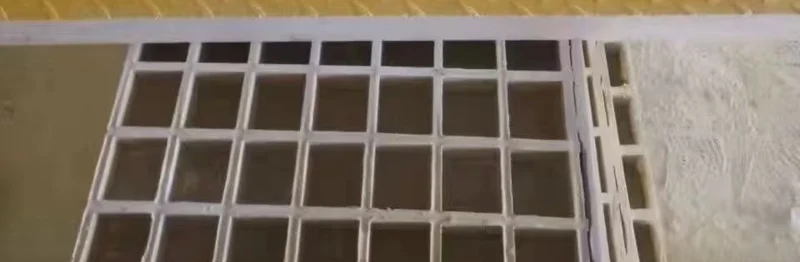
A cover closes the through-surface opening. It does not automatically seal:
- joints between panels;
- edges between cover sections;
- perimeter gaps;
- lifting or fixing penetrations;
- service openings; or
- the interface with the structure.
Where water must be kept out, drained or contained, those are separate design functions. A dry utility void may need a cover with a perimeter seal. A wet outdoor area may need a cover with falls to edge drainage. A working platform may need removable sections that can be refitted without leaving a gap.
The covered grating guide treats the cover as a configuration rather than a stock label, while the chequered-plate assembly guide covers the specific base-plus-patterned-cover construction.
Compare Drainage, Airflow and Cleaning Together
Mini mesh: open but increasingly fine
Mini mesh allows a path for water and air, but the path is reduced by narrow openings, two mesh layers, grit and debris. It can be the better answer over a pump opening, process area or wet platform where drainage and object retention both matter.
Covered grating: no through-path, new edge path
A covered surface turns drainage into an edge-and-joint problem. The project has to provide falls, gutters, edge scuppers or other outlets. Debris that once fell through now stays on top and must be removed.
Solid plate: neither air nor water passes through
A patterned flat plate has no through-surface opening and no through-surface airflow. It is not automatically a cover over a grating base. Load paths, condensation, thermal movement, fixing and drainage must be reviewed as plate-system questions.
If airflow is required for equipment, a covered surface may be the wrong starting point even when its object control looks better. If every through-opening is unacceptable, a mini-mesh product may fail regardless of how small its opening is.
Keep Access and Maintenance in the Product Choice
Covered panels are often used over service spaces, equipment or drains. If the area needs regular access, the assembly has to be designed for lifting and refitting.
Record:
- who lifts the panel;
- available lifting points;
- maximum piece mass;
- whether the cover remains attached;
- the orientation when it is replaced;
- fixing method and restraint;
- sealing or gasket detail;
- inspection of the support below; and
- replacement-piece identification.
A removable cover that is too heavy, too large or difficult to align may be left open or refitted incorrectly. That creates a different safety condition from the one used to select the product.
What the Factory Can and Cannot Confirm
We can confirm the offered mini-mesh row, upper and lower mesh fields, nominal panel dimensions, available cover formats, assembly type, machining and sealing scope, fixing components in our scope and agreed drawing or dimensional records.
We cannot:
- convert “nothing may fall through” into an object requirement without the actual object envelope;
- certify a dry, sealed or drainable installation from a panel-only drawing;
- use the open base panel’s load values for every covered assembly;
- guarantee that every perimeter and joint is closed;
- approve lifting weight or maintenance access without the layout; or
- replace the project designer’s decision on airflow, drainage or containment.
A Practical Dropped-Object Review
- Name the object and its worst credible orientation.
- Mark what is below and why passage matters.
- Decide whether water, air and light must pass.
- Measure the mesh opening and every bypass gap.
- Select mini mesh, base-plus-cover, flat plate or solid panel.
- Define drainage, cleaning and access.
- Review support, load, deflection, fixing and removal.
- Freeze the construction, drawing and acceptance evidence.
The result is a complete surface, not merely a smaller hole.
The Construction Rule
Use mini mesh when the surface must stay open and a measured smaller opening achieves the object-control goal. Use covered grating or a solid plate when the through-surface opening itself must be removed and the project can manage drainage and access. Never let “covered” stand in for a construction drawing, and never let “mini mesh” stand in for a measured installed opening.
Selection sequence
From Object Size to the Finished Surface
Define what cannot pass before deciding whether the surface should remain open.
Record what must stay above, how it could fall and what would be affected below.
If water, air and light must pass, start with mini mesh; if not, evaluate a covered or solid construction.
Check openings, joints, cuts, cover seams and perimeter gaps rather than one panel sample.
Fine mesh can clog; a cover can pond. Choose the maintenance method with the surface.
Identify base, cover, plate, thickness, resin and surface as one product.
Confirm support, span, load, deflection, fixing, lifting and removal with the selected assembly.
Evidence record
What a Dropped-Object Decision Must Retain
The selected surface, gaps and load path need one consistent record.

One object envelope
Record the smallest or most difficult shape that must not pass.
One installed opening
Check the mesh, cuts, joints and perimeter.
One through-surface decision
State whether water and air must pass.
One assembly
Identify base-plus-cover, flat plate or solid panel.
One drainage and cleaning plan
Include the maintenance method that the product will actually see.
One structural basis
Match support, load, deflection and fixing to the exact construction.
RFQ checklist
What to Send for a Mini-Mesh or Covered Grating Review
Include the object envelope, flow requirement and complete panel construction.
- Object requirement — Size, shape and orientation of anything that must remain above the surface.
- Area served — People, equipment or services below and the consequence of an object passing.
- Flow requirement — Water, oil, air, heat, light or wash-down that must pass through.
- Product construction — Mini-mesh upper and lower mesh, or base-plus-cover, patterned plate or solid panel.
- Joints and edges — Panel layout, perimeter, cover seams, cut-outs and removable pieces.
- Access — Lifting, cleaning, service access and refitting sequence.
- Structure — Support, span, load, deflection and fixing condition.
- Evidence — Drawing, sample, opening record, assembly detail and applicable test.
Request a review
Send the Dropped Object and Area Conditions
We will separate the through-surface requirement from drainage, access and structure.
- Object checks both mesh and joints
- Construction identified, not just “covered”
- Drainage, access and structure stay visible
Mini Mesh vs Covered Grating Questions
Is mini mesh better than covered grating for dropped objects?
Does covered grating stop every object?
Is covered grating watertight?
Why does a smaller opening sometimes make maintenance harder?
Can I use the open base panel's load data for covered grating?
Does a cover raise the load capacity?
Which option suits a drainage area?
What should be measured before choosing?
This content was prepared and reviewed by Dengtai Industry’s technical and production team using the project conditions, available product data and applicable documents. Limits that require design, testing or approval are identified in the content. Content last checked: