Drain-cover duty-zone guide
FRP Drain Grating Load Zones: Pedestrian, Trolley and Vehicle Areas
One drainage run can carry feet, cleaning equipment, carts, cars and forklifts. Divide the opening by the route that crosses it, record the loaded wheel and contact area for each zone, then review the cover, frame, support, drainage and fixing as one assembly.
Prepared by
Dengtai Industry
Published
·
Reviewed

A framed trench installation from our image library. A project drawing and load review remain necessary. Photo: Dengtai Industry.
Drain-cover vocabulary
Ten Terms That Separate a Duty Zone From a Product Name
A wheel reaction, clear opening and frame seat describe more than “pedestrian” or “heavy duty.”
- Duty zone
- A continuous part of a drainage cover assigned to one actual use, such as pedestrian access, a hand trolley route, occasional car traffic or a forklift turning area.
- Wheel reaction
- The force transmitted through one wheel or loading point. It comes from the loaded vehicle condition and its load distribution, not automatically from gross vehicle mass divided by wheel count.
- Contact area
- The shape and size of the tyre or equipment foot through which a load enters the cover. A small contact patch can create a different local condition from the same total load spread over a larger pad.
- Clear opening
- The unsupported distance across the drainage opening or cover support. It is not the trench outside width, frame pocket size or delivered cover size.
- Bearing frame
- The seat on which the cover rests. Its width, continuity, level, material and connection to the surrounding structure affect seating, local load and the finished surface.
- Zone transition
- The point where a pedestrian edge becomes a vehicle route, a covered section becomes open mesh, or two cover assemblies with different support conditions meet.
- Restraint
- The clip, bolt, hinge or other detail that limits cover movement. Restraint does not replace a missing bearing edge or increase the structural capacity of the panel.
- Open area and net opening
- Open area is the useful flow percentage of the cover. Net opening is the measured gap between bars or slots. They describe different hydraulic and debris questions.
- Duty evidence
- The drawing, wheel-load basis, support assumption, test or calculation, material record and inspection scope offered for the exact cover and frame being supplied.
- Complete cover assembly
- The grating, cover surface where used, interface, frame or bearing detail, fixings and handling features required for the quoted installed cover.
Duty zoning
Six Ways Traffic Crosses an FRP Drain Cover
Each route produces different contact, support, drainage and handling inputs.
| Duty zone | What crosses the cover | Information that changes the review |
|---|---|---|
| Pedestrian and cleaning | Feet, boots, wash-down hoses and small dropped items | Net opening, debris type, wet grip, lifting weight and repeated access |
| Hand trolley and wheeled equipment | Small wheels, castors, drum trolleys and portable equipment | Wheel diameter, contact width, load, turning path and gaps between bars or covers |
| Car and light service vehicle | Occasional inspection or maintenance vehicles | Loaded wheel reaction, tyre contact, track, approach direction and frame support |
| Truck and loading-zone route | Regular delivery, road or yard traffic | Axle and wheel reactions, tyre pressure, contact area, braking, turning, impact and frequency |
| Forklift and plant | Materials-handling equipment, small wheels and concentrated corners | Individual wheel loads, turning, braking, cycle count, load position and dynamic basis |
| Shared or changing duty | A pedestrian edge used occasionally by vehicles or maintenance equipment | Whether the vehicle path is controlled and remains inside the zone for which evidence exists |
Separate the load cases
Five Load Cases Before Choosing an FRP Drain Cover
Uniform, point, wheel, impact and sustained actions answer different structural questions.
| Load case | What it describes | What to provide | Why it cannot be substituted |
|---|---|---|---|
| Uniform distributed load | A load spread over a defined area, such as stored material or a broad equipment base | Magnitude, loaded area and duration | A UDL does not show the local contact produced by a wheel, foot or small pad |
| Concentrated point load | Force entering through a foot, jack, stand or temporary support | Force, contact shape and location relative to bars, joints and supports | A point check does not model rolling movement, braking or repeated wheel passes |
| Rolling wheel load | A moving load transmitted through a tyre or wheel | Loaded wheel reaction, contact patch, route, track, turning and frequency | Gross vehicle mass cannot replace the individual wheel condition |
| Impact or dynamic action | A demand increased by braking, turning, uneven entry or a dropped object | The event, speed or drop height and the project dynamic or impact basis | Static load tables do not automatically include a universal impact factor |
| Sustained load | A load that remains in place for a long period, often with temperature effects | Load duration, normal and peak temperature and allowable long-term deflection | A short-term ambient load row does not close a creep or long-duration case |
Load-zone record
What an FRP Drain Load Review Needs
The useful information connects the route, wheel, opening, frame, water path and evidence.
| Project input | State on the drawing | Why it changes the cover |
|---|---|---|
| Zone map | The full route, marked zones, barriers and transition points | Shows exactly which duty applies to each cover piece |
| Vehicle data | Loaded wheel reaction, tyre or pad size, track and load position | Defines the actual contact and load pattern entering the grating |
| Movement | Speed, turning, braking, impact basis and expected frequency | Separates a static row from a repeated or dynamic vehicle condition |
| Structure | Clear opening, bearing width, frame, embed and support condition | Establishes how the cover reaches the surrounding structure |
| Drainage | Flow, debris, solids, slope and required net opening | Prevents a stronger cover from blocking the drainage task |
| Handling | Cover mass, lift points, hinge, restraint and maintenance frequency | Makes the removable cover workable after installation |
| Serviceability | Allowable deflection, level tolerance, noise and traffic comfort | Adds requirements beyond material strength |
| Evidence | Required load basis, test, calculation, drawing and inspection record | Connects the quotation to the exact assembly and duty zone |
Review readiness
When a Drain Cover Is Ready for a Traffic Review
These checks determine whether a quotation can address the actual duty.
Specify this if…
- The project can mark where pedestrians, trolleys, cars and plant actually travel.
- At least one vehicle or equipment case can be described with a wheel reaction, contact area and position.
- The clear opening, frame and bearing arrangement can be shown.
- Drainage and debris requirements are stated with the structural duty.
- The required deflection, load evidence and approval basis can be named.
Look elsewhere if…
- The entire drain is described only as “heavy duty.”
- The buyer expects panel thickness alone to determine a vehicle load class.
- The vehicle is represented only by gross mass with no wheel, tyre or position data.
- The cover is shown without the frame, bearing edge or surrounding structure.
- A stock load table is being used for a different construction, span or support arrangement.
- The cover must be lifted or removed but no handling and restraint method is defined.
Example only
How a Mixed-Use Drain Duty Schedule Can Be Built
The rows organise project inputs; they do not assign a product load class.
| Example cover ID | Route and duty | Governing input | Linked response |
|---|---|---|---|
| D-01 | Pedestrian edge outside the controlled vehicle gate | Cleaning traffic, dropped tools and required drainage | Mini mesh with a manageable lift weight and a restrained seat |
| D-02 | Hand-trolley crossing between two doors | Small wheel, contact width, turning path and cover joints | Mesh, joint position and bearing checked for the trolley route |
| D-03 | Controlled light-vehicle crossing | Loaded wheel reaction, tyre footprint, track and approach | Cover and frame reviewed against the vehicle support case and project evidence |
| D-04 | Forklift turning area beside the intake | Individual wheel loads, turning, braking and cycle frequency | A separate governed zone, support layout and clear installation marking |
Start With the Route, Not the Drain Product
The same drainage run can pass through several duties within only a few metres. A pedestrian edge at a plant room door may lead into a trolley route, then a controlled car crossing, then a forklift turning area beside an intake. If the buyer requests one “heavy-duty” cover for the whole length, two things can go wrong: the pedestrian sections become unnecessarily expensive, while the governing vehicle section may still be underspecified because its actual wheel and support condition was never stated.
The first useful drawing is therefore a duty-zone plan. Mark the complete drainage route, every path that crosses it, gates or bollards that control access, the turning envelope for equipment, and all changes between finishes or cover formats. A zone should have a boundary that the installation and maintenance teams can recognise. This prevents a stock panel from later being moved into a more demanding place because it looks similar.
The zone map also identifies transitions. A vehicle cover does not stop being a single assembly at the moment its outline ends. The frame, bearing, finished level and fixing pattern must transition in a way that does not create a discontinuous edge, a trip point or an unseated cover. If the site cannot show how a vehicle is kept within the intended zone, the review should consider the uncontrolled path as well as the normal one.

Record the Actual Wheel Action
A vehicle name is a starting point, not a load calculation. “Car,” “truck” or “forklift” does not tell us how force reaches the cover. The project should identify the loaded wheel reactions and their positions. In some cases, the governing case is not the routine vehicle but a maintenance truck with a full tank, a loaded forklift turning beside the drain, or a single non-standard equipment foot.
For each governing wheel, record:
- the loaded wheel reaction and its source;
- the tyre or pad footprint and approximate shape;
- the track width and distance between wheels;
- where the wheel can sit relative to the trench edge, frame and intermediate support;
- travel direction, turning path, braking and any impact basis;
- expected speed and number of cycles; and
- the loaded condition that produces the maximum reaction.
Gross vehicle mass alone is weak input because payload, axle arrangement and centre of gravity can all change the distribution. Dividing a vehicle’s mass by four assumes a condition that may not exist. Where the project has already completed a structural load model, send the governing wheel reactions and the corresponding support condition. Where it has not, send the vehicle data and ask the responsible engineer to define the load case.
Dynamic effects deserve a separate question. A forklift turning, a truck braking or a delivery vehicle crossing a raised frame can produce a different response from a stationary wheel. The applicable impact or dynamic factor belongs to the project’s design basis. We do not replace that decision with a universal multiplier.
Separate Load Cases Before Using a Load Table
The useful load schedule keeps uniform, point, rolling-wheel, impact and sustained actions separate. A broad stored-material load may be described as a pressure, an equipment foot may act through a small pad, a vehicle may cross through individual tyre contacts, and a temporary maintenance component may create a concentrated or impact action. Converting one of those cases into another without a structural model can make a quotation look precise when it is not.
The same separation applies to time. A panel that is briefly crossed by a wheel is not necessarily represented by a permanent storage load, and a long-term load at elevated temperature can add deflection through creep. If the project has several cases, identify which one governs the cover, frame and support. The heavy-duty load guide examines these cases without assuming that a catalog row is a universal vehicle approval.
Match the Cover to a Supported Opening
The cover is only one part of the load path. The framing must carry the reactions from the grating into the concrete, steel or fabricated structure. An existing trench may have a narrow ledge that is uneven, spalled, discontinuous or partly blocked by mortar. A new cover can look correct on plan but rock because the frame is not a reliable seat.
Show the following together:
- trench or pit outside dimensions;
- clear opening between bearing edges;
- frame section, bearing width and embed or anchor condition;
- any intermediate supports;
- grating bar or bearing-bar direction;
- cover piece sizes and joints;
- clip, hinge or lifting details; and
- surrounding floor level and drainage slope.
A cover may be removable, restrained, hinged or fixed. The choice affects how the wheel load is transferred and how maintenance can use the opening. A clip across two bars is useful restraint, but it is not a bearing support and does not let a cover span from a missing ledge. Likewise, a cover handle helps lifting; it does not approve the handling plan or strengthen the cover.
This is also where the difference between a cover and a service trench panel becomes important. A narrow drain cover may use a small removable piece. A wide trench may need a frame or pultruded members arranged in the direction that actually carries the wheel path. The trench-cover guide covers long runs, while the heavy-duty grating guide separates rolling wheel, point and sustained loads.
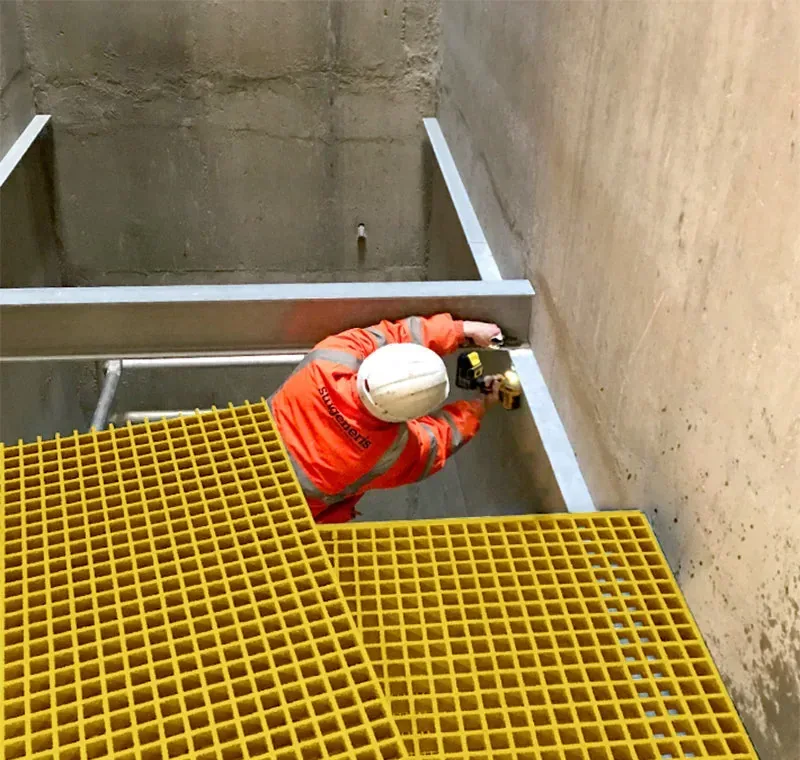
Check the Frame Before the Cover Is Accepted
Installation quality can change the practical support condition. Before a cover is accepted, the installation team should:
- clean the frame or bearing ledge and remove loose mortar, debris and obstructions;
- dry-fit the cover and check that it bears evenly without rocking or bridging a low point;
- confirm the correct piece ID, zone, bar direction and top face;
- install or verify the agreed clips, hinge or other restraint; and
- lift or release the piece through its intended maintenance method, reinstate it, and observe the drainage path.
Do not use an improvised vehicle proof load as a substitute for the project’s structural acceptance procedure. A visible dry fit proves that the piece can sit in the opening; it does not prove a load class. This distinction is central to our factory review: fabrication can reproduce a drawing, but the supporting structure and traffic approval remain project responsibilities.
Keep Drainage in the Same Decision
A stronger cover is not useful if it no longer passes the water, solids and cleaning load. Open molded grating, mini mesh, covered grating and solid-top grating have different relationships between hydraulic area, small-object retention and surface closure.
For a simple surface-water channel, open mesh may be appropriate. At a pedestrian edge where keys, caps or tools must not fall through, a smaller upper mesh can help. In an area where the surface must be closed, a covered or solid-top format may be considered, but the cover creates additional interfaces, mass and load-path questions. In a washdown area, cleaning access may matter as much as the nominal open percentage.
Record the water source, expected peak flow, slope, typical solids and cleaning method. Leaves, fibrous material, food waste, sand, plastic packaging and process spillage behave differently. Net opening should be checked against the object that must be retained or passed. The mini mesh versus covered grating guide explains this trade-off.

Treat Vehicle Zones as Controlled, Marked Areas
If a vehicle can reach an FRP cover, the review needs a boundary. The simplest controlled solution is to keep the vehicle path within the cover assembly that has been assessed for that duty. Bollards, kerbs, a widened frame or a dedicated crossing can all help, but they only work if the site layout and operating procedure actually preserve the boundary.
A routine pedestrian drain should not receive a maintenance truck because a contractor removes a barrier or because a vehicle can physically fit. Nor should a cover piece from a heavy zone be swapped with a lighter piece elsewhere. The finished-piece schedule should give each cover an ID and a zone; packing and installation marks should carry the same identity.
Where a mixed-duty run is unavoidable, a stronger vehicle section and a lighter pedestrian section can be joined at a deliberate supported transition. The joints still need to maintain level, bearing and restraint. The result is not one mysterious “mixed-duty panel”; it is a documented set of cover pieces with defined duties.
For a car-wash layout, continue with the drain grading and vehicle load-zone plan to coordinate wheel paths, water falls, trench positions and cover-piece duties on one site plan.
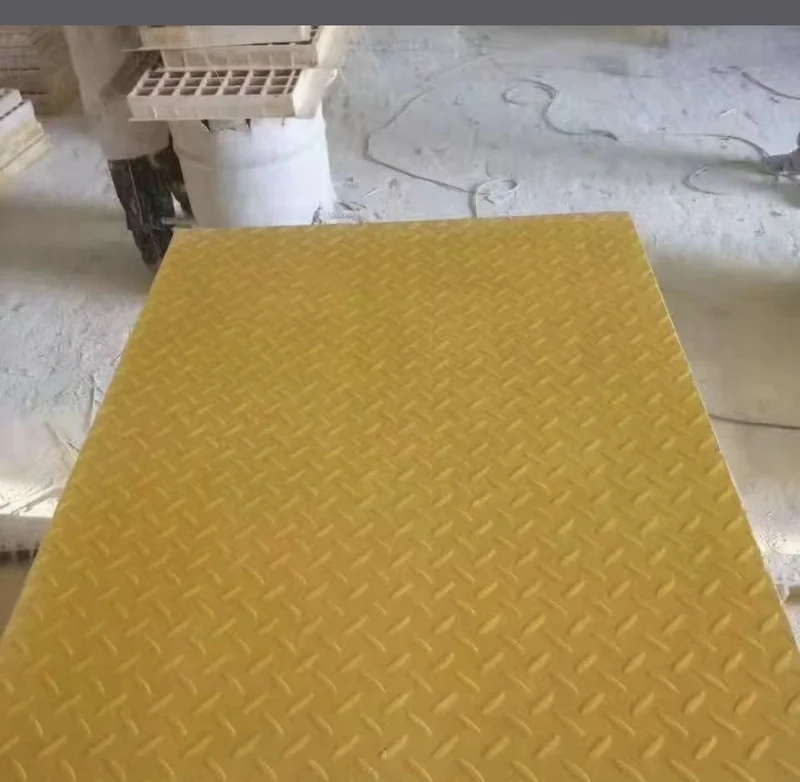
Include the Open Condition and Maintenance Sequence
A drain cover spends part of its life closed and part open for cleaning or inspection. The closed condition needs bearing and restraint. The open condition needs a project-approved temporary edge protection, a safe place to put the cover, and a repeatable reinstatement procedure.
Piece weight is central. The same assembly that is acceptable as a fixed panel may be too heavy to lift by hand in a cramped service corridor. Hinges can help, but they add anchors, corrosion interfaces and a swing path that must remain clear. Lifting eyes can accept mechanical equipment, but the lifting method and cover position need to be planned. These details belong in the enquiry if maintenance will occur frequently.
The maintenance team also needs to know how to clean the water path and inspect the frame. Debris accumulating in a corner can reduce hydraulic area even when the panel is unchanged. A fixed and covered section may need a gap or removable piece for flushing. Cleaning access and structural selection should not be decided in separate meetings.
What the Best Existing Guides Add
Useful manufacturer and technical pages often explain the difference between uniform, point and wheel loads, and show that tyre contact can be more relevant than a single nominal capacity. One strong example from Leihong’s heavy-load guide asks for wheel reactions, contact area, turning, braking, frequency and support, while also separating catalog readings from project approval. That approach is more useful than a universal “vehicle-ready” claim.
Other pages show open, slotted and solid formats with frames, hinges and lift features. We have carried forward the questions that make those pages useful, but our approach starts earlier: with a map of routes and duties. The cover is not the only variable. A pedestrian cover may be correctly selected yet fail the installation goal because its lifting method is poor, or a vehicle assembly may be structurally adequate on paper but sit on an uneven ledge.
Our factory view is that the best quotation is not the largest panel thickness. It is the clearest link between the zone drawing, exact cover piece, frame, wheel case, drainage requirement and verification document. If one of those links is missing, the right next step is a focused review, not an optimistic assumption.
How We Review an Enquiry
We can use the drawing to identify the cover outline, clear opening, piece sizes, cutting, edge treatment, chosen cover format, clips and the information that is still missing. We can point out a zone without a stated wheel case, a vehicle route that crosses an unsupported joint, or a cover that cannot be handled from the available space.
We do not approve the surrounding structure, road or yard traffic, temporary fall protection, installation procedure or regulatory compliance unless that scope is expressly included in writing. The project engineer remains responsible for the supporting structure and traffic design. This boundary is not a limitation on the product; it is what keeps a product quotation from being mistaken for a complete engineering approval.
The Four Documents We Prefer
- Zone plan: the entire drain, paths, transitions, barriers and access control.
- Load schedule: wheel reactions, contact area, position, direction and frequency for each governed zone.
- Opening drawing: clear span, bearing frame, support, cover pieces, joints and fixing positions.
- Technical requirement: drainage, debris, surface, deflection, handling and the exact evidence the project will accept.
With these four documents, a quotation can be structured around finished pieces and real interfaces. Without them, “pedestrian” and “vehicle” remain labels rather than design cases.
The example schedule shown near the top is deliberately written with roles and inputs rather than invented load values. It demonstrates the expected communication pattern. A real project replaces the example route descriptions with dimensions, actual governing actions and the evidence named by its engineer.
Selection sequence
From Site Route to Quoted FRP Cover Assembly
Six steps keep the traffic, drainage and support questions connected.
Mark the paths that cross the drain, including maintenance access, turning areas, controlled vehicle gates and pedestrian edges.
For each mechanical zone, state the loaded wheel or foot, contact size, position, direction, duration and frequency.
Set the clear opening, bearing frame, support, member direction, cover pieces and movement restraint as one assembly.
Confirm that the proposed cover format still gives the required hydraulic area, net opening and cleaning access.
Compare the exact panel, cover, frame and support condition with the required calculation, test or project design.
Mark each cover piece, zone, open/closed direction, fixing set and handling method for fabrication and installation.
Project checklist
What to Send With an FRP Drain Cover Enquiry
Ten inputs help the factory identify the real governing condition.
- Drainage layout — Plan, section, trench length, clear opening, slope and surrounding structure.
- Duty-zone drawing — Pedestrian, trolley, vehicle and plant paths with gates, barriers and turning areas.
- Governing wheel — Loaded wheel reaction, tyre or pad size, pressure if available, track and position.
- Operation — Direction, speed, turning, braking, impact basis, loaded state and cycles.
- Frame and support — Bearing width, frame section, embed or anchor, intermediate supports and condition.
- Cover format — Open mesh, mini mesh, covered, solid-top or mixed zones.
- Drainage requirement — Flow, solids, debris, cleaning method and acceptable net opening.
- Handling and restraint — Cover mass, lift points, hinge, clips, bolts, asset marking and reinstatement.
- Serviceability — Deflection, finished level, rocking, noise and surface requirements.
- Evidence scope — The standard, calculation, test report, drawing or inspection document required for approval.
Boundary view
What FRP Drain Grating Specifications Must Separate
Product format, structural duty, drainage and evidence answer different questions.
Request a Project Quote| Specification | Value |
|---|---|
| Cover format | Molded, mini mesh, covered or solid-top Selected by drainage, debris, walking and closure requirements; the format does not assign a load class. |
| Panel construction | Molded, pultruded or covered assembly Exact depth, bar direction, cover interface and support condition must match the duty evidence. |
| Frame | Project-specific bearing and restraint Existing concrete, embedded steel, fabricated frame and anchors belong in the drawing. |
| Vehicle review | Loaded wheel or point-load schedule Record contact area, position, direction, turning, braking, impact and frequency. |
| Drainage review | Flow plus debris opening Open area and net opening are checked against actual water, solids and cleaning. |
| Handling | Covers, hinges, clips and lifting points Removable pieces require a repeatable safe lift and reinstatement method. |
| Evidence | Configuration-specific Test or calculation must describe the proposed panel, frame and support arrangement. |
| Supply boundary | Written project scope Structure, traffic approval, installation and site safety remain separate unless expressly included. |
Quotation scope
Why a Bare Panel Price Cannot Price a Vehicle Duty Zone
The complete opening contains more than the visible grating.
Bare cover panel
Panel format, construction, size, fabrication and edge condition define one price layer.
Complete opening
Frame, bearing detail, fixings, lifting and trial fit can change the supplied assembly.
Duty evidence
Project calculation or testing is not created by changing a unit price or panel thickness.
We can quote the FRP cover pieces and agreed fabrication from a clear duty drawing. A lower offer is comparable only when the frame, support, fixings, drainage, evidence and delivery scope are also the same.
Request a review
Send the Drainage Route and Governing Wheel Load
Mark the zones, show the frame and explain how each cover will be handled.
- Mark every duty zone on the plan
- Show the loaded wheel and contact patch
- Define frame, support, restraint and evidence
FRP Drain Grating Vehicle Load Questions
Can one FRP trench cover serve pedestrians and forklifts?
Does a thicker FRP panel automatically reach a vehicle load class?
What vehicle information is useful at quotation stage?
Why not divide gross vehicle weight by four?
Is mini mesh suitable for a vehicle area?
Does open area tell me everything about drainage?
Does a clip make a cover vehicle-rated?
What if the vehicle path crosses only part of the drain?
Can the factory approve the road or yard loading?
This content was prepared and reviewed by Dengtai Industry’s technical and production team using the project conditions, available product data and applicable documents. Limits that require design, testing or approval are identified in the content. Content last checked: