Equipment platform fabrication
FRP Platform Grating Cutouts: Equipment Openings and Panel Schedule
Size each opening from the equipment envelope and the work required around it. Then identify interrupted bars, added support, fixed and removable pieces, and carry one piece ID through quotation, fabrication, packing and installation.
Prepared by
Dengtai Industry
Published
·
Reviewed

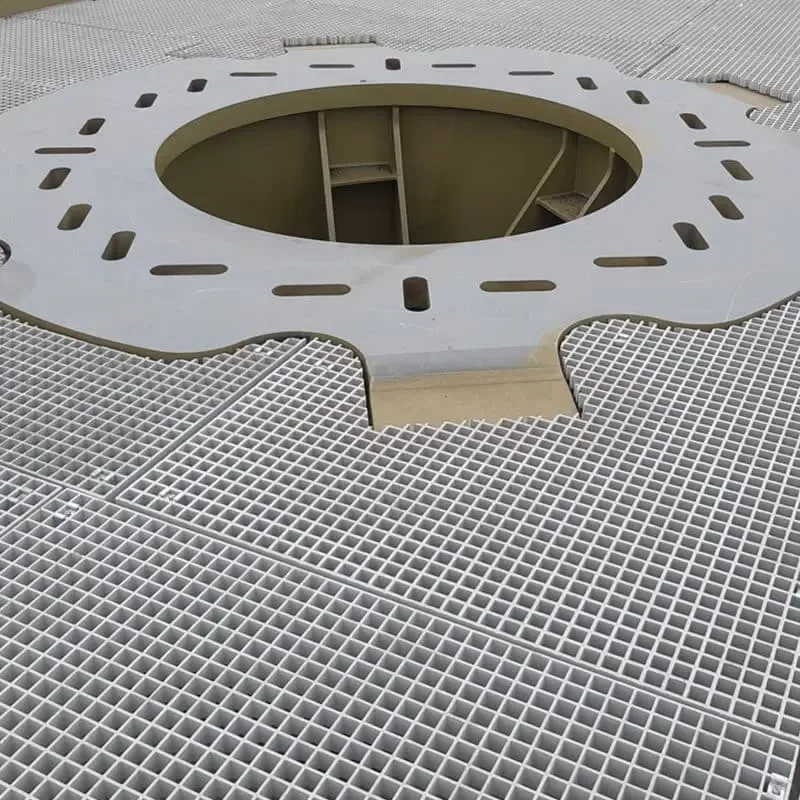
A service platform around equipment. Access volumes and remaining support have to be drawn with the panel layout. Photo: Dengtai Industry.
Opening vocabulary
Eight Terms That Turn an Opening into a Fabricable Piece
Equipment envelope, datum, support and piece identity all change the finished panel.
- Platform cutout
- A removed area in the grating for a pipe, valve, instrument, equipment movement, inspection or removable cover. It changes geometry, walking area and support.
- Equipment envelope
- The physical space occupied by an item when installed and during the movement needed to operate, lift, withdraw or replace it.
- Service clearance
- The additional space required for hands, tools, inspection, temporary parts and the intended maintenance action around the equipment.
- Opening datum
- The fixed reference used to locate the opening in both directions. Equipment-centre and pipe-centre dimensions are not interchangeable.
- Interrupted bar
- A molded bar or pultruded bearing member cut by the opening. Its end condition and effect on the load path must be reviewed.
- Cover piece
- A grating or solid cover placed over an opening. It needs bearing, restraint, lift detail, handling and reinstatement separate from the surrounding panel.
- Removable equipment panel
- A larger panel designed to be released so a component can pass through or be serviced. Its weight, lift direction, storage and refitting are part of the design.
- Panel schedule
- A row for every finished piece, including fixed panels, removable pieces, covers and transitions, with dimensions, openings, support, fixing and revision.
When to use this guide
When Equipment Access Requires a Panel Schedule
Use this method when a cutout, cover or removable panel affects more than a simple hole.
Specify this if…
- Equipment, access openings and maintenance actions are already marked on a plan.
- Finished platform pieces need to be fabricated, opened and identified in the factory.
- A removable cover or panel can be defined and handled safely.
- The support frame and intended bearing edges can be shared.
Look elsewhere if…
- The opening is dimensioned only from a pipe diameter.
- A hole is being cut without checking the remaining bars or support.
- A cover is assumed to be interchangeable with a platform panel.
- The factory is expected to approve the platform structure or access design.
Opening types
Five Platform Openings with Different Jobs
The task determines the geometry, support and handling detail.
| Opening type | Primary task | What the schedule must show |
|---|---|---|
| Pipe or cable penetration | Pass a service through the panel | Service size, position, edge gap and whether a split trim is needed |
| Valve or instrument access | Reach, view, operate or inspect the device | Tool space, hand clearance, datum and remaining walking route |
| Equipment removal opening | Lift or move a pump, fitting or motor component | Full movement envelope, temporary support, cover and piece handling |
| Inspection hatch | Reach a point below the platform | Opening size, cover weight, lift direction, restraint and reinstatement |
| Clustered openings | Serve multiple services or instruments | Individual datums, group frame, interrupted zones and one-piece/multiple-piece decision |
Piece schedule
Platform Cutout and Finished-Piece Fields
The information a factory needs to cut and identify the actual set.
| Schedule field | Information required | Why it matters |
|---|---|---|
| Piece ID | Unique number, description and quantity | Keeps fixed, removable, cover and transition pieces distinct |
| Equipment/task | Device ID, working action and movement envelope | Defines the opening beyond the static silhouette |
| Geometry | Datums, size, shape, location, top face and bar direction | Controls fabrication and installation orientation |
| Support | Bearing edges, interrupted bars, frame or transfer members | Ensures the opening does not leave an unsupported boundary |
| Handling | Piece mass, lift points, removal route and storage | Separates a removable panel from a panel that only has clips |
| Evidence | Load basis, drawings, inspection, surface and documents | Keeps the quotation tied to the actual finished pieces |
Schedule sequence
From Equipment Movement to Finished Piece
Define the task envelope, opening, support and piece ID in order.
Show each item in its installed state and the motion required to operate, lift, withdraw or replace it.
Add tools, hands, temporary parts and the approach direction around the equipment.
Decide whether the task needs a fixed cutout, removable cover, full removable panel or grouped frame.
Identify cut bars and the bearing, trim or transfer detail required around the opening.
Give every fixed panel, opening, cover and transition its own size, quantity, orientation and ID.
Keep the revision through cutting, edge treatment, marking, packing and installation.
An Equipment Opening Starts With the Maintenance Action
A platform opening is often drawn after someone notices that a pipe passes through the floor. That sequence can miss the real requirement. The maintenance team may need to turn a valve, remove a flange, lift a motor, read an instrument or place a temporary part. The required access volume can be much larger than the pipe diameter.
Start with the equipment and the task. Mark the installed footprint, the movement of handles or actuators, the direction a component is lifted or withdrawn, the tool arc and where a removed part will rest. Then draw the opening around that envelope.
The finished piece must also keep a usable walking route and a supported boundary. An opening that solves the equipment task but leaves an unsupported walkway edge is not complete.

Set One Datum for the Whole Platform
An opening can be positioned from a platform edge, column grid, equipment centre, pipe centre or building axis. The important rule is that plan, fabrication and site measurement use the same datum.
State the required size in both directions, the shape and the tolerance that affects fit. Do not rely on a scaled PDF or a photograph. If the equipment position is uncertain, mark it as unknown and show the measurement needed.
The same datum should locate adjacent guardrail posts, stairs, supports and removable covers. An apparently unrelated change to one item can move the remaining walking route and invalidate the panel split.
When a guardrail post penetrates or sits beside the panel, use the guardrail post opening guide to separate post anchorage from panel restraint and to define the clearance edge.
Predict How the Opening Interrupts the Panel
Molded grating uses an integral mesh. A cut localizes the interruption, but the remaining bars still form edges that need support. A large cutout can separate a substantial part of the grid or reduce the walking width.
Pultruded grating uses directional bearing bars. Cutting through a bearing bar interrupts the main structural path; a cross rod is not a substitute beam. A panel rotated to fit an opening may also rotate the bar direction away from its supports.
The opening drawing should identify:
- interrupted molded bars or pultruded bearing members;
- the remaining bearing edges;
- an added frame, trim, bearer or transfer detail;
- the condition of cut and drilled faces; and
- the removable cover support if one is used.
The molded cutout guide explains the geometric review in more detail. The platform overview covers the complete support and load path.
Fixed Panels, Covers and Removable Pieces Are Different
A fixed panel forms the normal platform surface. It still needs a piece ID because its top face, direction and edge treatment may differ from a similar piece nearby.
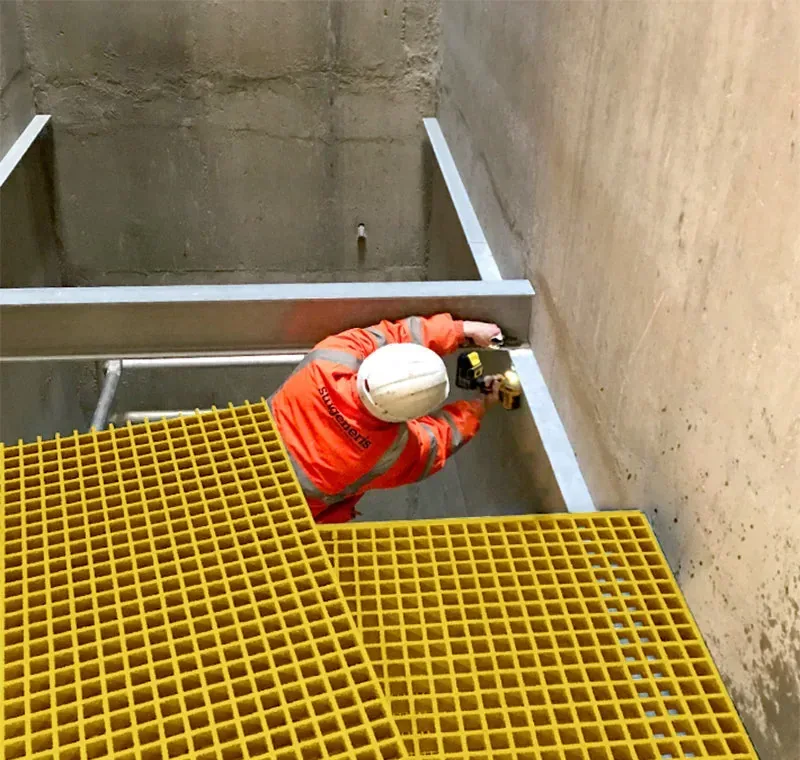
A cover closes one service opening. It needs a defined bearing frame, restrained position, lift point and handling method. A cover plate added on top of a grating base can have a different mass and assembly condition from a bare panel.
A removable equipment panel is larger than a normal cover and may expose a pump, motor or valve. Its weight, lift direction, temporary storage and reinstatement must be designed. Clips alone do not make it removable.
A transition piece relates the platform to a stair, walkway, guardrail line or change in support level. It should not be scheduled as interchangeable with a full field panel.
Use separate IDs for all four. The installation team should locate the piece by the layout, not by judging a similar appearance.
For a standalone equipment-access sequence, the machine platform removable grating guide turns that piece classification into a maintenance action, handling route and reinstatement schedule.
Design Both the Open and Closed Conditions
A cover is not complete when only its closed footprint has been drawn. The operating sequence must also show what happens while the opening is exposed: where the cover is stored, how the temporary edge is protected, how tools and parts are controlled, and how the piece is checked after reinstatement.
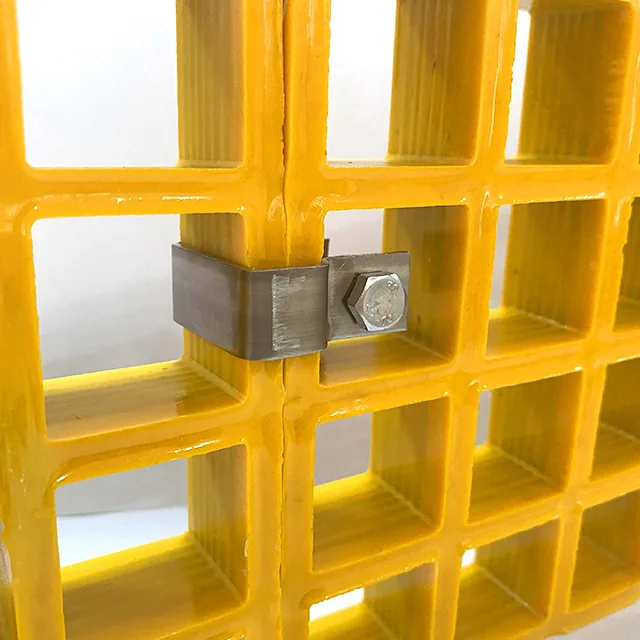
The closed condition needs a defined bearing edge, restraint and seating method. The open condition needs a project-approved temporary barrier or other fall-protection measure. Neither a C clip nor a cover handle supplies missing bearing, and neither automatically approves the temporary protection of an open hole.
Use the piece ID, installation mark and reinstatement record together. If the cover can be replaced before all fasteners engage, or if a temporary one-person barricade can be moved without control, the operating procedure should be clarified before fabrication is released.
Plan the Temporary Load and Working Area
During maintenance, the platform can see tools, removed parts, temporary support and people outside the normal walking load. The project should state those loads when they are material.
A large removable cover or equipment part may need space on the platform before it can be lifted out. A point load from a motor foot or temporary stand can be more severe than the normal foot-traffic condition. Include the temporary load location and duration in the review.
Long-term equipment left in place is a separate case. If a pump or frame remains on the platform permanently, the project needs a sustained-load check, not only a short-term pedestrian table. The temperature and creep guide explains the duration issue.
Keep the Piece Schedule Through the Factory
The finished-piece schedule is the bridge between design and fabrication. A useful row states:
- piece ID, description and quantity;
- final size and opening datum;
- top face and bar direction;
- support edges and added frame;
- fixed, removable, cover or transition class;
- clip and hardware;
- edge treatment, inspection and mass; and
- drawing revision and packing group.
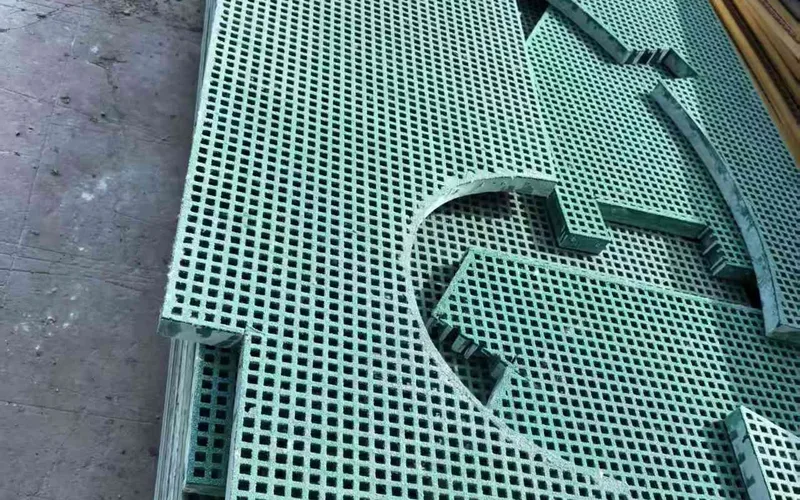
Factory cutting can then create the geometry and edge condition. We can carry the ID into inspection and packing. We cannot decide that two rows with the same outer size are interchangeable if their openings, bar direction or removal role differ.
When the Opening Changes After Quotation
A late equipment change can invalidate several pieces. Moving one opening may change the remaining walking strip, support relationship, panel ID and adjacent removable cover. The drawing revision should be reissued rather than editing one dimension informally.
Stop the release if:
- the equipment envelope is not known;
- the opening has a cut bar with no support response;
- the cover has no bearing or lift concept;
- the provisional load-table row comes from a different structure;
- the required documents name an unclear product; or
- the project expects the factory to approve the platform.
Competitor Content and Our Different View
Fibergrate’s platform article covers load, environmental exposure, slip, drainage and equipment access, and its catwalk guide highlights maintenance handling and corrosion. Those themes are valid. Much of the available content remains generic at the opening level, leaving the buyer to convert a photograph or equipment list into panels.
Our factory view is that the useful innovation is the schedule: every equipment task creates a specific opening, support condition and finished-piece identity. This connects the fabrication quotation to the maintenance operation instead of treating “custom cutouts” as an unbounded service.
Our Factory Review Boundary
We can review panel geometry, opening fabrication, edge treatment, piece IDs, agreed covers and clips. We can flag missing datums, ambiguous support and inconsistent piece schedules. We do not approve the equipment operating procedure, the permanent or temporary platform loads, the support structure, guarding, fall protection or installation unless those responsibilities are expressly included in the written scope.
Project checklist
What to Send With a Platform Cutout Enquiry
Ten fields connect the equipment, opening, support and fabrication scope.
- Platform plan — Platform boundary, supports, existing equipment and surrounding access points.
- Equipment schedule — Equipment IDs, installed footprint and movement needed for service or removal.
- Maintenance action — Operator position, tools, temporary parts and expected access duration.
- Opening geometry — Datum, shape, dimensions, service gaps and relationship to the walking route.
- Support — Beams, bearing edges, clear span and frame around each opening.
- Product construction — Molded or pultruded structure, depth or bar section, direction and mesh.
- Covers and removal — Cover type, weight, lift points, restraint, storage and reinstatement.
- Fixings — Clips, fasteners, removal hardware and support interface.
- Piece schedule — IDs, sizes, quantities, top faces, edge treatment, revision and packing groups.
- Evidence — Required load, material, fire, slip or inspection documents for the complete order.
Evidence boundaries
Four Things a Cutout Drawing Does Not Prove
Geometry is necessary but does not replace structural or operational approval.

Opening is a volume
The item, tool movement and temporary part can require more space than the installed footprint.
Sealing is not reinforcement
Edge treatment protects the composite; it does not replace a cut bearing member.
Covers need bearing
A removable cover requires a frame or support beneath it plus a repeatable lift and refit.
Schedule before price
Fixed, removable and transition pieces need separate rows before the quotation can be compared.
Request a review
Send the Equipment Plan and Finished-Piece Schedule
Show the equipment movement, opening and support around each piece.
- Mark equipment motion, not just its outline
- Show the support around every opening
- Give fixed, cover and removable pieces separate IDs
Platform Grating Cutout Questions
How do I specify a platform grating opening?
Is a pipe diameter enough to size the cutout?
Does a cutout need a perimeter frame?
Can the grinder seal the cut edge instead of adding support?
Should a service opening have a cover?
What is the difference between a cover and a removable panel?
What must be planned while the opening is open?
Can every panel of the same size be swapped?
Can the factory approve the opening?
This content was prepared and reviewed by Dengtai Industry’s technical and production team using the project conditions, available product data and applicable documents. Limits that require design, testing or approval are identified in the content. Content last checked: