Chemical platform review
FRP Grating for Chemical Platforms: Openings and Access Tasks
Start with the operations performed on the platform: which chemicals can reach it, what people need to reach, how equipment parts move, and which bars must be opened or removed. Then confirm support, resin, surface and fixing against the same drawing.
Prepared by
Dengtai Industry
Published
·
Reviewed

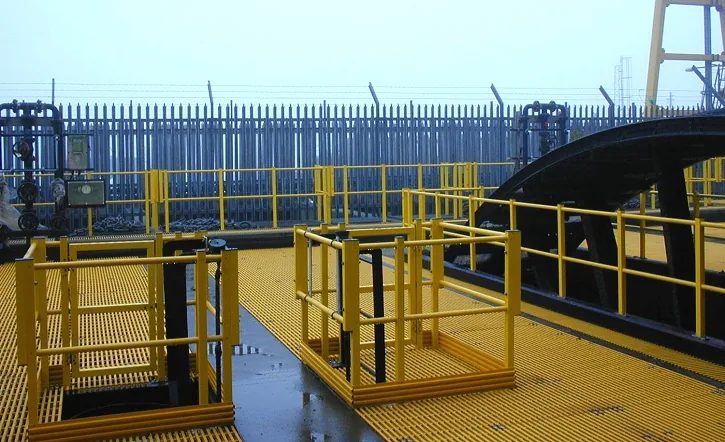
A process platform surrounds equipment with different maintenance tasks and exposure paths. Photo: Dengtai Industry.
Platform vocabulary
Seven Terms That Prevent a Chemical Platform Error
Exposure, maintenance action, opening and support are separate inputs that must meet on the same drawing.
- Chemical platform
- An elevated walking or working surface around process equipment. It may combine routine access, valve and pump maintenance, sampling, spill containment and escape routes.
- Process exposure zone
- A defined area with its own chemicals, concentration, temperature, splash, vapour, spill, washdown or immersion conditions. A plant name does not make every platform the same.
- Maintenance task
- The actual action carried out from or through the grating, including the approach direction, tools, parts, access duration and temporary loads.
- Equipment envelope
- The physical space occupied by a valve, pipe, pump, instrument or removable component, including the movement needed for adjustment, lifting or withdrawal.
- Service opening
- A cutout needed for access, passage or maintenance. It interrupts the grating surface and may remove bars, mesh or part of a protective layer.
- Added opening support
- A frame, trim, bearer or transfer detail introduced because the opening interrupts the original load path. Edge sealing is not structural reinforcement.
- Removable access panel
- A piece designed to be released, lifted and reinstated. Its piece weight, handling route, clips, orientation and reinstatement belong to the design.
- Supply boundary
- The written distinction between grating, fabrication and agreed clips and the separate support frame, guardrail, installation or structural approval.
When to use this guide
When a Platform Needs More Than Chemical-Resistant Grating
Equipment access, shaped openings and removable pieces turn the order into a finished-piece review.
Specify this if…
- The platform includes defined chemical, washdown, spill or fume exposure.
- Operators need to reach valves, instruments, pumps or sample points through or beside the grating.
- The platform needs shaped openings, removable covers or several different finished pieces.
- The support frame and current drawing can be shared.
Look elsewhere if…
- The request gives only a generic “chemical resistant” label without the chemicals.
- The opening size comes from a pipe diameter without the maintenance task.
- A cut edge is expected to replace the support removed by the opening.
- The panel supplier is assumed to approve the complete platform or area classification.
Claims and evidence
What a Chemical Platform Claim Must Prove
Resin, surface, fabrication and structure answer different questions.
| Evidence claim | What it can establish | What remains separate |
|---|---|---|
| Resin family | A starting chemistry for review | The actual grade, concentration, temperature, contact type and tested product |
| Grit surface | A walking texture that may help with wet or oily access | A tested slip class, cleaning performance or structural capacity |
| Factory-cut opening | A finished geometry made to the approved drawing | Added load capacity, support around interrupted bars or approval of the service task |
| Stainless clip | A possible fixing material for the stated exposure | A universal grade, compatible roof/support or completed installation |
| “Chemical plant platform” | An application description | The process zone, maintenance task, support, evidence and supply scope |
Platform schedule
Chemical Platform Grating Drawing Inputs
The fields needed before the factory can treat the platform as a buildable set.
| Drawing field | Information required | Why it changes the solution |
|---|---|---|
| Process zone | Area ID, chemicals, concentration, temperature and contact type | Resin and surface evidence must match that duty |
| Access task | Operator approach, tools, parts, frequency and expected duration | Defines clear width, opening size and removable-piece need |
| Equipment envelope | Pipe, valve, instrument or pump size plus movement and lifting space | The cutout must accommodate the task, not just the static item |
| Support | Beams, clear span, bearing width and edge supports | Structural evidence and remaining support around the opening |
| Product construction | Molded or pultruded, depth or bar section, mesh and direction | Defines the load path and how an opening affects the panel |
| Interface | Surface, edge treatment, clips, guardrail and platform frame | Fabrication, installation and responsibility boundaries |
Review sequence
From Process Task to Finished Grating Piece
Mark the exposure and human action first, then resolve the opening, support and product.
Separate dosing, pump, sampling, spill and normal access areas with their actual chemical and cleaning exposure.
Show where the operator stands, what is reached and how tools or parts enter and leave.
Size the service volume from the item envelope plus operation, lifting and withdrawal clearance.
Identify interrupted bars, bearing members and any frame or trim required before the panel is released.
Match structure, resin, surface, fixing and documentation to the finished pieces and the process zones.
Put fixed, removable and cover pieces on one revised schedule and inspect the delivered set against it.
A Chemical Platform Is a Set of Different Duties
Chemical-platform grating is often requested as a single material decision. The actual platform usually contains several operating conditions. A walkway beside a storage tank may see occasional spill, a pump pad may receive process drip and cleaning water, a sampling point may expose the operator to vapour, and a bunded area may combine chemical contact with drainage and containment.
The first review therefore separates process zones. For each zone, record the chemical names, concentration, temperature, contact type and duration. Splash, spillage, condensation, vapour, washdown and immersion are not interchangeable. A pH value alone does not identify the mixture, and one resin-family claim does not approve the whole platform.
This page is a platform and fabrication review for Dengtai grating. It connects the process duty to the finished pieces the factory can make. It does not approve the chemical process, area classification, platform structure, guarding or installed use.

Start With the Maintenance Action
An opening drawn only around a pipe can still be unusable. The operator also needs to reach the valve stem, turn a tool, see the indication, remove a fitting, place a temporary part and withdraw without stepping outside a supported walking area.
For each maintenance task, mark:
- where the operator stands;
- the hand and tool movement;
- the equipment envelope when opened or removed;
- the temporary part or tool-drop area;
- the route used to carry a component in and out; and
- whether the task blocks the normal escape or transfer route.
This is where many generic “chemical plant grating” pages stop too early. Corrosion resistance matters, but a chemically suitable panel that leaves insufficient access or removes the wrong bars is not a usable platform.
Turn the Task into a Real Opening
The opening is an access volume, not a single silhouette. Use the equipment drawing or a measured sketch to show the static item, its moving parts, the tool arc and the lifting direction. Add hand clearance and temporary-part space where the task requires them.
Record the opening type:
- circular pipe, duct or instrument penetration;
- rectangular valve or pump access;
- long slot for a control or inspection route;
- a group of closely spaced penetrations;
- a hinge or lift-out cover;
- a full removable panel for equipment removal.
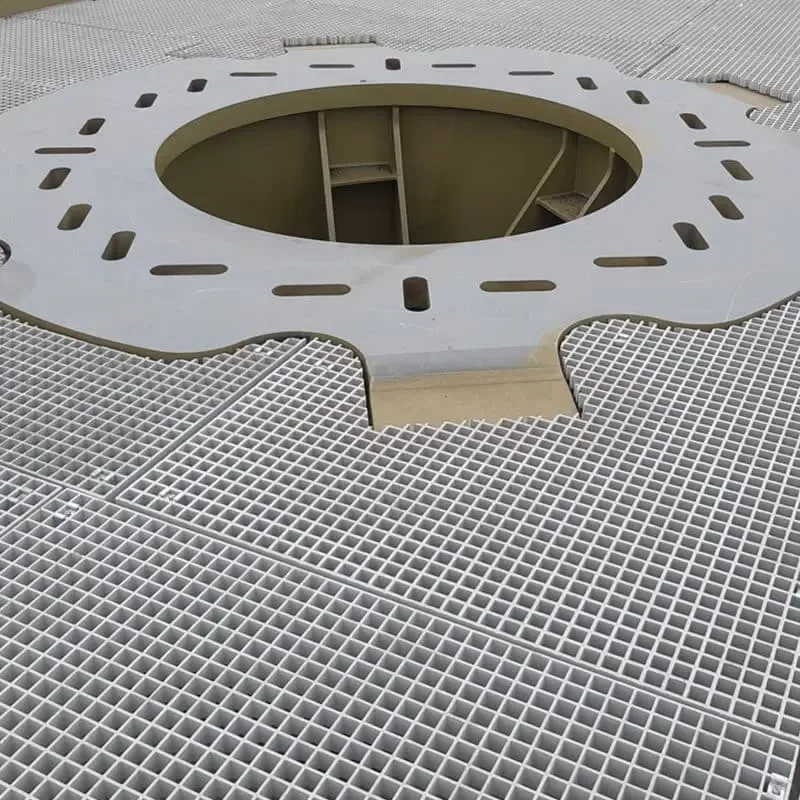
Each type changes the remaining piece differently. A round opening in a molded grid interrupts a local group of bars. A large rectangular opening may separate a substantial part of the panel. A cut through a pultruded bearing bar interrupts the primary load path. The cutout review guide explains opening datums, interrupted bars and added support.
Support Must Be Resolved Around Every Cut
Sealing a cut edge protects the exposed composite. It does not restore a removed bar or create a bearing edge. The factory drawing must show how the remaining boundary is supported:
- an existing beam behind the cut;
- a perimeter frame or trim member;
- a transfer bar between supports;
- a designed cover frame;
- a separately supported removable piece; or
- a combination of these details.
The supporting designer still has to approve the arrangement. We can flag an opening whose remaining bars do not reach a support and can fabricate the agreed trim or frame if that item is within the quotation. We do not treat an unsupported edge as acceptable because the cut was sealed neatly.
Product Construction Changes the Opening Review
Molded grating is an integral grid with bars in more than one direction. It is often considered where supports and equipment openings occur in an irregular layout. The grid can distribute load through more than one direction, but the interrupted area still needs a structural review.
Pultruded grating is assembled from directional bearing bars and cross rods. It can suit long, straight support runs, but a cut through a bearing bar changes the main load path. Rotating a panel to make an opening fit can also rotate which direction the bars span.
The platform grating guide explains the complete platform selection. For this page, the key point is that an opening cannot be approved from the product family name alone. Structure, bar direction, support and the finished-piece geometry must agree.
Chemical Exposure, Surface and Fixings
Chemical performance is specific to the resin system and the actual contact. Vinyl ester is a common starting direction for stronger chemical exposure, but the grade, formulation, reinforcement, surface and cure still require matching evidence. Isophthalic polyester may be suitable in milder areas where the actual duty supports it.
Grit can improve the walking texture in wet or oily areas, but it is not automatically a tested slip class. It may trap process solids and make cleaning more difficult. The cleaning agent, method, pressure and frequency belong to the surface decision.
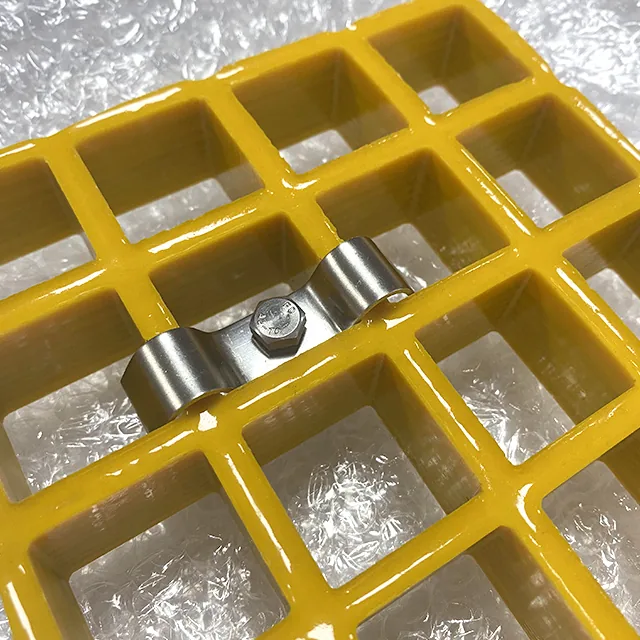
A stainless clip may be considered around wet or chemical exposure, but “stainless” covers different grades and support contacts. State the exposure and the support material. A chemical-resistant panel can still be paired with an unsuitable fastener or an unprotected carbon-steel interface.
The chemical resistance guide explains the evidence sequence, and the surfaces guide separates walking texture from chemical performance.
Separate Chemical Resistance from Fire, Static and Electrical Duties
“Chemical resistant” describes one part of the product duty. It does not establish reaction to fire, smoke performance, static dissipation, electrical insulation or non-sparking behaviour. Those requirements can overlap in the same plant, but they are not interchangeable product labels.
For a platform beside solvents or dust, state whether the project is asking for ordinary electrical insulation, controlled static dissipation, non-sparking behaviour or a tested anti-static system. For a fire-exposed area, provide the required fire test, smoke and toxicity basis, mounting condition and evidence of the finished construction. A resin-family name is not enough.
A normal FRP panel may be electrically insulating without being static-dissipative. Likewise, a non-sparking description is not a numeric electrical test, and a flame-retardant claim does not prove performance in an installed platform. Separate the property, test method, product sample and applicable area on the drawing.
Open grating helps water pass, but it does not replace a bund, drain, containment or cleaning plan. Where a solid cover interrupts drainage, define outlets, joints and the route for process liquid. The fire-rating guide and anti-static grating guide explain the evidence boundaries.
What the Factory Can Control
The factory can control the grating construction, panel cutting, opening geometry, agreed edge treatment, piece identification and packing. It can check that the finished geometry matches the approved drawing and that the ordered panel and accessory descriptions remain linked.
The factory cannot calculate a platform span from a photograph, approve an opening because a pipe passes through it, choose a chemical grade without the medium, or certify a support frame that is outside the scope. Those gaps should remain visible in the quotation.
For a platform with mixed duty, the release drawing should show:
- each process zone;
- the maintenance task and equipment envelope;
- fixed panels, removable pieces and covers;
- support and added frame around openings;
- resin, surface and fixing requirements;
- evidence required for the finished pieces; and
- exclusions and responsible parties.
Competitor Content and Our Different View
Fibergrate’s work-platform article emphasizes slip resistance, drainage, visibility, load and environment. Preet’s chemical-plant article identifies chemical processing, electroplating, storage and drainage applications and discusses resin families. Those are useful category inputs.
Neither generic category treatment replaces the task-specific opening review. Our factory view is that the chemical platform should be quoted from a zone-and-task map, with every opening and removable piece connected to its support and finished-piece identity. That is the practical step between “chemical-resistant grating” and a fabricable platform.
Our Factory Review Boundary
We can review the proposed grating, opening geometry, edge scope, clips and fabrication record. We can identify missing support, ambiguous equipment clearance and inconsistent piece descriptions. We do not approve the process safety, area classification, platform structure or guarding, and we do not substitute a resin-family name for project-specific chemical evidence.
Project checklist
What to Send With a Chemical Platform Enquiry
Ten inputs connect process duty, access design and the grating quotation.
- Platform and zone plan — Platform outline, process areas, access and escape routes, equipment and surrounding structures.
- Chemical exposure — Chemical names, concentration, temperature, contact type, frequency and cleaning agents.
- Maintenance tasks — Who approaches what, from where, with which tools and parts, and how often.
- Equipment envelopes — Static footprints plus valve operation, lifting, withdrawal and temporary part placement.
- Support layout — Beams, clear spans, bearing widths, free edges, openings and existing frame condition.
- Product configuration — Molded or pultruded, depth or bar section, mesh, direction, resin and surface.
- Openings and covers — Fixed openings, removable covers, temporary access and the frame around each cutout.
- Fixings — Clip type, material, support contact, removal frequency and reinstatement method.
- Evidence — Required chemical, load, fire, slip, static or inspection documents for the actual product scope.
- Supply boundary — Panels, fabrication, clips, supports, guardrails, installation and structural approval listed separately.
Evidence boundaries
Four Facts a Grating Quotation Cannot Establish Alone
Product data does not approve the process hazard, equipment task, support structure or complete installation.

Chemical resistance is zone-specific
A resin family name is not a compatibility result for every process medium.
Maintenance task defines the opening
Lifting and withdrawal clearance may exceed the static equipment footprint.
Support follows the cut path
Interrupted bars require an identified bearing or transfer detail.
Factory evidence has a boundary
Panel fabrication does not approve the platform structure, guarding or installed use.
Request a review
Send the Platform Plan, Exposure and Maintenance Tasks
Mark zones, openings and supports on one current drawing revision.
- Separate the process zones
- Show the actual maintenance movement
- Mark supports around every opening
FRP Chemical Platform Grating Questions
What is FRP chemical platform grating?
Is vinyl ester always suitable for a chemical platform?
How large should a valve or pump opening be?
Does a cutout always need a frame?
Can edge sealing restore the strength removed by a hole?
Should the platform grating be removable?
Does a grit surface make the platform safe around chemicals?
Does chemical-resistant grating also meet fire, static or electrical requirements?
Can you supply the complete chemical platform?
This content was prepared and reviewed by Dengtai Industry’s technical and production team using the project conditions, available product data and applicable documents. Limits that require design, testing or approval are identified in the content. Content last checked: