Fire evidence and product selection
FRP Grating Fire Rating: What It Means & How to Choose
There is no single fire rating that applies to every FRP grating. Start with the project question, then match the resin formulation, product construction and test evidence. Surface flame spread, oxygen index, smoke and structural fire resistance are not interchangeable.
Prepared by
Dengtai Industry
Published
·
Reviewed

A physical sample defines what is measured or tested. The report must match its resin, construction and intended use. Photo: Dengtai Industry.
Fire terminology
What Does FRP Grating Fire Rating Mean?
The term can refer to several tests and classifications, so the standard and product scope must be defined before the number means anything.
- FRP grating fire rating
- A shortened market term that can refer to several different fire tests or classifications. It should never be used without naming the standard, edition, result, product configuration and scope of acceptance.
- Fire-retardant resin
- A resin formulation designed or modified to affect burning behaviour. The term does not identify a flame-spread index, smoke class, structural fire-resistance period or approval for every grating made with that resin.
- Noncombustible material
- A material or product accepted as noncombustible under the governing definition and test. It is not another name for ASTM E84 Class A, fire-retardant resin or a structural fire-resistance period.
- Surface burning test
- A test of how fire behaves across an exposed material surface under controlled conditions. ASTM E84 reports comparative flame-spread and smoke-developed indices under its stated procedure.
- Oxygen index
- The minimum oxygen concentration that supports candle-like combustion of a plastic specimen under ASTM D2863. It is a material-screening result, not a building fire class or a structural fire rating.
- Structural fire resistance
- The ability of a defined construction or assembly to retain load-bearing capacity, integrity or insulation for a period under a fire-resistance test such as ASTM E119 or ISO 834. A panel surface test does not establish this.
- Reaction-to-fire classification
- A regional or code-based classification of a product's contribution to fire under a specified test and classification system. The exact edition, class and intended use must be stated.
- Test specimen and product scope
- The actual item tested, including its construction, resin, thickness, pitch, surface, orientation, mounting and test conditions. Results do not automatically transfer to a different configuration.
Evidence map
Separate the Four Fire Questions
Screening, surface burning, structural fire resistance and project approval answer different questions and use different evidence.
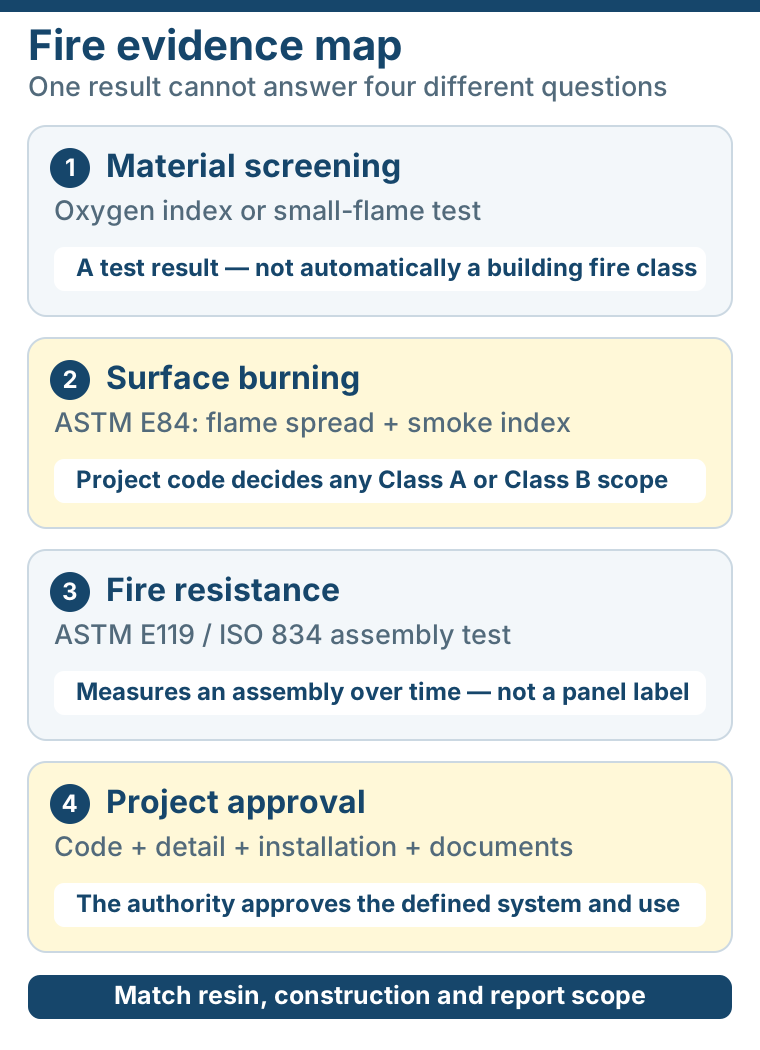
Separate screening from classification
An oxygen index or small-flame test can help compare materials, but it does not become an ASTM E84 class or a structural fire-resistance period.
Name the surface-burning test
Ask for the standard and edition, flame-spread index, smoke-developed index and the code or classification rule that uses those results.
Define structural fire resistance separately
Terms such as “60-minute fire rated” normally point to a tested construction or assembly, not a bare grating panel.
Match the report to the product
Resin grade, thickness, mesh or bar profile, surface and test mounting must describe the configuration being supplied.
Specification translation
What Do Common Fire Phrases Actually Require?
Translate the phrase used in the inquiry or specification into a test, product scope and explicit acceptance criterion.
Swipe horizontally to view all columns.
| Project phrase | Possible technical meaning | Evidence the supplier should identify |
|---|---|---|
| “Class A fire-rated grating” | Usually a surface-burning classification used by a building code or project specification; the governing rule must be named. | ASTM E84 edition, flame-spread index, smoke-developed index, tested product and the code-based classification being claimed. |
| “Noncombustible grating” | A separate material or product classification under the governing definition and test method. | The exact test and acceptance rule, such as ASTM E136 where applicable, and confirmation that the product falls within that test scope. |
| “Fire-retardant resin” | A formulated resin intended to reduce or slow burning; it is not itself a fire class. | Resin family and grade, supplier or formulation identifier and fire-test results for the relevant finished product. |
| “Self-extinguishing” | A behaviour observed under a defined test exposure, not a universal property of FRP. | Test method, specimen, ignition exposure, result and acceptance criterion. A video does not replace the report. |
| “Low smoke” or “low toxicity” | Smoke density and toxic-gas composition are different questions, and both are separate from flame spread. | Test standard, smoke index or class, toxicity criterion where required, specimen configuration and the project limit. |
| “60-minute fire-rated platform” | Normally a tested assembly achieving a defined fire-resistance period, not a bare panel result. | Assembly drawing, tested construction, load condition, test standard and evidence that the proposed platform is within scope. |
| “High-temperature resistant” | A continuous or short-term thermal-performance question, which is different from reaction to fire. | Temperature, duration, load, allowable change and supporting product data; fire tests alone do not establish service temperature. |
Test comparison
ASTM E84, Oxygen Index, UL 94 and Fire Resistance Compared
These standards do not cover the same risk. Compare them by what they measure and what they cannot establish.
Swipe horizontally to view all columns.
| Evidence type | What it evaluates | What it does not prove by itself |
|---|---|---|
| ASTM E84 | Comparative surface flame spread and smoke development under its controlled tunnel-test procedure. | Structural fire resistance, noncombustibility, real-fire outcome or approval of the complete platform. |
| ASTM D2863 | Minimum oxygen concentration supporting candle-like combustion of a plastic specimen. | A flame-spread class, smoke class, fire-resistance period or performance of a different resin formulation. |
| ASTM E136, where applicable | Combustibility of a specified specimen in a vertical tube furnace under controlled laboratory conditions. | An E84 surface class, structural fire resistance or automatic noncombustibility of a product outside the test’s stated scope and limitations. |
| UL 94 | Small-scale flammability response of plastic materials used for parts in devices and appliances. | A building-finish classification or equivalent performance outside its specimen and product scope. |
| ASTM E119 / ISO 834 | Fire resistance of a defined construction or assembly under a standardised fire exposure. | Surface flame spread, smoke production or free transfer of a panel result to another support and joint detail. |
| Project code classification | Applicability of a tested result to the building, use, location and acceptance rule adopted by the authority. | Unless stated, it cannot be inferred from a supplier’s marketing label or another project’s approval. |
Report audit
What a Usable FRP Grating Fire Report Should Identify
A report is only useful when the product, specimen, result and acceptance path can be connected.
Request a Project Quote| Specification | Value |
|---|---|
| Test standard and edition | Named method, not only “fire rated” Record the complete standard and edition so a current or older report is not applied without review. |
| Laboratory and report | Issuing body and unique report Identify the laboratory, report number, date and accreditation or listing stated by the issuing organization. |
| Tested product | Resin, construction and dimensions Match molded or pultruded construction, resin grade, thickness or bar profile, pitch, surface and colour where relevant. |
| Specimen and mounting | The actual test condition Confirm specimen orientation, joints, substrate, support and preparation because they can change the tested response. |
| Result and criterion | Indices, class or period State flame-spread index, smoke index, oxygen index, fire-resistance period or class exactly as reported, without renaming it. |
| Scope and limitation | What the document can support Check whether the result covers a material specimen, finished product or assembly, and whether field changes require a new assessment. |
Resin formulation
Which Resin Direction Should You Investigate?
Start with the required fire evidence and service environment, then verify the exact resin and finished product.
Swipe horizontally to view all columns.
| Resin direction | Fire-related relevance | What must be confirmed |
|---|---|---|
| Polyester, fire-retardant grade | A common economical direction where an appropriate formulation and evidence are available. | Exact grade, additives, finished panel configuration and the required test result. “FR polyester” alone is not a class. |
| Vinyl ester | May be considered where corrosion and fire requirements both apply. | The specific formulation and test evidence, because chemical resistance and fire performance are separate results. |
| Phenolic | Often considered where low flame spread, smoke or toxicity is important. | Test method, smoke criteria, finished construction and intended application. Phenolic is not automatically noncombustible. |
| Epoxy | A resin choice for some pultruded or chemical-service duties. | Formulation, fire-test scope and whether the exact finished profile has evidence for the project requirement. |
| Additives and fillers | Formulation changes can alter ignition, flame spread, smoke, mechanical properties and corrosion resistance. | The controlled production formulation and reports tied to it; adding a flame-retardant label does not prove the complete result. |
Application review
Where FRP Grating Fire Requirements Change
Industrial access, chemical plants, offshore platforms, public buildings, solar roofs and manufacturing catwalks can ask for different evidence and approvals.

Industrial access platforms and walkways
Fire exposure may be coupled with escape, falling objects, hot work, drainage and access for emergency response. Define the fire question before choosing resin or comparing suppliers.
Fire question + access + supporting structure

Chemical and wastewater plants
A resin may be selected for chemical resistance while the fire requirement still needs its own test. Do not treat corrosion data as smoke or flame-spread evidence.
Chemical exposure + fire evidence

Offshore and marine platforms
Fire, smoke, structural evidence and corrosion requirements may all appear in the same specification. Ask for the exact performance criterion and whether it applies to a material, panel or assembled platform.
Fire + smoke + corrosion + documents

Public buildings and shared-access walkways
Building, interior-finish, means-of-escape and local-code requirements can differ from industrial fire criteria. Name the governing code and classification before selecting a panel.
Public access + building classification

Solar and roof maintenance routes
A photovoltaic array, roof assembly and walkway can be governed by different fire and escape requirements. Check whether the fire requirement applies to the grating, roof system or complete access route.
Roof assembly + fire access

Manufacturing and utility catwalks
Hot work, sparks, combustible dust and emergency access may change the risk even when the grating product is unchanged. State the credible fire scenario as well as the material test requirement.
Hot work + escape + process risk
Suitability check
When a Fire-Rated FRP Grating Claim Is Usable
A usable claim identifies the test, result, product and authority that accepts it.
Specify this if…
- The project names the fire test, classification system or acceptance criterion instead of only asking for “fire-rated FRP.”
- The proposed product can be tied to a report covering the same resin, construction and relevant configuration.
- Surface flame spread, smoke, structural fire resistance and high-temperature service are being reviewed as separate questions.
- The project can state whether the requirement applies to a material, a panel, a floor assembly or the complete platform.
- The governing code or authority can confirm how the test result is used for the intended location and occupancy.
Look elsewhere if…
- The request is only “send your fire certificate” and no standard, class or acceptance threshold is stated.
- A supplier is applying one product’s Class A result to every thickness, resin, colour or grating structure.
- An oxygen-index value is being presented as an ASTM E84 result or as proof of structural fire resistance.
- The project assumes “fire-retardant resin” means noncombustible or safe for any fire exposure.
- The required fire-resistance period has not been connected to a tested platform assembly, support and joint detail.
What FRP Fire Ratings Actually Measure
Fire Rating Is Not One Material Property
FRP grating does not have one universal fire rating. A supplier may use that phrase for a flame-spread classification, a smoke result, an oxygen-index test, a fire-resistance period or an approval tied to a particular platform. Those claims are not interchangeable.
The first useful question is therefore: what fire outcome does the project need?
- How quickly does flame spread across an exposed surface?
- How much smoke is produced under that test?
- Does the material ignite or cease burning under a small-scale test?
- Does a supported platform retain load capacity or integrity for a stated time?
- What continuous or peak temperature can the product tolerate without unacceptable change?
- Which classification and evidence does the governing code accept?
The standards and evidence guide explains the difference between a standard, a test method, a report and a project approval. This page applies that boundary specifically to fire.
Read the Test Before Reading the Claim
ASTM E84: Surface Flame Spread and Smoke
ASTM E84 is a comparative surface-burning test for building materials. It reports a flame-spread index and a smoke-developed index under the conditions of that method.
An E84 result can be highly relevant where the project invokes an interior-finish or surface-burning requirement. It does not prove that the material is noncombustible, that an FRP platform remains structural during a fire or that every thickness and resin in a product family has the same result.
“Class A” also needs care. Many codes use E84 results as part of a classification rule, but the thresholds, permitted products and application conditions come from the adopted code or classification system. The report and project specification should identify the edition and basis of the class claimed.
ASTM D2863: Oxygen Index Screening
ASTM D2863 measures the minimum oxygen concentration that supports candle-like combustion of a plastic specimen. The result is called the oxygen index.
It can help compare formulations, but it is not an E84 flame-spread class, a smoke class, a structural fire rating or a real-scale fire approval. A 28.5% oxygen index does not mean a platform survives 60 minutes of fire.
ASTM E136: Noncombustibility Is a Separate Claim
ASTM E136 assesses combustibility of building-material specimens in a vertical tube furnace under specified laboratory conditions. Products passing that test are typically classified as noncombustible, subject to the standard’s scope and limitations.
That does not make E136 another name for ASTM E84 Class A, and its stated limitations must be read. A supplier should identify the exact test, result and classification basis before calling an FRP product “noncombustible.”
UL 94: Small-Scale Plastic Flammability
UL 94 uses controlled small-scale flame tests to evaluate plastic materials for parts in devices and appliances. It can be useful for material preselection, but its scope is not a universal building-floor or structural fire-resistance classification.
Do not equate an “HB”, “V-0” or another UL 94 result with an ASTM E84 class or a fire-resistance period. The tested material, specimen and product context must remain visible.
Smoke Density Is Not Smoke Toxicity
E84 reports its smoke-developed index under the test’s conditions. That is not a measurement of the individual toxic gases produced in every fire scenario, and it does not automatically satisfy a project’s smoke-toxicity limit.
Where the specification controls toxic gases, smoke composition, optical density or another smoke classification, ask for the named test method and acceptance criterion. A “low smoke” marketing phrase is not enough.
ASTM E119 and ISO 834: Fire Resistance of an Assembly
ASTM E119 evaluates building construction and materials under a standard fire exposure. ISO 834-1:2025 specifies a fire-resistance test using a standard time-temperature curve.
These methods address questions such as whether a defined assembly retains load capacity, integrity or insulation for a period. The reported criterion may be load-bearing capacity, fire separation, temperature rise or another defined limit. Supports, joints, restraints, specimen construction and failure criteria matter. A surface-burning result from the grating material does not establish any of them.
A Fire-Retardant Resin Still Needs Product Evidence
FRP fire behaviour begins with the polymer resin and the complete composite, not the glass reinforcement alone. Resin formulators can use flame-retardant additives or different resin chemistry to change ignition and burning behaviour.
Phenolic resin is often considered where low flame spread, smoke or toxicity is important. Vinyl ester may be considered when corrosion and fire criteria coexist. Fire-retardant polyester can be an economical direction for some duties. Those are starting points, not ratings.
Each change can affect more than fire:
- mechanical strength and stiffness;
- smoke and combustion products;
- chemical resistance;
- surface appearance and processing;
- moisture and UV behaviour;
- the evidence needed for the finished product.
The exact formulation, not a generic resin family, has to be linked to the report. A phenolic label does not prove noncombustibility. A fire-retardant polyester label does not establish Class A. A vinyl ester label does not provide smoke or toxicity evidence automatically.
How to Use Fire Evidence in a Real Project
What Our Current Factory Evidence Can Support
Our available sample report HZTC/BG-24051102 was issued on 17 May 2024 by Hebei Haozheng Testing Services Co., Ltd. It records an oxygen index of 28.5%, along with appearance, hardness, water absorption, tensile and load results.
The report does not provide an ASTM E84 flame-spread or smoke-developed index. It also does not identify a complete grating model with thickness, mesh, bar section and resin grade. We therefore do not present it as:
- an ASTM E84 Class A certificate;
- a structural fire-resistance rating;
- a low-smoke classification;
- approval for every molded or pultruded grating.
Where a project requires additional fire testing, we discuss the specimen, proposed construction, laboratory, standard and edition, lead time, cost and reporting scope before treating the test as part of the order. We will not borrow another supplier’s test or relabel a material screening result as the project’s required class.
Match the Evidence to the Installed Use
Industrial Platforms and Walkways
An industrial platform may need to address escape, hot work, falling objects, support failure and firefighting access. A material fire class alone does not cover those system questions.
Ask for the fire scenario, occupancy and code basis in addition to the panel result. Where a defined platform assembly is required, the support and fixing detail should belong to the tested scope.
When the same industrial platform also has process exposure and maintenance openings, use the chemical platform grating task map to keep fire, chemical and access claims separate.
Chemical, Wastewater and Process Areas
Chemical resistance and fire performance are separate reviews. A resin selected for an acid or cleaning chemical does not automatically have the required flame-spread, smoke or toxicity result. Some fire-retardant changes can also affect the chemical or mechanical performance.
List the chemical medium, concentration, temperature, contact type, fire standard and acceptance criterion together. Then verify one proposed product against those independent requirements.
Offshore and Marine Platforms
Projects may combine corrosion, impact, fire, smoke, escape and documented approvals. A generic “FRP is fire resistant” statement is especially weak in this setting because the consequence and approval route are system-specific.
Use the offshore platform guide for the wider environmental and document review. Keep any fire report tied to the exact panel or assembly being proposed.
Public and Commercial Walkways
A building code may classify an interior finish or floor surface differently from an industrial-platform fire-exposure requirement. The location, occupancy, exposed surface, substrate and protected construction can matter.
Do not adopt a Class A statement from a product brochure without checking how the governing code applies it. If local code classifies the product as part of a floor assembly, the assembly evidence may control.
Solar and Roof Maintenance Routes
A photovoltaic array, roof membrane and walkway can belong to different tested assemblies. The walkway cannot borrow the roof’s classification, and the roof cannot inherit a grating’s material test result.
Identify which fire requirement applies to the roof system, the grating and the access route. Then keep those scopes separate in the submittal and quotation.
Manufacturing and Utility Catwalks
Hot work, sparks, combustible dust, electrical equipment and emergency access can change the risk around a catwalk even when the grating product does not change. A material fire class does not remove ignition sources or replace fire-prevention procedures.
Describe the credible fire scenario and access need alongside the required product test. That lets the grating evidence be reviewed in the context where it will actually be installed.
Compare Fire Claims Like a Buyer
Two statements can look similar while answering completely different questions:
| Supplier statement | Question to ask |
|---|---|
| “FR grade resin” | Which resin grade, and what result does the finished product have under the project standard? |
| “Class A fire rating” | E84 edition, flame-spread index, smoke index and the code-based rule used to claim the class? |
| “Passed the flame test” | Which standard, specimen, result and acceptance criterion? Is it a video, a screening test or a classification report? |
| “Self-extinguishing” | Under which ignition source, orientation and test procedure, and for how many seconds? |
| “60-minute fire-rated platform” | Which assembly, load condition and fire-resistance test? Is the proposed support detail inside the tested scope? |
| “High temperature to 200°C” | Continuous or short-term, under what load, with what allowable deformation and supporting evidence? |
The claims can be legitimate, but only when their scope is explicit. If the supplier cannot connect the phrase to a standard, report and supplied product, the buyer cannot compare offers responsibly.
Fire Performance Differs From Service Temperature
A product can tolerate a stated temperature in normal service and still perform poorly in a fire test. Conversely, a short flame test does not define the continuous service-temperature limit.
For hot service, check temperature, duration, applied load, allowable deflection, resin system and any long-term data. The temperature and creep guide covers that separate review.
Keep the Accepted Fire Scope Through Supply
Protect the Evidence Through Fabrication and Installation
A report describes a specimen and scope. The order must keep that scope visible through production:
- freeze the resin grade and product structure;
- record the edition of the fire standard;
- keep panel thickness or bearing-bar profile and pitch unchanged;
- identify the required surface and any cover layer;
- show joints, supports, fixings and openings relevant to the tested assembly;
- pair the report with the approved drawing revision and product identifiers.
If a field change alters the tested assembly, ask whether it remains within the report’s field of application. A supplier cannot automatically extend a result by writing “equivalent” on a drawing.
What We Can and Cannot Confirm
We can confirm the proposed resin family and grade after review, the panel construction and measured dimensions, the fabrication and drawing revision, and the documents that the factory can issue. We can identify which report belongs to the supplied item.
We cannot:
- turn an oxygen index into an E84 Class A result;
- turn a surface-burning test into a structural fire-resistance period;
- approve a complete platform from a bare panel report;
- transfer another product’s fire classification to our resin or construction;
- determine which code classification applies without the project’s governing requirement.
That list is not a refusal to support a project. It is the information needed to make a fire claim traceable.
Selection path
How to Choose FRP Grating for a Fire Requirement
Start with the governing fire question and finish with a report that matches the proposed product and installation.
State surface flame spread, smoke, oxygen index, fire-resistance period, high-temperature service or another criterion, with the governing code and acceptance value.
Use ASTM E84 for its surface-burning indices, ASTM D2863 for oxygen index, ASTM E136 only where its noncombustibility scope applies, UL 94 only within its plastics scope, and ASTM E119 or ISO 834 for defined fire-resistance assemblies.
Record construction, resin grade, thickness or bar profile, pitch, surface, colour where relevant, joints and mounting.
Match report date, laboratory, standard edition, specimen, result and classification wording to the proposed product and project requirement.
Check whether the project needs a panel result or a complete assembly, including supports, fixings, penetrations, edges and surrounding construction.
Put the exact evidence, product configuration and exclusions in the quotation so a material report cannot be mistaken for complete-system approval.
RFQ evidence
Fire Rating Information to Send With the Inquiry
The more exact the requirement and product scope, the less likely a report will be misapplied.
- Governing code and exact criterion — Standard, edition, class, index limit, fire-resistance period, smoke limit or other acceptance value.
- What level is being approved — Resin specimen, finished panel, floor assembly or complete platform.
- Resin and construction — Resin family and grade, molded or pultruded, thickness or bar section, pitch, reinforcement and surface.
- Test specimen — Size, orientation, joints, mounting, substrate and any conditioning described in the report.
- Reported result — Flame-spread index, smoke index, oxygen index, class or period exactly as the test reports it.
- Laboratory and date — Issuing body, report number, test date and any accreditation or listing referenced by the report.
- Project application — Occupancy, location, height, escape route, chemical exposure, expected fire scenario and authority having jurisdiction.
- Installation and change control — Supports, clips, penetrations, trims, cover layers and any field modification that could place the installation outside the tested scope.
Fire review
Send the Standard, Class or Fire-Resistance Period
Include whether the requirement applies to a material, panel or complete assembly, together with the application and proposed grating.
- State the exact test standard and acceptance criterion
- Identify whether it applies to a material, panel or assembly
- Send the drawing or application with the fire requirement
FRP Grating Fire Rating Questions
Does FRP grating have a fire rating?
Is ASTM E84 a structural fire rating?
Does an ASTM E84 Class A result mean the grating is noncombustible?
Is a high oxygen index the same as Class A?
Does fire-retardant resin make FRP noncombustible?
What does a 60-minute fire-rated platform require?
Is phenolic FRP automatically low-smoke and safe?
Does low smoke mean low smoke toxicity?
Can you provide an ASTM E84 report for your grating?
Does fire performance apply to a different resin or panel thickness?
Is FRP suitable for hot process areas?
What should I send for a fire-rated grating quotation?
This content was prepared and reviewed by Dengtai Industry’s technical and production team using the project conditions, available product data and applicable documents. Limits that require design, testing or approval are identified in the content. Content last checked: