Our review process
FRP Grating Standards: What We Check Before We Quote
We do not treat FRP grating standards as one certificate. Before quoting, we check the exact edition, whether the document governs a panel or a complete access system, and whether the report we can issue actually covers the proposed configuration.
Prepared by
Dengtai Industry
Published
·
Reviewed

Panel finishing at our factory. The drawing, product configuration and test record have to point to the same item. Photo: Dengtai Industry.
First filter
Four FRP Grating Documents, Four Different Jobs
Our first step is to identify which kind of requirement the project has named.
- Product standard or manual
- Defines the product family or gives design and standard-specification guidance, such as the US FRP grating manual for molded and pultruded grating and stair treads. It does not certify a particular factory or panel.
- Access or system standard
- Governs the installed platform, walkway or machinery access arrangement, including items around the grating. Meeting a panel specification does not prove that the complete access system meets it.
- Test method
- Sets a laboratory procedure and specimen arrangement. The result applies to that specimen and those conditions; it is not automatically a fire class or an approval of the finished installation.
- Project requirement and order evidence
- The clause the buyer actually invokes, plus the report, certificate of conformity, drawing or dimensional record the supplier must issue against the approved configuration.
Standards map
Which FRP Grating Standard Governs Your Project?
Each document answers a different question. The links go to the publishers' scope pages; the purchased standard remains the governing text.
ANSI/ACMA/FGMC FG01-17-2025
US design and standard-specification guidance for pultruded and molded FRP grating and stair treads. We use it to frame the panel discussion, not as factory certification or approval of the installed platform.
BS 4592-6:2008
UK requirements for molded open-mesh GRP industrial flooring, walkways and stair treads. It does not cover machinery access, where BSI directs users to BS EN ISO 14122, or every FRP product.
BS EN ISO 14122-1/-2/-3
Machinery access requirements for platforms, walkways, stairs and guardrails. It governs the access system, not a loose panel, and does not turn our quotation into system approval.
ASTM F3059-24
Testing and performance requirements for FRP gratings in marine construction and shipbuilding. It does not cover equipment support during or after fire, hydrocarbon pool or jet fire, or classification rules.
Our report and certificate of conformity
A sample test report records results for named specimens; a certificate of conformity follows the order. Neither becomes a published standard or a universal product rating.
We cannot approve a platform, walkway or machinery access system from a grating catalogue. What we can do is identify the panel, drawing, production record and documents that belong to the grating supply, then state their limits clearly. That is how we review an FRP grating standard before a quotation.
The most common mistake is to treat every standard number as a product certificate. In our review, the document first has to be placed in one of four groups:
- A product standard or manual that describes the grating family or design method.
- An access-system standard that governs the installed platform, walkway, stair or machinery access.
- A test method that produces a result for a specimen under stated conditions.
- A project requirement and order document that names the clause, acceptance criteria and evidence the supplier must provide.
Once that distinction is clear, the quotation can name what is actually being checked. Before that point, phrases such as “FG01 compliant” or “E84 rated” do not tell a buyer what product, edition or evidence they are getting.
The Questions We Ask First
Our review begins with three questions:
- What does the named document govern? A panel, a complete access system or a laboratory test?
- Which edition and clause apply? An older edition or a general standard family can change the acceptance route.
- What evidence must be issued? A test report, certificate of conformity, drawing, dimensional record or third-party inspection?
If any of those answers is missing, we mark it as unknown rather than filling it with a generic claim. The approved drawing remains the reference for structure, resin, surface, sizes and openings.
What a Complete FRP Grating Specification Contains
A specification is more than a product name and a standard number. When a customer sends us a tender document, we read it in six layers. This is also the structure we use when a buyer asks us to help complete a missing specification.
1. The Governing Requirement
The document should name the standard, edition and clause, or the client specification that replaces it. It should also say whether that requirement applies to the grating product, the installed platform or a test. “FRP grating to BS 4592” is not a complete requirement if the product is pultruded or the grating is part of a machinery access system.
2. The Material Identity
The material description should identify the resin family and grade where relevant, the glass reinforcement, fillers or additives that affect performance, and the walking surface. Colour is a separate selection; it does not identify the resin or prove UV, fire or chemical performance.
3. The Product Geometry
Geometry includes molded or pultruded structure, overall depth, bearing-bar or mesh dimensions, panel length and width, open area, bearing direction and tolerances. These values need to be written in a way that can be inspected, not left as “standard size” or “standard mesh”.
4. The Performance Requirement
The specification should state the design load, load pattern, support arrangement, deflection limit, load duration, temperature and any fire, smoke, slip, electrical or chemical requirement. It should also say which test or calculation demonstrates each one.
5. Fabrication and Installation Details
Cut pieces, openings, edge treatment, panel joints, clips, bearing width, thermal gaps and piece marking belong here. These details often decide whether a correctly made panel can be installed correctly.
6. Inspection and Evidence
Finally, the specification should state what is inspected, who witnesses it, whether third-party testing is required and which documents are submitted at each stage. A product standard without an acceptance route is difficult to close out.
We use these six layers as a checklist, not as a promise that every project needs a separate document. A small walkway order may resolve them in one drawing and one short specification. A tender for a chemical plant may need a separate schedule for every layer.
US Projects: What FG01 Changes in Our Review
The ANSI/ACMA/FGMC FG01-17-2025 manual covers pultruded and molded FRP grating and stair treads. It provides design and standard-specification guidance for that product family. We treat it as technical language for the quotation, not as a certificate that every panel automatically satisfies the manual.
For a US project that names FG01, we ask for:
- the exact edition;
- whether the item is molded, pultruded or a stair tread;
- the support direction and clear span;
- the load type and required deflection limit;
- the resin, surface, mesh and panel sizes;
- the report or other document the project expects.
The panel is then selected as a configuration. We do not describe a thickness as if it were a standard load class, and we do not print “FG01 certified” without a document that supports that statement.
UK Projects: Why BS 4592-6 Is Not Automatically the Right Clause
BS 4592-6:2008 covers molded open-mesh GRP grating for industrial flooring, walkways and stair treads. Its product scope matters. A pultruded panel, a covered assembly or a different access arrangement should not be called compliant merely because the project mentions BS 4592.
The more important distinction is where the grating is used. BSI states that BS 4592-6 is not applicable where access to machinery is required and directs users to BS EN ISO 14122. That series addresses the choice of access, working platforms and walkways, and stairs, stepladders and guardrails.
This changes the supplier conversation. A UK machinery-access project may require:
- a grating panel selected to the drawing and support layout;
- a platform or walkway designed to the access standard;
- guardrails, fixings and structural work outside the panel scope;
- evidence that the project team has checked the complete installation.
We can quote the panel and agreed accessories. We do not turn a panel quotation into approval of the platform or guarding.
Marine Projects: Where ASTM F3059 Stops
ASTM F3059-24 provides testing and performance requirements for FRP gratings in marine construction and shipbuilding. It is relevant when the project calls for that marine scope, but it is not a universal offshore approval.
ASTM’s published scope states that the specification does not address the ability of the grating to support moving or stationary equipment during or after fire, and it does not cover hydrocarbon pool or jet-fire exposure. It also does not replace ship classification rules.
For a marine enquiry, we therefore separate:
- the grating configuration and F3059 evidence requested;
- the structural and fire scenario;
- vessel classification and local rules;
- the installation, support and guarding scope.
See the offshore platform guide for the wider project discussion. The standards page only fixes the grating evidence boundary.
Fire Tests: Why We Do Not Call Every Result a Fire Rating
Two ASTM documents appear regularly in enquiries:
- ASTM E84 compares surface flame spread and smoke density under its controlled tunnel-test exposure.
- ASTM D2863 measures the oxygen index of a plastic specimen.
Neither result is, by itself, a structural fire rating. ASTM E84 does not establish noncombustibility or complete fire-hazard performance, and ASTM D2863 does not imply correlation with actual-use burning behaviour. A project may still require a different smoke, fire-resistance or system test.
When a project names one of these tests, we need the requested method, specimen construction, acceptance value and document format. We do not convert an oxygen-index number into “Class A”, and we do not present an E84 index as proof that a complete walkway will retain structural capacity in a fire.
Material and Geometry: What the Data Sheet Has to Identify
A data sheet can look complete while leaving the most important purchasing information unstated. For our review, a usable material description must go beyond “FRP” or “GRP”.
- Resin family and grade. Polyester, vinyl ester, epoxy and phenolic are families, not complete grades. The formulation and supplier data matter when chemicals, temperature, fire or UV exposure are specified.
- Glass reinforcement. The reinforcement type and arrangement affect stiffness, impact behaviour and the way the panel can be cut. We do not infer them from colour or surface texture.
- Fillers and additives. Fire retardants, UV stabilisers, anti-static additives and fillers can change performance. If the project specifies one, it belongs in the controlled product description.
- Walking surface. Concave, grit, inlaid grit, milled, covered and other finishes are separate from the structural mesh. A slip requirement should name the test and acceptance criterion rather than only “anti-slip”.
- Structure and depth. Molded or pultruded, nominal depth, bar or mesh dimensions, bearing-bar profile and open area are all part of the product identity.
- Panel size and tolerance. Length, width, squareness, flatness and cut-piece tolerance need to match the support frame and installation method. A nominal size is not an exact delivered dimension.
The photograph below is useful for seeing mesh geometry and surface texture. It is not a substitute for the approved drawing, because the photograph does not identify the resin, reinforcement, tolerances or load capacity of the delivered panel.

When the product is pultruded, the bearing-bar section is part of the identity. An I-bar, T-bar or hollow profile with the same overall depth can behave differently and may not fit the same clip or support detail. We confirm the section, bar pitch, cross-rod layout and bearing direction before matching a load table.
How We Read Load, Deflection and Safety Factor
FRP grating is often governed by deflection before strength. ANSI’s public description of the FG01 manual notes that glass-fibre composites have a relatively low modulus of elasticity and that serviceability, particularly deflection, commonly controls design. That is why a quotation based only on “strength” or “thickness” is not enough.
Before using a load row, we require five facts:
- What does the table call span? Clear distance, support centre distance and panel length are different dimensions. We do not copy a “span” value onto a drawing until its definition is known.
- Which edges are supported? Two-edge, four-edge and continuous multi-span arrangements are not interchangeable.
- What load pattern applies? Uniform load, point load, line load, wheel load and equipment-foot load require different inputs.
- What deflection limit governs? A fraction of span, an absolute maximum, or both may apply.
- What is the duration and temperature? Temporary room-temperature data does not automatically cover a permanent load in a hot process area.
A published allowable load and an ultimate failure load are not the same number. We ask which value the table contains and what safety basis was used. We do not apply a factor from one supplier’s table to another panel or turn a test result into a project approval.
The load and span guidance explains the reference data we hold and the inputs we need. For this standards page, the key point is simpler: a standard can tell you how to approach the check, but it cannot supply your supports, clear span or operating load.
Molded and Pultruded Grating Are Not Interchangeable
Molded grating is formed as an integral grid, so its load path runs through intersecting bars. Pultruded grating is assembled from directional bearing bars and cross rods, so the bearing direction is fixed. The two structures can both be FRP grating, but a standard, load table or installation detail written around one does not automatically apply to the other.
The scope difference appears in the standards themselves. BS 4592-6 addresses molded open-mesh GRP grating. FG01 covers molded and pultruded grating and stair treads. A project may therefore name the right material family but the wrong product scope for the proposed panel.

Our review therefore asks for the bearing-bar direction before discussing a span. We also check whether a cut piece keeps the intended bearing direction and whether the remaining bars still reach the supports. A beautiful panel rotated by 90 degrees is a different structural question.
Where the Grating Supply Ends and the Access System Begins
An installed walkway is more than a grating panel. It includes the support structure, bearing details, fixings, guardrails, access openings and the method used to reach the area. Those items may be governed by the project’s structural and access requirements even when the grating itself is correctly specified.

This is why we write exclusions into a quotation. We can supply panels, factory-cut pieces and agreed clips. We do not silently include platform design, guardrail approval, installation work, temporary works approval or a statement that the complete access system meets ISO 14122. If those items are in the customer’s scope, the quotation should say so.
Fabrication and Openings: Where a Compliant Panel Can Become Non-Compliant
Cutting and drilling change the product that was originally reviewed. A pipe opening interrupts bars, an edge trim reduces bearing, and a notch can remove the support path that made the original load table valid. The finished drawing must therefore show the actual piece, not only the original panel.

For cut-to-size work, our drawing review covers:
- the finished piece dimensions and the panel it comes from;
- the bearing direction on the installed piece;
- the position and size of every opening;
- the bars removed and the support around the opening;
- edge sealing and exposed cut faces;
- piece marks, quantities and drawing revision.
Edge sealing protects an exposed cut face. It does not reconnect a severed bar or restore a load path. That is why a sealed edge cannot be used to turn an unreviewed opening into an approved structural detail.
Inspection and Acceptance: What We Check Before Packing
An inspection plan should be written against the product that is being supplied, not against a generic photograph. Our regular factory check covers surface flatness, cracks and blowholes. Where a project needs quantified acceptance criteria, sampling frequency or a witnessed inspection, those requirements should be agreed before production.
For a standards-based order, the inspection conversation usually covers:
- Appearance: surface defects, cracks, exposed fibres, blowholes and colour consistency against the agreed sample.
- Dimensions: panel and piece sizes, depth, mesh or bar pitch, squareness, opening positions and edge treatment.
- Configuration: resin and surface identification, bearing direction, piece marks and conformity with the approved drawing.
- Performance evidence: the test report or third-party test requested for the sample and conditions, not a generic catalogue statement.
- Packing and identification: piece marks, bundle labels, packing list and protection for transport.
Our published sample report records test results for the submitted samples, including load performance at a stated 600 mm span. It also has a specification field that does not identify a complete resin grade, thickness and mesh. We show that limitation because an inspection plan should reveal it before a tender, not after delivery.
The evidence section below explains which documents we can issue and which remain outside our present scope.
What Our Own Test Report Proves
Our published report HZTC/BG-24051102 was issued on 17 May 2024 to our Jianxing factory. It records appearance, Barcol hardness, water absorption, oxygen index, tensile strength and load performance for submitted samples, including a stated 600 mm test span.
The report’s specification field does not identify a complete resin grade, panel thickness or mesh. That is a real limitation, not a detail to hide. It means the report can support a discussion about the samples and methods recorded in it, but it cannot be attached to any catalogue panel and described as a universal rating.
This is why we ask for the proposed configuration before discussing a tender document. If the project needs a report for a different resin, surface, thickness or test method, that scope has to be reviewed separately. Read the full document explanation before using the report in a submission.
What a Useful FRP Grating Submittal Package Contains
A submittal package should let the reviewer connect the standard clause to the delivered product without asking a further round of questions. We prefer a small, coherent package over a folder of unrelated certificates.
Product data sheet
The data sheet should identify molded or pultruded structure, product family, available depths, mesh or bearing-bar dimensions, resin directions, surface options, colour and panel sizes. It should distinguish available options from the exact configuration offered on the order.
Approved drawing
The drawing should show the finished piece, bearing direction, dimensions, openings, edge treatment, piece marks and revision. The revision is important because a report or certificate that points to an earlier drawing does not automatically cover a later change.
Load and deflection information
The load document should identify the structure, span definition, support arrangement, load case, deflection basis and source conditions. If the project requires a site-specific calculation, that calculation belongs to the qualified designer or engineer responsible for the platform.
Resin and exposure information
Where chemical or UV exposure matters, the package should identify the resin direction and the conditions covered by any supporting data. A general “corrosion resistant” statement is not a substitute for the medium, concentration, temperature and contact condition.
Fire, smoke and slip evidence
The package should identify the test method, specimen, result and acceptance criterion. An ASTM E84 index, an oxygen-index result and a slip test answer different questions. We do not present one as a complete fire or safety approval for the installed system.
Quality and conformity documents
These may include the factory inspection record, certificate of conformity, dimensional record, sample test report and any project-specific third-party test. The document should identify the batch, order, drawing revision or sample it applies to.
Packing and identification
The packing list connects the delivered pieces to the approved drawing. For multi-piece orders, piece marks and bundle identification reduce the chance that a correctly fabricated panel is installed in the wrong place.
If a submittal contains a standard number without a clause, a report without a sample description, or a certificate without an order reference, it is incomplete for our review. We send it back with a specific list of missing information rather than treating the folder as approved.
Common FRP Grating Standard-Number Mix-Ups
Standards are easy to misquote because the document titles sound similar. We check the publisher’s current scope before accepting a number in a specification.
- ASTM D4385 classifies visual defects in pultruded reinforced-plastic products. It is not the general FRP grating design or load-table standard, and a visual-acceptance practice does not establish structural capacity.
- ASTM D6109 covers flexural tests for plastic lumber and related products. It is a test method for a product category, not automatic proof that a grating panel meets a project load case.
- ASTM E84 is a comparative surface flame-spread and smoke-density test. A flame-spread index is not noncombustibility, structural fire resistance or approval of a complete walkway.
- ISO 9001 is a quality-management system certification. It does not establish the load, resin, fire, slip or dimensional performance of a particular grating panel.
- “BS 4592 compliant” is not a complete clause. The standard has separate parts and a specific product scope; the project still needs the applicable part, edition and clause, and BS 4592-6 does not cover machinery access.
The same logic applies to test reports. A report on one pultruded profile does not become a report for a molded panel. A report on a resin sample does not become a report on a finished walkway. We ask what the document tested, not only what its title says.
What We Put in a Standards-Based Quotation
A quotation can make the review easier by showing the assumptions instead of hiding them in a general product description. Our standard quote structure records:
- the customer’s standard and clause, when one is supplied;
- the offered structure, resin, surface, mesh and panel dimensions;
- the support direction or drawing on which the offer is based;
- the load and deflection information available for that configuration;
- the parts of the access system that are excluded from our supply;
- the documents we expect to issue and any third-party test to be arranged;
- the drawing revision and any values still marked unknown.
That structure also protects the buyer. It makes clear where a supplier has priced a panel only, where a project needs an additional test, and where the design responsibility stays with the project team.
Where We Stop and Ask Before Quoting
Our review stops when a standard claim depends on a fact that has not been established. The usual points are:
- the project names a standard without the edition or clause;
- a product standard is being used as approval of the installed access system;
- a test report does not identify the proposed resin, thickness and mesh;
- a fire class is requested but only a material test method is named;
- third-party testing is required after production without an agreed specimen or acceptance route.
We would rather mark one of these points as open than put an unsupported sentence into a quotation. The evidence section below shows the documents we can issue and the limits attached to them.
Our evidence
What We Can Actually Issue With an FRP Grating Order
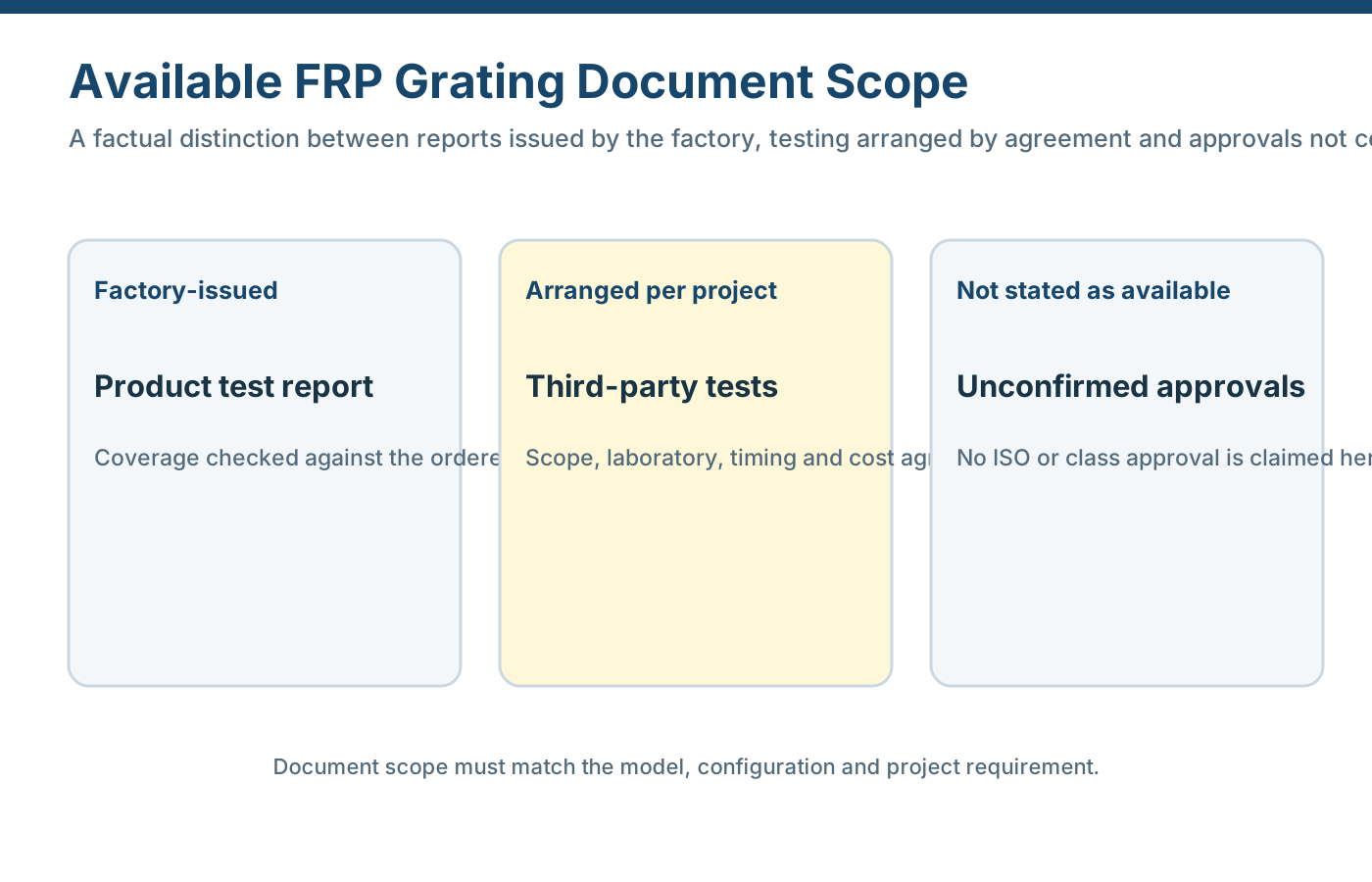
We keep the sample report, order certificate and project testing in separate categories.
The report is tied to a sample, not the whole catalogue
Our independent sample report HZTC/BG-24051102 records tests on submitted samples, including a load test at a stated 600 mm span. We read it with the sample description and report conditions, not as a rating for every panel.
Review the report and its stated limitsThe drawing and order documents come before production
For a cut-to-size order, we tie the approved drawing revision, piece dimensions and certificate of conformity to the configuration being supplied.
Third-party testing is scoped before it is promised
If the project requires another laboratory or test standard, we agree the specimen, method, laboratory, lead time and cost before treating the test as part of the order.
We do not display an unverified ISO certificate
No ISO 9001 certificate is shown because a certificate number, issuing body and scope have not been confirmed for publication. The report we do hold remains a sample test record.
Our review
How We Review a Standard Before Quoting
Five checks, starting with the governing text rather than a catalogue claim.
We ask for the standard number, edition and project clause. “BS 4592”, “FG01” or “ASTM” alone does not tell us which requirement applies.
If the clause governs a platform, walkway, stair or machinery access system, we identify the part that belongs to the grating supply and the part that remains with the project designer.
Structure, resin, surface, thickness, mesh, panel size, bearing direction and openings are checked against the drawing before we discuss a report or rating.
Clear span, bearing, load type, deflection and service conditions are either supplied or marked unknown. We do not invent them to make a data row fit.
We state which test report, certificate, drawing or dimensional record can be issued, by whom and when. Production follows the approved drawing revision.
Your input
What We Need to Review an FRP Grating Standard
The request can be short, but these five items remove most of the guesswork.
- Standard, edition and clause — The exact requirement, not only the standard family, plus any client specification that adds to or replaces it.
- Project use and country — Industrial flooring, walkway, stair tread, machinery access, marine application or another duty, and where it will be installed.
- Proposed panel or drawing — Molded or pultruded, resin, surface, thickness, mesh, panel size, bearing direction, openings and drawing revision.
- Supports, loads and environment — Support layout, clear span, bearing width, load type and value, deflection limit, temperature, chemicals and any fire or slip requirement.
- Required documents and deadline — Report, certificate of conformity, dimensional record or third-party test, and the stage at which each is required.
Send for review
Send the Standard, Drawing and Required Documents
We will identify what the grating scope can support and what still has to come from the project.
- Send the exact clause, not only the standard name
- Attach the drawing or project specification if available
- Tell us which document must be issued and when
FRP Grating Standards Questions
Which FRP grating standard do you work to?
Does naming a standard mean the panel is certified to it?
Is an ASTM E84 result a fire rating?
Can our current factory report support a tender?
This content was prepared and reviewed by Dengtai Industry’s technical and production team using the project conditions, available product data and applicable documents. Limits that require design, testing or approval are identified in the content. Content last checked: