Load-report reading method
Reading an FRP Grating Load Test Report: Specimen, Span and Limits
Read the complete document before using its result. Identify the tested specimen, support and span, load type and direction, test method, result, criterion and traceability, then write only the claim those fields support.
Prepared by
Dengtai Industry
Published
·
Reviewed

Use a report as evidence for the specimen and condition it records, not as a universal product rating. Source: Dengtai Industry.
Document vocabulary
What Each Part of a Grating Load Test Report Means
- Report identity
- The report number, issuer, issue date, page sequence, signatures, seals and any accreditation statement that identify which controlled document is in use.
- Specimen
- The exact object tested, including construction, geometry, dimensions, material, surface, sample source and preparation.
- Test method
- The named standard and edition plus the procedure, apparatus, measurement points and calculations used to obtain and interpret the result.
- Support condition
- The way the specimen was held or supported during the test, including the support type, contact, spacing, span and restraint.
- Load case
- The defined load application, such as uniformly distributed, line, concentrated or impact loading, including magnitude, area, direction and duration.
- Deflection
- Movement of the specimen under the stated load. A deflection value needs a measurement datum and must be compared with the project or report criterion.
- Allowable and ultimate
- An allowable value is intended for a stated design basis. An ultimate value describes a limit or failure-related result and is not automatically a working load.
- Applicability
- The documented reason that a report answers a question about a proposed item or condition. It is not created by a matching product family name.
Evidence boundary
Load Report, Load Table and Structural Calculation: Different Evidence
| Evidence | Question it can answer | What it does not automatically establish |
|---|---|---|
| Load test report | How a named specimen behaved under the recorded method, support and load | Another product row, span, environment or installed assembly |
| Published load table | A tabulated relationship among defined configurations, span, load and deflection | A test of the buyer's item or a condition outside the table notes |
| Structural calculation | A predicted response for stated geometry, properties, loads and assumptions | Physical test evidence unless it cites and matches one |
| Material data sheet | Nominal material properties, construction and product information | Whole-panel capacity, connection strength or installed-system approval |
| Certificate of conformity | A declaration that defined goods or production meet an agreed requirement | Independent testing of every performance claimed elsewhere |
| Third-party inspection | That an inspector observed named stages, samples or records | Every unobserved batch, process or future production run |
Report anatomy
Fields to Read in an FRP Grating Load Test Report
| Report field | Record this value | Why it changes the claim |
|---|---|---|
| Document control | Number, issuer, dates, page count, signatures and seals | Establishes the controlled report being reviewed |
| Named parties | Client, manufacturer, laboratory and relationship | Connects the evidence to a production source |
| Specimen identity | Product or sample ID, construction, dimensions, depth, mesh or bar, resin and surface | Prevents transfer from a different row |
| Sample source | Batch, drawing, selection, preparation and conditioning | Determines whether the specimen represents the proposed goods |
| Standard and method | Standard number and edition, apparatus, procedure and measurement points | Makes the result comparable only with a matching method |
| Support and span | Support type, contact, clear span, span direction and restraint | Changes the structural condition under test |
| Load case | Uniform, line, concentrated or impact load, magnitude, area, direction and duration | One load case does not define another |
| Impact record | Object mass, drop height, impact-head geometry and orientation, support, hold-down and number of impacts | Makes the impact event, specimen fixture and repeated exposure auditable |
| Impact response | Deflection and rebound history, permanent set, cracking or delamination and residual capacity | Separates “no collapse” from serviceability, damage and repairability |
| Result basis | Raw readings, deflection, derived value, unit, calculation and rounding | Separates observation from interpretation |
| Criterion | Allowable or ultimate basis, safety or design factor, limit and pass rule | Prevents a failure-related value from becoming a service load |
| Traceability and scope | Batch, order, drawing, covered product and express exclusions | Makes the supported sentence auditable and bounded |
Worked document
How to Read Our Available HZTC Load Report
| HZTC/BG-24051102 field | What the available report records | What the buyer can and cannot conclude |
|---|---|---|
| Report identity | Issued by Hebei Haozheng Testing Services Co., Ltd. on 17 May 2024 | A named document and issue date; project acceptance after that date remains a buyer decision |
| Named client | Zaoqiang County Jianxing FRP Co., Ltd., our own factory | The production relationship is named; another supplier's goods are not covered |
| Standard | JC/T 1026-2007 and the methods printed in the report | The report basis; every individual method and condition still needs reading |
| Material results | Barcol 45, water absorption 0.335%, oxygen index 28.5% and tensile strength 74.2 MPa | Those results apply to the submitted sample and stated methods |
| Load record | 4 kN/m² equivalent uniform design load over a stated 600 mm span; midpoint deflection 0.49 mm at the one-times design-load condition | Evidence for that load, span and recorded response; not a vehicle, point-load or universal panel rating |
| Acceptance rule | At one-times design load, deflection is limited to span/120 and 9 mm, whichever governs; at 1.5 times, no surface cracking or delamination; at five times, no fracture | Those are the requirements for this report item, not a default rule for every project |
| Product identity | The specification field is “/”; model, thickness, mesh and resin are not identified | The report cannot be assigned to a catalogue row by assumption |
| Batch linkage | The available document does not establish a delivered-order batch match | A receiving or production record is still needed for order traceability |
| Supported sentence | The report records a 4 kN/m² equivalent uniform design load at 600 mm for the submitted sample | A statement about another construction, support or load case is outside this evidence |
Applicability
Where a Report Can Stop Short of the Order

A report can identify a sample without identifying a sellable row
The submitted sample and the proposed construction can share a family name while differing in depth, mesh, bar profile, resin or surface.
A uniform load is not a wheel load or line load
Load distribution changes the structural problem. Ask for a matching case or a project calculation when the application loads through a small contact area.
A full-panel test is not an installed-system approval
Frame, clips, supports, openings, uplift, temperature and repeated loading can change the governing condition.
A dated test is evidence, not an expiry rule by itself
The project must decide whether its acceptance basis requires a current report, production surveillance or another test.
Seven-step method
A Repeatable Way to Read a Load Report
Record the report number, issuer, client, dates, pages, signatures, seals and any way to verify authenticity.
Write down the exact product or sample ID, construction, dimensions, depth, mesh or bar profile, resin, surface and source.
Record the standard edition, support condition, clear span, load type, contact area, direction, rate and duration.
Capture the measurement points, readings, units, derived calculations and corresponding deflection.
Identify whether values are allowable or ultimate, the applicable factor or limit, and how pass or classification was decided.
Check batch, drawing, sample source and item identity. Mark any missing link instead of filling it with the product family name.
Create one sentence the report supports and a short list of questions that need another report, calculation or test.
Before relying on the report
Grating Load Report Review Checklist
- Report number and issuer verified — The document is controlled and can be traced to the issuing organization.
- Specimen is explicitly identified — Product or sample ID and the relevant construction fields are recorded.
- Missing specimen fields are flagged — No model, depth, mesh, resin or surface value is inferred from appearance.
- Standard and edition recorded — The exact method and test version are named.
- Support and span are known — The test condition can be compared with the proposed installation.
- Load case is not mixed — Uniform, line, concentrated, impact or other loading remains distinct.
- Impact setup is recorded when applicable — Object mass, drop height, impact location, head orientation, support and hold-down arrangement are all checked.
- Impact response and residual capacity are read — Rebound, permanent deformation, damage and post-impact capability are not reduced to a simple pass label.
- Deflection criterion is stated — The result is read against the report limit and any separate project limit.
- Allowable and ultimate are separated — A failure-related or ultimate result is not treated automatically as an allowable service load.
- Report scope and exclusions are captured — The claim is limited to the products and conditions the document names.
- Order traceability is checked — Batch, drawing, item ID or another auditable link is required for the proposed order.
A load test report is valuable only after you identify the object and condition it tested. The headline number may be accurate and still answer the wrong question. Start with the report identity and specimen, then read the support, span, load direction, method, result and criterion. Only after those fields agree should the result be connected to a proposed order.
This page is a reading method. The companion test-report applicability guide is the field-by-field order match. The load-table and span guide explains how to use a tabulated design basis. A test report is another form of evidence and should not be substituted for either one without checking their scopes.

Read the Specimen Before the Headline Result
A test report normally identifies a laboratory, client, date and sample. Those controls show which document and material record are being discussed. They do not automatically identify a product that can be quoted. The report must also describe the tested specimen well enough to separate it from another catalogue row.
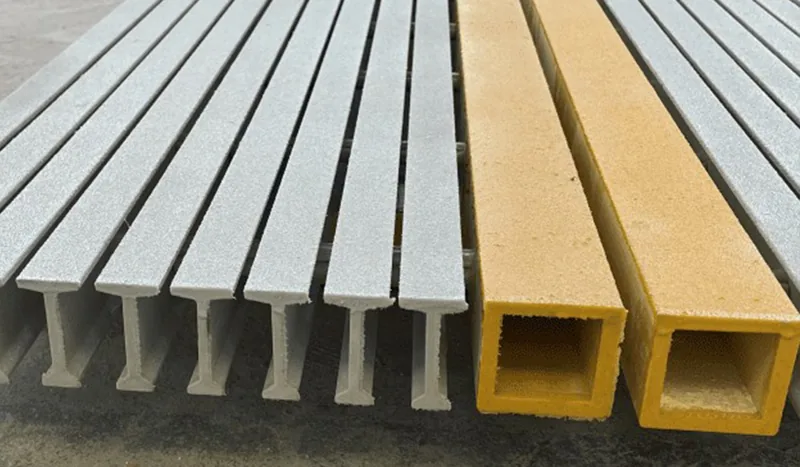
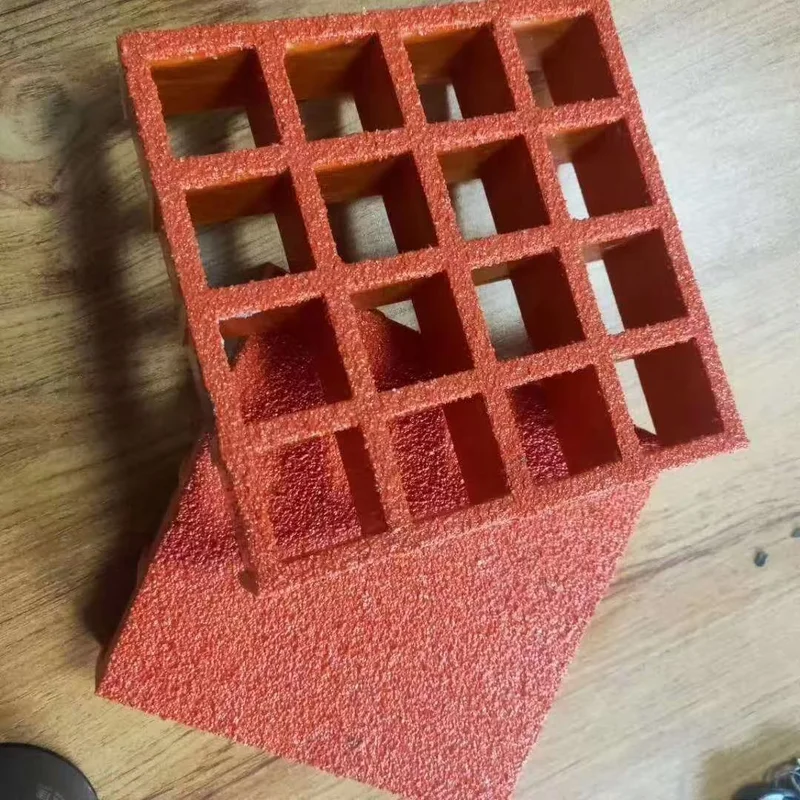
For molded grating, useful specimen details include the panel construction, depth, mesh dimensions, bar geometry, resin, surface, colour and preparation. For pultruded grating, they include the bearing-bar profile, depth, top width, bar pitch, cross-rod arrangement, resin, surface and direction. A nominal depth shared by two products does not make them interchangeable.
M.M. S.r.l.’s initial type-testing page illustrates why the test object and method matter. Its fire, electrical, anti-slip, ageing and frangibility items are not one generic certificate; they use different specimens, methods and classifications. That structure is useful even when the applicable standards are different. A buyer should ask which claim is being made and whether the report names the product arrangement that will be supplied.
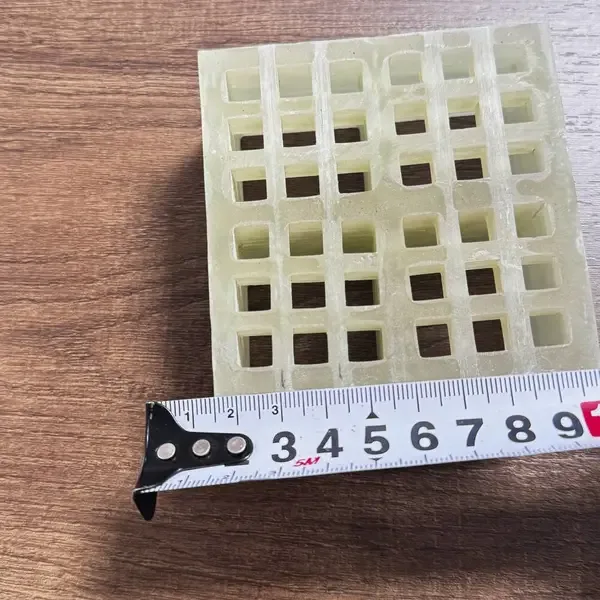
If the report gives a model code, look for the data sheet that defines it. If it gives only a sample description, keep that description in the review. Do not fill an empty resin, mesh or thickness field because the photograph looks similar. A physical sample can confirm visible geometry, but it cannot reconstruct a missing controlled test identity.
Read Support, Span and Load as One Condition
A load result is produced under a support arrangement. The report should explain whether the specimen was supported on two edges, a frame, a fixture or another arrangement; what the clear span was; whether bearing was continuous; and how rotation or uplift was restrained. The span used in a test is not automatically the finished piece length or the distance between support centres.
The load type must also remain separate. A uniformly distributed load is spread over an area. A line load follows a narrow strip. A concentrated load acts through a small contact area such as a wheel. Impact loading introduces another time-related condition. The same specimen may respond differently to each.
HotFRP’s load-table reading guide correctly separates span direction, load type, deflection and allowable or ultimate values. MACHS’s load-capacity page also states that its tables come from simple supports and that different mesh or bar geometry requires matching data. Those peer explanations support a useful reading rule: match the table or report to the actual support and row before comparing the numeric value.
The direction of the load path matters especially for pultruded grating. A bearing-bar direction that works in a drawing may not match the rails installed on site. The same issue appears in a solar strip, where the finished piece length and the unsupported distance are different quantities. If the report does not define the direction, the buyer cannot know whether the tested load path matches the order.
Impact and Drop Reports Need a Different Reading Sheet
An impact report is not simply another load table. The result comes from an object striking a specimen through a defined contact face while the specimen is held by a defined support and fixing arrangement. Read the object mass, drop height or energy, impact-head size and orientation, impact location, specimen dimensions, support edges and hold-down system first.
A single impact can include several rebounds. A repeated-impact test can apply multiple drops to one specimen. The report may therefore show peak deflection, rebound behaviour, residual movement, permanent set, surface and internal damage, damage around the clips and the capacity left after impact. “No structural failure” is only one observation; it does not automatically mean that the walkway remains acceptable without repair.
Fibergrate’s published drop-test report demonstrates the level of detail a reader should expect. It identifies the impact mass and drop-height range, fixes roughly 3 ft square specimens on two opposite edges, records clip type and orientation, and discusses repeated drops, rebound, cracking, delamination, permanent deformation and residual capacity. We do not copy its result into our page or apply it to a Dengtai product. We adopt the reading principle: impact evidence belongs to the tested specimen, contact and fixture.

The buyer should also describe the real exposure: dropped tools or parts, expected mass, available fall height, likely contact point, repeated handling and whether the walkway must remain removable. An impact result from a different contact or support condition remains useful context, but not a direct approval.
Separate the Result from the Acceptance Rule
Read the raw readings, units, calculation and deflection before interpreting the stated result. A report may show the load at a measured deflection, the deflection under a stated load, a calculated equivalent load, a pass/fail declaration or several results from a sequence. These are not interchangeable statements.
The criterion determines what the value means. An allowable or design value may already include a particular basis. An ultimate, breaking or failure-related value describes another limit and should not be relabelled as a safe service load. If a safety factor is stated, record what it applies to. Do not assume that a factor found in one manufacturer’s table is the project’s required factor.
Deflection is part of the result for pedestrian grating because serviceability can govern even without failure. The project may set its own limit based on use, supports or engineer requirements. The report’s reported deflection and the buyer’s target are separate fields. Both should be recorded.
This is the stage where many summaries go wrong. They quote “supports X kN/m²” and omit that the value was equivalent uniform load at a stated span, under a stated support condition, against a stated criterion. The number survives; the conditions that make it meaningful disappear.
Write the Claim You Can Actually Support
A safe review ends with a bounded sentence. For example:
The available report records a 4 kN/m² equivalent uniform design load over a stated 600 mm span for the submitted sample. It does not identify a complete model, thickness, mesh or resin and does not establish performance for another span, concentrated load or installed assembly.
That sentence is more useful than “the product passed load testing” because it names the result and the limit. The exact wording should come from the report, not from a marketing page. If the project requires a particular regulatory statement, engineer’s calculation or independent certification, check whether the document explicitly provides it.
Traceability connects this statement to the proposed order. A batch number, sample ID, drawing, item ID or production record may be needed. The absence of an order link does not necessarily make the report invalid, but it limits what the buyer can infer about delivered goods. The quality and documentation guide helps separate conformity, inspection and test evidence.
A Worked Review of HZTC/BG-24051102
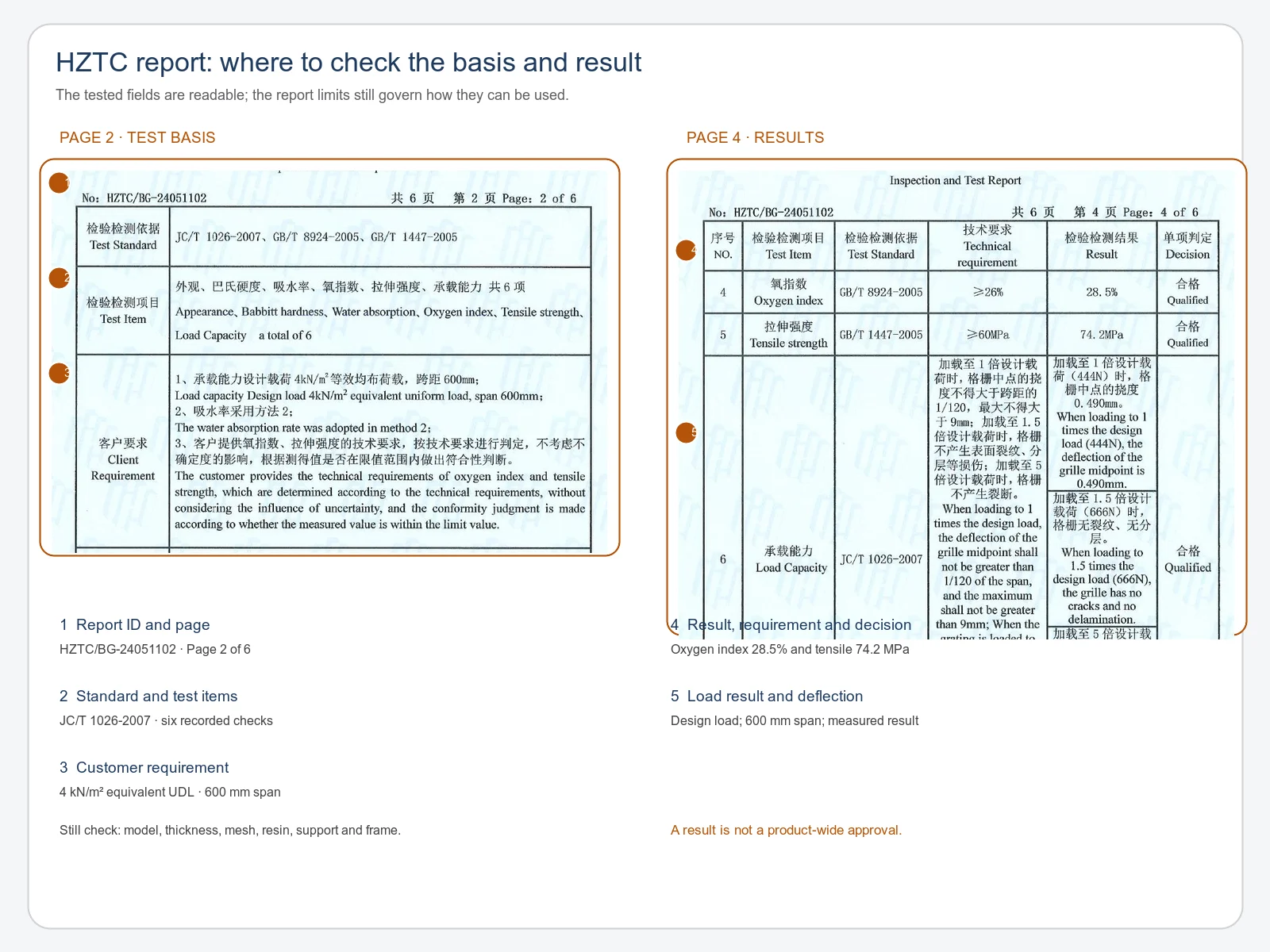
Our available independent report was issued by Hebei Haozheng Testing Services Co., Ltd. on 17 May 2024 and names Zaoqiang County Jianxing FRP Co., Ltd., our factory. It records appearance, Barcol hardness, water absorption, oxygen index, tensile strength and a load test. The material results shown are Barcol 45, water absorption 0.335%, oxygen index 28.5% and tensile strength 74.2 MPa. The load record states a 4 kN/m² equivalent uniform design load over a 600 mm span.
The report’s load item also gives a useful worked result. Its requirement limits midpoint deflection at one-times design load to span/120 and 9 mm, whichever governs, requires no surface cracking or delamination at 1.5 times the design load, and requires no fracture at five times the design load. The result table records a 0.49 mm midpoint deflection at the one-times design-load condition. This is much easier for a buyer to interpret than a statement that a “load test passed”: the span, load, deflection result and acceptance rule are all visible.
The document is useful for showing the actual methods and results of the submitted sample. Its limits are just as important. Its specification field is “/”, and the model, thickness, mesh and resin are not identified. It does not provide a vehicle class, wheel-load value, installed-system approval, universal span table or a direct batch match for every order. Nor does this static load item become an impact report.
That is why our internal review treats it as a sample and material report with a recorded load condition, not as a short brochure statement that every product has the same capacity. The datasheet guide shows how to define the exact product row, and the standards guide explains how to attach the right evidence question to that row.
What Strong Peer Material Adds
The strongest peer material does not merely publish a larger number. It explains the record structure. MACHS states its support layout and identifies the design manual behind its tables. HotFRP separates allowable from ultimate values and requires the configuration and span to match. M.M. shows that “test reports” can cover distinct properties and standards rather than one generic approval. Fibergrate’s impact report adds the test fixture, repeated-drop and residual-damage fields that a static load summary would miss.
We consolidate those ideas into a buyer’s reading sequence. The sequence starts with the controlled document, then the specimen, then the method and condition, then the result and criterion, and finally the order traceability. This goes beyond copying a competitor’s load table because it gives the procurement team a reusable way to challenge any report, including ours.
The boundary is equally important. A visual review can identify document gaps, but it cannot certify a different product or recalculate a support system. When the application includes a vehicle, guardrail, wind uplift, temporary works, high temperature or chemical exposure, the responsible engineer must define the relevant evidence.
Our Factory View: Make the Evidence Traceable
Our quotation review should start with the product row, drawing revision, support condition and the exact document the buyer needs. We can distinguish a material or sample report from a panel test, conformity declaration and project-specific calculation. That prevents one document from being sold as another.
If a requested configuration falls outside the evidence we can provide, the honest result is an open requirement. Additional testing or calculation can be discussed with its scope, schedule, specimen and cost. We do not fill an unknown thickness, resin, bar profile or support condition with an optimistic assumption.
The downloadable worksheet follows the same sequence. It lets a buyer record report, specimen, method, support, load, result, criterion and traceability, then write the supported claim and the remaining question. The RFQ template and incoming inspection page carry that evidence reference into the commercial and receiving stages.
Send the evidence package
Ask Us to Read the Report Against Your Order
- Send every report page
- Identify the exact order item
- State the claim you need to support
FRP Grating Load Test Report Questions
What is the most important part of an FRP grating load test report?
Can I use a load test result for another grating thickness or mesh?
Does a load test report provide a safe working load?
Is a panel test enough for an installed walkway?
How should I read an impact or drop test report?
Does “no structural failure” mean the panel is acceptable after impact?
What if the report omits the model, resin or thickness?
What should a buyer attach to an RFQ?
This content was prepared and reviewed by Dengtai Industry’s technical and production team using the project conditions, available product data and applicable documents. Limits that require design, testing or approval are identified in the content. Content last checked: