FRP grating documentation
FRP Grating Specification PDF: Datasheet Fields and Review
Use one specification file to distinguish the catalog row, project requirement, approved drawing, inspection record and performance evidence. State units, revisions, test scope and unresolved values instead of mixing a data sheet with a certificate.
Prepared by
Dengtai Industry
Published
·
Reviewed

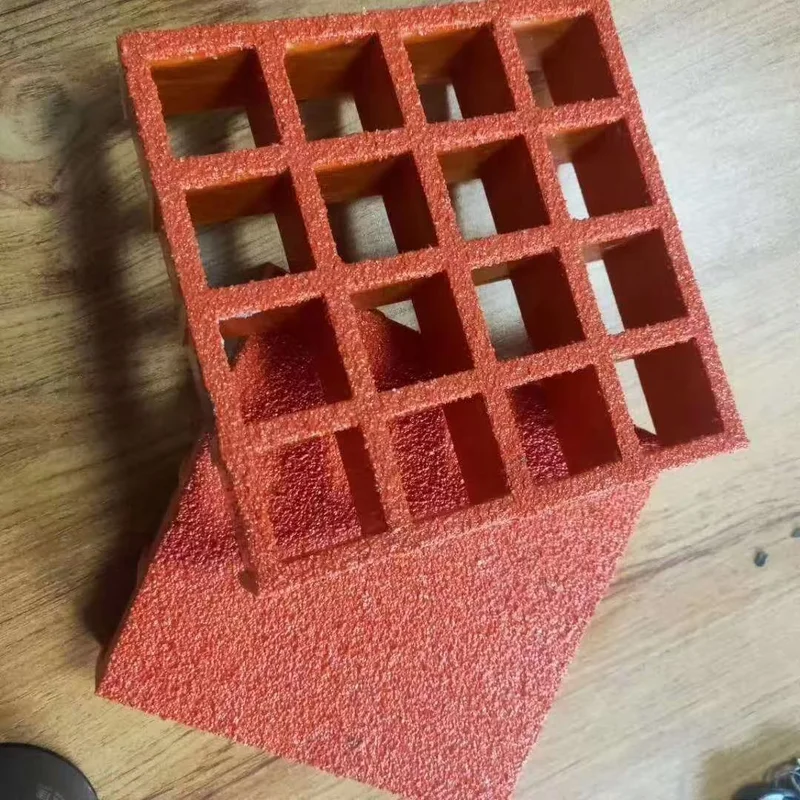
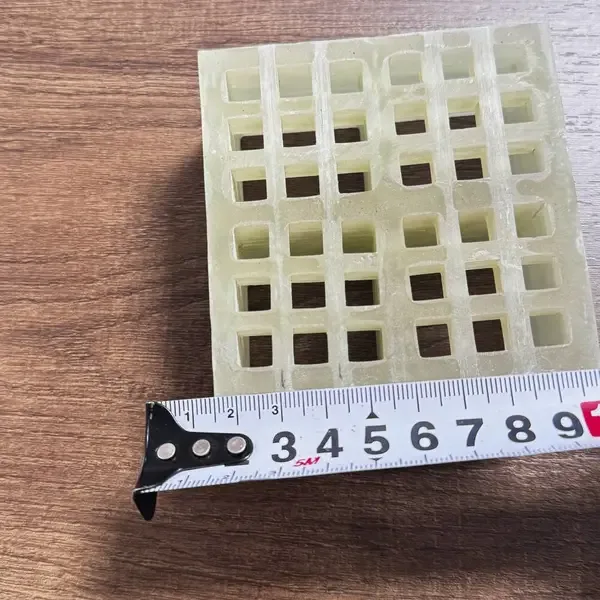
Report HZTC/BG-24051102 records named tests and conditions. It is not a blanket product certificate for every grating row. Photo: Dengtai Industry.
An FRP grating specification PDF should make one product configuration traceable from requirement to delivery evidence. It is not enough to collect a data sheet, drawing and test report into one file. Each document must keep its own question, scope and revision while pointing to the same product row.
This distinction matters because search results for “FRP grating specification pdf” contain several page types: manufacturer catalogs, project master specifications, dimension tables, test reports and engineering guides. They can all be useful, but they do not prove the same thing. A buyer who uses one as another can approve a panel that was never tested, or reject a suitable panel because the document scope was misunderstood.
We recommend five linked records:
- Product data sheet: what rows are offered?
- Project specification: what must the product and system achieve?
- Order drawing: what finished pieces will be made?
- Inspection and conformity: what was checked and released?
- Performance evidence: what test or calculation supports a stated claim, and for what specimen?
Template and Worked Example
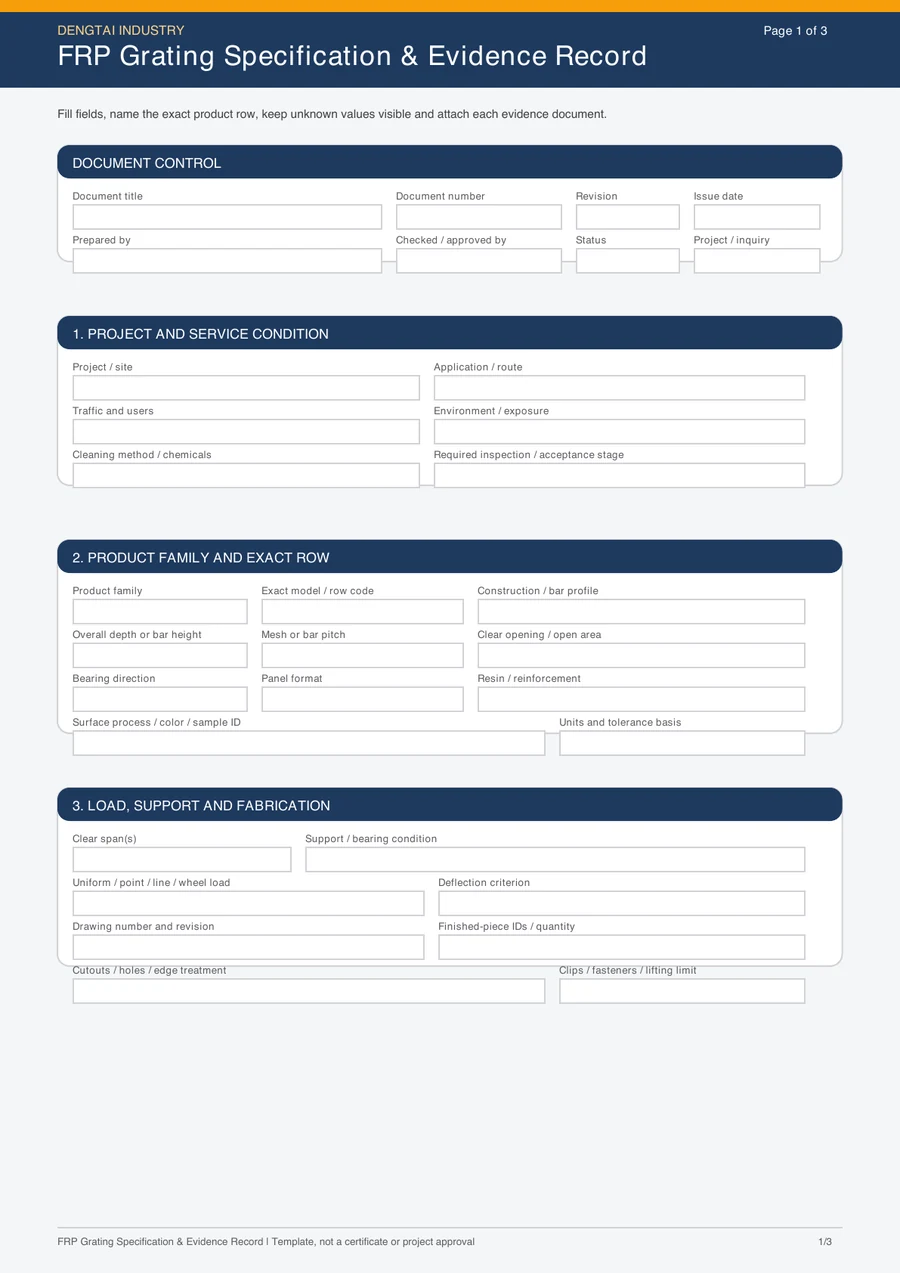
Our downloadable template uses this structure as a practical checklist for a buyer, estimator or quality reviewer.
This guide is prepared and reviewed by Dengtai Industry’s FRP grating technical and production team. The files organize evidence but do not replace the project’s structural, safety or commercial approval.
Download the fillable template and worked example
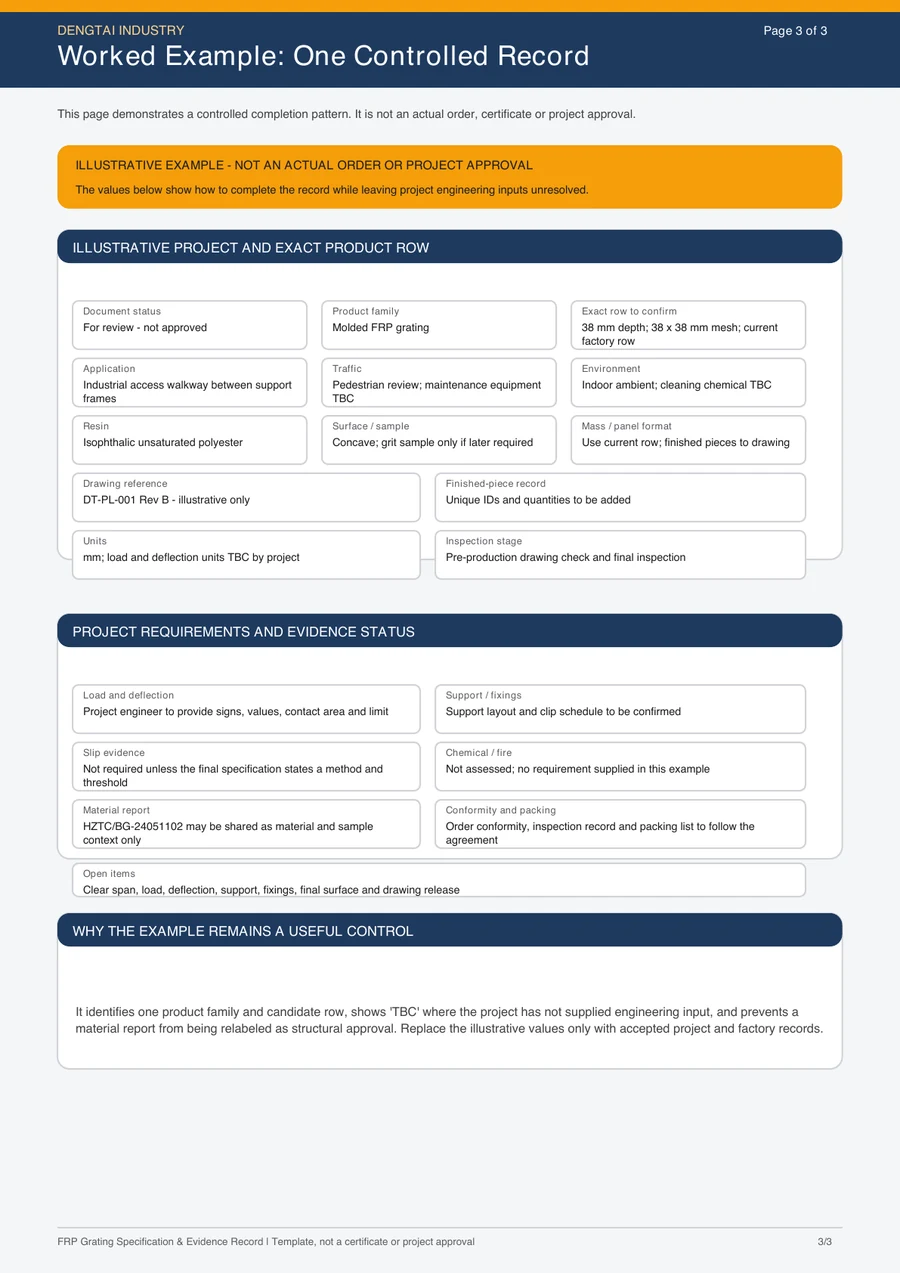
The PDF contains two fillable record pages with 52 form fields and a third page showing a clearly labelled worked example. The example leaves load, deflection, support, fixings and final surface as open items rather than inventing project approvals.

What the Specification PDF Is For
A specification file can serve several workflows:
- an early budget inquiry;
- a tender or project submittal;
- an approved product data sheet for review;
- a first-article or pre-production record;
- a repeat-order reference;
- an incoming inspection basis;
- a document package for delivery.
The required detail changes with the stage, but the document logic stays the same. It should tell the reader:
- what product is being discussed;
- which exact row or finished piece is included;
- what the project requires;
- how the requirements and product are connected;
- what evidence is supplied;
- what remains open;
- who approved the revision and when.
If the file is being used only to compare product families, the project drawings may be absent. If it is used to release production, the drawing and approved configuration are essential. The document title should make that stage clear.
Do Not Mix These Seven Document Types
Product data sheet
A data sheet presents a manufacturer’s available product rows. It may include dimensions, mass, resin systems, surface options and reference properties. It should provide enough geometry to identify the exact offered item. A range table is useful, but it is not one approved order row.
Project specification
A project specification describes what the installation must achieve. It may specify support, load, deflection, fire, chemical, slip, accessibility or document requirements. It does not prove that an available product meets those requirements, and a manufacturer’s catalog does not automatically satisfy it.
Order drawing
The drawing converts the product into finished pieces. It shows piece IDs, sizes, bearing direction, joints, cutouts, edge treatment, fixing locations and revision. A catalog panel size can be correct while the finished piece is wrong.
Inspection record
An inspection record reports what was checked for a named production batch or piece set. Depending on the agreed scope, it may cover dimensions, appearance, surface, quantity, piece marks or accessories. It is not a general type-test report.
Certificate of conformity
A conformity document states that a defined batch or configuration complies with an agreed requirement. The requirement and inspection basis remain part of the evidence. The words “certificate” and “certified” should not be used to imply third-party testing, structural approval or a certification mark that has not been verified.
Test report
A laboratory or factory test report identifies a specimen, method, conditions and result. It may support a material, product or assembly claim. The reviewer must check whether the specimen matches the offered row and whether the tested condition matches the project.
Engineering calculation
A calculation applies engineering inputs and assumptions to a defined product and support condition. It can address a case a catalog table does not cover, but its validity depends on those inputs, assumptions and limits. A calculation for another span or load is not a generic panel rating.
Read a Real Report: HZTC/BG-24051102
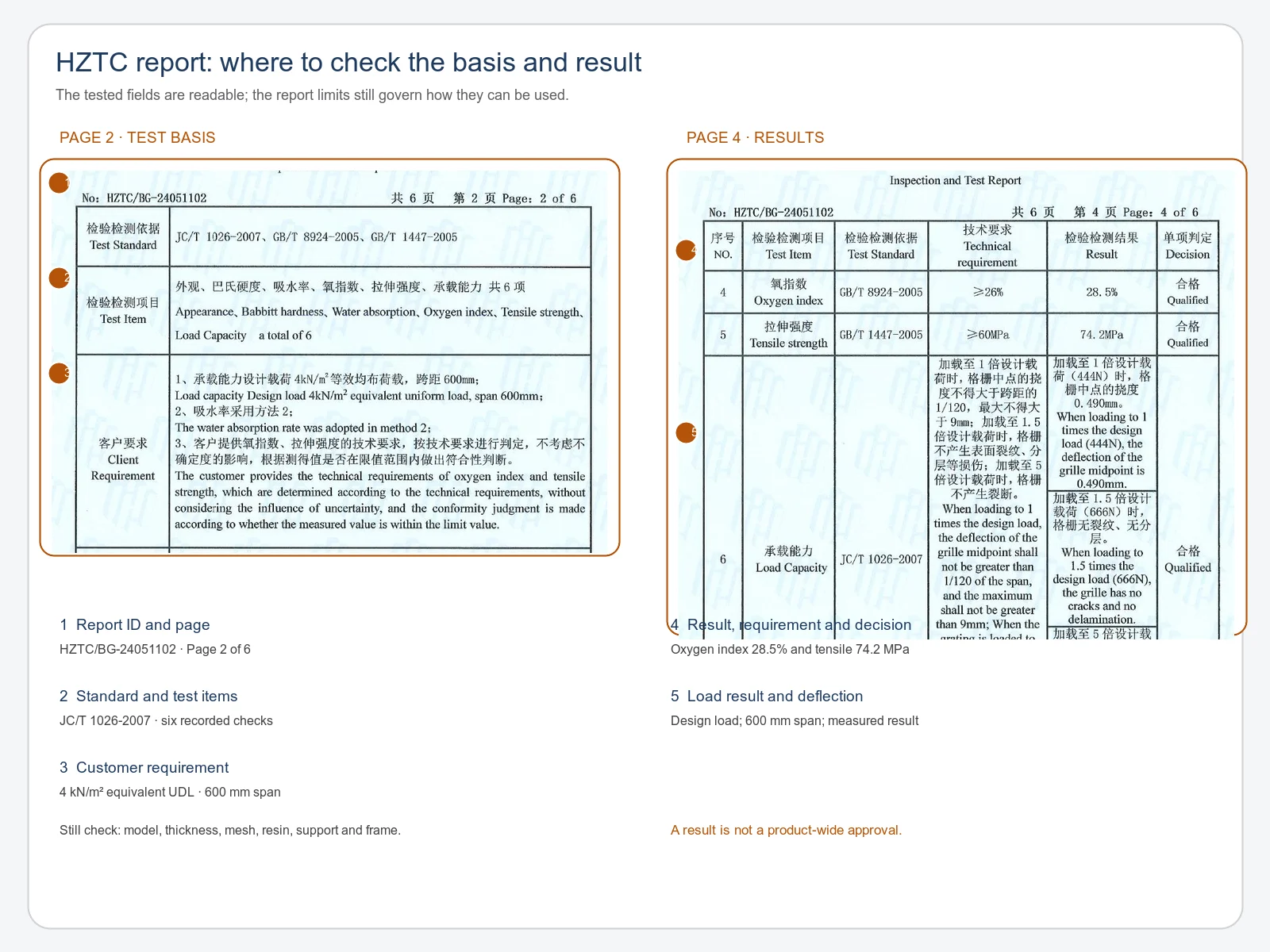
Our Jianxing factory’s independent sample report HZTC/BG-24051102 was issued on May 17, 2024. It records six test items:
- appearance;
- Barcol hardness;
- water absorption;
- oxygen index;
- tensile strength;
- load capacity.
The report identifies JC/T 1026-2007, GB/T 8924-2005 and GB/T 1447-2005 in its test basis. Its load item states a 4 kN/m² equivalent uniform design load over a 600 mm span. The report also records material-level results such as water absorption 0.335%, oxygen index 28.5% and tensile strength 74.2 MPa.
The report is valuable because the standards, customer requirements and measured results are visible. It is not a blanket product certificate for every panel:
- the specimen is not identified as one complete model with depth, mesh, bar section and resin;
- the load result is for the stated design-load condition and span;
- a 4 kN/m² equivalent uniform design load is not a universal point, wheel, impact or sustained-load rating;
- the report does not prove every offered 25, 30, 38 or 50 mm row;
- the appearance check is not a quantitative release criterion for every order.
Our test report applicability guide shows how to compare the specimen, method, support and result. The quality and documentation page explains how a test report differs from a certificate of conformity.
Start the PDF With Document Control
Every specification file should open with:
| Control field | Example format | Why it matters |
|---|---|---|
| Document title | Product specification and evidence record | Tells the reader the document’s purpose |
| Document number | Project-specific identifier | Supports traceability |
| Revision | A, B, 1, 2 or another controlled scheme | Distinguishes superseded requirements |
| Issue date | Year-month-day | Anchors the document in time |
| Prepared by | Company or responsible role | Shows authorship |
| Checked/approved by | Named responsible function | Shows release authority |
| Project or inquiry | Reference | Connects to the commercial record |
| Status | Draft, for review, approved, superseded | Prevents accidental use |
| Source list | Each attachment number and revision | Shows what the evidence consists of |
Do not overwrite an approved revision with a newer value and leave the old attachments. Produce a new revision, list the changes and state which previous file it replaces.
Product Fields That Need an Exact Basis
Product family and model
Name molded, pultruded, mini mesh, micro mesh, covered or another construction. Then identify the exact model row. If the product is custom, reference the approved drawing rather than inventing a model name.
Geometry
Record:
- overall depth or bar height;
- mesh pitch and clear opening;
- bar width or I, T and WT profile;
- bearing direction;
- cross-rod spacing where relevant;
- open-area percentage;
- panel width and length;
- finished-piece dimensions;
- dimensional tolerances.
State what each dimension measures. “38 mm” does not tell the reader whether the figure is panel depth, bar depth or some other feature.
Material
Record reinforcement and resin grade where supplied. Do not list a strong chemical-resistance family name without the actual exposure and supporting data. Material data from a resin supplier is not automatically the result of the finished grating.
Surface
Record the process rather than only “grit.” Add color reference, coverage expectation, sample ID and any separate slip-test requirement. A covered or milled surface needs its own height, joint and drainage fields.
Mass
Separate:
- kg/m² from the product row;
- calculated nominal panel mass;
- finished-piece mass;
- accessories;
- package gross mass.
This prevents handling and freight assumptions from being based on the wrong number.
Use the FRP grating weight guide when unit mass must be converted into a full-panel or finished-piece handling estimate.
Performance property
For every stated property, identify:
- value and unit;
- specimen;
- method and standard edition;
- test or calculation condition;
- result type;
- applicability;
- date and source.
Project Fields That Belong Beside the Product
The product row becomes meaningful only when it meets the project. Add:
- use and traffic;
- support layout;
- clear span and bearing;
- uniform, point, line, wheel and sustained loads;
- deflection criterion;
- chemical, temperature and UV exposure;
- fire, electrical or anti-static requirement;
- slip and cleaning requirement;
- accessibility or opening criterion;
- fixing and lifting method;
- required documents and inspection stage.
The buyer can mark a field unknown. The important control is that unknown remains visible. A blank line that is later interpreted as “not required” can remove an important check from the order.
Build an Evidence Matrix Instead of a Certificate Pile
Use a table that links each requirement to its evidence:
| Requirement | Evidence type | Exact scope | Status |
|---|---|---|---|
| Product row identification | Data sheet and approved drawing | Model, depth, mesh or bar series | Supplied |
| Dimensions | Drawing and inspection record | Finished pieces and critical dimensions | To confirm |
| Load and deflection | Matched table or calculation | Span, support, load and limit | To confirm |
| Chemical resistance | Resin report or project assessment | Medium, concentration and temperature | Not supplied |
| Slip performance | Test report | Surface process, specimen and wet condition | To arrange |
| Fire performance | Test report or classification | Standard, specimen and result | Scope to confirm |
| Conformity | Certificate or declaration | Batch and agreed requirement | At shipment |
| Packing and mass | Packing list | Package, gross mass and marks | Before dispatch |
This table is more useful than a folder named “certificates.” It shows the reviewer which claim is supported and which file relates to it.
Units, Nominal Dimensions and Tolerances
Length and area are common sources of error. State millimeters, meters, inches or feet everywhere, and show the conversion basis. The exact conversion of 4 x 8 ft is 1219.2 x 2438.4 mm. A 1220 x 2440 mm panel is close but not identical. The buyer must say whether the nominal metric size is acceptable.
Pitch, clear opening and open area are different:
- pitch is the center-to-center spacing;
- clear opening is the unobstructed gap at a stated plane;
- open area is the proportion of the panel surface that is open.
A tolerance should describe the allowed variation from a stated nominal dimension. “Standard” is not a tolerance unless the applicable standard or drawing gives a value.
For every critical dimension, state:
- nominal value;
- actual or measured value where relevant;
- upper and lower tolerance;
- measuring location;
- inspection stage.
The FRP grating size and mesh definitions provide the separate fields for pitch, clear opening and nominal panel dimensions.
The Order Drawing Is Not an Optional Attachment
A complete drawing should show:
- layout of the installed area;
- support centerlines, bearing faces and clear spans;
- product row and bearing direction;
- individual panel and finished-piece IDs;
- finished length and width;
- joints and panel orientation;
- cutouts and openings with datums;
- holes, clips and fixings;
- edge type and treatment;
- tolerances and drawing revision.
The specification PDF should reference this drawing by number and revision. The quotation should do the same. The packing list should carry the piece IDs. If the three documents use different names, delivery verification becomes guesswork.
Pultruded grating needs special attention to bar direction and custom panel dimensions. Molded grating needs mesh direction, cutouts and finished edges. Both need a piece-level record when the order contains more than one shape.
Continue the same identity through the FRP grating receiving inspection record so physical pieces, accessories and documents can be compared at arrival.

How to Handle Missing Data
Do not fill a blank because the document looks more complete. Use one of these statuses:
- supplied: a value and source are attached;
- to confirm: a responsible party and date are named;
- not applicable: the reason is recorded;
- not supplied: the requirement exists but evidence is absent;
- outside scope: the requirement belongs to another party.
For example, “fire report: not supplied” is more useful than leaving a certificate table empty. “1.5 hour fire rating: not applicable because the governing specification does not require it” is more useful than copying a competitor’s claim.
Keep unresolved items visible until the stage that requires them. A budget quote may allow more open fields than a production release.
Using Our Fillable FRP Grating Specification Template
The two fillable pages cover:
- document control;
- project and use;
- product family and row;
- dimensions, mesh or bar geometry and units;
- resin, reinforcement and surface;
- support, span, load and deflection;
- chemical, fire, slip and other performance requirements;
- finished pieces and drawing references;
- evidence and document scope;
- inspection, packing and release;
- open items and approvals.
It is a document-control tool, not a certificate and not a product approval by itself. Complete it with the current product row, drawing and applicable evidence. Delete no field simply because it is difficult; mark it unresolved and state why. Page 3 shows one illustrative completion pattern.
Our Manufacturer View: What Makes a Buyer-Ready Datasheet
A useful datasheet lets our estimator and the buyer’s reviewer see the same product. It starts with the product row and does not bury limitations in a footnote. It also distinguishes the factory facts we can control from project decisions we do not own.
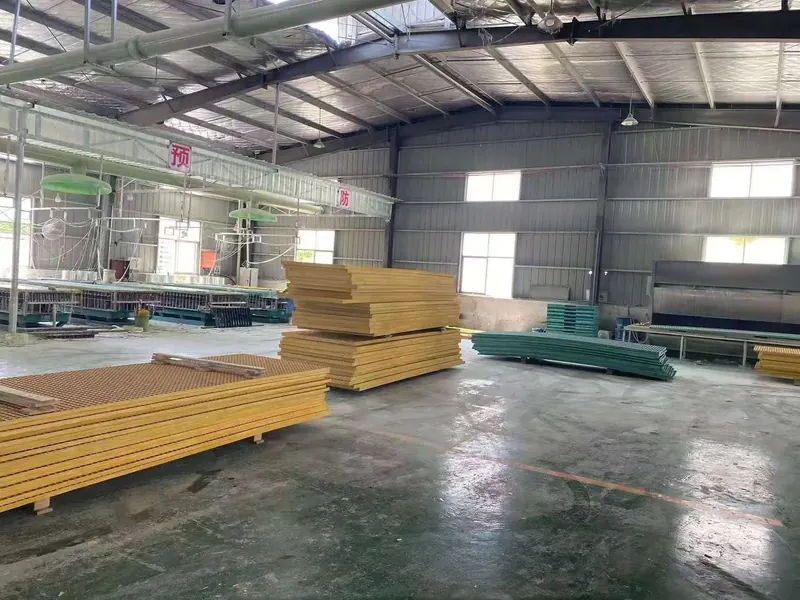
We can identify the current molded row or pultruded series, review the drawing and fabrication scope, state available resin and surface options, and identify the documents that apply to an order. Our historical HZTC report can be shared, but we preserve its specimen and condition rather than converting it into a universal rating.
We cannot approve another party’s structural design, invent missing test evidence or treat a competitor’s datasheet as our product record. Those limits make the document more trustworthy, not less.
Approval Rule: Product, Project and Evidence in One Revision
Before release, ask three questions:
- Product: Does every field identify one exact product row and finished-piece set?
- Project: Does the file state the actual support, load, exposure and acceptance requirements?
- Evidence: Does each performance claim point to a document whose specimen and scope match the offer?
If any answer is no, the file is still a draft. Mark the gap and give it an owner. A truthful draft is safer than an apparently complete document built on copied assumptions.
The FRP grating manufacturer checklist helps review supplier capability, while the quotation comparison guide keeps documents beside commercial scope and price.
What the Final PDF Should Look Like
A strong specification PDF is readable without reading all attachments first:
| Page or section | Content |
|---|---|
| Cover and control | Title, number, revision, status, issuer and approvals |
| 1. Project basis | Use, support, load, exposure and required evidence |
| 2. Product row | Family, model, geometry, resin, surface and mass with units |
| 3. Fabrication | Drawing references, finished pieces, edges, fixings and tolerances |
| 4. Evidence matrix | Requirement, document, scope, status and attachment |
| 5. Inspection and packing | Checks, release, marks, quantities and gross mass |
| 6. Open items | Missing values, owner, due date and effect |
| Attachments | Data sheet, drawing, report, calculation, conformity and packing list |
The structure is intentionally simple. It lets a buyer review the product against the project before opening the supporting reports, and it lets quality find the exact evidence later.
Use the fillable template as the working index. The final file should show both what is known and what is still open, and the export packing guide extends the same identity through package marks and delivery.
Get a Quote
Get a FRP Grating Specification PDF: Datasheet Fields and Review Quote
- Upload the current specification and drawing
- Mark missing values rather than guessing
- List the documents required for approval
Document types
What Each FRP Grating Document Actually Proves
Data sheets, drawings, inspections, conformity statements and test reports answer different questions.
| Document | Buyer question | What it proves | What it does not prove |
|---|---|---|---|
| Product data sheet | What product rows are offered? | The manufacturer's stated geometry, material and nominal properties | That one project row has been fabricated, approved or installed |
| Project specification | What must the product and system achieve? | The owner's or designer's requirements and document scope | That an available product meets the requirement |
| Order drawing | What pieces will be manufactured? | Sizes, direction, cutouts, edges, marks and revision | Structural capacity or performance unless separately stated |
| Inspection record | What was checked before release? | The observed dimensions or appearance for the named lot or pieces | A project-wide type test or long-term performance |
| Certificate of conformity | Did the batch or order conform to the agreed requirement? | The defined conformity statement and its scope | That every property was independently tested |
| Test report | What was measured on a stated specimen and method? | Test conditions, results and stated decisions | Applicability to another size, resin, construction or support |
| Engineering calculation | Was the proposed structure checked for the stated case? | Inputs, assumptions, limits and calculated outcome | General approval for a different load or support |
Data fields
FRP Grating Datasheet Fields That Need a Clear Basis
The best template makes units, definitions, test scope and missing inputs visible.
| Datasheet group | Required fields | Review question |
|---|---|---|
| Document identity | Manufacturer, document title, number, revision and date | Can the buyer identify the current version? |
| Product family | Molded, pultruded, mini mesh, covered or another construction | Is the category clear before the row is named? |
| Exact model row | Product code, depth, bar profile and panel format | Does the row identify one manufacturable configuration? |
| Mesh or section geometry | Pitch, clear opening, bar width, bar height, cross rods and open area | Are all dimensions labeled and measured at stated planes? |
| Panel dimensions | Nominal and actual length, width, bearing direction and tolerances | Are "standard" and "finished" sizes separated? |
| Material | Reinforcement, resin grade and relevant material results | Is the data linked to the offered formulation? |
| Surface | Concave, grit, covered, milled or another process; color and finish reference | Is appearance separate from slip performance? |
| Mass | kg/m², nominal panel mass, finished-piece mass and packing gross mass | Which mass belongs to design, handling and freight? |
| Structural data | Span definition, support condition, load, deflection and source | Does the evidence match the proposed row and project case? |
| Exposure data | Chemical medium, concentration, temperature, duration and UV condition | Is the test or recommendation scoped to the actual exposure? |
| Fire or electrical data | Standard, specimen, classification, resistance value and test date | Is a general resin claim being used as a product result? |
| Fabrication | Cut and seal method, edges, holes, openings and piece marking | Does the order scope match what the factory and site can do? |
| Fixing | Clip type, material, support, spacing and complete hardware | Is restraint separate from load support? |
| Documents | Drawing, inspection, conformity, report, calculation and packing list | Is each document named instead of summarized as "certificate"? |
Review sequence
How to Build and Approve One Specification Revision
Start with the project requirement and finish with one coordinated release file.
Record use, traffic, support, span, load, deflection, exposure, fire, surface and required documents.
Bind depth, mesh or bar series, resin, surface and panel format into one configuration.
Convert every source to agreed units and label span, pitch, opening and mass at the correct basis.
Show finished pieces, direction, supports, fixings, cutouts, edges, tolerances and revision.
State which report, calculation, test or conformity document covers the exact offered item and condition.
Agree dimensions, appearance, piece marks, accessories and document release before production.
Keep the quotation, drawing, sample and evidence references together; superseded values remain traceable.
Document checklist
What a Complete FRP Grating Specification PDF Includes
Use this list for a tender, product submittal, first article or repeat order.
- Document control — Title, number, revision, issue date, issuer and status of every file.
- Product identity — Family, model row, depth, mesh or bar profile and construction.
- Geometry and units — Metric or imperial units, pitch, clear opening, bar size, panel size and tolerances.
- Resin and reinforcement — Grade, formulation reference and the evidence or source behind the stated properties.
- Surface and color — Process, sample, color reference, coverage and any separate slip-test requirement.
- Structural basis — Support, clear span, load type, deflection limit, data source and exclusions.
- Exposure basis — Chemical, temperature, UV, fire, electrical or other service conditions.
- Drawing and pieces — Piece IDs, finished sizes, direction, supports, openings, fixings, edges and approval.
- Inspection — Check items, sampling, acceptance criteria, stage and record format.
- Packing and delivery — Package count, gross mass, protection, labels, packing list and document release.
- Open items — Known unknowns, responsible party, due date and the effect on quotation or release.
FRP Grating Specification PDF Questions
What should an FRP grating specification PDF contain?
Is a datasheet the same as a certificate?
Is a test report enough for project approval?
What does HZTC/BG-24051102 cover?
Can we use a competitor's catalogue PDF as our product datasheet?
Why is nominal thickness not enough in a datasheet?
How should pitch and clear opening be recorded?
What evidence should a buyer request for load capacity?
What is a certificate of conformity for?
How should blank fields be handled?
Why include packing and gross mass in the specification?
Evidence boundary
Make Every Claim Traceable
The document is useful only when the reader can see what supports each value.
- Final document rule — Every requirement and every performance claim should name the exact product row, evidence scope, units, revision and unresolved conditions it depends on.
- Keep scope language visible — Use "nominal," "measured," "calculated," "tested," "allowable," "conforms" and "certified" only for what the underlying record actually supports.
- International specification reference — Seassafe's project specification shows the useful pattern of naming product construction, thickness, grid, resin and separately defined load and deflection criteria. Open the Seassafe FRP specification example
- Technical data reference — Perma Composites pairs product rows, dimensions, mass, tolerances and load tables, then notes verification by certified test results for the actual ordered product. Review the Perma molding technical guide
This content was prepared and reviewed by Dengtai Industry’s technical and production team using the project conditions, available product data and applicable documents. Limits that require design, testing or approval are identified in the content. Content last checked: