Manufacturer and supplier review
How to Check an FRP Grating Manufacturer Before You Buy
“Manufacturer” can describe a factory, a fabricator, a stock reseller or a trading company. Confirm who produces the panel, who cuts and inspects it, what is truly in house and which drawings, records and reports will apply to your exact order.
Prepared by
Dengtai Industry
Published
·
Reviewed

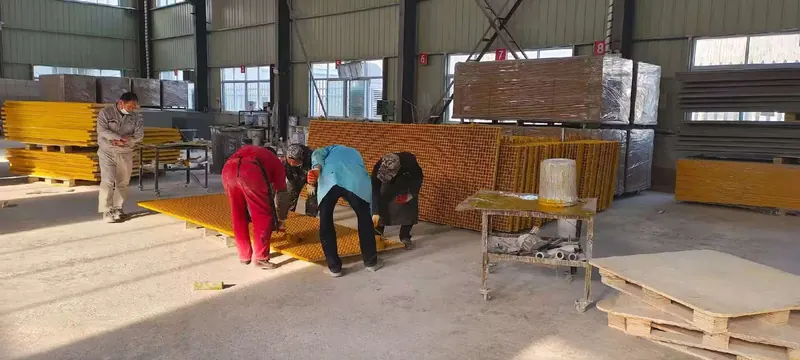
Our workshop and panel stock. The photograph supports a site visit or video discussion, not a universal product claim. Photo: Dengtai Industry.
Supplier vocabulary
Ten Terms That Separate Manufacturing From Reselling
The company selling the grating, the company producing it and the company issuing evidence may not be the same.
- Manufacturer
- The company that controls a stated production route for the product being purchased. For FRP grating, this may mean molded panel production, pultruded bar and panel assembly, another product family or a defined part of the process.
- Fabricator
- A supplier that cuts, drills, assembles, coats or packages grating. It may buy the source panel from another manufacturer, so fabrication capability does not automatically prove panel production.
- Trading company
- A commercial intermediary that coordinates one or more factories. A trader can be useful, but the production source, inspection owner and document issuer still need to be identified.
- Product scope
- The exact molded, pultruded, mini-mesh, covered, stair or accessory family a supplier really offers. A broad website range does not mean every item is made in the same facility.
- In-house capability
- A process performed by the supplier’s own controlled facility, such as molding, pultrusion, cutting, drilling, finishing, inspection or packing. “In-house” should name the process and legal entity.
- Batch traceability
- The ability to connect the delivered pieces to an order, drawing revision, production record, material information or certificate. A batch number alone is not proof of tested performance.
- Current datasheet
- Product information that describes the product currently offered. It should identify structure, dimensions, resin, surface and limits; a catalogue family page may not be specific enough.
- Sample
- A physical piece used to check visible mesh, colour, surface or approximate dimensions. Unless tested and documented, it does not establish structural capacity or exposure approval.
- Test report
- A record of named tests performed on a stated specimen under stated methods and conditions. Its application to another thickness, mesh, resin, support arrangement or finished assembly must be reviewed.
- Certificate of conformity
- A document stating that supplied goods conform to a defined requirement. It is not automatically an independent test report, certification mark or approval of the installed system.
Supplier roles
Five Supply Roles With Different Control and Evidence
Match the question to the role instead of treating every seller as a factory.
| Supplier role | Typical control | Evidence to request | Main risk |
|---|---|---|---|
| Direct grating manufacturer | Stated molded or pultruded production route | Product range, production location, current specification, batch record and applicable tests | The listed family may still be fabricated or tested outside the site without disclosure |
| Manufacturer plus fabricator | Panels and finished pieces handled under one supply | Drawing approval, cut list, edge treatment, inspection and packing records | A strong panel offer can hide unclear fabrication responsibility |
| Independent fabricator | Cutting, drilling, assembly and finishing | Source-panel identity, fabrication drawing, inspection and traceability to the maker | A fabricated product can be mistaken for the original producer’s standard item |
| Stock reseller | Availability from existing inventory | Exact stock product, source factory, identification and records that can accompany it | Fast supply may not match a custom resin, size or document requirement |
| Trading company | Supplier selection, coordination and commercial handling | Named production factory, inspection owner, document issuer and responsibility matrix | Responsibility fragments when production, quality and after-sales do not share one controlled system |
Evidence map
Eight Capability Claims and the Records That Support Them
Each claim needs an object, a source and a stated coverage limit.
| Capability area | Claim to verify | Objective evidence | Coverage limit |
|---|---|---|---|
| Product manufacturing | Molded, pultruded or another family is actually produced | Production site, equipment in use, current product row and process record | A demonstration of one family does not prove every listed product family |
| Engineering | Drawings, panel layout and opening review are supported | Sample drawing, revision block, mark-up, cut list and review comments | Engineering support does not automatically transfer structural approval to the factory |
| Fabrication | Cutting, drilling, edge sealing, marking and piece control | Finished-piece photographs, dimensional record, edge treatment and packing marks | A neat cut edge does not prove the supporting structure or load path |
| Quality | Inspection happens before packing and can be traced | Current inspection fields, sampling method, result record and responsible inspector | A generic appearance statement is not a dimensional or performance standard |
| Documents | Report, certificate and records apply to the supplied order | Issuer, specimen, order or batch, drawing revision and issue date | A document title without a matching scope is not product approval |
| Export | Packing, marks, loading and delivery follow the agreed terms | Packing specification, label sample, package weight and pre-shipment photographs | Loading photographs do not prove the full piece count or undamaged inner packing |
| Legal and production identity | The seller, factory and process owner can be identified | Legal name, factory address, seller-to-factory relationship and any requested audit document | Registration or identity evidence does not prove panel performance |
| Capacity and repeat supply | The factory can cover the required volume and repeat order | Proposed line or mold, production slot, peak schedule, handling limit and approved repeat specification | A stated capacity is not a quality certificate or guaranteed delivery date |
Review matrix
Questions That Reveal Real FRP Grating Capability
Eight answers connect the supplier, product, process, evidence and order.
| Review question | What the supplier should state | Evidence that closes the question |
|---|---|---|
| Who makes the product? | Manufacturer name, factory location and exact production route | Quotation, certificate or order document naming the same legal entity and site |
| What product is controlled? | Molded, pultruded, mini mesh, covered, treads or accessories | Current product matrix with rows and limits, not a list of page names |
| What is fabricated? | Cutting, drilling, notch, edge work, marking and trial fit | An approved drawing and a finished-piece inspection plan |
| How is repeatability controlled? | Resin, glass, curing, mold or profile identification and batch record | Traceable production record fields for the actual order |
| What can be tested? | Material, panel, accessory or complete-system question | Laboratory, standard, specimen, method, condition, result and scope |
| What documents will arrive? | Datasheet, drawing, inspection record, conformity certificate or test report | A document schedule with issuer and stage before order placement |
| How are changes controlled? | New drawing revision, material substitution, price and schedule effect | Written approval and a revision trail through fabrication and packing |
| What happens after delivery? | Contact, evidence required for a discrepancy and replacement route | Order terms plus a documented issue-response process |
Review readiness
When an FRP Grating Supplier Is Ready for an Order
These gates separate a credible quotation from a catalogue claim.
Specify this if…
- The supplier names the product, factory and process it actually controls.
- The required product family and configuration appear in a current product matrix.
- Fabrication and inspection responsibilities are stated rather than implied.
- The sample has a defined purpose and the report has a defined specimen.
- Order documents can identify the product, drawing and batch.
- The quotation and technical schedule use the same item and revision.
Look elsewhere if…
- “Manufacturer” is used without naming the production site or process.
- The supplier cannot separate panel manufacture from cutting or trading.
- A catalogue or logo is offered in place of a current product specification.
- A sample is described as proof of load or chemical approval.
- A test report does not identify the tested product or conditions.
- Certificates, packing or testing are promised after production without written scope.
Start With the Role, Not the Homepage Title
Many websites describe themselves as an FRP grating manufacturer. That phrase can cover several supply models. One company may mold panels, another may buy those panels and perform all fabrication, and another may coordinate several factories from an office. Each model can work, but they answer different questions.
For a standard panel with no fabrication, a stock reseller may be the fastest route. For a project with drawings, openings, matched clips, a special resin and a defined document package, the buyer needs to know which company controls each process. Mixing those responsibilities without writing them down is where quotation errors begin.
The first useful question is therefore not “How many years have you been a manufacturer?” It is:
- Who is the legal seller?
- Which factory or factories may produce this product?
- Which process is in house at that site?
- Who prepares the drawing and confirms the finished pieces?
- Who inspects the panel and the fabrication?
- Who issues the certificate or report?
- Which order, batch or drawing will those records reference?
The answer can name more than one company. That is acceptable if the supply chain is transparent. It becomes risky when the quotation says only “our factory” while production, cutting or testing actually happens somewhere else.

Map the Product to the Process
FRP grating is not one production line. Molded grating is formed in a mold with reinforcement and resin. Pultruded grating uses continuous bearing-bar profiles tied by cross rods. Mini mesh combines grids, covered grating adds a surface layer, and stair treads, clips and cut pieces add further fabrication.
Ask for the current product matrix and identify:
- the exact molded depth, mesh, panel size, resin and surface;
- the pultruded I, T or WT row, pitch and bearing-bar direction;
- whether mini-mesh upper and lower grids are both identified;
- whether covered grating is a defined assembly or a separate plate;
- which stair tread and fixing formats are supplied; and
- which products are manufactured, fabricated or sourced.
This prevents a broad catalogue from being read as vertical integration. A factory can have an excellent molded line and still source pultruded panels, or it can cut and finish panels produced elsewhere. The answer should be specific rather than embarrassing.
Our own about page separates molded and pultruded production, full panels, factory-cut pieces, clips and the documents we can issue. It does not convert every listed product into a universal rating.
Treat the Drawing as a Capability Test
A supplier’s technical capability is easier to judge with one real drawing than with a long questionnaire. Send a platform, trench or stair package with supports, spans, openings, quantities and document requirements, even if some fields remain unknown.
A capable response should identify what is clear and what is missing. It should not immediately return a square-metre price with every technical assumption hidden. For cut-to-size work, the useful response connects:
- the finished-piece IDs;
- dimensions and quantity;
- panel construction and orientation;
- opening positions and remaining support;
- cut-edge treatment;
- clip or fixing scope;
- drawing revision; and
- inspection and packing requirements.
The mixed-product RFQ guide shows how to structure that package when more than one product family is involved.
Use the Evidence Ladder
Supplier evidence is not one level. A useful hierarchy is:
- Order-specific requirement: the approved drawing, item schedule, acceptance criteria and named documents.
- Order-level record: inspection result, conformity certificate, packing list and traceability data for the supplied goods.
- Matched test or calculation: evidence whose specimen, construction, support, load and method correspond to the order.
- Current product data: the datasheet or product row that identifies the offered configuration.
- General capability evidence: factory photographs, line cards, website statements, experience claims and unrelated certificates.
A lower-level document does not become higher-level evidence because it looks official. A factory photograph does not prove a panel’s load. A sample report does not become an order certificate. A certificate of conformity does not become a third-party structural test.
The higher-level question is always the same: does the evidence identify the item, condition and acceptance criterion being discussed?
Samples, Reports and Certificates Have Different Jobs
A physical sample is useful when the buyer needs to see mesh, colour, surface, edge appearance or approximate thickness. It is weak evidence for structural load, fire classification or chemical compatibility unless those properties were tested on an identified specimen.
The three common document types are also different:
- A datasheet describes the offered product and may state limits.
- A test report records a named test on a named specimen under stated conditions.
- A certificate of conformity states that the order conforms to an agreed requirement.
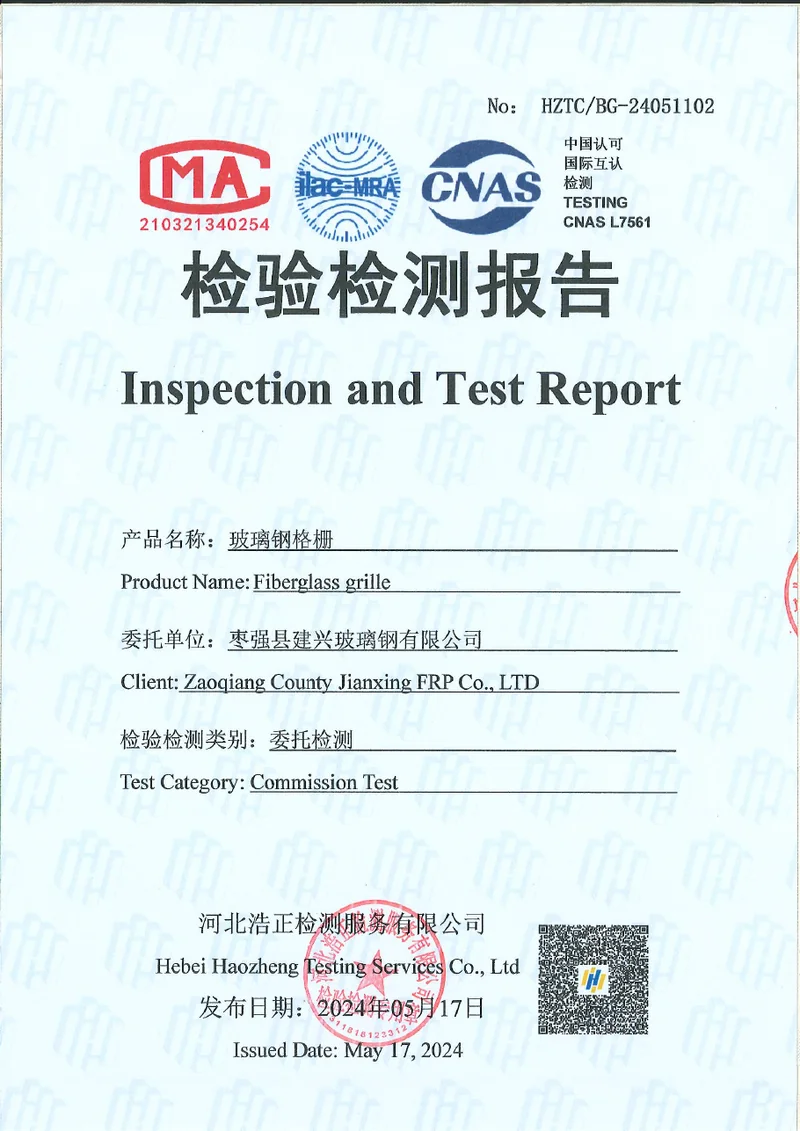
The available HZTC/BG-24051102 report on our quality page is a useful example. It identifies the factory, laboratory, dates and reported test results, but it does not identify a complete model, resin, thickness or mesh. It can support discussion of the named samples and methods. It cannot certify every molded or pultruded product in the range.
Check How the Supplier Controls Change
Changes are another capability test. If a pipe opening moves, the resin changes, a panel is split or a clip type is substituted, the supplier should be able to show which records change.
Ask how the update is controlled:
- a new drawing revision or marked-up approval;
- revised piece and accessory quantities;
- updated material or surface requirement;
- revised price and delivery effect;
- a changed inspection or document scope; and
- confirmation that old and new revisions cannot be mixed in packing.
A supplier that can quote quickly but cannot explain revision control may still create a production mismatch. A capable system makes the change visible before it reaches the mold, saw or packing bench.
Request a Prequalification Pack Before the RFQ
For a new supplier or a tender, a short capability questionnaire is more useful than a long sales brochure. Ask for a controlled pack that can be compared across candidates:
- legal seller name, address and named commercial contact;
- factory name, production address and relationship to the seller;
- product families and processes actually controlled at that site;
- fabrication services and any subcontracted operations;
- current quality documents, certificate number, issuer, scope and validity where claimed;
- typical production slot, peak capacity and constraints for the requested volume;
- one or two approved reference projects or anonymized case descriptions;
- proposed audit agenda, responsible guide and issue-closing process; and
- approved sample, drawing and packing files for the intended first order.
These documents support supplier qualification. They do not replace the quotation, order drawing or acceptance inspection. Keep them linked to the same supplier and product scope rather than filing them as general marketing material.
Separate Capacity From Quality
Capacity answers whether the supplier can produce the volume in the required window. Quality answers whether the exact product conforms to the agreed requirement. A factory can have high capacity and weak order control, or strong quality records and limited capacity for a particular product family.
State the request as a production question: quantity by item, required approval stage, sample date, first-article or pre-production review, shipment dates and whether the line or mold is dedicated or shared. Ask what changes during peak periods. A reliable answer identifies the production slot, bottleneck and decision point rather than promising every date verbally.
Repeat orders add another test. The supplier should be able to retain the approved product row, resin direction, surface, colour, drawing, label and packing standard. If the same appearance can hide a different bar profile or resin, the reorder needs the original technical identity, not only a photograph.
Red Flags in a Manufacturer Reply
The following answers deserve a follow-up before price comparison:
- a catalogue page is sent instead of a current product row;
- “all specifications available” without naming one structure;
- the factory name changes between quotation, certificate and packing;
- an old report is described as valid for every panel;
- the supplier cannot distinguish a sample from a tested specimen;
- cut pieces are promised without a drawing or piece schedule;
- certificate, testing or special packing is described as “no problem” but not written into the quote;
- the seller cannot say who owns inspection or after-sales; and
- “ISO” is displayed without a certificate number, issuer, scope and validity.
These are not reasons to reject a supplier automatically. They are reasons to keep the technical basis open until the answer is specific.
The Manufacturer Review We Use
Our position is simple: a manufacturing claim is useful only when the product and process can be identified. We manufacture molded and pultruded FRP grating in our Jianxing factory and supply full panels, factory-cut pieces and clips. We can review the drawing, finish pieces, apply agreed edge treatment, identify packing and discuss the documents we can issue.
We do not claim an unverified ISO 9001 certificate. We do not turn the current sample report into a rating for every product. We do not approve supports, anchors, installation, site safety or the complete access system unless that responsibility is expressly included in writing.
That boundary makes a supplier review more useful. The buyer can see what is offered, what is supported and what remains outside the factory scope.
The Most Useful Supplier Review Packet
For a real comparison, ask every candidate to return the same six items:
- legal seller and production-site responsibility;
- current product matrix and exact proposed row;
- in-house versus sourced process statement;
- drawing and finished-piece review method;
- inspection and document schedule with issuer and stage; and
- commercial, packing and change-control basis.
When those six items are present, a factory visit, sample or video call has a defined purpose. Without them, the buyer is comparing confidence rather than evidence.
Audit sequence
From Supplier Claim to Traceable Order
Six steps keep role, product, sample and evidence aligned.
Identify the legal seller, manufacturer, fabricator and inspection owner, including any outsourced process.
Confirm the exact molded, pultruded, mini-mesh or fabricated family and where it is produced.
Send one real application question and see whether the reply identifies missing support, exposure and evidence fields.
State what the sample will prove and which report, certificate, drawing or inspection record the order needs.
Tie item IDs, drawing revision, material, fabrication, documents, packing and commercial terms together.
Compare the packed pieces, marks and records with the approved package before release.
Evidence limits
Four Things a Manufacturer Claim Cannot Prove by Itself
Visible capability is useful only when it is attached to the exact product and order.
- A factory photograph is not a factory audit — A photograph or video can show equipment and activity. It does not prove the offered family, current production control, order traceability or the validity of a report.
- A supplier certificate is not always an independent product test — Ask who issued the document and what sample it covers. A factory conformity certificate and a third-party test answer different questions.
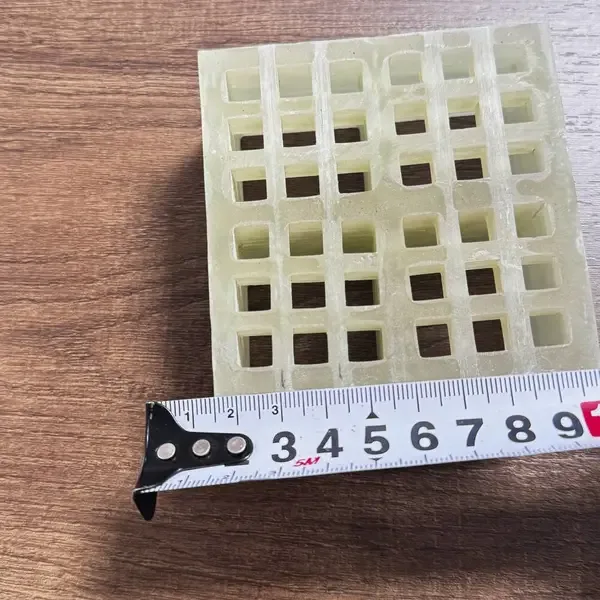
- A sample is a narrow approval tool — A 3 × 3 cell sample can show visible mesh and surface. Load, chemical resistance, fire behaviour and installed-system performance need relevant evidence and test conditions.
- A broad product list does not prove vertical integration — A company may manufacture some products and trade others. The product row should identify the manufacturer and the process, especially where resin, bar geometry or fire performance is critical.
Questions to ask
The FRP Grating Manufacturer Checklist
Twelve areas cover the path from legal role and capacity to delivered packing.
- Supplier role — Manufacturer, fabricator, reseller or trading company; legal entity and factory site.
- Product matrix — Exact families, construction rows, sizes, resin and surface choices currently available.
- Production route — Which molded, pultruded, mini-mesh or covered processes are in house and which are sourced.
- Fabrication — Cutting, drilling, openings, edge treatment, trial fit, piece marking and packing.
- Engineering — Drawing revision, load and support inputs, review responsibility and approval boundary.
- Quality plan — Inspection fields, sampling, acceptance criteria, responsible inspector and record format.
- Sample plan — What the sample must show, what it cannot prove and who records approval.
- Document plan — Datasheet, drawing, inspection record, conformity certificate or test report, issuer and due date.
- Traceability — Order, item ID, drawing revision, batch, certificate and packing-list connection.
- Commercial and export — Quantity, Incoterm, named place, packing, marks, payment and change route.
- Prequalification pack — Legal seller, factory site, process scope, capacity, references, audit agenda and responsible contacts.
- Lead time and repeat order — Requested delivery date, production route, peak volume, approval sample and reorder record.
Product identity
What a Manufacturer Quotation Should Identify
The product row and the evidence must describe the same supplied item.
Request a Project Quote| Specification | Value |
|---|---|
| Molded range | Depth, mesh, panel size and resin rows Confirm which rows are current and whether the quoted item is manufactured or sourced. |
| Pultruded range | I, T or WT row, pitch, bar direction and length A family name does not identify the exact bearing-bar profile. |
| Mini-mesh and covered | Upper mesh, base construction, overall height and surface Both layers and the complete assembly belong in the product identity. |
| Fabrication | Finished pieces from an approved drawing Opening support, edge treatment, tolerances and inspection are separate from panel supply. |
| Sample | Physical and visual reference Define colour, mesh, surface and dimensions; do not use it as an unqualified load or chemical approval. |
| Test evidence | Specimen, method, condition and result Match any report or certificate to the exact product and acceptance question. |
| Order record | Drawing revision, item ID, batch and packing The chain should let a delivered piece be compared with what was approved and invoiced. |
| Supply boundary | Written responsibility matrix State which supports, anchors, installation work and system approvals remain with the project. |
Request a review
Send Your Product, Process and Evidence Questions
Use one real requirement so the reply can be checked instead of remaining a general capability claim.
- Identify the role and production site
- Separate product, fabrication and evidence
- Name the documents the order requires
FRP Grating Manufacturer Questions
How can I tell an FRP grating manufacturer from a trading company?
Does a factory visit prove product quality?
Is a free sample enough to approve a supplier?
What does “made in house” mean for FRP grating?
What documents should a manufacturer issue?
How do I check a manufacturer’s test report?
What is the difference between laboratory marks and factory certification?
How should a manufacturer handle a specification change?
Can one supplier quote an entire mixed-product package?
This content was prepared and reviewed by Dengtai Industry’s technical and production team using the project conditions, available product data and applicable documents. Limits that require design, testing or approval are identified in the content. Content last checked: