Gritted surface procurement
Gritted FRP Grating: Surface, Configuration and Acceptance
Match the walking-surface process to wet, oily, sloped or wash-down service, then bind it to the exact grating construction, resin, color, approved sample, production check and any separately required slip test.
Prepared by
Dengtai Industry
Published
·
Reviewed

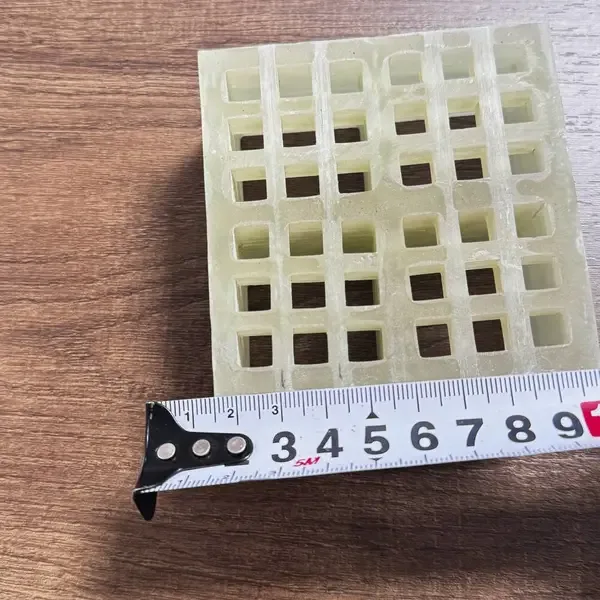
A surface sample can show texture, color and edge condition. It does not establish a universal slip class or panel load. Photo: Dengtai Industry.
Gritted FRP grating is a complete surface specification, not a promise that every panel is equally slip resistant. The buyer needs to identify the panel underneath the grit, the process that holds the grit, the resin and color, the physical sample used for approval, and any separate performance test. Without those fields, two quotations can both say “gritted” while describing different products.
The practical question is not simply “Is there grit?” It is:
- What condition is the walking surface expected to handle?
- Which grating construction will receive the surface?
- How is the grit formed or bonded?
- What will be kept as the visual and tactile reference?
- Which production checks and performance reports will follow the order?
Our factory view is straightforward: control the surface as a production route and control the panel as a structural product. Do not let a surface photo become a substitute for either one.
This guide is prepared and reviewed by Dengtai Industry’s FRP grating technical and production team. Product selection remains subject to the current row and the project’s separate safety, structural and acceptance review.

What “Gritted” Means on FRP Grating
Grit is an abrasive material added to the walking face to create a texture that can engage a boot, shoe or wheel. On molded grating, the panel may already have a shallow concave profile formed during molding. A gritted version adds a coarser mineral layer through one of several production routes. On pultruded grating, the grit is applied to the walking face of the assembled bearing-bar product.
Those descriptions are intentionally broader than “grit is embedded in the resin.” That sentence can be true for one process and misleading for another. A buyer exchanging specifications should record the process, not only the family name. This article extends the wider FRP grating surface guide into an order and acceptance method.
Concave is not grit
Many molded panels naturally form a shallow recess along the top of each bar when released from the mold. This concave or meniscus shape can contribute grip, but it is not an added grit layer. If the project requires an abrasive top, saying “standard surface” is not sufficiently specific.
Inlaid grit is part of the molded order
When grit is incorporated during molding, the grains are intended to sit within the resin-rich walking surface. This route generally has to be set up with the panel order and tooling rather than added to any finished stock panel. It can offer a different edge appearance and wear mechanism from a layer applied after cure, but those advantages should not be stated as a universal test result.
Bonded grit is a post-cure surface operation
A bonded surface is applied after the grating has cured using a compatible resin or adhesive system and grit. Its production controls include surface preparation, the bond system, grit application, cure and edge condition. It can be useful where the factory offers that process for the requested format, but the quotation should not call it “inlaid” merely because both surfaces look coarse.
Surface and substrate are two different approvals
The surface process does not define the panel depth, mesh, bearing direction, resin or load evidence. A gritted 38 mm molded panel and a gritted pultruded I-bar panel are different substrates. Approving either one from the surface photograph alone would leave the structural product unidentified.
Start With the Surface Problem, Not the Grain Type
“Anti-slip” is an outcome the user wants, not a complete condition. Water, oil, grease, food residue, dust, ice, wax, cleaning foam and mixed contamination behave differently. The route may also be flat, sloped, curved or interrupted by joints, ramps and covers.
Record the following before choosing a grit process:
| Condition | What to record | Why it changes the request |
|---|---|---|
| Wet area | Water source, depth, flow, drainage and dry periods | Standing water and a damp surface are different conditions |
| Oil or grease | Medium, concentration, temperature and cleaning frequency | Residue can fill the surface texture and change grip |
| Food or fibrous debris | Particle type, cleaning tool and hygiene requirement | Coarse grit can retain material that is difficult to remove |
| Wash-down | Pressure, nozzle, chemicals, temperature and frequency | The cleaning method can affect the surface and bond |
| Sloped route | Slope percentage or degrees, direction and drainage path | The entire route, including joints and edges, must be reviewed |
| Footwear or wheels | Boot type, barefoot use, trolley and wheel size | A grit texture for boots may not solve a small-wheel issue |
| Temperature and UV | Normal, peak and cleaning temperatures; sun exposure | Resin, color and surface durability are product-specific |
If the route is wet because water cannot drain, the first correction may be the drainage path rather than a coarser grit. A gritted top is not a substitute for falls, openings, collection channels or cleaning access.
Choose the Panel Before Approving the Surface
The surface is added to a structural product. First identify the construction and its intended role:
- Molded grating: an integral grid with an available depth and mesh row.
- Pultruded grating: parallel bearing bars connected by cross rods, with a defined bearing direction.
- Mini mesh: a fine upper grid over a lower structural grid.
- Covered grating: a more continuous top assembly with separate joints, drainage and load questions.
- Factory-cut piece: a finished outline with edges, openings and fixing locations.
The exact panel identification should include:
- depth;
- mesh or bar series;
- bearing direction;
- panel or finished-piece size;
- resin;
- color;
- surface process;
- quantity;
- fixing and edge scope.
This record prevents a common purchasing error: the surface sample comes from one panel family, the quotation names another row, and the delivery drawing shows a third mesh. Each document may look reasonable alone, but they do not describe the same product.

Compare the Main Gritted Surface Routes
Peer manufacturers commonly separate in-mold grit from a grit layer added after cure. The comparison below preserves that useful distinction without assuming that every supplier offers the same materials, lead times or repair method.
| Buying decision | Inlaid grit during molding | Grit bonded after cure |
|---|---|---|
| When it enters the order | Set up with the molded panel order and its production schedule | Applied after the agreed panel has cured, where that process is offered |
| Inventory implication | Usually more closely tied to the ordered panel or tooling | May be adaptable to a finished standard panel, subject to supplier capability |
| Peer-described benefit | Grit can be intended to remain part of the formed surface | Can be economical and adaptable to an existing panel format |
| Peer-described trade-off | Usually planned earlier, with less late substitution | Bond preparation, cure, wear and repair become separate controls |
| Typical grit examples across the market | Quartz or aluminium oxide systems can exist; our exact reference must be confirmed | The same material names still require process-specific confirmation |
| Repair question | Ask how the original formed surface and edges are restored | Ask how compatible loose or worn areas are prepared and recoated |
| Evidence required | Exact row, process, grit, coverage, sample and optional test | Same fields plus bond process and repair method |
The words “inlaid” and “bonded” do not automatically establish chipping resistance, service life, cost or slip performance. Redco’s grit process comparison explains the inventory and lead-time distinction, while Evergrip’s gritted product page shows a named aluminium-oxide finish supported by a separate test extract. Both are useful peer evidence, not statements that our factory offers the identical material or result.
Inlaid grit during molding
Use this direction when the order needs a grit surface formed as part of the molded panel. The purchasing record should state the panel row, resin, color, grit appearance, coverage expectation and edge condition. The factory should identify whether the requested grit is available for that mold and production schedule. The molded grating product page shows the base rows and panel formats that have to be identified first.
A key factory perspective is lead time. A surface that must be incorporated while the panel is made cannot be treated like a stock finish selected after the panel is complete. The order entry and production planning must reserve the right process.
Bonded grit after molding
The post-cure route depends on adhesion. The surface must be clean and prepared in the agreed way, the bond system must be compatible with the panel and exposure, and the grit must be applied before the system reaches the point where it can no longer hold it. Include intricate outlines, openings and edge details in the fabrication discussion; a water-jet or other agreed cutting route can change how the finished surface is made and inspected.
Acceptance should include the top face, corners, cut edges and the appearance after a basic wipe where appropriate. If the buyer needs repair guidance, ask for a repair method that matches the original surface system.
Gritted pultruded surface
Pultruded grating is directional. The walking surface does not remove the need to show which bars carry the load and where they bear. Its surface may be produced with a textured top along the profiles, but the exact I, T or WT series and bar pitch remain part of the order. Review the pultruded product range when the supporting span points to a directional product.
Fine mesh with a grit surface
A fine top grid can retain small objects while grit improves the walking texture. Those are two separate benefits. The opening does not establish slip resistance, and grit does not establish object retention. Check the upper opening, lower grid, depth, clip fit and cleaning consequence together.
Covered or solid-top grating
A covered assembly changes drainage and total height. A gritted cover may be suitable where the route needs a more continuous surface, but the joints, cover attachment and complete assembly load basis still need their own review. Water will not pass freely through the mesh because the mesh is no longer exposed.
How to Approve the Physical Surface Sample
A surface sample is more useful when everyone knows what it represents. Label it with the grating row, resin, color, surface process, sample date and drawing revision. Keep the approved sample protected from handling, oil and sunlight so it remains the intended reference.
Inspect the sample under consistent light from more than one angle:
- Color: compare the overall face against the approved reference, not a screen image.
- Texture: note the visible and tactile grain, including whether coarse particles are concentrated in patches.
- Coverage: inspect the central bars, near edges, intersections and cut edges.
- Surface uniformity: look for bare areas, loose material or an uneven bond layer.
- Edge condition: confirm how the top layer terminates at a finished edge.
- Cleaning response: where relevant, wipe with the agreed method and inspect what remains trapped.
The sample does not need to prove a structural load. It is the physical appearance and surface reference for the agreed configuration. Our molded grating sample guide explains how to connect the coupon to the panel row, while this page adds the surface process and grit-specific fields.
How to Specify Slip-Test Evidence
If the buyer needs a numeric slip result, define the requirement before production. A useful clause names:
- the test standard and edition;
- the required specimen and surface orientation;
- dry, wet or contaminated condition;
- contaminant and application method;
- footwear or slider specified by the test;
- test direction;
- required result and averaging rule;
- report date, laboratory and sample identity.
DIN 51130 and pendulum methods are common examples, but they are not interchangeable. A result expressed as an R class cannot simply be converted into a pendulum value. A report for one grit size, surface process and resin does not automatically cover another.
The test report is evidence about the tested specimen. It is not a product certificate, a guarantee for every installed route or a replacement for cleaning and maintenance. The quotation should say whether an existing report is supplied, whether a new test must be arranged, and which party owns the test specification and acceptance decision. Use the test-report applicability guide and the quality and document guide to keep the claim, specimen and conformity file separate.
What Our Factory Controls in a Gritted Order
Our production review begins with the released product configuration. We confirm the current row, resin, color and requested surface direction. We then identify whether the requested process is available for that format and whether the finish belongs in the original production order or a post-cure operation.
The control plan should preserve the following links:
| Link | Factory question | Buyer evidence |
|---|---|---|
| Approved sample to order | Which physical sample did the buyer approve? | Sample ID, date and product row |
| Order to drawing | Which panel depth, mesh and finished pieces are included? | Drawing revision and piece list |
| Surface to panel | Does the process apply to the actual substrate? | Process name and production record |
| Color to resin | Is the color reference possible with the selected resin? | Approved color and sample reference |
| Cut edge to surface | How should the gritted edge be finished? | Edge detail and inspection point |
| Test to specimen | Does the report cover the same surface and condition? | Report, method, specimen and date |
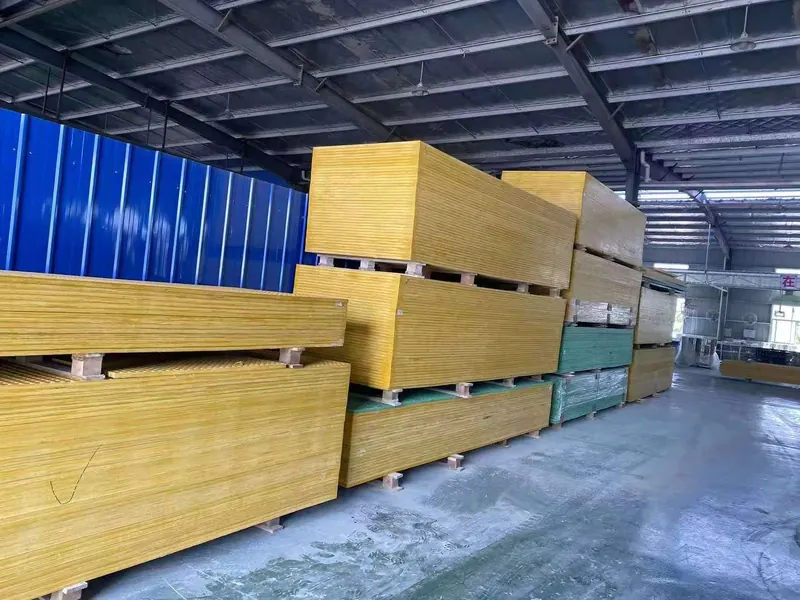
| Package to product | How is the textured face protected in transit? | Packing method and package identity |
This is also where our factory adds practical value. A buyer may know that the route is wet and wants a darker color. Production has to know the mesh, resin, grit appearance, sample and packing method before it can make a repeatable offer. The earlier those fields are fixed, the fewer assumptions enter the quotation. Check the clip and fixing range where the surface build or finished panel height may affect the fixing interface.
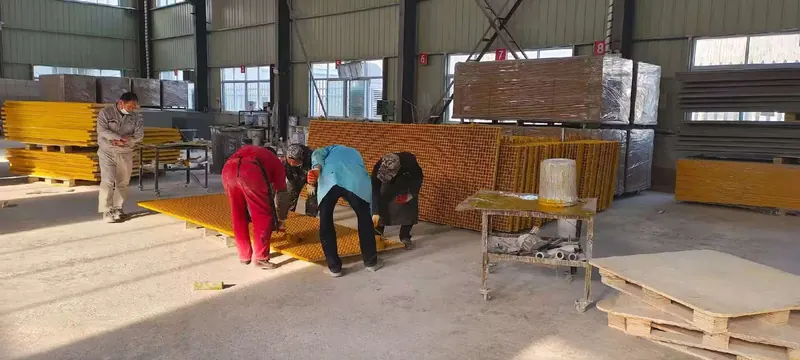
The photograph below documents general panel finishing, not the specific grit application. Where the process itself is critical, request a process-specific photograph or video tied to the approved order; a generic workshop image should not be used as evidence of inlaid or bonded grit.
Inspect a Gritted Delivery
At receiving, compare the package to the approved order before moving the panels into service. Check:
- order and package identity;
- piece marks and quantity;
- panel depth, mesh and bearing direction;
- color against the retained sample;
- surface texture and visible coverage;
- bare or damaged patches;
- cut edges and edge sealing where specified;
- accessories and fixing quantities;
- documents and report scope.
Do not decide that a panel is structurally unsuitable only because the grit appearance differs. Separate the observations:
- An appearance deviation is compared with the accepted surface record.
- A dimensional error is compared with the approved drawing.
- A damaged bar or edge is a product-integrity question.
- A loose panel is a support or fixing question.
- A slip result is a scoped performance question.
That separation makes it possible to raise the right issue with the right evidence.
Cleaning and Maintenance Notes
A textured surface can trap material. For wash-down areas, confirm that the cleaning method removes residue from the grit rather than pushing it into the openings. Soft brushes, the agreed cleaning chemical and a controlled rinse are safer starting points than a sharp metal scraper. High pressure or abrasive cleaning can damage a bonded surface or dull the intended texture, so the process-specific method should be confirmed.
When inspecting an installed route, record:
- generalized loss of texture;
- bare patches at edges or traffic lanes;
- trapped oil, food or fibrous debris;
- cracks, chipped bars or loose pieces;
- water ponding, blocked drainage or failed joints;
- loose or damaged clips.
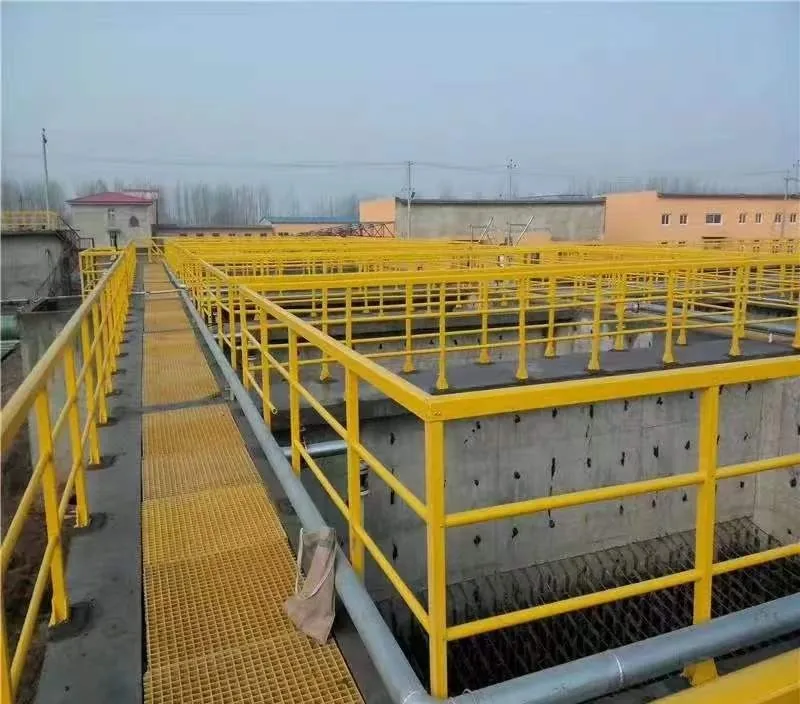
Surface wear alone is not a structural failure. A crack across a load-bearing bar or a panel that moves on its support is a different condition and should be isolated until the responsible person reviews it. The maintenance and service-life guide explains the wider inspection route.
Questions That Expose a Weak Gritted Quotation
Ask every supplier the same questions:
- Which panel family, depth and mesh or bar series does the price include?
- Is the grit part of molding, a post-cure bonded layer or another named process?
- Which resin and color are included?
- What physical sample will be retained for production?
- How are corners, cut edges, openings and removable pieces finished?
- What appearance checks are performed before packing?
- Does the offered test report match the same surface and specimen?
- What cleaning and repair methods are compatible?
- Is the textured surface included in the package price and packing plan?
- How is the approved sample referenced on the repeat order?
A quotation becomes comparable when the answer to each question describes the same product configuration. A low price for “gritted FRP grating” may omit the tooling, improved bond system, sample, repair method or required testing.
Our Manufacturer View
Our strongest contribution is not to claim that one surface works everywhere. It is to make the order unambiguous. We start with the service condition, identify the current panel row, separate the surface process from the structural product, and ask for a physical reference when appearance or texture matters.
We can review the available process for the requested product and quote it with the parts, edges and fixing scope that belong to the order. We do not convert an appearance sample into a slip certification, and we do not claim that a general material report proves a particular gritted panel. When the project requires a measured slip value, the test must be specified and attached to the correct product and condition.
That boundary makes the article useful for procurement. It shows what to decide, what to document and what evidence to request, rather than only describing a surface.
Get a Quote
Get a Gritted FRP Grating: Surface, Configuration and Acceptance Quote
- State the actual service and cleaning condition
- Send or request a physical surface sample
- Name any required slip-test standard and threshold
Surface routes
Compare Gritted FRP Grating Surface Options
The process, substrate and evidence change together; the word grit does not identify one product.
| Surface direction | What it is | Strong starting point | What must be settled |
|---|---|---|---|
| Concave molded top | A shallow relief formed in the bar during molding | General access with no stated need for an added grit layer | Actual profile, wet performance, cleaning and any project test |
| Inlaid grit | Grit incorporated into the resin-rich top during molding | A specified grit surface that must be part of the original panel order | Tool and row availability, grit reference, coverage, color and edge |
| Bonded grit | A grit layer applied and bonded after the panel is cured | A surface added to an agreed panel format where that process is offered | Bond system, cure, coverage, wear, repair and acceptance |
| Pultruded grit surface | A gritted walking face on a pultruded bearing-bar product | Directional grating where wet grip and a supported span are both required | Bar type, pitch, surface process, fixture and matched structural data |
| Gritted mini mesh | A coarse walking finish over a fine-opening double grid | Small-object retention and a textured surface on the same piece | Upper and lower mesh, depth, drainage, cleaning and clip fit |
| Covered gritted surface | A textured layer on a more continuous top assembly | A closed or flatter surface with a separately defined walking finish | Cover joints, drainage, total height, mass and assembly load basis |
Purchase record
What to Record for a Gritted Grating Order
A production-ready request ties the environment to the exact panel and the physical acceptance reference.
| Purchase field | Recorded value | Why it matters |
|---|---|---|
| Service condition | Water, oil, grease, food residue, dust, slope, traffic and cleaning method | Identifies why the surface exists and what it must tolerate |
| Grating substrate | Molded, pultruded, mini mesh, covered or another assembly | Determines the surface process and structural evidence |
| Exact row | Depth, mesh or bar series, bearing direction and panel format | Prevents a surface sample from being attached to the wrong panel |
| Resin and color | Resin grade, color reference and UV or chemical requirement | Surface appearance and exposure are not interchangeable |
| Surface process | Concave, inlaid grit, bonded grit or another agreed process | Different processes have different tooling, repair and lead time |
| Grit reference | Grain type and grade where confirmed, plus coverage and surface appearance | A generic word "grit" does not describe the offered top |
| Reference sample | Retained coupon with top, edge, color and approval date | Converts visual requirements into a physical comparison |
| Slip-test basis | Method, standard edition, specimen, condition and acceptance value | Separates appearance from measured performance |
Fit check
When a Gritted Surface Is Ready to Quote
A proper surface brief separates route demand, panel construction, appearance approval and performance evidence.
Specify this if…
- The wet, oily, sloped or wash-down condition is described rather than summarized as "need anti-slip".
- The exact grating substrate, depth, mesh or bar series can be identified.
- The desired surface process is named and can be confirmed for that product.
- A retained sample can be approved before production.
- A project-specific test is requested with method, specimen and threshold when a measured slip class is needed.
- Cleaning materials and methods are known and compatible with the surface and resin.
- Cut edges, clips and adjacent interfaces are included in the review.
Look elsewhere if…
- The buyer is treating "gritted" as a guaranteed slip rating.
- The sample and test specimen do not represent the exact product and surface.
- The request does not state whether contamination is water, oil, grease, food, dust or a mixed condition.
- A bonded surface is proposed without a defined repair or wear route.
- Fine grit is being used to remove the need for drainage or cleaning.
- A surface change is expected to increase structural load capacity.
- The panel row is still unknown, so the surface cannot be tied to a finished product.
RFQ checklist
What to Send for a Gritted FRP Grating Review
Known values and a marked drawing are enough to start; missing test values can remain explicitly unresolved.
- Intended route — State whether the panel is a walkway, platform, stair landing, access cover, dock or another use.
- Surface problem — Describe water, oil, grease, food residue, chemical splash, slope, debris, wash-down or cleaning conditions.
- Panel construction — Identify molded, pultruded, mini mesh, coated, covered or another product type.
- Exact geometry — Give depth, both mesh values where relevant, bar series, bearing direction, panel size and quantity.
- Resin and color — State the exposure requirement, preferred resin, color reference and UV expectation.
- Surface process — Say whether the order needs concave, inlaid grit, bonded grit or a supplier's named sample.
- Sample approval — Define who compares the sample, under what lighting and which top, edge and color features are accepted.
- Cleaning — Provide cleaning chemicals, brush type, pressure and frequency where they affect surface durability.
- Test requirement — Name the exact method, standard edition, test condition, specimen and acceptance value if slip performance is specified.
- Fixing and edges — Include clips, holes, cutouts, edge sealing, removable pieces and any adjacent floor interface.
Gritted FRP Grating Questions
What is gritted FRP grating?
Is gritted FRP grating automatically slip resistant?
What is the difference between inlaid and bonded grit?
Does grit increase the load capacity of FRP grating?
Is a photograph enough to approve a grit surface?
What slip test should I request?
Can the cut edge be sealed after the grit surface is made?
How should we compare two gritted samples?
Will the grit remain unchanged for the whole service life?
Can we add grit to an existing panel after delivery?
What belongs in the purchase record for a repeat order?
Evidence boundary
What the Surface Claim Can and Cannot Prove
The factory controls the supplied configuration; the project confirms the use, test and complete installed condition.
- Final acceptance rule — Approve the exact panel, surface process, color and reference sample first, then attach any slip-test report and production check to that same product record.
- Keep the surface separate from structure — Grit changes the walking interface. It does not replace the support, load, deflection, fixing or fall-protection review for the complete installation.
- Manufacturer process reference — Redco separates a naturally concave molded surface, secondary grit and integral grit, including different production and inventory implications. Read Redco's grit process comparison
- Sample and test reference — Evergrip presents its gritted product together with a separate surface-slipperiness test extract, showing why appearance and test evidence need separate records. Review Evergrip's gritted product and test files
- Grit finish reference — Perma Composites reports a grit finish under DIN 51130 in its technical guide, illustrating that a slip rating must be connected to a named finish and test basis. Open the Perma molded grating technical guide
This content was prepared and reviewed by Dengtai Industry’s technical and production team using the project conditions, available product data and applicable documents. Limits that require design, testing or approval are identified in the content. Content last checked: