Fire and smoke evidence
Phenolic Grating: Fire and Smoke Evidence for the Ordered Product
Phenolic is a resin family used where fire and smoke requirements govern. It is not a blanket class or certificate. Identify the required test outcome, then match the report to the resin grade, grating construction and approval scope being ordered.
Prepared by
Dengtai Industry
Published
·
Reviewed

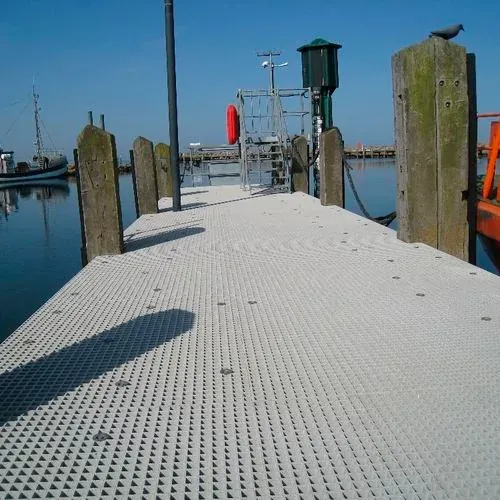
Phenolic can be a candidate for demanding fire duties; the project evidence determines the offer. Photo: Dengtai Industry.
Fire terms
Seven Terms That Must Stay Separate
A phrase becomes useful only when the property, method and product scope are identified.
- Phenolic grating
- FRP grating made with a phenolic resin system. The term describes a resin family and does not by itself identify a grade, finished construction, test result or approval.
- Flame spread
- The movement of flame across a material surface under a named test procedure. The result is comparative and belongs to the method and tested specimen.
- Smoke density
- The amount of smoke measured by a defined test. It is different from smoke toxicity and from flame-spread performance.
- Smoke toxicity
- The composition or biological effect of combustion products under a stated test method and exposure. Low smoke density does not automatically establish low toxicity.
- Structural fire resistance
- The ability of a defined load-bearing assembly or construction to retain a stated criterion for a period under a specified fire test.
- Test specimen scope
- The resin grade, product construction, thickness or profile, surface, orientation, mounting and test conditions actually covered by the report.
- Approval
- Acceptance by the governing code, classification body, client or technical authority. A test report is evidence used in that decision, not automatically a project approval.
When to use this
When Phenolic Grating Needs a Product-Level Evidence Check
Use this method when fire or smoke is a governing requirement, not merely a marketing adjective.
Specify this if…
- The project names a fire test, class, smoke limit, toxicity criterion or fire-resistance period.
- Phenolic is specified or is being considered because fire or smoke governs material selection.
- A supplier is offering a phenolic report and the product configuration must be matched to it.
- The installation must satisfy an offshore, marine, tunnel, transit or public-building approval route.
- A resin or construction substitution could affect the fire evidence.
Look elsewhere if…
- The inquiry says only “fire-rated phenolic grating” without a standard, class or acceptance criterion.
- A phenolic resin name is being treated as a product certificate.
- One report is being applied to every thickness, mesh, bar profile, surface or colour.
- Smoke density, smoke toxicity and structural fire resistance are being used as interchangeable terms.
Typical uses
Where Phenolic Grating Is Usually Considered
These are candidate applications, not automatic approvals; the governing code and project evidence still decide.
Offshore and high-fire-risk platforms
Corrosion, escape, fire and smoke requirements can overlap. Treat phenolic as a candidate only after the area and approval route are defined.
Rail, metro and tunnel projects
Smoke, toxicity, flame spread and project-specific approval language often govern. Identify the exact transport or tunnel standard before selecting the product.
Public buildings and evacuation routes
Interior finish, floor assembly and building-code scope may differ. The authority having jurisdiction and the installed assembly decide how a report is used.
Chemical and industrial platforms
A fire-oriented phenolic grade still needs a separate chemical-exposure review for the medium, temperature, cleaning and contact.
Claims vs evidence
What Different Phenolic Statements Can Support
The right-hand column shows where a common brochure claim exceeds the document.
| Phrase or document | What it can support | What must still be checked |
|---|---|---|
| “Phenolic resin” | A resin-family direction that may be relevant to fire and smoke duties | Grade, formulation, finished product and explicit test results |
| ASTM E84 report | Flame-spread and smoke-developed indices for the tested surface and procedure | Smoke toxicity, structural fire resistance or coverage of a different product |
| ASTM D635 or small-flame result | Burning behaviour under that small-scale method | A building class, low-toxicity claim or load-bearing fire-resistance period |
| USCG Level 2 / ASTM F3059 statement | Acceptance only when the report, product scope and current approval route support the exact claim | Automatic equivalence with IMO, E84, customer criteria or a different grating construction |
| Certificate of conformity | Conformity with the specification or order requirements stated | A fire class or approval outside the document scope |
Current scope
What We Can State From the Available Evidence
The evidence must cover the proposed product before a project-specific claim is made.
| Evidence available | What we can state | Boundary |
|---|---|---|
| Factory material test report | The tested sample, methods and recorded results within the report | Not a finished phenolic product fire rating or blanket approval |
| Resin grade data | Properties or test information supplied for that named grade | Not automatically the performance of our finished grating construction |
| Finished-product report | The result and scope when the tested item matches the proposed supply | Not other thicknesses, constructions, surfaces or untested changes |
| Project-specific test | The agreed specimen, standard and acceptance criterion after completion | Performance until the defined test programme has been completed |
| Customer or class approval | A decision by the authority named in the document | A claim that can be inferred from an untraceable brochure statement |
Verification
Check Six Links From Requirement to Approval
Stop where the required outcome, tested product or approval route is missing.
Identify flame spread, smoke density, smoke toxicity, fire resistance, structural integrity or another named criterion.
Record the method edition, class or limit and the code or authority that will use the result.
Record resin grade, molded or pultruded structure, thickness or bar profile, mesh, surface and identified options.
Obtain the report number, issue date, laboratory, specimen identity, test conditions and actual result, not only a marketing statement.
Identify any difference in grade, construction, thickness, surface, orientation, mounting or batch that could affect applicability.
State whether the client, classification body or technical authority accepts the report and what remains to be tested.
Phenolic Is a Resin Family, Not a Certificate
Phenolic grating is often considered where fire and smoke performance governs material selection. That makes the resin a useful shortlist direction, but it does not establish a class, smoke result or structural fire performance. The controlled question is which phenolic grade and finished grating are supported by which evidence for which acceptance criterion.
A supplier statement can fall anywhere between a material description, a laboratory screening test, a product test report and a project approval. Those documents answer different questions. Before comparing products, identify exactly what outcome the project needs and what type of evidence it will accept.

Start With the Fire Question
Flame spread, ignition and self-extinguishing behaviour
A flame-spread, ignition or small-flame test answers a defined material or surface question under that method. The result belongs to the tested specimen, test standard and conditions. It is not automatically a structural fire-resistance period.
Where a project names ASTM E84, ASTM D635, ASTM F3059, an IMO requirement or another method, record the exact edition and acceptance rule. Terms such as “Class A,” “Class 1,” “self-extinguishing,” “USCG Level 2” or “low flame spread” should not be used without the supporting test and classification route.
Smoke density and smoke toxicity
Smoke density asks how much smoke a defined test records. Smoke toxicity asks about combustion-product composition or biological effects under its own method and acceptance criterion. One does not establish the other.
If the project requires low smoke, obtain the smoke parameter and limit. If it also requires low toxicity, identify the toxic-gas or other acceptance method. A phenolic resin brochure that says “low smoke” without the test scope is not enough to close both questions.
Fire resistance and structural integrity
A statement such as “60-minute fire-rated platform” normally describes a tested assembly under a defined load and fire exposure. The result may depend on supports, joints, restraints, penetrations and failure criteria. A bare panel surface test does not prove that an installed platform retains capacity, integrity or insulation for the same period.
Record whether the project treats the grating as a surface material, a component or part of a complete load-bearing assembly. That decision determines which evidence can be relevant.
Match the Evidence Packet to the Product
Resin grade and supplier identification
“Phenolic” is not a production identity. Record the resin supplier, named grade and formulation identifier used in the offer. A report or material declaration should identify the same grade or clearly state why another identifier is equivalent under the governing approval route.
Construction and geometry
Phenolic molded grating and pultruded grating are different constructions, and the test specimen may not transfer across them. Record molded or pultruded type, thickness or bearing-bar section, mesh or pitch, top surface, colour where relevant and any cover or coating.
The tested specimen may also depend on orientation, span support, mounting or the presence of joints. Ask for the report pages that define the specimen rather than accepting an isolated property table.
Batch, production and changes
Where the acceptance route requires traceability, connect the approved resin grade and report to the production order. A change in resin supplier, grade, reinforcement, surface or construction should return to the evidence review.
The final invoice and packing documents do not turn an untested construction into an approved one. They can support traceability only after the required evidence and acceptance route have been established.
Read the Report Like a Product Document
Start at the report cover and follow the same chain a technical reviewer would use:
- Identify the laboratory, report number, issue date and any revision or addendum.
- Read the test standard and edition before reading the product name.
- Identify the specimen, including resin grade, construction, dimensions, orientation and mounting.
- Find the raw result, class or period and the acceptance limit that is being compared.
- Read limitations, exclusions and any statement that narrows the tested scope.
- Record which part of the proposed order is inside or outside those pages.
A certificate of conformity and a test report are different documents. The certificate may show that an order or product conforms with named requirements; the report explains what was tested. Neither automatically becomes a project approval. The standards and evidence guide explains the wider document boundary.
Phenolic Does Not Automatically Solve the Other Duties
Fire and smoke can govern the resin direction, but the grating still has a structural and service duty. A phenolic label does not establish allowable span, deflection, impact performance, fixing adequacy or suitability for a concentrated load. Those require the product construction and project load review.
Chemical exposure remains separate. A phenolic product selected for a fire requirement may not be the best chemical choice for every medium, concentration and temperature. Marine exposure also brings salt, moisture and fixing compatibility. UV exposure may affect appearance or surface performance depending on the formulation and finish. State every governing condition rather than treating “phenolic” as a universal high-performance answer.
Service temperature is also separate from fire performance. A short flame test does not define a continuous operating limit, and a material temperature index does not prove that a loaded platform will retain its required stiffness under sustained heat. Use the temperature and creep guide when heat is part of normal service.
What to Do When the Report Does Not Match
A partial match is not a pass. If the report covers a different resin grade, molded instead of pultruded construction, a different surface or an untested mounting arrangement, mark the difference and decide what evidence is required. Do not bridge the gap with words such as “equivalent” unless the governing authority accepts the basis.
The usual options are to offer a product within the tested scope, obtain a product-specific report, arrange an agreed test or have the project authority record a formal acceptance. Each option has a different schedule and commercial consequence. Include that consequence in the quotation rather than assuming the test is free, immediate or automatically accepted.
If the required evidence will arrive after the quotation, keep it as a condition of supply. The order should state which report or approval is required, who must accept it and what happens if the result does not meet the criterion.
What the Available Factory Evidence Can and Cannot Support
Our current Jianxing factory material test report records the sample and methods listed inside that report. Dengtai identifies Jianxing as its own factory; the quality and documentation guide publishes the report identity and relationship in full. The report does not by itself establish an ASTM E84 class, a smoke-toxicity result, a USCG or IMO approval or a structural fire-resistance period for every phenolic grating configuration.
Use the fire rating guide to separate those evidence types, and the quality and documentation guide to understand the difference between a test report, a certificate of conformity and an approval. Where a project requires evidence that the current report does not cover, the test specimen, standard, laboratory, timing and commercial scope must be agreed before the test becomes part of the offer.
Compare Phenolic Claims Like a Buyer
Ask for the exact sentence that must be supported: flame spread no greater than a stated value, smoke density below a limit, compliance with a classification rule, USCG Level 2, or a fire-resistance period for a defined assembly. Then request the report page and result that supports it.
Check that the tested resin grade and construction match the proposed product. Check the report date and revision, laboratory identity and any accreditation or listing claimed. Where another manufacturer publishes a phenolic class, use it to understand the market question; do not transfer that result to our product.
Freeze the Evidence Before Production
A phenolic product should be released with the required fire outcome, test method and acceptance rule, resin grade, construction, surface and document scope recorded. Any later change should be checked against those fields rather than treated as a visually equivalent substitution.
The project evidence file can be assembled in one place: the requirement, raw report, product data, drawing revision, approved resin grade, any approval or acceptance letter and the unresolved items. This prevents a later reader from seeing only the brochure sentence and assuming the rest of the chain exists.
The useful conclusion is not “phenolic equals fire-rated.” It is that a specific phenolic product, supported by identified evidence, has been accepted against a specific project requirement.
Technical Sources and Their Limits
The peer material reviewed for this page shows the range of market claims and the questions that must follow them:
- Eurograte identifies phenolic directions for high-fire-risk and smoke-sensitive environments and refers to product-specific USCG and ASTM scope.
- Bedford describes phenolic products for fire, smoke and toxic-fume requirements, but a product description is not the underlying report.
- Strongwell’s phenolic service case demonstrates that durability can be studied, while its specimen and long-term test do not become a fire class for our product.
These sources help define the evidence questions. They do not transfer their resin grades, test results or approvals to Dengtai grating.
Evidence request
What to Request for the Ordered Phenolic Product
Ask for the raw evidence and scope, not only a one-line certificate description.
- Requirement — The exact fire property, standard or client phrase, class or threshold and the governing code or approval authority.
- Standard edition — The exact test method and edition named in the project; do not assume all editions or methods are equivalent.
- Resin grade — Phenolic family, named grade, supplier or formulation identifier and whether it is the proposed production grade.
- Product construction — Molded or pultruded, thickness or bearing-bar section, mesh or pitch, surface, colour and any cover.
- Specimen details — Specimen dimensions, orientation, mounting, conditioning and any construction detail named in the report.
- Raw result — Result, class or period, test conditions and the report page that supports the claim.
- Report identity — Laboratory, report number, issue date, accreditation shown and any revision or addendum.
- Approval status — Whether the project authority accepts the evidence and whether additional testing, listing or witness inspection is required.
Document review
Keep the Test, Product and Approval Connected
The report’s identity is only useful when it describes the construction being supplied.

A report is not a brochure claim
Read the specimen, method, result and stated limitations instead of relying on the phrase “fire-resistant.”
A resin name is not a product class
Phenolic must still be connected to the finished construction and the required acceptance criterion.
An approval belongs to the named route
A customer, USCG, IMO, code or classification acceptance is identified separately from the laboratory result.
Request a review
Send the Fire Requirement and Product Drawing
Include the standard, acceptance rule and governing authority so the available evidence can be assessed.
- Molded and pultruded grating produced in house
- Full panels or factory cut-to-size pieces
- No fixed minimum order quantity
Phenolic Grating Fire and Smoke Evidence Questions
Is phenolic grating automatically fire-rated?
Is low smoke the same as low smoke toxicity?
What is the difference between a test report and an approval?
Can a phenolic report for molded grating cover pultruded grating?
Does a USCG Level 2 claim cover every installation?
Is smoke density the same as a structural fire rating?
Can testing be arranged for a project?
What is the main document gap to check first?
This content was prepared and reviewed by Dengtai Industry’s technical and production team using the project conditions, available product data and applicable documents. Limits that require design, testing or approval are identified in the content. Content last checked: