Covered product identification
Covered Grating vs FRP Chequered Plate: What Are You Buying?
A patterned top can be a cover attached to a grating base, a one-piece moulded plate, or part of another solid-panel system. The useful comparison is not the surface pattern. It is the construction below, how load reaches the supports, where water goes, how the joints behave and what evidence belongs to the complete item.
Prepared by
Dengtai Industry
Published
·
Reviewed

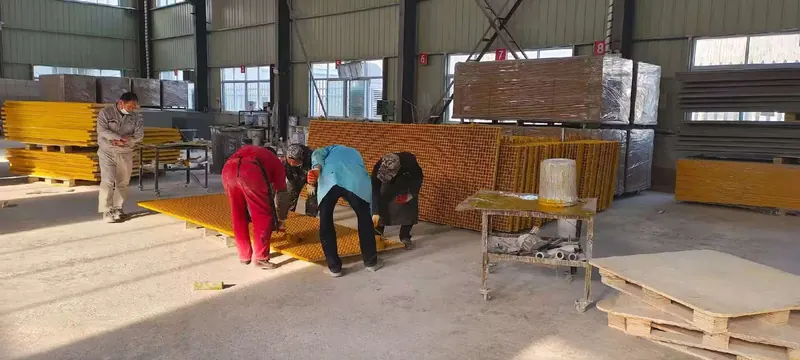
The visible surface is only the first clue. A quote must identify what carries the surface underneath. Photo: Dengtai Industry.
Naming the product
Four Constructions Hidden Behind Similar Top Surfaces
Start with what is underneath the walking surface, because that decides the load path.
- Open grating
- A moulded, mini-mesh or pultruded panel with open cells through the walking surface. The mesh, bearing bars, thickness or bar section, support and edges are part of the structural description.
- Covered grating
- A complete assembly made from a grating base and a continuous cover layer. The connection between base and cover, the finished height, joints, drainage, lifting and load basis all belong to the assembly rather than to either part on its own.
- Patterned FRP plate
- A one-piece moulded or formed FRP plate whose raised pattern is part of the plate. It may be called a chequered sheet, checker plate or anti-slip plate. It does not rely on a grating base for its construction.
- Independent solid FRP plate
- A solid composite plate used as the floor, landing or access piece in its own right. The plate and its supports form the structural system; there is no hidden grating unless the drawing shows one.
- FRP grating with chequered plate
- A more specific covered-grating direction in which the continuous top has a raised chequer or checker pattern. The term does not settle the base type, cover thickness, interface or overall height.
- Finished assembly
- The delivered item after the base, cover, connection, cutting, edge treatment, fixings, lifting details and marking have been defined for the project.
Side-by-side
Covered Grating vs FRP Plate vs Open Grating
Compare construction and service consequences, not just the word “anti-slip.”
Swipe horizontally to view all columns.
| Decision point | Open grating | Covered grating | Patterned FRP plate | Independent solid plate |
|---|---|---|---|---|
| Main construction | Moulded, mini-mesh or pultruded open grid | Grating base plus attached cover layer | One-piece plate with a raised pattern | Solid composite panel with the required surface |
| What carries the load | Grating bars and their support conditions | Base, cover, connection and supports acting as a defined assembly | Plate and its supports | Plate and its supports |
| Walking surface | Open bars, which may have grit or another finish | Continuous surface with an agreed cover texture | Continuous patterned surface | Solid surface, patterned, gritted or smooth as specified |
| Through drainage | Direct through the grid | Reduced or eliminated in the panel field | None through the plate | None through the plate |
| Surface drainage | Not normally the primary path | Falls, joints, edge openings or outlets must be designed | Falls, joints and outlets must be designed | Falls, joints and outlets must be designed |
| Small dropped objects | Limited by the clear opening | Retained in the closed field, but joint and opening paths remain | Retained where the plate remains continuous | Retained where the plate remains continuous |
| Typical depth | Comes from the grating structure | Base depth plus interface and cover | Comes from the plate | Comes from the plate |
| Load evidence | Exact open panel, span, supports and load case | Exact complete assembly and project conditions | Exact plate construction, supports and load case | Exact plate construction, supports and load case |
| Main failure of terminology | Open area is confused with clear opening | A photo of a solid top is assumed to prove a complete assembly | Patterned plate is called covered grating without checking the underside | Plate thickness is assumed to provide a standard load class |
Fit check
When Each Grating or Plate Construction Fits
A useful choice satisfies the surface task without breaking drainage, access or structure.
Specify this if…
- Open drainage, airflow or sunlight is the leading requirement.
- A smaller clear opening can retain the critical object while keeping the surface open.
- A continuous walking surface is needed and a grating base is required for the available depth or support arrangement.
- A one-piece patterned plate can meet the support, stiffness, load and fixing requirements without a grating base.
- The joints, edges, lifting and drainage path can be designed as part of the complete installation.
- The required drawings or evidence can be named for the exact proposed construction.
Look elsewhere if…
- The supplier has not shown whether there is a grating below the patterned top.
- "Covered" is being used as a promise of watertight or airtight containment.
- The installed height cannot accept a base plus cover.
- A loose plate is expected to sit safely on an untrimmed or unsupported mesh.
- The project needs a structural rating but only a catalogue photo and material name are available.
- Nobody has defined how the panel is fixed, lifted or kept in place.
Start With the Construction, Not the Product Name
The same yellow, textured surface can appear on several different products. One may be an open grating base with a cover joined to it. Another may be a moulded plate made in one piece. A third may be a thin sheet placed over a frame, and a fourth may be an independent solid panel with no grating at all.
That matters because the products do not carry load, drain water or fail in the same way. The question “Do I need covered grating or a chequered plate?” cannot be answered from a catalogue thumbnail. It needs three views:
- The top, to understand the walking surface and pattern.
- The underside, to establish whether there is a grating grid.
- The cut edge, to reveal the base, interface and cover as separate layers.
If these three views are not available, ask for them before comparing the price. A seller who cannot show the construction may be using the same words for a different item.
Where the same comparison turns on a milled-flat base with a cover or an open grating surface, use the milled-flat versus covered construction guide before the surface is named.

What Makes a Covered Grating a Covered Grating
A covered grating uses an open grating as the base and adds a continuous top layer. The base can be moulded grating, mini-mesh grating or pultruded grating. The cover can use a raised pattern, grit or another agreed flat format.
The important word is assembly. A covered grating is not a grating plus a generic sheet. It has a defined relationship between:
- the grating type, depth and bar direction;
- the cover material, thickness, pattern and underside;
- the bond or mechanical fixing between them;
- the total finished height;
- the panel joints and perimeter;
- the surface drainage path;
- the support and restraint arrangement;
- the intended lifting method;
- the tested or calculated load basis.
If one field is missing, the item is incomplete even when its top surface looks correct.
The underside reveals the base
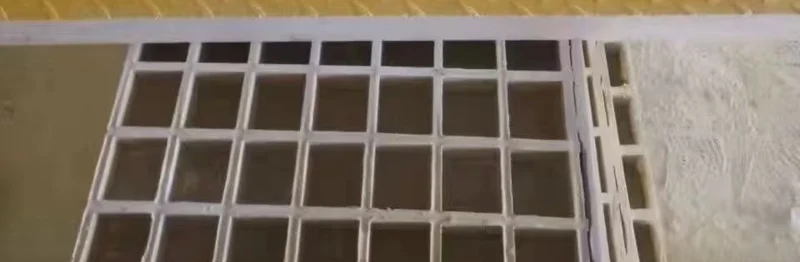
The underside does not need to be clean and photogenic. It needs to show the grid, bar spacing and how the continuous layer sits over it. A section through a cut edge is even clearer, because it can show the thickness of each layer and whether an interface exists.
What a Patterned FRP Plate Is
A patterned FRP plate is a standalone product. Its raised chequer, diamond, square or other texture is formed as part of the plate. There may be no open grid underneath.
Catalogue language is inconsistent. Suppliers may use chequered plate, checker plate, checkered sheet, anti-slip plate or solid-top sheet for similar ideas. The name does not establish:
- the resin and fibre construction;
- the plate thickness;
- the raised-pattern height;
- the stiffness over the actual support spacing;
- the fixing method;
- whether the piece is rated for foot traffic, trolleys or vehicles;
- whether it can be lifted safely as a cover.
A patterned plate can be the right product for a landing, gutter cover, machine guard, vehicle component or architectural panel. It can also be the wrong product when a structural grating base is needed.
Open Grating Is Not the Fallback Choice
Open grating is a primary design choice, not simply the cheaper alternative. It allows liquids, air and light through the panel field. That can be essential:
- on outdoor walkways where rain and snow must not collect;
- over tanks and process areas where ventilation matters;
- on docks and marine structures where sunlight or water movement is relevant;
- in wash-down areas where solids must be removed through or beneath the platform;
- where reduced mass and easier handling are important.
The open grid can also be appropriate over equipment or an occupied area if its clear opening controls what may pass through. Mini-mesh grating reduces the upper opening while retaining a mesh, but the remaining hole, joints and cut-outs still form part of the drop behaviour.
Do not close a successful open-drainage design without asking where the water will go. Installing a plate can solve a dropped-object concern and create a puddle, cleaning or slip problem at the same time.
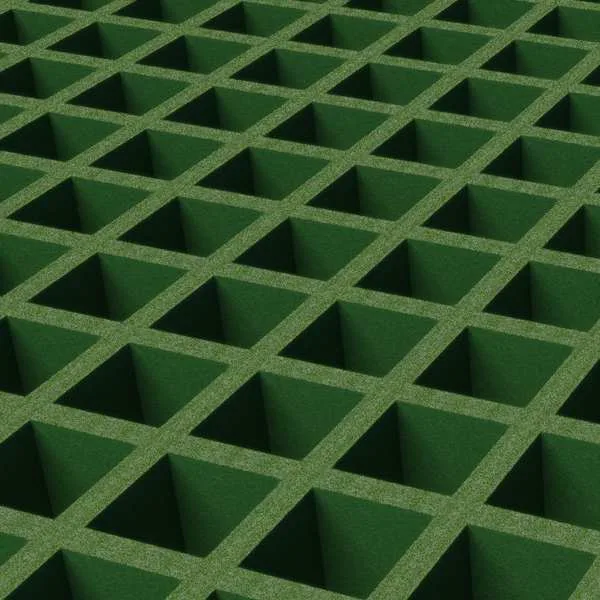
Compare the Load Path Before the Appearance
The load path is the sequence through which a foot, wheel or equipment foot reaches a support.
Open grating
The load enters the walking bars and spreads through the grating structure to the supported edges. The exact path depends on the product type, bearing-bar direction, panel aspect ratio, support layout and point of application. A fixing clip is not automatically a load-bearing support.
Covered grating
The load first enters the cover, then passes through the cover-to-base interface into the grating base. Whether the two layers act as a composite section depends on the connection, materials, geometry and how the assembly is supported. A light bond or intermittent fixing does not automatically produce full composite action.
Patterned or solid plate
The plate itself spans between its supports, with beam or plate action depending on geometry, edge support, thickness and stiffness. Its load path has no grating grid unless the drawing shows one.
This is why “covered grating has a higher load capacity” is too broad to use as a purchasing rule. The conclusion can be true for one tested assembly and false for another. Ask for the exact section, span, support, load and deflection basis.
The covered grating load guide explores the evidence needed for the complete assembly. The general load and span guide explains why even an open-panel table applies only to its stated configuration.
Drainage Changes When the Panel Field Closes
An open grating has a distributed route through its cells. A covered assembly or a solid plate closes that route. Water then has four possible remaining paths:
- flow across the top to an edge or outlet;
- flow into a designed joint or scupper;
- leakage through lifting holes, service openings or perimeter gaps;
- accumulation on the surface when none of the above works.
The drainage decision must include the frame and the rest of the platform. Closing only one panel does not change the fall of the surrounding floor. If the requirement is watertight, odour-tight or chemically contained, a covered top alone is not that system.
This is a common source of mismatch:
| Project intention | Common product assumption | What still has to be designed |
|---|---|---|
| Keep small tools from falling through | “Solid top” | Joints, openings, panel edges and lifting points |
| Reduce splashes below | “Covered grating” | Surface fall, perimeter drainage and the route through the frame |
| Provide a flat trolley route | Patterned plate or cover | Wheel load, joint ride, plate support and fixing |
| Contain liquid or vapour | Solid closed surface | A separately specified sealing and containment design |
| Improve hygiene | Smooth-looking panel | Cleaning access, joints, debris traps and material suitability |
Standards, classifications or test results should not be inferred from a pattern name. Raised chequer, grit and a printed texture are descriptions of geometry, not automatically a slip class.
Identify the Product From a Sample or Existing Installation
When replacing an installed panel, the easiest starting point is usually an inspection of a removed piece or the installation from below.
Check the top
Record the pattern, raised height, direction of the texture, colour, apparent wear areas, drainage slope and whether water stands in a particular zone.
Check the underside
Look for the grating grid, bar direction, cross members, cover attachment, local damage and evidence of contact with the supports. Photograph the underside straight on so measurements are not distorted.
Check the edge
The cut edge should show whether the product has one layer or several. Record the overall thickness, the cover thickness where visible, any trim, and the condition of the exposed edge.
Check the joint and frame
A sample on a table cannot show what happens between two panels. Record the panel gap, the way the pieces meet, the frame bearing, fixing locations, lifting recesses and any gasket or seal.

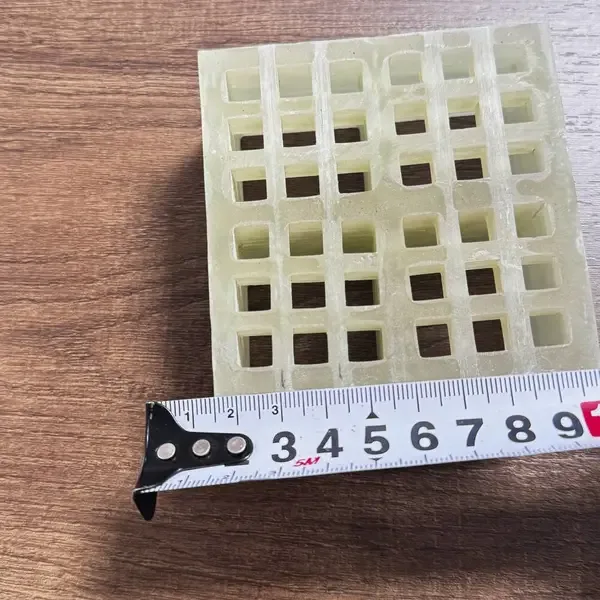
For replacement work, send top and underside photographs together with at least one section or edge photograph. Mark the load-bearing direction, support beams and the location from which each photograph was taken.
Where Covered Grating Usually Makes Sense
Covered grating is a serious candidate where a more continuous surface and a structural grating base are both needed. Examples can include:
- an industrial platform that must retain small tools while maintaining a defined base structure;
- a walkway where small wheels, narrow heels or dropped objects make an open mesh unsuitable;
- a tank-top or process platform where the grating structure already suits the support layout;
- a trench, pit or service opening that needs a continuous walking surface and planned access;
- a wash-down area where the surface must close while water is deliberately directed to outlets.
These are candidate conditions, not automatic approvals. The exact cover, base, connection, support and load case still have to be defined.
Set the Exposure, Compliance and Cleaning Gate Before a Cover Is Shortlisted
Construction and load are not the only reasons a product can fail selection. Two covered products with the same visible top may use different resin systems, surface constructions, edge treatments and fixing materials. Those differences matter when the installation has to resist chemicals, fire, weather, static electricity or a defined cleaning regime.
Wet, chemical and wash-down duty
List the actual medium, concentration, contact type and temperature rather than the plant type alone. “Wastewater” or “chemical area” does not identify a compatible resin. Cleaning can be equally important: state the cleaning agent, temperature, pressure, nozzle distance, brush type and frequency. A surface that looks clean after a gentle wash may wear or trap residue under a more aggressive routine.
The resin and cover construction must both be reviewed. A resistant resin does not make every cover interface, seal, fixing or grit binder suitable for the same exposure. Use the chemical resistance guide and resin selection guide to define the material review.
Fire, smoke and elevated temperature
A product called “fire retardant” is not enough when the project requires a tested fire class, smoke limit or structural fire performance. Record the test method, acceptance criterion, complete product construction and the document that demonstrates compliance. Heat also affects sustained load and deflection, so review temperature and creep separately.
Electrical, anti-static and accessibility requirements
Where static discharge, electrical isolation or a conductive system is relevant, state the required surface-resistance range, earthing method and test standard. For an accessible route, define the clear opening at the walking plane, joint limits, travel direction and any sphere or gauge check. A small mesh name does not itself demonstrate these properties. The FRP fire-rating guide and ADA opening review explain the evidence boundaries.
These environmental and compliance checks do not replace the structural review. They sit alongside it so that a product is not approved for the wrong service simply because its underside and thickness look correct.
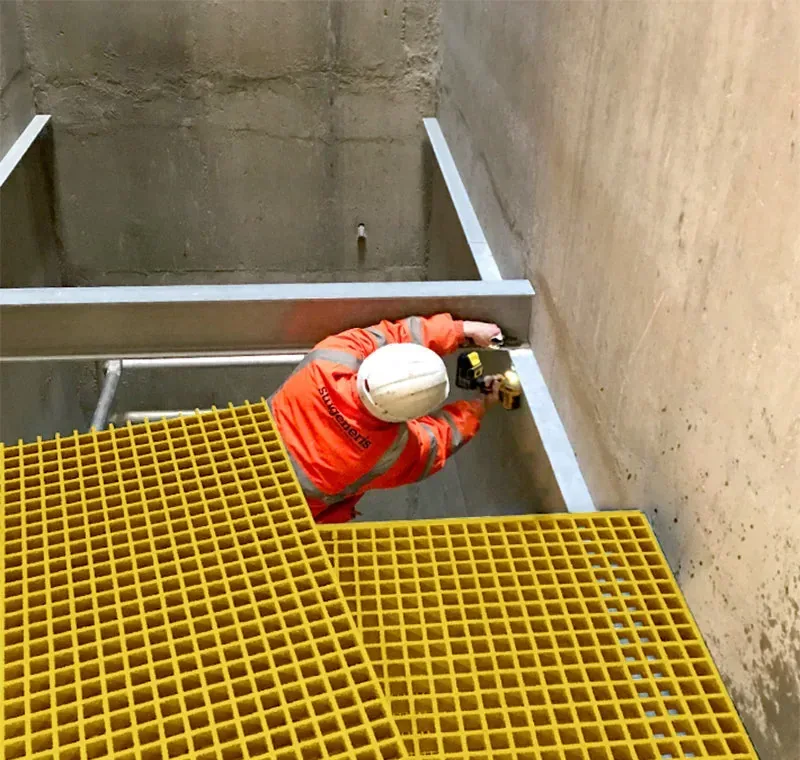
Where a Patterned Plate Is the Better Question
A one-piece patterned plate may be better when the plate can carry the load over the actual supports without a grating base. The decision should still use the same project fields: support spacing, load, deflection, fixing, drainage, edge condition and access.
A standalone plate is often easier to describe, but “solid plate” is not a structural grade. Two products with the same outside size can have different construction, thickness, stiffness and support requirements. The total assembly still matters.
The Factory Position on Covered Grating
Our factory works with patterned flat and grit flat moulds, and can review covered assemblies over moulded, mini-mesh or pultruded grating bases. The factory can cut pieces, create openings, finish edges and pack agreed finished items.
What we do not do is treat a mould, name or photograph as a standard covered product. The complete combination is checked and quoted from the order drawing. This is deliberate:
- the base structure changes with support and load;
- the cover format changes mass, surface and cleaning behaviour;
- the bond or fixing changes handling and load sharing;
- the total height affects frame clearance and transitions;
- the joints determine how the “solid” surface behaves as a complete floor;
- the evidence must match the finished assembly, not just one component.
For application-specific layouts, see the GRP flooring guide and the drain-cover guide. For the established chequered-top construction, use the FRP grating with chequered plate guide.
Why a Lower Unit Rate May Not Be a Lower Project Cost
A panel-only rate can exclude the work that makes a covered product usable. Compare these line items:
| Quoted item | Why it must be checked |
|---|---|
| Base product row | Moulded, mini-mesh or pultruded structure, depth or bar section, pitch and direction |
| Cover format | Pattern or grit, thickness, colour, surface and measurable appearance |
| Interface | Bond or mechanical fixing, preparation and inspection |
| Finished size | Source panel, cut list, piece area, orientation and quantity |
| Openings and edges | Interrupted bars, trim, sealing, support and identity |
| Fixings and lifting | Clip type, hardware, cover fixing and removable-piece handling |
| Surface drainage | Fall, outlet, joint and perimeter responsibility |
| Packing and transport | Piece protection, bundle or pallet, marks, gross weight and trade term |
| Documentation | Drawing revision, inspection record and applicable test or conformity document |
Two offers are only comparable when these items are either included or explicitly assigned to someone else.
What We Need in Order to Quote the Right Construction
Start with a photograph and a short purpose statement. The most useful first message is:
“The top must be closed. The existing support is one direction, 1.2 m clear span, pedestrian and maintenance-trolley traffic. Water reaches the end outlet. Send the base, cover and total-height proposal with the load basis.”
It is perfectly acceptable to include unknowns. Mark them as unknowns rather than guessing. A decision record with clear gaps is safer than a complete-looking set of invented dimensions.
Final Rule: Name the Whole Item
The safest quotation language names the complete construction rather than a single word:
Open moulded grating: 38 × 38 mm, 30 mm depth, finished size and fixing.
Covered grating: specified grating base, specified patterned or grit cover, defined interface, overall height, joints, edge treatment and fixing.
Patterned FRP plate: one-piece plate, specified thickness and pattern, supported and fixed on the defined frame.
That level of description lets a buyer compare the same physical product. It also exposes any offer that is relying on a photograph, a familiar term or a competitor’s claim instead of a defined assembly.
Factory position
What Our Factory Can Confirm and What Must Be Defined
The product family is clear; the complete finished assembly remains project-specific.
Swipe horizontally to view all columns.
| What our factory can review | Confirmed starting point | What remains project-specific |
|---|---|---|
| Open grating base | Moulded, mini-mesh and pultruded structures are in the product range | Exact panel row, dimensions, support, load and finished pieces |
| Patterned or grit flat moulds | Patterned flat and grit flat formats are confirmed as moulds the factory works with | The plate format, thickness, pattern, surface and fit for the intended assembly |
| Covered assembly | Assemblies are reviewed and quoted from the order drawing | Base plus cover combination, connection method, joints, height and drainage |
| Cutting and openings | Panels can be supplied cut to finished sizes where agreed | Cut list, opening positions, interrupted bars, edge treatment and piece identity |
| Fixings | M, L and C clips are the established base-panel fixing family | Clip fit, cover-specific fixing, lifting arrangement and corrosion exposure |
| Documentation | Appearance check, certificate of conformity and applicable product reports are part of the order discussion | The document must identify the supplied configuration and test or inspection scope |
Request a construction review
Show Us the Top, Underside and Edge
A short section drawing or three photographs is often more useful than a product name.
- Molded and pultruded grating produced in house
- Full panels or factory cut-to-size pieces
- No fixed minimum order quantity
Covered Grating vs FRP Chequered Plate Questions
Is FRP chequered plate the same as covered grating?
Can I tell the difference from a product photograph?
Does a covered top make the panel watertight?
Is covered grating stronger than open grating?
Can a loose patterned plate be laid over existing grating?
When should I choose open or mini-mesh grating instead?
This content was prepared and reviewed by Dengtai Industry’s technical and production team using the project conditions, available product data and applicable documents. Limits that require design, testing or approval are identified in the content. Content last checked: