Construction comparison
Milled-Flat and Covered FRP Grating: Different Constructions
A milled-flat panel keeps its open mesh and machines the bar tops. A covered grating adds a continuous surface over a base panel. Both may look flat from above, but their section, drainage, mass, joints and load evidence are different.
Prepared by
Dengtai Industry
Published
·
Reviewed

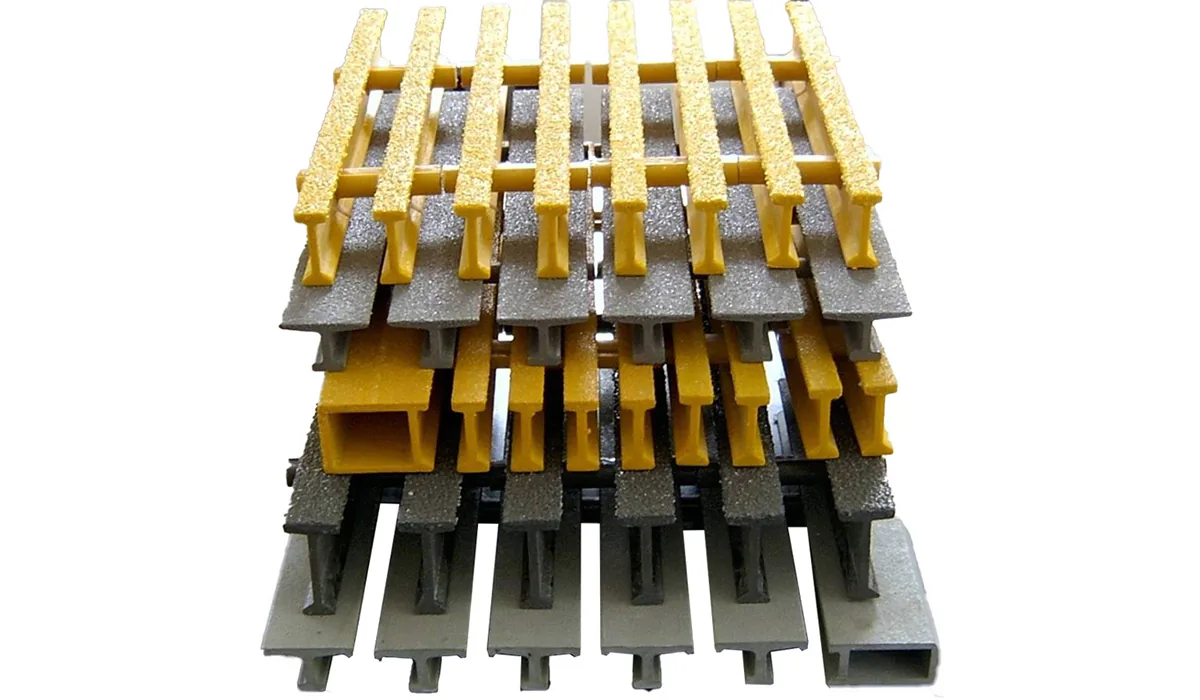
The visible top does not show whether the product is a machined open panel or a base with a cover. Ask for the section. Photo: Dengtai Industry.
Definitions
Milled-Flat and Covered FRP Grating Terms
Separate the top process, the open or closed construction and the evidence that belongs to each.
- Milled-flat grating
- An open grating whose cured bar tops are machined to create a flatter walking surface. The openings remain, and the starting panel, removed material, finished section and edge treatment are part of the product definition.
- Covered grating
- A base grating with a continuous cover layer bonded or fixed over it. The base, cover, interface, total height, joints, drainage and fixing arrangement form the assembly.
- Cover layer
- The solid or textured layer that closes the upper openings. Its material, thickness, pattern and attachment should not be inferred from a photograph.
- Overall height
- The finished vertical dimension from the lowest relevant datum of the assembly to the walking surface. It is not the base-panel depth alone.
- Assembly load basis
- The support, span, load path, cover-to-base connection, joints and deflection condition represented by the structural evidence or calculation.
- Structural or non-structural cover
- A cover is structural only when the tested or calculated basis includes composite action and a credible shear path through the attachment. Otherwise it is treated as a separate protective or walking layer, with its mass and fixing requirements stated.
- Drainage path
- The route water follows after it reaches the walking surface. Open mesh drains through the cells; a covered product needs a fall, joint, edge opening, outlet or other defined path.
When to use each
Choose Milled-Flat or Covered Grating From the Function
Start with what the surface has to do, then compare the section and complete supply scope.
Specify this if…
- The main need is a flatter top for trolleys or cleaning while the mesh remains open.
- Small items, heels or wheels require a continuous surface rather than smaller openings.
- An existing open panel is being considered for machining, and the remaining section can be verified.
- A covered base-and-cover assembly is proposed and its drainage, joints, fixing and load basis can be defined.
Look elsewhere if…
- “Flat” is being used without stating whether the mesh remains open.
- A covered product is described as watertight without a joint and edge sealing design.
- An open-panel load table is being used as the covered assembly rating without review.
- Machining or adding a cover has not been checked against finished height, remaining section and support.
Construction matrix
Milled-Flat vs Covered FRP Grating Compared
The most important difference is not appearance; it is whether the open mesh remains.
| Decision | Milled-flat open grating | Covered grating | What to confirm |
|---|---|---|---|
| Top surface | Machined flat bar tops; original molded profile removed | Continuous cover or plate over a base grating | Surface texture and sampling method |
| Openings | Open mesh remains | Upper openings are closed by the cover | What must pass through and what must be retained |
| Drainage | Water can pass through cells; it sits differently on flat bar tops | Water needs a fall and a defined joint, edge or outlet path | Drain locations, slope, standing water and cleaning |
| Mass | Reduced slightly by machining, within the agreed process | Base plus cover and connection | Total mass per area and lifting weight |
| Load basis | Remaining bar section and configuration must match the supporting data | Complete base, interface, cover, joints and support must match the evidence | Span, load type, deflection and test or calculation |
| Edges and joints | Machined edge, exposed fiber and sealing | Cover termination, joints, edge trim and panel-to-panel continuity | Factory or site fabrication and inspection |
Specification
What a Milled or Covered Grating Order Must Define
Six order fields that keep the base, top, finished height and evidence connected.
| Order field | Required record | Why it changes the product |
|---|---|---|
| Base construction | Molded, pultruded or mini mesh; panel thickness, mesh or bar profile | The base load path and available cover interface depend on it |
| Top process | Milled from a named starting panel or covered with a named layer | Two products can look flat while having different sections |
| Finished section | Remaining bar top, cover thickness, interface, total height and mass | The installed level and structural evidence need these values |
| Drainage | Open cells retained or cover with falls, joints, edges and outlets | Covered grating does not automatically drain or contain liquid |
| Fixing and lifting | Standard clips plus cover-specific restraint, trim or removable pieces | The assembly may need a different handling and maintenance plan |
| Evidence | Open-panel data, machined-section data or complete assembly data as named | A document only supports the product and conditions it identifies |
Selection sequence
How to Choose Between Milled-Flat and Covered Grating
Six steps from the operational need to a controlled construction drawing.
Separate trolley contact, cleaning, small-object retention, drainage and appearance instead of using one adjective for all five.
Decide whether the openings remain part of the solution or have to be closed by a cover.
Identify the starting panel, remaining bar or cover build-up, interface, overall height, mass and edge datum.
Show how water, cleaning agents and debris leave an open panel or a covered area.
Tie the span, support, load type, joints and deflection evidence to the complete construction.
Record cutting, sealing, cover attachment, edge trim, panel handling and the checks performed before packing.
The Short Answer: Look Below the Walking Surface
Milled-flat grating and covered grating can both look flat, but they are different products. A milled-flat panel starts as an open grating and removes material from the bar tops. The openings remain. A covered grating puts a continuous layer over a base panel. The upper surface is closed, and the cover, interface, joints and edges become part of the supplied assembly.
That difference is easy to lose in a short RFQ such as “flat FRP grating.” It affects what falls through, how water drains, how much the product weighs, how pieces are fixed, how the load reaches the supports and what evidence is needed. This guide is the construction check that belongs between the surface list and the product quotation.
Prepared by Dengtai Industry for buyers comparing our open molded or pultruded grating with covered configurations.

Milled-Flat Grating: A Machining Operation on an Open Panel
Milling removes the original convex, concave or other molded profile from the top of the bars. The aim is usually a predictable contact line for trolleys, trays, cleaning equipment or a specific architectural appearance. Depending on the starting product, the operation may also remove part of the resin-rich surface and expose reinforcement if the depth is not controlled.
The product description therefore needs more than “milled.” It needs:
- the starting panel, thickness, mesh or bar profile;
- the amount of material removed and the remaining top condition;
- the finished tolerance and edge treatment;
- whether any seal or protective finish is required;
- how exposed fiber and surface defects are inspected; and
- which test or product data corresponds to the finished section.
The open cells remain a functional feature. Water can pass through the mesh, ventilation is maintained within the openings, and debris that reaches a cell can fall through. However, water may sit differently on the flat top, and the reduced texture can change the wet grip. If the walking condition is oily, sloped or frequently washed, compare the milled surface with a grit format before deciding that “flat” also means “safer.”
Our surface and treatment guide treats milling as a separate top process. The cutting and sealing guide explains why a newly exposed edge or machined area should not be treated as a cosmetic issue.
Covered Grating: A Complete Base-and-Cover Assembly
Covered grating starts with a base panel and adds a cover layer. The cover may be bonded, fixed or otherwise attached according to the assembly drawing. It can provide a continuous walking surface, reduce the ability of small objects to fall through, support a smoother cleaning route or create a defined appearance.
The cover does not replace the base. The complete product includes:
- base construction and section;
- cover material, thickness and texture;
- preparation and attachment at the interface;
- panel joints and perimeter termination;
- overall height and mass;
- drainage and cleaning path;
- fixing and lifting arrangement; and
- the load and deflection evidence for the assembly.
The covered FRP grating page explains the difference between a base-plus-cover product, a patterned flat plate and an independent solid panel. This page stays on the narrower comparison: a milled open panel versus a covered assembly.
Why the Load Table Cannot Simply Move From One Product to the Other
For a milled panel, the removed material changes the top of the structural bars. Even if the base is only slightly machined, the finished section should match the section represented by the design or reference data. The edge condition and the effect on the resin-rich layer also matter.
For a covered assembly, the load enters the cover, passes through the interface into the base and then reaches the supports. The cover thickness, bond or fixing, panel joints, support layout and load contact may all change the governing behavior. A base-panel table does not describe the complete assembly unless the evidence explicitly extends to that construction.
A cover should not be assumed to add stiffness merely because it is present. It can contribute to out-of-plane stiffness only when the attachment, preparation and panel joints provide a credible shear path and the calculation or test treats the base and cover as a composite assembly. If the connection is intermittent, flexible, removable or untested, the safer model is a separate cover carried by the base, with its mass and local contact effects included. The structural role should be stated explicitly as composite, non-composite or not established.
The covered grating load capacity guide sets out the complete evidence path. The thickness and height guide shows why the base depth, interface, cover and pattern should be dimensioned separately. The joint and drainage guide addresses the parts that a top-only photograph cannot show.
Drainage: Open Cells, Falls and Edge Details
Open and covered products deal with water in different ways. The open panel drains through the cells, but the bar-top profile still influences how water moves before it falls through. A milled bar can create a flatter surface where water spreads, while a concave profile can guide water along the bar.
A cover closes the cell area. Water reaching the surface must then get to a fall, a joint, an edge opening, a scupper, a gutter or another defined outlet. The cover itself does not create that route. This is why “closed surface” and “watertight” should not be used as synonyms. A covered field can be continuous while the panel joints and perimeter still allow water to move.
For an outdoor area, also consider debris, leaves, snow or wash-down solids. A cover may be easier to sweep, but it also gives material a place to accumulate. Cleaning is part of the selection, not a later maintenance afterthought.
What Changes Below the Deck
The comparison does not stop at the top surface. A milled panel keeps the cells open, so air can circulate through the deck and light or visual access to the space below remains possible. That can matter around hot equipment, service voids, tanks, cable routes and structures that need inspection from above. In cold or wet conditions, open cells also give ice, debris and spilled liquid somewhere to leave, although the bar tops and local drainage detail still affect how readily that happens.
A continuous cover interrupts those paths. That can be an advantage when the requirement is to stop small parts, spray, dust or process liquid reaching the space below, reduce visible contamination, control odour movement from a tank or protect equipment beneath the walking route. It can also be a disadvantage when airflow, ventilation, daylight, cooling or visual inspection through the mesh is part of the function.
For a covered assembly, record the reason for closing the surface and what has to remain possible below it:
- ventilation or heat release;
- light transmission for plants, water or inspection;
- visual checks of pipes, valves, cables or tank surfaces;
- drainage of rain, wash water or firewater;
- access for maintenance from above; and
- prevention of debris, spray, odour or contamination passing through.
The covered grating and joint and drainage guides carry these assembly details further. A “solid top” is therefore not automatically the premium choice: it is an architectural and operational decision that trades through-drainage and below-deck exposure for a continuous working surface.
Wheel Contact, Small Items and Cleaning
A milled panel is often considered for wheeled traffic because the bar tops form a flatter contact line while the openings remain. Small wheels, casters, chair legs and trolley plates can still catch in or cross over the cells, so the actual wheel geometry matters.
A covered assembly gives a continuous top and may suit small-item retention or a smoother cleaning route, but the working surface is now a second structural layer with joints. Check whether the cover is bonded, removable or mechanically fixed; how its edges terminate; and how a damaged cover is repaired.
Neither product is automatically the better cleaning surface. The milled panel has open cells that can pass debris, but its flat bar tops may hold a water film. The covered panel avoids through-holes, but it can show standing water and requires joint cleaning. The mini-mesh versus covered guide is useful when the real question is “what must not fall through?” rather than “what looks flatter?”
Fixing, Lifting and Reproduction
The base panel is normally held to its support with a compatible clip or fixing arrangement. A covered assembly adds another question: how does the cover stay with the base when the piece is lifted, and how is the complete piece secured at its edges?
On a milled panel, the fixing detail may intersect a machined area or a cut edge. On a covered panel, the cover may need edge trim, an interlock or a removable detail so it does not trap water or prevent maintenance. If the grating is frequently lifted, identify the lifting points, maximum piece weight and whether the cover remains attached during handling. These details should appear in the assembly drawing, not be improvised on site.
A Practical Selection Route
Start by writing down what the word “flat” is expected to achieve:
| Requirement | Milled open grating | Covered grating assembly |
|---|---|---|
| Trolley or tray contact over an open mesh | Candidate after remaining-section review | Candidate when a continuous contact is desired |
| Small items must not fall through | Does not solve the opening | Candidate if the cover and joints are suitable |
| Water should pass through the panel | Preserves the open cells | Requires a separate drainage design |
| Easier squeegee cleaning | Flatter bar tops remain separated | Continuous field, but joints need attention |
| Use an existing open panel as the starting point | Machining review may be possible | Cover attachment must be designed |
| Known load table for the base panel | Must match the machined section | Does not automatically cover the assembly |
The table is a shortlist, not an approval. For each row, confirm the finished section, load path, support, edge, drainage and evidence.
Factory Scope: What We Confirm and What Must Be Drawn
The factory can review a milled top or a covered configuration only when the starting panel, finish and order scope are identifiable. For covered formats, the patterned and grit flat molds are confirmed as formats the factory works with, and base panels can include molded, mini mesh or pultruded structures. The combination is still reviewed against the order drawing.
That distinction is important. A confirmed format is not an automatic approval of every base-and-cover assembly. The factory’s regular appearance inspection can check flatness, surface defects and agreed workmanship; it does not turn an open-panel load table into a covered-assembly load test. If the order needs dimensional inspection, a sample approval, a load calculation or a third-party report, that requirement must be stated before production.
We avoid two common selling shortcuts: saying a cover makes the panel stronger, and saying a milled top makes it universally easier to clean. Both statements depend on the geometry, construction and service condition. A complete drawing and evidence scope are more useful than either claim.
What to Put in the RFQ
Send the following with the enquiry:
- Whether the open cells must remain or the surface must be closed;
- base product type, thickness or bar section, mesh and resin;
- milled depth and remaining section, or cover material, thickness and texture;
- overall height, mass and the dimension datum;
- slope, drainage, edge outlets, joints and cleaning method;
- support layout, clear span, load type and deflection limit;
- fixing, lifting and removable pieces;
- cut list, edge sealing and fabrication responsibility;
- sample, inspection, test or calculation required; and
- the approved construction drawing that will govern production.
If the project has only a photograph of a flat-looking grating, say that the section is not yet known. The next useful step is to establish whether the openings remain.
Technical Sources and Their Scope
This comparison is informed by published manufacturer guidance:
- Strongwell’s selection guidance separates design criteria, constraints, resin, span and appearance.
- FiberrStore’s surface-option documentation describes concave, gritted, sanded, covered and cover-texture formats as different production options.
- Fibergrate’s open-versus-covered comparison highlights ventilation, light, below-deck exposure, drainage and possible stiffness differences; its product-specific stiffness figure is not transferred to our assembly.
- Bedford’s grating selection guide links surface selection to load, span, working conditions and product construction.
Those sources describe their own products and formats. They do not establish the section, drainage, fixing or load evidence for a Dengtai order.
RFQ checklist
Milled-Flat vs Covered Grating RFQ Inputs
The details that prevent an open panel and a covered assembly from being quoted as if they were the same.
- Purpose — Trolley or wheel contact, easier cleaning, small-item retention, closed surface or another function.
- Base panel — Product type, thickness or bar section, mesh or bar spacing, resin and starting condition.
- Flat-top or cover build-up — Machining depth and remaining section, or cover material, thickness, texture and attachment.
- Finished dimensions — Overall height, mass per area, piece weight, tolerance and the datum used for measurement.
- Drainage and cleaning — Slope, openings, edge outlets, joints, cleaning method and standing-water expectation.
- Support and load — Span, supports, load type and value, deflection limit and the evidence required.
- Fixing and lifting — Clips, cover restraint, removable sections, lifting points and maintenance access.
- Cut edges and joints — Edge sealing, cover termination, panel joints and who performs each operation.
- Sample and inspection — Reference sample, surface texture, cover interface, dimensional check and document scope.
- Supply terms — Quantity, destination, packing, replacement pieces and the approved construction drawing.
What to verify
Four Boundaries for Milled and Covered Grating
Keep the finished geometry, water path and structural evidence tied to the actual construction.

A flat top is not a closed top
Machining changes the bar profile while the cells remain open.
A closed top is not automatically watertight
Joints and edges need a separate sealing and drainage design.
More mass is not more capacity
The base-panel load table does not become an assembly rating by adding a cover.
Stiffness contribution needs a load path
A cover participates structurally only when the attachment and joints provide the assumed shear transfer in the tested or calculated assembly.
The evidence follows the section
Record the tested or calculated base, cover, interface, joints, supports and span.
Request a review
Send the Base, Top and Drainage Details
A sketch of the section is often the fastest way to show what the finished product has to become.
- Attach the section or cross-section if available
- State whether the openings must remain
- Show where water has to go
Milled-Flat and Covered FRP Grating Questions
Is milled-flat grating the same as covered grating?
Does milling make grating stronger?
Is covered grating watertight?
Can I use the base panel’s load table for a covered assembly?
Which option suits trolleys?
Can covered grating drain through the panel?
Does a cover make the grating stiffer?
What changes below covered grating?
This content was prepared and reviewed by Dengtai Industry’s technical and production team using the project conditions, available product data and applicable documents. Limits that require design, testing or approval are identified in the content. Content last checked: