Resin name resolution
Epoxy and Epoxy Vinyl Ester in FRP Grating Specifications
Epoxy, vinyl ester and epoxy-based vinyl ester are not interchangeable order descriptions. Resolve the wording in the drawing or RFQ, then connect the named grade to the finished grating and the evidence being offered.
Prepared by
Dengtai Industry
Published
·
Reviewed

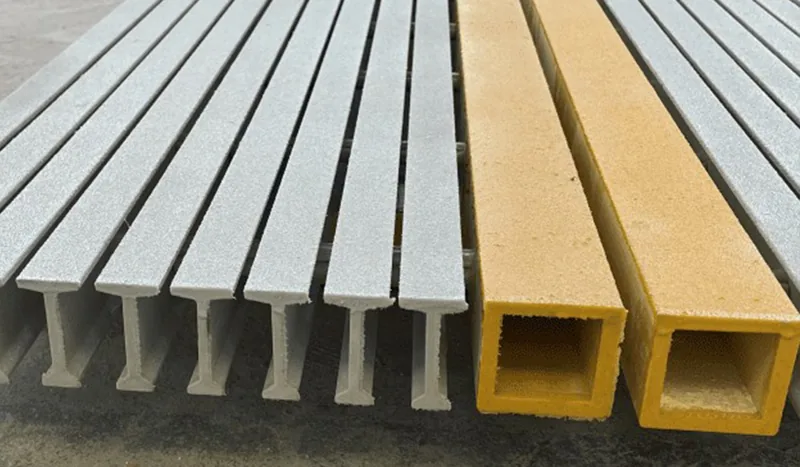
Pultruded grating samples from our range. The order must identify the resin grade, bar section, surface and evidence. Photo: Dengtai Industry.
Definitions
Epoxy and Vinyl Ester Names in FRP Grating
Five chemistry and order terms that stop an ambiguous resin label from becoming a purchase assumption.
- Epoxy resin
- A thermosetting resin system in its own right. In an FRP grating review, epoxy should be named as a distinct family with a grade and finished-product configuration, not inferred from the phrase epoxy-based vinyl ester.
- Vinyl ester resin
- A thermosetting resin family commonly selected for demanding composite service. Its chemistry, named grade, formulation, cure and evidence control what can be stated for the finished grating.
- Epoxy-based vinyl ester
- A vinyl ester grade made using an epoxy or bisphenol A epoxy backbone. It is a useful chemical description, but the product remains a vinyl ester and still needs a grade and finished-product scope.
- Bisphenol A vinyl ester
- A vinyl ester description that identifies part of the resin chemistry. Bisphenol A is not a synonym for epoxy resin, and the phrase alone does not establish chemical compatibility.
- Resin grade
- The named commercial or internal product within a resin family. Two vinyl ester grades can differ in viscosity, reactivity, chemical data, cure and recommended processing.
- Finished-product configuration
- The molded or pultruded grating construction, thickness or bar profile, reinforcement, surface, cure, cut edges and fixings that a proposed resin is part of.
- Substitution
- A proposed change from the resin, grade or product basis named in the specification. It needs a technical review and the approval route required by the buyer or specifier.
When to review
When Epoxy and Vinyl Ester Wording Needs Resolution
Use the name-resolution process whenever the project or quotation depends on a specific resin family, grade or approval.
Specify this if…
- A drawing, data sheet or RFQ uses epoxy, vinyl ester, epoxy vinyl ester or a named grade.
- Two quotations use different words for the resin and need comparison on one basis.
- A supplier proposes a substitute or “equivalent” resin grade.
- The project ties corrosion, fire, temperature or mechanical performance to a named resin.
- The finished grating construction or evidence scope may differ from the wording in the specification.
Look elsewhere if…
- “Epoxy” is being used as a general quality rank without a resin grade.
- An epoxy-based vinyl ester is being treated automatically as a separate epoxy system.
- A resin supplier’s data sheet is being applied to an unidentified finished grating.
- A proposed substitution is being accepted because the family name matches.
Wording map
Resolve Common Epoxy and Vinyl Ester Phrases
Keep the original wording visible while identifying the chemistry, grade and finished product it actually refers to.
| Wording found in a document | What it may describe | What the order still needs |
|---|---|---|
| “Epoxy resin” | A separate epoxy system, or an imprecise reference to a vinyl ester made with an epoxy backbone | Full chemistry, named grade, finished product and approval of the intended meaning |
| “Epoxy vinyl ester” | A vinyl ester resin description, often based on an epoxy or bisphenol A epoxy backbone | The exact grade and supplier description; the word epoxy does not make it a separate epoxy system |
| “Bisphenol A vinyl ester” | A vinyl ester chemistry descriptor | Named grade, formulation, process, finished grating and project exposure |
| Resin supplier grade code | One resin product from a particular supplier | Availability in our product, proposed substitution and evidence covering the application |
| “Epoxy coated” or “epoxy adhesive” | A coating or joining material, not necessarily the resin matrix | Which component uses it, its grade and how it affects the finished assembly |
| “Equivalent resin” | A proposed technical comparison with no defined basis by itself | Original wording, proposed grade, differences and documented acceptance |
Verification
What an Epoxy or Vinyl Ester Grating Claim Must Identify
A usable claim connects the resin grade to the product, exposure and evidence scope.
| Check | Evidence that helps | Limit to record |
|---|---|---|
| Resin family and chemistry | Supplier technical description and named grade | A family word does not establish performance by itself |
| Product configuration | Drawing, model, section, thickness, reinforcement and surface | A resin data sheet does not describe our finished grating |
| Processing and cure | The grade’s stated process, recommended cure and production record where applicable | Similar viscosity or reactivity does not prove finished-product equivalence |
| Chemical exposure | Medium, concentration, temperature, contact and evidence for the relevant product | Plant name or generic “chemical resistant” wording is insufficient |
| Performance evidence | Test report or technical statement identifying the tested grade and configuration | Supplier data for another manufacturer or construction is not automatically our approval |
| Commercial scope | Agreed description in quotation, order, drawing and packing list | An email phrase alone is weak order control |
Review sequence
How to Resolve the Resin Name Before Ordering
Six steps from the original specification phrase to controlled order language.
Copy the phrase or grade exactly as it appears in the project specification, data sheet or drawing before interpreting it.
Decide whether the wording identifies a separate epoxy system, a vinyl ester, an epoxy-based vinyl ester or an unidentified grade.
Tie the resin to the molded or pultruded construction, section, reinforcement, surface and cut-edge scope.
Check the actual medium, concentration, temperature, contact mode and cleaning against the proposed grade and evidence.
If the offer differs from the project wording, state the difference and obtain approval before production.
Use the same resin family, grade and finished-product wording in the quotation, approval drawing, order and inspection record.
Why “Epoxy vs Vinyl Ester” Is Not a Simple Product Choice
The phrase epoxy vs vinyl ester FRP grating appears in buyer searches, but the answer cannot stop at a generic ranking. The words can describe different resin families, an epoxy-based vinyl ester chemistry, a grade code, or even an epoxy coating or adhesive used in an assembly. Those possibilities do not have the same technical meaning, price, process or evidence requirement.
Scope note: this is about the resin matrix in factory-made grating.
It is not a boatbuilding laminating-resin comparison, a wood-bonding test or a recommendation for a general-purpose repair adhesive. Those applications can use the same broad resin vocabulary while asking for different properties and evidence.
This guide is a name-resolution check for project specifications, quotations and orders. It does not replace the wider FRP grating resin selection guide or the product-specific chemical resistance review. It answers a narrower question: what did the specification actually mean, what grade and product are being offered, and how should the order preserve that meaning?
When the broader document also uses a generic polyester label, use the polyester resin-type map to retain the original wording and the offered chemistry as separate fields.
Prepared by Dengtai Industry for buyers checking our molded and pultruded grating supply.

Epoxy-Based Vinyl Ester: The Source of the Confusion
Vinyl ester resins can be made using an epoxy or bisphenol A epoxy backbone. Scott Bader, for example, describes its Crystic VE671 grade as a bisphenol A epoxy-based vinyl ester intended for demanding corrosion resistance and high-performance pultrusion. That wording is technically useful: it tells the reader something about the chemistry. It does not mean the grade belongs to the separate epoxy resin family.
This distinction affects how the order should be written. “Epoxy-based vinyl ester,” “epoxy vinyl ester” and “bisphenol A vinyl ester” may all describe a vinyl ester product. “Epoxy resin” can refer to a different resin system with its own cure chemistry, processing profile and data. A supplier can offer either one, but neither label should be translated into the other by a shortcut.
That is also why we avoid treating epoxy as a premium rank above vinyl ester. Epoxy may be a candidate for some high-corrosion pultruded work in our range. Vinyl ester is commonly used for demanding chemical, wastewater and marine duties. The actual grade, finished grating and evidence decide which choice is defensible.
What We Mean by “Epoxy Grating” in a Quotation
When a drawing says “epoxy grating,” ask which of these statements is intended:
| Possible meaning | How it should be resolved |
|---|---|
| A separate epoxy resin matrix in the grating | State the epoxy grade, the molded or pultruded construction and the supporting product data |
| A vinyl ester made with an epoxy-based backbone | Use the full vinyl ester grade description and the relevant vinyl ester evidence |
| An epoxy coating on a different resin substrate | Identify the substrate, coating grade, film, repair method and exposed surface |
| Epoxy adhesive used to join a cover or other component | Identify the adhesive grade and joint design as part of the assembly |
| A generic shorthand for “chemical-resistant” | Ask for the named resin chemistry and the actual performance requirement |
The same rule applies to quotations. A line item that says only “epoxy resin grating” is not sufficiently specific to compare with a vinyl ester offer. The buyer needs the resin family, named grade, product construction, surface and evidence destination. If the resin family is the only thing being compared, the offers are not yet on the same basis.
Family, Grade, Formulation and Finished Product
Four layers have to stay visible through the review:
- Family: epoxy, vinyl ester, polyester or phenolic.
- Grade and formulation: the named resin product and the production system used with it.
- Finished grating: molded or pultruded panel, bearing-bar or mesh geometry, reinforcement, surface, colour and edge treatment.
- Evidence: what the document tested or assessed, and what remains outside that scope.
Two vinyl ester grades are not equivalent simply because the family matches. Their viscosity, reactivity, thermal behavior, recommended processing, chemical data and availability can differ. Likewise, one grade’s corrosion table is not automatically a statement about a different finished panel with another reinforcement or cure. This is why the resin-name review belongs in the technical query, not only in a purchasing email.
For pultruded grating, the pultruded resin option guide links the chemical family to the I, T or WT section and the finished-product evidence. For a molded panel, use the molded-grating resin specification guide to keep the resin with panel thickness, mesh, support and load.
Our Factory View: Separate the Choices Instead of Ranking the Words
Our starting directions come from the requirements we routinely review, not from a universal material league table:
- For ordinary construction access and tree surrounds, unsaturated polyester is often the starting direction.
- For wastewater and marine duties, vinyl ester is commonly the first direction we review.
- For some pultruded high-corrosion applications, we also consider epoxy.
- Where fire and smoke requirements govern, phenolic is reviewed separately.
None of those statements turns a family name into a product approval. If the project specifies a named grade, we keep that wording in front of the buyer and identify any proposed alternative explicitly. If the project uses only a broad chemical description, we ask for the medium, concentration, temperature, contact type, cleaning method and finished configuration before calling the resin suitable.

This is where a manufacturer can add more value than a catalogue table. A useful supplier should be able to say, “Your wording may mean A or B; these are the questions needed to distinguish them; this is what the proposed product actually is; and this is the evidence that does or does not cover it.”
How to Compare an Epoxy Offer With a Vinyl Ester Offer
Do not compare by resin price alone. Put the two offers on the same page:
| Comparison item | Epoxy offer | Vinyl ester offer |
|---|---|---|
| Family and chemistry | Confirmed epoxy system and named grade | Confirmed vinyl ester grade and chemistry |
| Product construction | Same section, thickness, mesh or bar profile? | Same section, thickness, mesh or bar profile? |
| Surface and edges | Same grit, cover, seal and repairs? | Same grit, cover, seal and repairs? |
| Exposure basis | Same medium, temperature, contact and cleaning? | Same medium, temperature, contact and cleaning? |
| Evidence | Resin, laminate, sample or finished product? | Resin, laminate, sample or finished product? |
| Substitution | What changes from the project wording? | What changes from the project wording? |
If one offer uses a resin data sheet while the other uses a finished-product report, the documents answer different questions. If one quotation excludes cut-edge sealing or surface treatment, the apparent price difference is not a resin-only difference. The technical comparison and the commercial scope have to be aligned.
What to Check in a Technical Data Sheet
A resin data sheet is valuable, but it is not a finished-grating certificate. Look for the named grade, chemistry description, intended process, cure conditions, mechanical properties, thermal information and any chemical-resistance guidance. Check the date and revision. Then ask which of those results apply to the offered product and which are material-level information only.
For chemical service, a supplier table may describe a resin coupon in a listed medium. That does not automatically cover a molded panel with a different glass content, a pultruded bar made on another line, a bonded grit surface or a cut edge. The vinyl ester exposure schedule shows how to record the missing project conditions. The quality and documentation guide separates a mill certificate, a sample report and a finished-product inspection.
Keep a simple evidence line in the order:
Resin family and grade: [exact description]. Finished product: [panel or bar, section, surface, edge]. Evidence offered: [document type, reference and scope]. Remaining assumptions: [explicit gaps].
That line is more useful than a sentence claiming that one resin is “better” than another.
Color and markings are not cross-manufacturer resin identifiers. Some producers use an internal visual code—for example, Strongwell says its cross rods use different colors for polyester and vinyl ester—but another factory can use different colors or the same color for different systems. A color reference is useful only with that supplier’s legend and the named grade. Do not accept a resin substitution because the delivered bars “look like” the approved sample.
Where an Epoxy Coating or Adhesive Fits
Not every use of the word epoxy refers to the matrix resin. A covered grating assembly may use an epoxy adhesive to join the cover to the base, or a coating may be applied to a finished surface. Those are legitimate construction choices, but they are separate components.
If a project says “epoxy bonded,” ask:
- Which surfaces are bonded?
- What is the adhesive grade and cure?
- Is the bond continuous, and how is it inspected?
- Is the bond exposed to the same chemicals and temperatures as the grating?
- Can the cover be repaired or removed?
- Which document covers the bond, and which covers the base resin?
These questions belong in the covered grating review. A good resin choice in the base does not automatically prove the adhesive joint, and a good adhesive does not turn the base into an epoxy grating.
Common Specification Phrases and What to Do Next
| Phrase in the project | First question to ask | Record in the order |
|---|---|---|
| “Epoxy resin grating” | Separate epoxy system or epoxy-based vinyl ester? | Exact family, grade, product configuration and evidence |
| “Epoxy vinyl ester grating” | Which named vinyl ester grade and which finished product? | Full vinyl ester description, grade and scope |
| “Bisphenol A resin” | Is it a bisphenol A vinyl ester, epoxy or another system? | Chemistry, grade, process and chemical-duty evidence |
| “Resin supplier code only” | Is the code available for this construction and supported for the exposure? | Original code, proposed grade and substitution record |
| “Epoxy-coated grating” | Is this coating the walking surface, a repair layer or a protective system? | Substrate, coating, film build, test and repair method |
| “Equivalent to [named grade]” | What properties and product scope are being compared? | Side-by-side property, exposure and approval table |
If the phrase has more than one plausible meaning, do not approve the quotation on the basis of the family name. Send the wording back with a technical query and ask the supplier to identify the proposed material and document scope.
What We Need Before Quoting
Send the following information with the enquiry:
- The original resin wording and any grade code;
- Molded or pultruded product, panel dimensions, mesh or bar section, thickness and surface;
- The medium, concentration, temperature, contact type and cleaning method;
- The required fire, smoke, UV, electrical or other performance test;
- Whether a supplier data sheet, sample report, finished-product report or third-party approval is required;
- The name of the authority that can approve a substitution; and
- The quantity, destination, cut list and delivery scope.
If the exact grade is not yet known, that is acceptable. Mark it as unknown and allow the review to identify what needs to be resolved. The resin selection guide explains the broader exposure record; this page narrows the question to epoxy and vinyl ester terminology.
Technical Sources and Use of Their Information
The terminology in this guide is informed by manufacturer descriptions and technical selection content:
- Scott Bader’s Crystic VE671 product page describes an epoxy-based vinyl ester grade for corrosion-resistant pultrusion.
- Strongwell’s five selection tips separate resin selection from design criteria, constraints, span and appearance.
- Bedford’s resin-system guide shows how named grades and product lines can use different resin descriptions.
Those sources describe their own materials and systems. They do not identify the resin grade or approval for a Dengtai order, and their ratings are not transferred to our finished products.
RFQ fields
Epoxy vs Vinyl Ester FRP Grating RFQ Checklist
The inputs that let the factory and buyer compare the same resin and finished product.
- Original specification wording — Copy the resin phrase, grade code, standard and clause references exactly.
- Intended resin family — Epoxy system, vinyl ester, epoxy-based vinyl ester, polyester, phenolic or not yet resolved.
- Named grade and supplier — The proposed commercial grade, supplier, revision and technical data sheet.
- Finished grating — Molded or pultruded, section, thickness, mesh or bar spacing, surface, colour and cut-edge treatment.
- Exposure — Chemical names, concentration, temperature, contact type and cleaning conditions.
- Required evidence — Supplier data, resin sample, laminate test, finished-product report, certificate or project approval.
- Substitution route — The comparison report, technical query and authority that may approve a change.
- Order language — The exact wording to appear in the quotation, production drawing and release record.
Factory review
Keep the Resin Family, Grade and Product Together
The most expensive error is not a wrong word; it is an unrecorded assumption that the word proves more than it does.

Separate the family from the grade
Epoxy and vinyl ester are families; a supplier code identifies one grade within a family.
Keep epoxy-based vinyl ester on the vinyl ester side
The epoxy precursor explains part of the chemistry but does not make the cured resin a separate epoxy system.
Attach evidence to a product
State whether the document covers resin, laminate, sample or finished grating and identify the exact configuration.
Make substitution visible
A change in grade, product construction or evidence scope needs approval rather than a silent equivalent.
Request a review
Send the Resin Wording From Your Project
Include the exact phrase, grade, product and required evidence so the review starts from the real specification.
- Include the exact phrase used in the project
- Send the grade code and technical data if available
- Identify the evidence needed for approval
Epoxy and Vinyl Ester FRP Grating Questions
Is epoxy vinyl ester the same as epoxy resin?
Is bisphenol A vinyl ester an epoxy resin?
Which is better for FRP grating, epoxy or vinyl ester?
Does your factory offer both epoxy and vinyl ester grating?
Can a supplier substitute an epoxy-based vinyl ester for a specified epoxy?
What document should I send to get an accurate review?
This content was prepared and reviewed by Dengtai Industry’s technical and production team using the project conditions, available product data and applicable documents. Limits that require design, testing or approval are identified in the content. Content last checked: