Anti-slip covered grating
FRP Grating with Chequered Plate: Construction and Selection
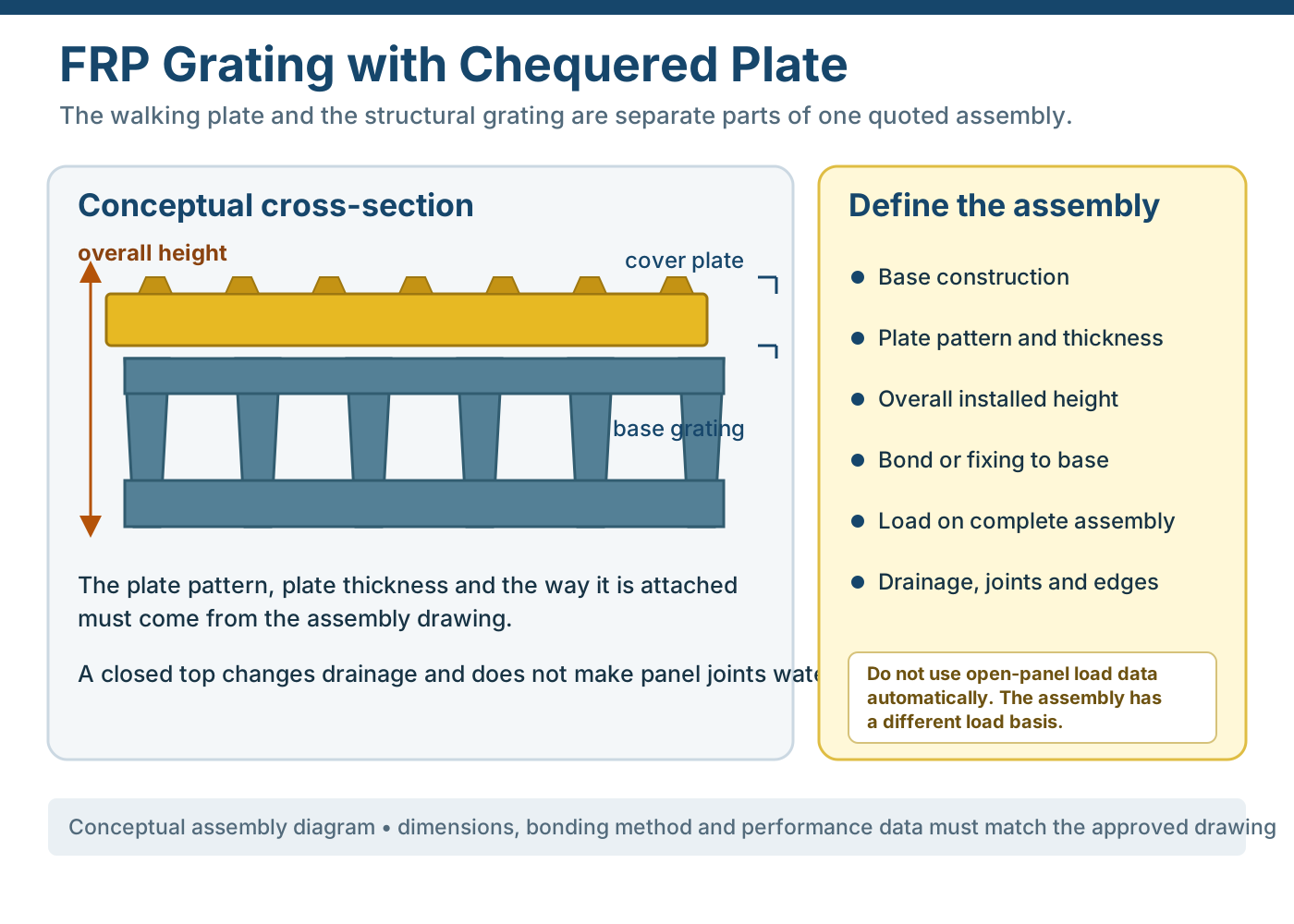
An FRP grating with chequered plate combines a structural grating base with a raised-pattern cover plate. It gives a more continuous, textured walking surface, but the plate pattern, total height, bond or fixing, load and drainage still have to be confirmed as one assembly. Our factory works with patterned and grit flat formats, quoted from the project drawing.

A chequered anti-slip top over an FRP grating base. The complete assembly is specified per project. Photo: Dengtai Industry.
Terms
What Is FRP Grating with Chequered Plate?
The product can mean a complete grating-and-cover assembly, a standalone plate or several different surface constructions. These definitions keep those meanings separate.
- FRP grating with chequered plate
- A walking assembly made from a rigid FRP grating base and a continuous top plate with a raised chequered pattern. It is not the same as an open mesh panel, a loose sheet placed over an existing grating, or a plain solid FRP plate.
- Chequered or checker plate
- A plate with a repeated raised pattern intended to provide a textured walking surface. “Chequered” is common in UK English and some export markets; “checker” or “checkered” is commonly used in US English. The pattern shape and raised height should be confirmed on the drawing.
- Base grating
- The structural molded, mini mesh or pultruded panel beneath the cover. Its thickness or bearing-bar section, bar direction and support layout establish how the assembly reaches the structure.
- Cover plate
- The continuous top layer that changes the walking surface. Its material, thickness, pattern and connection to the base are separate specification fields.
- Overall thickness
- The total height of the complete assembly, including base, cover and any interface or fixing. A quoted base thickness is not the finished overall thickness.
- Grit plate
- A flat cover with an abrasive grit surface rather than a raised chequered pattern. It can provide a different texture and cleaning profile; neither grit nor chequered is automatically a slip class.
- Solid FRP plate
- A standalone composite plate that carries load through the plate itself. It may look similar from above but does not share the same construction or load basis as grating with a cover.
- Assembly load basis
- The structural evidence and acceptance conditions for the complete base-plus-cover product. An open grating's load table does not automatically apply after a plate has been added.
Suitability
When Should You Use FRP Grating with Chequered Plate?
A continuous anti-slip top can solve some walking, handling and dropped-object problems, but it is not a universal upgrade over open grating.
Specify this if…
- You need a more continuous walking surface while keeping a structural grating beneath it.
- Small dropped items, narrow heels or cart wheels need a surface less open than standard grating.
- The location needs a raised anti-slip pattern, and the actual project slip requirement can be stated.
- The base needs to be one of our molded, mini mesh or pultruded grating directions.
- You can provide a drawing showing finished sizes, openings, support, load and where water must go.
Look elsewhere if…
- You only need a standalone FRP sheet and do not need a grating base.
- Maximum open drainage and airflow are the primary requirements.
- The expectation is a watertight, airtight or sealed containment system.
- Only a slip-resistance claim is needed but no test method, condition or acceptance value can be stated.
- The chosen cover and base combination has no reviewed load basis for the required support, span and traffic.
Surface comparison
Open Mesh, Mini Mesh, Chequered Plate or Solid FRP Plate?
Compare the actual walking surface, drainage, dropped-object behavior and load basis rather than only the product name.
Swipe horizontally to view all columns.
| Decision point | Standard open mesh | Mini mesh | Grating with chequered plate | Solid FRP plate |
|---|---|---|---|---|
| Construction | Integral open molded grid | Fine upper grid over a wider lower grid | Grating base plus continuous patterned cover | Standalone solid composite plate |
| Walking surface | Open grating bars | Finer open upper grid | Continuous surface with raised anti-slip pattern | Continuous plate surface, pattern to be specified |
| Drainage | Water passes through the grid | Water passes through a smaller opening | Surface drainage at edges, joints or designed openings | Surface drainage and joint detail |
| Dropped objects | Limited by the opening | Improved retention but still open | Covered in the panel field; joints and openings remain | Covered where the plate remains continuous |
| Cart and wheel contact | Depends on wheel size and opening | Improved contact but not continuous | More continuous top; joints, fixing and wheel load to confirm | Continuous top; plate support and wheel load to confirm |
| Slip surface | Concave or grit top may be available | Concave or grit top may be available | Raised chequer pattern or other agreed plate surface | Pattern, grit or smooth surface to be specified |
| Load basis | Exact open panel and support condition | Exact double-layer panel and support | Complete base-plus-cover assembly | Exact plate construction and support |
| Main trade-off | Open drainage but larger fall paths | Finer openings but reduced drainage | Closed top requires drainage design and assembly data | No grating depth unless supports and plate are designed for it |
Selection matrix
Which Base Fits a Chequered Plate Grating Assembly?
The base structure follows support and load. The cover adds surface, height, connection and drainage questions.
Swipe horizontally to view all columns.
| Project requirement | Starting structure | What decides the result |
|---|---|---|
| Continuous top over a molded frame | Molded grating base plus patterned cover | Mold size, base depth, cover thickness, bond or fixing and assembly load data |
| Smaller dropped objects plus a draining core | Mini mesh base plus patterned cover | Whether the closed top makes the mini mesh redundant and where surface water drains |
| Long directional platform | Pultruded base plus cover | Bearing-bar direction, bar depth, pitch, cross rods and complete assembly support |
| Walkway with trolley or cart traffic | Covered grating with a specified top | Wheel load, contact width, joints, grip, plate support and deflection |
| Loading bay, ramp or crossing plate | Needs matched structural review | Vehicle or concentrated load, impact, slope, edge transfer and structural evidence |
| Washdown or wet process area | Covered grating with resin and surface review | Cleaning chemicals, fall direction, perimeter drainage, joints and slip criteria |
| Open airflow or rapid through-drainage | Return to open or mini mesh | A covered top may obstruct the primary requirement |
| Watertight containment | Separate sealed design | Chequered plate alone does not seal panel joints, edges or penetrations |
Configuration options
FRP Chequered Plate Pattern, Base and Fixing Options
Plate texture, base structure, connections, color and fabrication are separate configuration choices.
Raised chequer pattern
Diamond, square or other raised patterns may be considered. The exact pattern, plate thickness and raised height are confirmed against available tooling and the project drawing rather than assumed from a photo.
Grit or inlaid grit plate
A grit surface is a different anti-slip direction. It may be suitable where a flat plate texture is preferred, but cleaning, wear, color and any test requirement need their own review.
Molded, mini mesh or pultruded base
The factory can review different base structures, but the complete covered assembly must be quoted and checked as one configuration. The base family alone does not establish the finished assembly performance.
M, L and C panel fixings
The standard clips hold the base panel to its support. Cover-specific edge trim or fixing may be needed; these are confirmed with the assembly and are not assumed to be included in the panel rate.
Factory cutting and edge sealing
Panels can be cut to finished sizes and openings where agreed. Edges through the base and cover require a suitable treatment, and removed bars still require support and load-path review.
Color and resin direction
Standard or agreed custom colors can be reviewed. Color is separate from resin duty, UV exposure, anti-slip evidence and fire performance.
Specification
FRP Grating with Chequered Plate Specification Fields
The finished assembly requires base, plate, overall height, connection, load, drainage and fixing to be defined together.
Request a Project Quote| Specification | Value |
|---|---|
| Product family | Covered FRP grating with a chequered or checkered top plate The finished item is an assembly rather than a standalone solid plate. |
| Base structure | Molded, mini mesh or pultruded grating Structure, depth or bar section and bar direction follow the support and load case. |
| Plate format | Raised-pattern flat plate; grit plate or another format can be compared Pattern, plate thickness and raised profile are confirmed against available molds or drawings. |
| Overall thickness | Base plus cover and interface, confirmed per assembly Do not quote the base thickness as the complete installed height. |
| Plate-to-base connection | Bonded or fixed construction, confirmed per order Connection affects handling, repair, joints and whether the cover stays attached when a panel is lifted. |
| Surface texture | Raised chequered pattern or another agreed texture A pattern name is not a slip-resistance class without a defined test and result. |
| Drainage | Surface falls, joints, edge outlets or openings A closed top turns through-panel drainage into a surface-drainage design. |
| Load basis | Complete base-plus-cover assembly Open-panel load data cannot be transferred automatically after adding a cover. |
| Fixing | Agreed M, L or C clips to the base, plus any cover-specific fixings The clip is selected against panel height, bar width, support and exposure. |
| Fabrication | Cutting, openings, edge treatment, marking and packing as agreed Edge sealing protects the cut face but does not restore structural bars removed by cutting. |
FRP grating with chequered plate is a walking assembly made from a structural grating base and a continuous cover plate with a raised pattern. The pattern gives the surface a more mechanical texture than a smooth plate, while the grating underneath provides the base structure. The product should not be confused with a loose sheet laid over an existing grid or with a standalone solid FRP plate.
The cover is usually described as “chequered” in UK English and export usage, and as “checker” or “checkered” in US English. Those spellings should lead to the same technical question: what is the actual base, what is the actual cover, and what evidence applies to the finished assembly?
Our factory works with patterned flat and grit flat formats and with molded, mini mesh and pultruded grating bases. The finished combination is reviewed against the project drawing because plate thickness, plate-to-base connection, overall height, joint detail, fixing and assembly load basis are not established by the product name alone.
What Makes It Different From Open Grating?
An open grating lets water, air and some debris pass through its mesh. Mini mesh keeps that open construction but reduces the upper opening. A plate-covered grating closes the field of the walking surface, so the user no longer sees the grid while standing on the panel.
That changes four practical conditions:
- the walking texture is now the plate surface;
- water must drain across the top rather than through the mesh field;
- small objects cannot fall through a continuous cover area;
- the complete assembly becomes the relevant product for load and handling.
The cover does not automatically improve the base panel. The connection, added thickness, mass, joints and load path all have to be considered. A stronger-sounding term such as “solid top” is not a load rating.
Chequered Plate, Grit Plate or Solid Plate?
These descriptions answer different questions.
Raised Chequered Plate
A raised pattern such as a diamond or square texture creates a visible, mechanical surface. It may suit walkways, platforms and areas where a continuous top is wanted. The pattern geometry, plate thickness and raised height are product-specific and should be confirmed against the available mold or an approved sample.
Grit Plate
A grit surface adds abrasive texture to a flat plate. It can feel different underfoot and may collect or retain dirt differently. Grit and raised-chequer patterns are not interchangeable names, and neither establishes a slip class without a stated test method.
Standalone Solid FRP Plate
A standalone plate carries load through its own construction and support arrangement. A grating with a cover combines a base panel and a cover. From above they may look similar, but the structural assumptions and quotation basis are different.
For the broader choice between standard, mini and fine open mesh, use the FRP mesh grating comparison before returning to a covered plate.
Our Drawing Review Sequence
The first factory review separates the base from the cover:
- Which base construction is proposed: molded, mini mesh or pultruded?
- What base depth or bearing-bar section is required by the support and span?
- Which chequered, grit or other cover format is available for that construction?
- What plate thickness and raised pattern are required?
- How is the cover connected to the base?
- What is the overall height from the base underside to the top of the pattern?
- What load and deflection information applies to the complete assembly?
- Where do water, joints, cut edges and fixings go?
The covered grating page explains the wider family. This page focuses on the specific chequered-plate direction and the fields required to quote it.
How Should the Assembly Carry Load?
The base structure is part of the load path. A molded base distributes load through a grid in two directions. A mini mesh base has a finer upper layer over a wider lower structure. A pultruded base carries the principal load along parallel bearing bars.
The cover adds material and may distribute some local contact load, but it does not make every base stronger. The complete assembly must be matched to:
- clear span and support condition;
- base structure and bar direction;
- plate construction and connection;
- concentrated or distributed load;
- wheel diameter and contact area where applicable;
- allowable deflection;
- openings and joints.
An open-panel load table cannot be applied automatically to a covered product. If the project needs an allowable load, ask for evidence that names the complete assembly and its setup.
What Happens to Drainage and Joints?
A chequered top closes the open field of the grating. Surface water must then reach:
- a slope or fall;
- a perimeter outlet;
- a joint detail;
- a scupper or dedicated drainage opening.
The panel joints still exist. Covering the grid does not make the joints watertight, and a raised pattern may trap small debris or water if the cleaning method is not considered. A continuous surface can be easier to sweep, but it also makes hidden areas and edges more important.
For washdown, state the cleaning chemical, water temperature and frequency. The resin, plate surface, edge treatment and fixing material have to be compatible with the same cleaning routine.
How Are the Cover and Base Connected?
The plate can be bonded or mechanically fixed, and the actual method is confirmed per assembly. The connection affects:
- handling and lifting;
- whether the cover remains attached when a panel is removed;
- repair and replacement strategy;
- joint and edge finishing;
- the load path through the assembly.
Ask for the connection method to be stated in the quotation. Do not treat a top plate laid on a grating as an assembled product unless the intended restraint and handling method are defined.
How Are Fixings and Edges Handled?
M, L and C clips are selected against the panel height, bar width, support section and exposure. A clip restrains the base panel; it does not create bearing or reduce the structural span. A cover-specific edge trim or fixing may be needed, but it is not automatically included.
Cutting removes part of the base and cuts through the cover. The remaining bars, support around openings and the weight of the finished piece need review. Cut edges, including the edge through the plate, can be treated where specified. Edge treatment protects the exposed face; it does not restore removed structural bars.
What the Finished Base-and-Cover Package Changes
Adding the patterned top is not a cosmetic line item. It changes the finished product in four practical ways:
- the overall height includes both layers;
- the cover and its attachment become part of the handled piece;
- the panel field no longer provides free through-drainage;
- the complete assembly requires its own load basis.
Those changes affect the drawing and the quotation even when the open grating base remains the same. The FRP grating cost guide explains the wider panel, fabrication, delivery and installation cost layers. The molded price table remains the reference for bare molded panels, not for this complete covered product.
Turn Existing-Panel Information Into a Reviewable Drawing
For a replacement, a top-only photograph is not enough. Photograph the patterned face and the underside, then measure the finished overall height where access allows. Record the base-bar pattern, plate edge, fixing positions, opening dimensions and any removable section. Mark whether each measurement is taken from a sample, the installed panel or the surrounding frame.
Describe the required surface as more than “chequered”: record the pattern shape, plate thickness and raised height if already specified. Show where water drains, which edges are exposed and how the panel is lifted. Where a dimension cannot be measured safely, mark it as unknown instead of estimating the stack.
For a new build, provide the same level information on the project drawing and use a sample or photograph only as a reference. The requirements and RFQ fields below turn that information into a comparable assembly quotation.
Send your chequered plate and base requirements for a project review.
Applications
Where FRP Chequered Plate Grating Is Considered
Industrial access, ramps, service platforms, washdown and below-platform protection create different questions about texture, drainage and load.
Industrial walkways and service platforms
A continuous patterned top can reduce the open-field fall path and give carts or feet a more uniform surface. Check the base support, wheel loads, joints and deflection before relying on the plate.
State traffic, support layout, clear span, load, cart wheel size and acceptable deflection.
Loading bays, ramps and crossings
These areas can need a raised anti-slip surface and a more continuous path, but vehicle or concentrated loads and impact require a separate structural review. A generic pedestrian panel is not enough.
Provide vehicle axle or wheel load, contact area, impact, slope, edge bearing and deflection limit.
Washdown and wet process areas
A patterned plate may provide a cleanable surface where small items must not pass through the field. Water then needs a surface route to joints, falls or edge outlets, and the cleaning method must suit the resin.
State cleaning chemicals, temperature, wash frequency, fall direction, debris and perimeter drainage.
Areas below sensitive equipment
A cover can reduce direct falling paths through the panel field, but plate joints, openings, removable panels and platform edges remain. A sealed containment requirement needs more than a covered top.
State what must not pass, whether liquid or odour containment is required and how openings are kept closed.

Trenches and liftable access covers
A chequered cover may suit a removable cover where a continuous surface is useful. The finished piece weight, lifting points, edge bearing, frame condition and cover-to-base connection must be checked.
Provide trench clear width, frame detail, cover size, lifting method, traffic and expected access frequency.
Replacing an existing covered panel
Measure the installed overall height, base structure, plate pattern and fixing detail rather than the outside size alone. A different cover stack may affect clearance, joints and removable-piece weight.
Send top and underside photos, thickness measurements, fixing detail, support condition and required load.
Resin and color
Which Resin and Color Suit a Chequered FRP Cover?
Resin follows the environment and required evidence. Color and surface pattern are chosen separately.
Swipe horizontally to view all columns.
| Service condition | Starting resin direction | Surface and fixing consideration | What must be confirmed |
|---|---|---|---|
| Ordinary industrial access | Isophthalic unsaturated polyester with alumina filler | Molded or grit pattern; galvanized clips where suitable | The service is genuinely outside strong chemical, fire and high-temperature duty |
| Coastal or permanent moisture | Vinyl ester project review | Stainless fixing grade and compatible cut-edge treatment | Salt, chlorine, temperature, cleaning, fixing grade and relevant evidence |
| Chemical or wastewater splash | Vinyl ester or another project-reviewed resin | Pattern selected with deposits, washdown and grip | Medium, concentration, temperature, contact type and cleaning chemicals |
| Fire or smoke requirement | Phenolic project review | Base, cover, connection and fixing reviewed as a package | Test method, limit, product tested and required documentation |
| Outdoor visible installation | Pigmented resin with UV stabilizer or treatment where available | Standard or agreed custom color; pattern is separate from color | Color reference, fading expectation, cleaning and visible batch consistency |
| Oily or sticky contamination | Surface shortlisted after a cleaning and sample review | Raised chequer or grit compared against cleaning method and footwear | Cleaning access, residue, wet grip and any project test criterion |
Before quotation
What to Send for a Chequered Plate Grating Quote
A useful inquiry distinguishes a plate from a grating assembly and captures base, cover, load, drainage and fixing.
- Base construction and depth — State molded, mini mesh or pultruded, with base thickness or bar section and bearing direction.
- Plate pattern and thickness — Provide the required pattern, plate thickness, raised height and sample or drawing reference.
- Overall finished height — Give the available installation height and the required total thickness from base underside to top pattern.
- Cover connection — Explain whether the cover is bonded or mechanically fixed, how repairs are handled and whether panels must be removable.
- Support, load and deflection — Show support layout, clear span, traffic, wheel or concentrated loads and the project deflection limit.
- Drainage and cleaning — Mark slopes, outlets, joints, edge details, wash method and what may pass below the platform.
- Slip and performance evidence — Name the test method and acceptance value where slip, fire, chemical or other performance evidence is required.
- Fabrication and delivery — Include finished sizes, openings, edge sealing, fixing package, marking, packing, trade term and destination.
Selection steps
How to Specify FRP Grating with Chequered Plate
Work from the load path and surface requirement through the full assembly drawing.
Use the load and support information to distinguish a plate from a base grating with cover plate.
Compare molded, mini mesh and pultruded panel configurations against the same support layout and span.
Compare raised chequer, grit and other available plate finishes with a sample where possible.
Record base depth, plate thickness and interface so the overall height matches the site constraints.
Obtain or check load and deflection data for the complete covered assembly, not just the open base panel.
Set falls, edge outlets, joint details and cleaning access before freezing the panel layout.
Match clips to the base, check cover-specific fixings and confirm cut edges, openings and removable-piece weight.
Record pattern, color, resin, total height, load basis, fixing and fabrication revision on the order drawing.
Price basis
How Is FRP Grating with Chequered Plate Priced?
It is quoted as a covered configuration, not as a standard open grating panel.
Quoted as a complete covered assembly
The molded base-panel rate does not price a chequered-plate cover assembly. Base structure, plate format, bonding or fixing, edge treatment, size and quantity all belong to the configuration quotation.
Compare the same finished surface package
Ask whether the offer includes the cover, its attachment, cut edges, clips and packing. A bare grating rate and a completed chequered covered assembly are different scopes.
Cost follows the required performance
Resin, color, pattern, fire or slip evidence, custom sizes, openings and documentation can change the quote. Use the cost guide to compare panel, fabrication and delivery layers before selecting the lowest headline.
The base panel and cover are specified together. We do not transfer an open grating load rating to a covered assembly or describe a surface pattern as a slip class without matching evidence.
Factory evidence
What Our Factory Can Confirm About the Covered Assembly
Product images, manufacturing formats and test records are useful when each is kept inside its actual scope.

Chequered top visible in the factory image
The image shows a raised yellow pattern on a covered panel. The pattern shape, plate thickness and overall height for an order are confirmed on the drawing.
The base remains visible from below
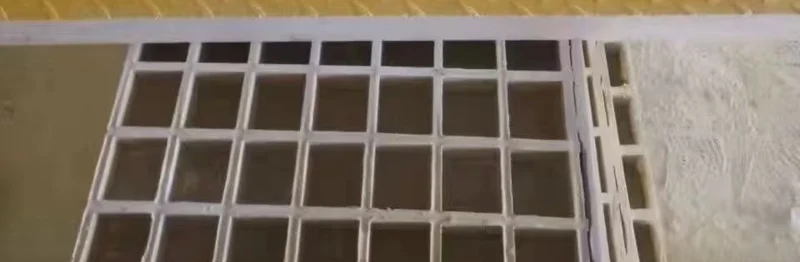
The underside photograph confirms that the walking plate is supported by a grating structure. This is why the finished product is specified as an assembly.
Material evidence has a defined scope
Report HZTC/BG-24051102 records material-level results for submitted samples. It does not identify a chequered assembly, plate thickness, bonding method or complete-panel load rating.
Read the original factory test reportCutting and fixing remain part of the configuration
Finished pieces, openings, cut edges and clips can be coordinated with the order. Supports, installation and structural approval remain project responsibilities unless separately quoted.
Project review
Send Your Chequered Plate and Base Requirements
State whether you need a complete grating assembly or only a plate. A sketch or photo of the required pattern can start the review.
- State whether you need the complete grating assembly or only a plate
- A photo, sample or drawing of the required pattern helps
- Mark any unconfirmed plate or overall thickness as unknown
FRP Grating with Chequered Plate Questions
What is FRP grating with chequered plate?
Is a chequered plate the same as a solid FRP plate?
Is checker plate the same as chequered plate?
Does the plate make the grating stronger?
Will the covered panel drain?
Is the chequered pattern slip-resistant?
Which base is suitable?
Can it be cut to size with openings?
What is the minimum order or sample charge?
What should I send for a quotation?
This content was prepared and reviewed by Dengtai Industry’s technical and production team using the project conditions, available product data and applicable documents. Limits that require design, testing or approval are identified in the content. Content last checked: