Wheel and caster route selection
Mini-Mesh Grating for Wheelchairs and Small-Wheeled Carts
A finer upper mesh can reduce wheel drop, but it does not prove accessible passage or load capacity. Review opening, caster size, joints, turns and thresholds separately from wheel load, span and deflection.
Prepared by
Dengtai Industry
Published
·
Reviewed

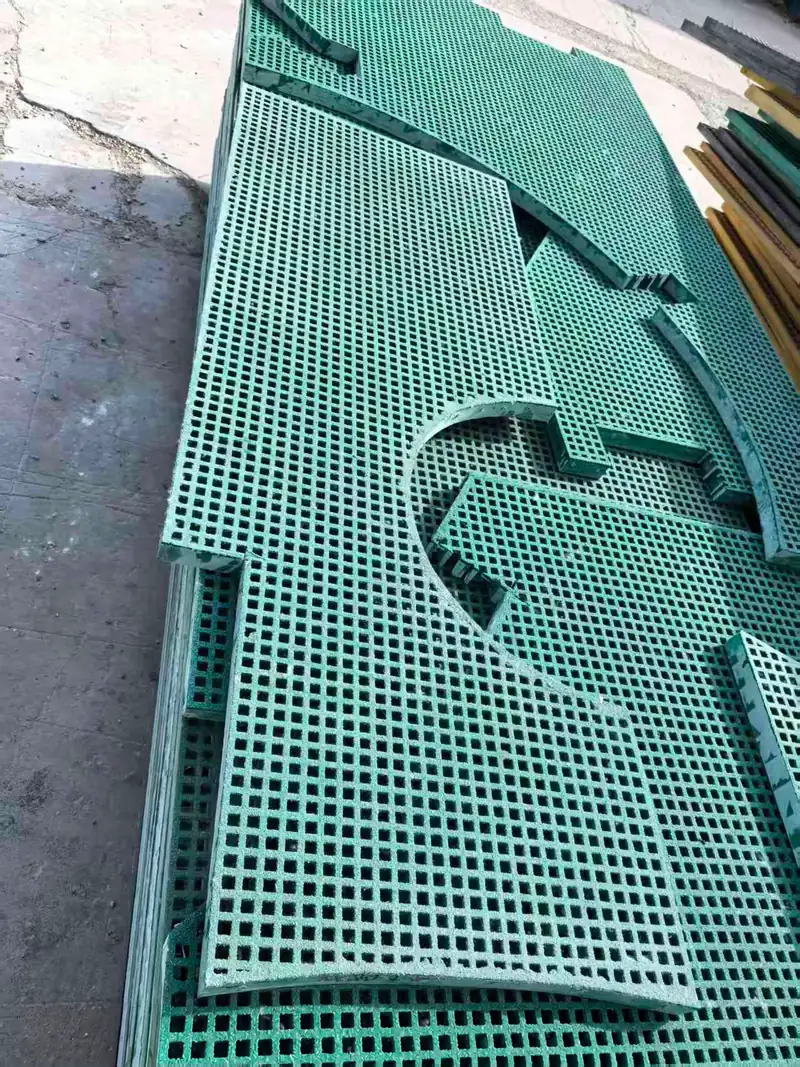
The walking surface, frame transitions and supports must work together for a chair or cart route. Photo: Dengtai Industry.
Wheel-route vocabulary
Mini Mesh, Wheel Passage and Structural Capacity Are Different Terms
A wheelchair or cart route needs both a traversable surface and a structure that supports the wheel load.
- Wheel passage
- The geometric ability of a wheel or caster to cross the installed surface without dropping into an opening or being stopped by a joint, lip or raised edge.
- Caster
- A small wheel mounted in a fork, often able to swivel. Diameter, width, tread, load and turning direction can change how it meets a grating opening.
- Contact patch
- The local area through which a wheel transfers load into the grating. A small hard wheel and a larger pneumatic wheel can carry the same total load with very different local pressure.
- Clear opening
- The finished gap between bar edges at the walking plane. It is not the centre-to-centre mesh pitch and can change at joints, cuts and tapered sections.
- Accessible route
- The complete path used by people with mobility devices. In an ADA context, the route and installed surface are evaluated against the applicable requirements, not against one product label.
- Clear span
- The unsupported distance between effective support faces. A cart path across a panel does not automatically follow the panel's longest dimension.
- Deflection
- Movement under load. A noticeable dip or spring may affect rolling passage even when the panel has not failed, so a project deflection limit belongs in the structural review.
- Repeated wheel load
- A moving or cyclic load from chairs, carts or trolleys. It is not automatically represented by a static pedestrian load or by a standard-mesh load-table row.
Two-lane comparison
Wheelchair and Trolley Passage Versus Panel Load Capacity
Opening geometry, wheel interaction and structural evidence answer separate questions.
Swipe horizontally to view all columns.
| Question | Passage review | Structural review | Evidence that does not replace either |
|---|---|---|---|
| What is being checked | Can the wheel or caster cross without dropping, catching or excessive disturbance? | Can the panel, support and fixing carry the wheel load within the deflection limit? | The supplier's product name or a single product photograph. |
| Main dimensions | Wheel diameter, width, tread and turning motion; opening, joint and threshold. | Wheel load, contact patch, clear span, support bearing, panel row and fixing. | Mesh pitch alone or overall thickness alone. |
| Installed condition | Route direction, turns, joints, removals, slopes and level changes. | Two-way or edge support, local cut-outs and whether panels can move. | A full uncut panel tested away from the actual frame. |
| Test or table | Named opening criterion and a representative wheel/route trial. | Load table, calculation or test matched to the mini-mesh construction and support. | ADA opening evidence with no structural scope, or a load table with no route geometry. |
| Result | A geometric route that suits the stated wheels and interfaces. | A structure and fixing scheme that suits the stated wheel loads and movement limit. | Neither conclusion alone proves the complete installation. |
Selection boundary
When Mini Mesh Is Only the Starting Point
A complete route and a matched structural row are required before a product can be approved.
Specify this if…
- The route has been defined and its applicable accessibility requirements are known.
- The smallest and most demanding wheel or caster has been identified.
- Finished openings and joints will be measured, not inferred from mesh names.
- Wheel loads, supports, clear spans and deflection limits are available.
- The exact mini-mesh row and fixing arrangement can be matched to evidence.
Look elsewhere if…
- A mini-mesh product is being approved from a wheel photo alone.
- A 13 mm opening check is being used as proof of load capacity.
- A standard 38 mm mesh load table is being copied to a double-layer mini-mesh row.
- Panel joints, turns or adjoining level changes are outside the drawing.
- The caster may carry a concentrated or repeated load that has not been described.
Review matrix
Eight Inputs for a Wheelchair and Small-Wheel Route
Record the wheel, route, opening, support and load in one comparable dataset.
Swipe horizontally to view all columns.
| Route or product field | What to record | How it changes the review |
|---|---|---|
| Route duty | Public accessible route, staff route, service trolley, mixed-use platform. | Defines the applicable code and acceptance criteria. |
| Wheel or caster | Diameter, width, tread, hardness, fixed/swivel type and approximate load. | A narrow hard caster and a broad tyre do not present the same opening or pressure. |
| Opening and joints | Measured clear gap in both directions at the top plane and at every joint. | The installed gap, not the nominal mesh pitch, determines wheel drop. |
| Route layout | Straight travel, turns, reverse movement, thresholds and removable sections. | Crossing at an angle or turning can expose a different gap and edge. |
| Support | Support faces, bearing width, clear span, panel direction and cut-outs. | The load path must remain continuous under the wheel path. |
| Load case | Static, moving, repeated or braking load and contact area. | A pedestrian load or point load must not be assumed equivalent to a trolley caster. |
| Deflection | Project limit and its measurement basis. | Rider comfort, rolling resistance and serviceability may control before strength. |
| Evidence | Exact product row, drawing, calculation or test and fixing detail. | Evidence must share the structure, support and load condition. |
Mini-mesh grating can improve the rolling surface for a wheelchair, trolley or small-wheeled cart, but the product name is not an access approval. The same panel can present an acceptable opening in one place and an unacceptable joint at a frame. It can also have a suitable opening while being undersized for a concentrated wheel load or too flexible for comfortable movement.
The reliable method is a two-lane review. Lane one asks whether the wheel can pass across the finished route. Lane two asks whether the panel, support and fixing can carry the wheel demand with the required movement limit. Price, mesh name and photographs do not replace either lane.

Lane One: Can the Wheel Cross the Surface?
Start with the moving object rather than the panel. A standard wheelchair may use large rear wheels and much smaller front casters. A hand trolley may have two small hard wheels. A platform cart may use four casters that swivel, reverse and cross joints at different angles.
Record:
- wheel or caster diameter;
- tread width and material;
- fixed or swivel arrangement;
- the smallest wheel likely to cross;
- the direction of approach;
- whether the route includes turns, reverse movement or transitions;
- the approximate load transferred through each wheel;
- whether the wheel can be represented in a sample or on-site trial.
A caster that crosses a 19 mm opening straight ahead may behave differently when it turns, or when it meets the long direction of a slot. This is why a product-only dimension is weaker than a route check.
Start With the Finished Opening
On an applicable ADA accessible route, openings in floor and ground surfaces must not allow passage of a sphere larger than 1/2 inch (13 mm) in diameter, except where a listed exception applies. Elongated openings must have their long dimension perpendicular to the dominant direction of travel. The U.S. Access Board Chapter 3 sets out this opening check.
The requirement applies to the installed walking surface. Check:
- the clear gap at the top plane;
- both dimensions of the opening;
- the orientation of elongated slots;
- panel joints and removable covers;
- frame edges and perimeter gaps;
- cut-outs around services or equipment; and
- changes in level between the grating and adjoining finishes.
ADA does not certify a mesh. A 19 × 19 mm product label does not identify a 12.5 mm finished opening, and that calculated value does not prove the route. Use the detailed ADA small-opening review to separate the applicable route rule from the product geometry.
Fine Mesh Helps With Wheel Drop, Not Every Route Problem
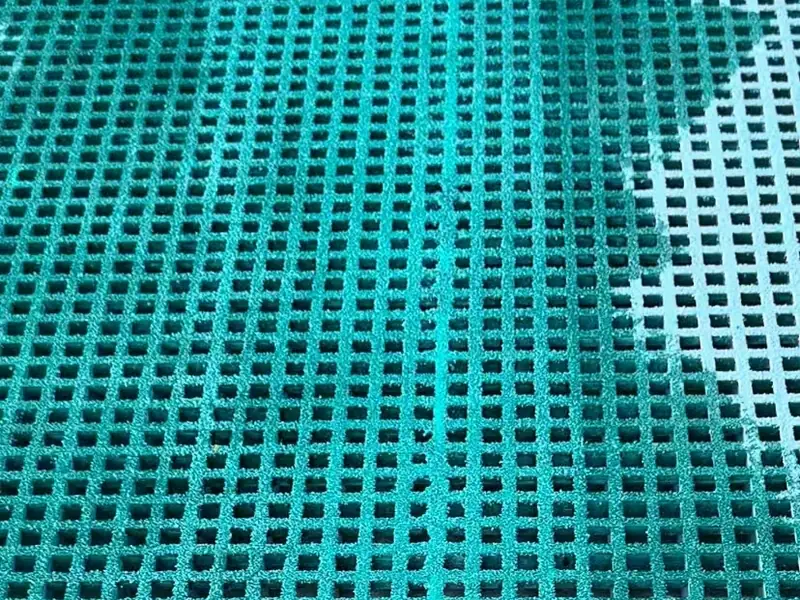
A fine upper grid puts more bars beneath the wheel and can reduce the chance of a small caster dropping into an opening. The smoother, more continuous contact can also reduce vibration under rolling traffic compared with a very open standard mesh.
That benefit is conditional. It does not repair:
- a wide panel joint;
- an unsecured removable cover;
- a raised frame lip;
- a flexible panel;
- a route without adequate turning space;
- an unsafe slope or level change; or
- a structural span that moves excessively under a wheel.
Wheel comfort and rolling resistance are real selection criteria, but they do not turn an inaccessible route into an accessible one. The project’s designer and authority still evaluate the complete route.
The route must also remain stable, firm and slip resistant. The ADA does not prescribe one universal coefficient-of-friction value, so a wet, oily or food-processing project should name its test method and acceptance criterion. More grit is not proof of a wet-route result, and a fine opening does not make a slippery surface acceptable.
Use a Route Trial Where the Equipment Matters
A sample cannot prove the full route, but it can expose a real mismatch. Where the chair, trolley or cart is available, test it on an approved sample or mock-up with the intended frame and joint detail.
Run the check in the directions that matter:
- straight across the short opening dimension;
- across the long slot or joint direction;
- diagonally if the route suggests that approach;
- a slow turn and a reverse movement;
- starting and stopping on the panel;
- crossing the frame or adjoining level change.
Record the wheel type, load condition, direction and any jump, catch, noticeable deflection or noise. A trial is project evidence; it should not be described as a universal product certification.
Lane Two: Can the Structure Carry the Wheel?
Wheel passage is only half of the problem. A wheelchair or loaded cart transfers force through a relatively small contact patch. A fine mesh visual surface does not supply a load rating for the complete panel and support.
The structural enquiry needs:
- load at each wheel;
- contact-patch size;
- load position and travel path;
- static, moving, braking or repeated action;
- clear span and support faces;
- panel direction and bearing;
- the exact upper and lower mesh construction;
- panel depth and fixing arrangement;
- the project deflection limit; and
- the actual evidence available for that row.
A narrow hard caster can create a much more concentrated local condition than a uniformly distributed platform load. The panel may be strong enough for the total mass but deflect or vibrate excessively under a moving wheel.
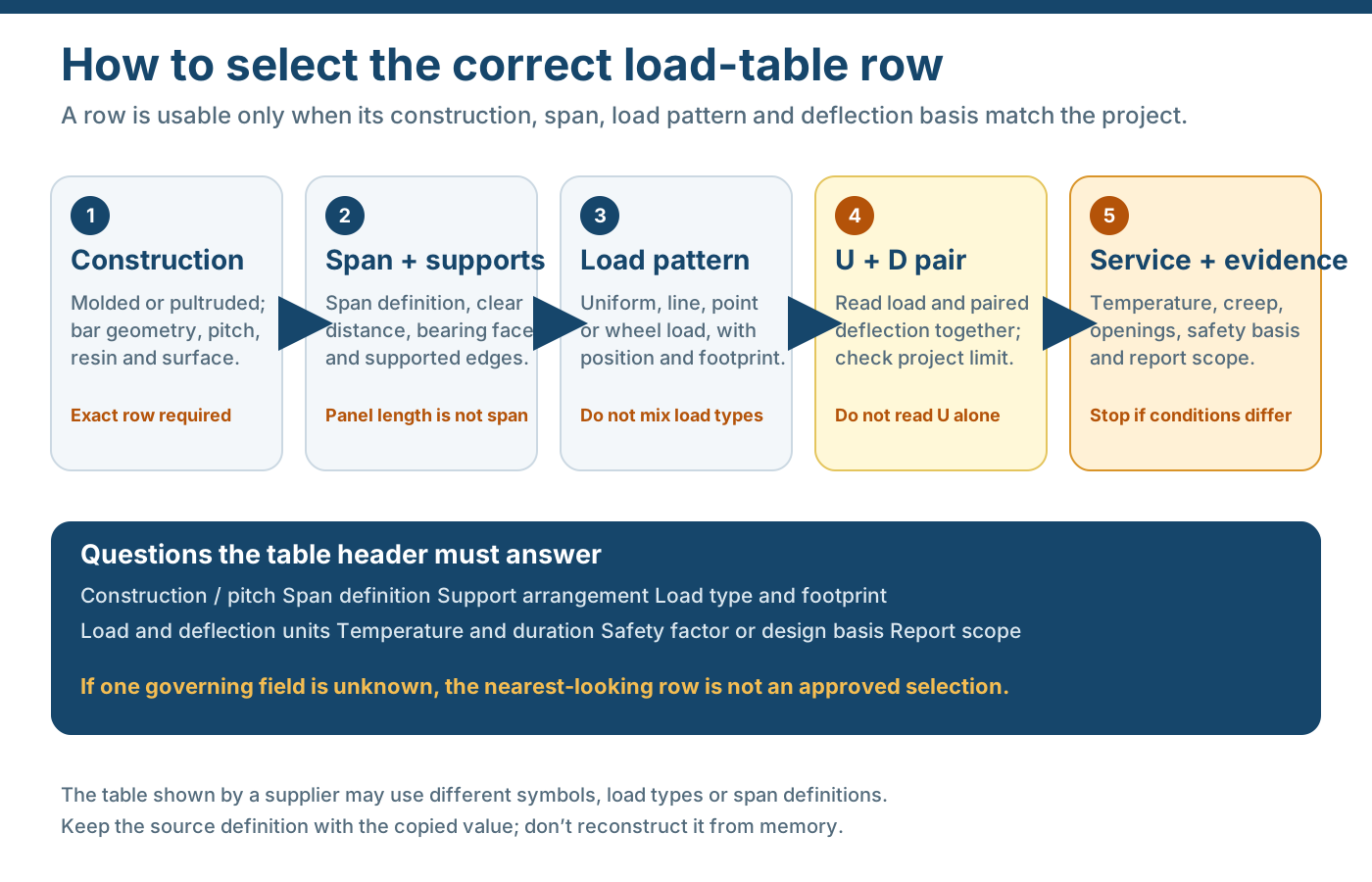
Do Not Copy a Standard Mesh Load Row
Mini mesh is usually a double-layer molded product. Its upper fine layer, lower grid, bar spacing, depth and mass are different from a standard single-mesh panel. A load value for a standard 38 mm molded row cannot be transferred to every mini-mesh row.
The structural question must match:
- the exact mini-mesh product row;
- the support and clear-span arrangement;
- the wheel-load and contact-patch case;
- the deflection limit; and
- any test or calculation relied upon.
Our current public mini-mesh schedule provides nominal geometry and mass rows. It does not create a universal fine-mesh load rating. Send the support and wheel-load data so the applicable evidence can be identified for the proposed configuration. The load and span guide explains why a table row is a condition-specific record.
Deflection Is Part of Passage
A panel can carry the load and still be the wrong route if it deflects too much. Excessive movement can:
- make a small caster harder to control;
- increase rolling resistance;
- create a visible step at panel edges;
- loosen or stress fixings;
- cause discomfort for a wheelchair user; or
- allow one panel to move differently from its neighbour.
The project should state whether deflection is measured relative to the clear span, an absolute movement or another acceptance basis. The same panel condition can look acceptable under one limit and fail a stricter one.
Small Wheels Need Fixing and Joint Control
A panel that is not restrained can lift, shift or form a lip at the edges. Small casters are sensitive to even a modest change in level.
Review clips, edge restraint, frame bearing, removable pieces and the sequence in which covers are replaced. Fine mesh at the centre of the panel cannot compensate for a displaced panel at the perimeter.
Wheelchair, Trolley and Cart Are Not the Same Duty
Wheelchairs and mobility devices
The route may be governed by accessibility requirements. The mobility device can have large rear wheels and small front casters, and the user may turn, stop and reverse on the surface. Keep route geometry and structural capacity separate from the product’s upper-mesh label.
Hand trolleys and two-wheel carts
The wheel may be small, hard and highly loaded. The route may include lifting, turning, loading docks and thresholds that are not part of a pedestrian accessible route. The structural load and local contact pressure can control the panel even when the opening is small.
Platform carts and four-wheel trolleys
Turning changes the direction of the caster and can expose the wheel to a slot or joint at a new angle. Four wheels may not share load evenly, especially when the floor is uneven or the cart is loaded off-centre.
Delivery and maintenance carts in public areas
The same surface may serve pedestrians, wheelchairs, small wheels and occasional service equipment. Define the mixed traffic and the applicable requirements before choosing one panel for every zone. A route can change duty at an entrance, lift lobby, service door or threshold.
Standard Mesh, Mini Mesh or Covered Surface?
Mini mesh is useful only when it beats the alternatives on the actual route. For public access, standard open grating may provide more drainage and easier cleaning when the wheel and opening checks can tolerate the wider mesh.
Mini mesh adds a finer upper layer. It can reduce wheel drop and small-object passage, but adds mass, makes fine debris harder to clean and still depends on the exact lower mesh, opening and structural row.
A covered or solid-top surface removes the open walking-plane mesh. It can be the better answer where dropped objects or very small wheels dominate, but drainage must be designed elsewhere and perimeter gaps, lifting points, fixing, surface friction and the frame still require review. If the choice is between milled-flat and covered grating, use the construction comparison rather than a surface photograph.
| Decision | Standard open mesh | Mini mesh | Covered or solid top |
|---|---|---|---|
| Small wheel or caster | Adequate only when the actual opening and wheel interaction pass | Finer contact surface, but joints and structure still control | Continuous top helps with wheel drop; perimeter and transitions still need checking |
| Drainage | Highest open area of the three | Lower open area and more debris retention | No through-surface drainage unless separately designed |
| Cleaning | Usually easiest for large debris | Fine debris can lodge in the upper pattern | Depends on surface, falls and drainage around the cover |
| Dropped objects | Holds only objects larger than the opening | Retains more small objects | Removes the through-surface opening; perimeter gaps and transitions still need checking |
| Structure and fixing | Exact molded row, span, load and clips | Exact double-layer row; do not copy a standard-mesh table | Cover assembly, frame, lifting, restraint and local loads |
| Best starting point | Low debris, greater open area is useful and wheels bridge the opening | Finer opening is required and the complete route can still drain | Continuous surface or stricter object control is required |
If two options both pass the opening requirement, compare drainage, cleaning, mass, support and maintenance before price. A more closed product is not automatically the more accessible product.
What the Factory Can and Cannot Confirm
We can review:
- available mini-mesh upper pitch, bar width and depth rows;
- lower mesh and product construction;
- finished cut sizes and openings;
- edge treatment and piece marking;
- surface and colour options;
- fixing details in the agreed scope;
- the support and load inputs supplied for structural review; and
- drawing, sample or dimensional records where agreed.
We cannot turn a panel quotation into approval of:
- the complete accessible route;
- turning, circulation or travel distances;
- slopes and transitions we do not design;
- the structural frame or civil support;
- site installation quality;
- the authority’s interpretation of the adopted code; or
- a load case we have not received.
That boundary is useful. It lets the buyer see which decisions are fixed by the product order and which remain project responsibilities.
A Practical Review Sequence
- Mark the full route, not only the grating rectangle.
- List the chair, trolley and cart types and their smallest wheel or caster.
- Record each wheel’s approximate load and contact condition.
- Mark the applicable opening requirement and measuring plane.
- Measure panel openings, joints, cuts and frame gaps.
- Identify turns, reverse movements, thresholds and removable sections.
- Define the support faces, clear span and wheel-path direction.
- Select the exact upper and lower mesh, depth and fixing.
- Compare load, deflection and repeated-movement evidence for that row.
- Trial representative equipment where the project requires it.
- Freeze the drawing revision and acceptance record.
The result should show a complete route and a complete product row. If either is missing, the quotation remains provisional.
Where the route crosses grating, covers, thresholds, ramps and changes of support, the trolley-route transition guide coordinates wheel passage and edge details across the complete path.
The Wheelchair and Cart Selection Rule
Mini mesh can be useful where a small wheel benefits from a fine support surface, but the material and product need to be selected for both passage and structural duty. Measure the installed opening and every joint; define the smallest wheel, route and turning condition; match the exact double-layer row and support to the wheel load and deflection limit; then confirm the fixing and transitions as installed.
A fine mesh is neither a route approval nor a load rating. It is one part of a complete wheeled-access solution.
Review Basis and Limits
This guide combines the factory’s current mini-mesh rows, fabrication practice and quotation questions with the U.S. Access Board’s floor-surface criteria. It does not publish a universal caster limit, wheelchair load rating or slip coefficient. Those must be matched to the project’s equipment, route, frame and test requirement before approval.
Selection sequence
How to Evaluate Mini Mesh for Chairs and Carts
Follow the route from entry and turning through the panel, support and structural evidence.
Mark the start, end, turns, thresholds, removable covers and any area where the chair or cart leaves the grating.
Record the smallest caster, width, tread, load and whether it swivels or crosses at an angle.
Check clear openings and joints in both directions at the finished surface.
Walk or simulate straight, turning and reverse movement using representative equipment where possible.
Match the exact mesh, depth, support and fixing to the moving or repeated wheel-load case.
Check deflection, panel movement, edge restraint and transitions before accepting the installation.
Evidence map
What Must Match Before a Wheeled Route Is Accepted
Passage and load evidence need the same product, route and installation basis.

One complete route
Straight sections, turns, thresholds and adjoining surfaces are marked on the same layout.
One demanding wheel
The smallest or highest-pressure caster is named rather than assumed.
One measured opening
The clear gap is measured at the correct plane and at joints or cuts.
One exact product row
Upper mesh, lower mesh, depth, mass and structure stay attached.
One load and support basis
Wheel load, contact patch, span, deflection and repeated movement share one case.
One fixing condition
Restraint, bearing and panel movement are confirmed in the installed assembly.
Project inputs
What to Send With a Wheelchair or Trolley Grating Inquiry
Include the route, wheel data and structural basis, not only the term “mini mesh.”
- Route and use — Public accessible route, staff circulation, chair type, trolley type and mixed traffic.
- Wheel or caster details — Diameter, width, tread, hardness, swivel/fixed arrangement and approximate wheel load.
- Opening criterion — Required sphere or opening check, measuring plane, direction and acceptance method.
- Finished layout — Panel sizes, joints, cuts, frames, removable pieces and transitions.
- Support and span — Support faces, clear spans, bearing width and the direction of the wheel path.
- Load and deflection — Static, moving or repeated load, contact area, duration and project movement limit.
- Fixing and movement — Clips, edge restraint, frame detail and any expected panel movement.
- Evidence — Exact product row and the drawing, calculation, sample or test whose scope covers it.
Request a review
Send the Wheel, Route and Support Conditions
We will separate passage geometry from the exact product and load evidence.
- Passage and structural evidence reviewed separately
- Exact mini-mesh row required for load conclusions
- Joints, turns and transitions included
Wheelchair and Small-Wheel Cart Grating Questions
Is mini-mesh grating automatically suitable for wheelchairs?
Is a 1/2 inch opening enough for every wheelchair or caster?
Does a smaller mesh reduce vibration from a trolley?
Why can two carts with the same total weight need different grating?
Can I use a standard molded-grating load table for mini mesh?
Do panel joints matter for wheelchair passage?
Is a larger caster always better?
What should be included in a comparable quotation?
This content was prepared and reviewed by Dengtai Industry’s technical and production team using the project conditions, available product data and applicable documents. Limits that require design, testing or approval are identified in the content. Content last checked: