Trolley and small-wheel routing
Solid Top or Open Grating for Small Wheels and Trolleys?
A solid top removes open cells from the panel field, but a trolley can still catch at joints, slow down on texture or overload the base. Select from the real wheel, route, contact load, support and deflection rather than from a broad “trolley-rated” label.
Prepared by
Dengtai Industry
Published
·
Reviewed

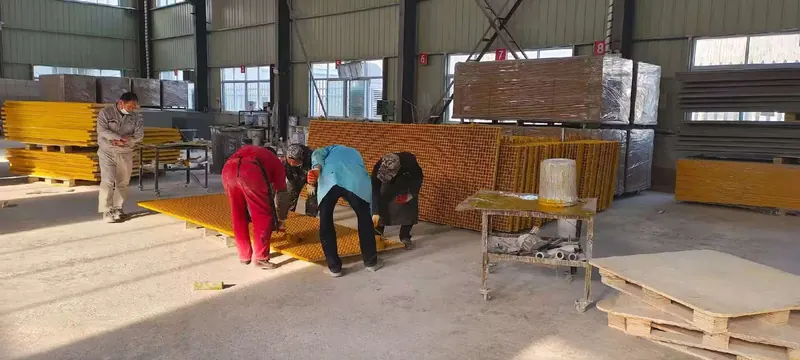
The continuous field is only the first part of trolley suitability. Photo: Dengtai Industry.
Wheel definitions
What Decides Trolley Passage and Performance
Wheel geometry, route details, surface and structural load are separate checks.
- Wheel geometry
- Wheel or caster diameter, width, tread profile, hardness and arrangement. The smallest wheel on the route is usually the critical passage check.
- Contact patch
- The area over which a wheel transfers load into the surface. It depends on wheel shape, load, material deformation and contact position.
- Wheel load
- The individual force delivered through one wheel. It is not obtained by dividing the total trolley mass evenly unless the actual arrangement supports that assumption.
- Joint transition
- The change between panels, frame, curb or adjacent flooring. It may include a gap, step, clip, edge trim or different surface texture.
- Rolling resistance
- The effort required to move the wheel across the surface. Pattern, grit, contamination, deflection and soft tread can all change it.
- Route acceptance
- The agreed criteria for practical movement and structural performance, checked with the actual or representative trolley on the installed geometry.
Surface comparison
Solid Top vs Mini Mesh vs Open Grating for Small Wheels
The panel field is only one part of the route.
Swipe horizontally to view all columns.
| Decision point | Open grating | Mini-mesh grating | Solid-top covered grating |
|---|---|---|---|
| Panel field | Open cells across the walking surface | Smaller upper grid over a wider lower grid | Continuous cover over a grating base |
| Small-wheel risk | Wheel can drop into, bump over or jam in cells | Reduced upper opening but still open | No open cell in the panel field |
| Main remaining trap | Mesh opening and joints | Upper/lower grid and joints | Panel joints, perimeter and texture |
| Drainage | Direct through the grid | Through a smaller opening | Surface drainage to a defined route |
| Wheel load | Exact open panel and support | Exact mini-mesh row and support | Exact cover-interface-base assembly |
| Rolling feel | Depends on wheel, opening and crossing angle | Finer contact, still affected by joints | More continuous, affected by pattern or grit |
| Cleaning | Debris can pass or lodge | Fine openings trap smaller debris | Debris stays on top and needs an outlet |
| Evidence | Clear opening, support, wheel load, deflection | Both grids, support, wheel load, deflection | Complete assembly, joints, wheel load, deflection |
Route review
When a Grating Route Is Ready for a Trolley Decision
The real wheel, joint and load have to meet the proposed product.
Specify this if…
- The smallest wheel and its actual contact are known.
- The route can be checked with loaded and unloaded trolleys.
- Joints, turns, ramps and transitions have been drawn.
- Wheel load and deflection are reviewed for the complete construction.
- The surface texture is compared for both grip and rolling resistance.
- Drainage, cleaning and access remain acceptable after the top is closed.
Look elsewhere if…
- The only wheel information is total trolley weight.
- The supplier assumes every wheel carries an equal load.
- A pedestrian load table is being used as a trolley rating.
- The route has an unspecified step, gap or soft transition.
- A solid top is expected to solve structural deflection automatically.
- The smallest wheel is never tested against a production joint.
Start With the Smallest Wheel
A trolley route is not defined by a catalogue category such as “industrial cart.” It is defined by the smallest contact that has to cross the route.
Record:
- the smallest wheel diameter;
- wheel or caster width;
- tread material and hardness;
- fixed or swivelling action;
- wheel spacing;
- loaded trolley mass and payload position;
- the route direction at joints, turns and slopes.
The smallest wheel may be a front caster, a levelling foot or an unloaded support wheel. It may never be the wheel that carries the maximum structural load, but it can still be the wheel that jams first.

Compare the Three Surface Families
Open grating
Open grating preserves through-drainage and airflow. It is the simplest route where the wheels are clearly larger than the cells and the crossing angle, joints and surface condition do not cause a trap.
The relevant measurement is the finished clear opening, not the nominal bar pitch. A wheel may cross a square cell easily in one direction and catch at a diagonal or at a cut edge.
Mini-mesh grating
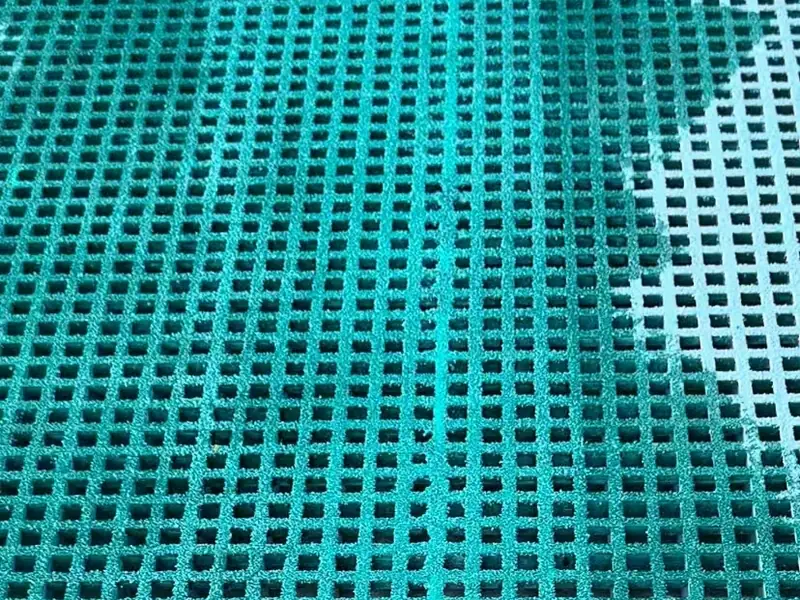
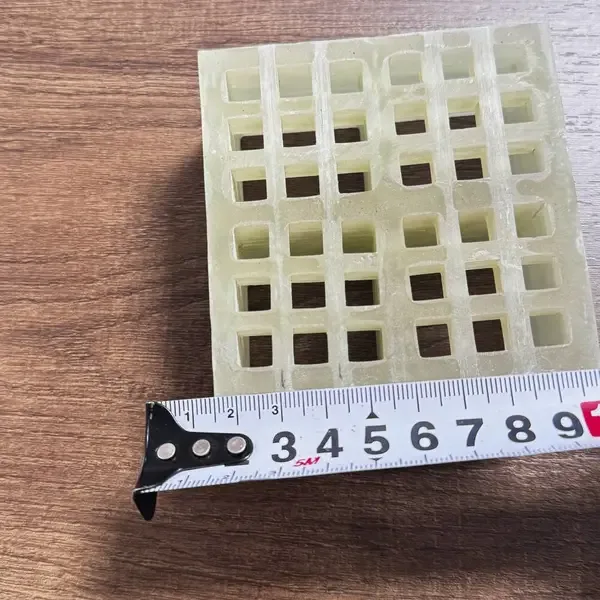
Mini-mesh grating adds a smaller upper grid over a wider lower structure. It can reduce the chance of a small wheel entering the upper opening while keeping the surface open.
It does not become a solid top. The upper and lower grids, joints, cut-outs and support arrangement still matter. Measure both grid layers and inspect the actual finished route.
Solid-top covered grating
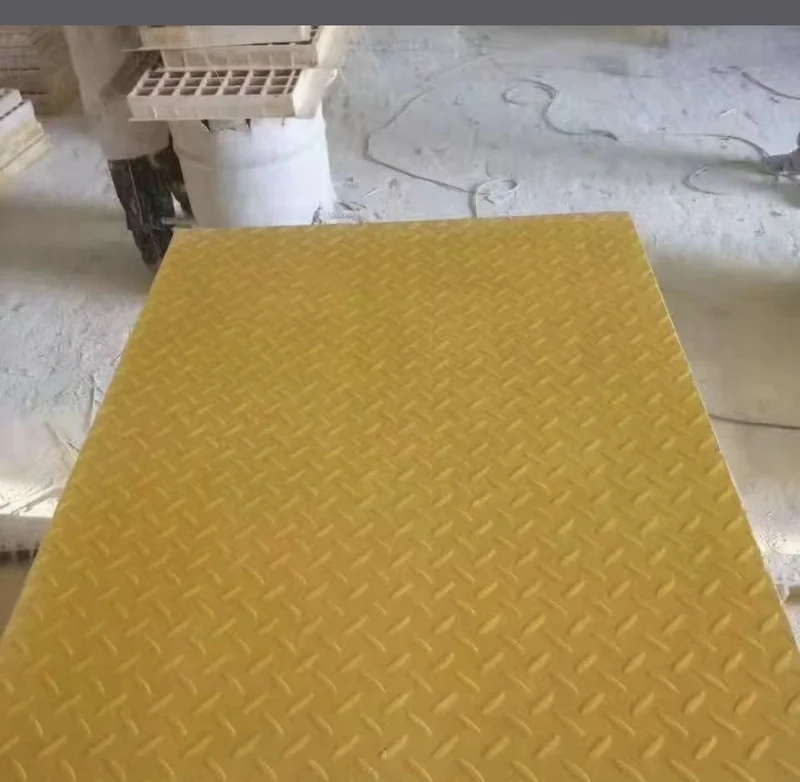
A solid-top covered grating closes the field. This removes the open cell as a wheel trap, but four other checks remain:
- the surface texture;
- panel joints and frame transitions;
- the complete assembly’s wheel-load capacity;
- deflection and vibration along the route.
The cover can also change drainage and cleaning. A trolley route may need a continuous surface and a defined water outlet at the same time.
Where a milled-flat open panel is being compared with a separate cover layer, use the milled-flat versus covered grating construction guide to keep the base, cover and load path separate.
Do Not Hide the Joint Behind the Product Name
A solid top can be ideal in the middle of a panel and poor at a panel joint. The trolley wheel may:
- drop into a panel gap;
- strike a raised edge or trim;
- change height at a frame;
- cross from grit to smooth plate;
- rotate against a raised pattern;
- encounter a loose or rocking piece.
The route drawing should show every joint and transition, not only the panel field.
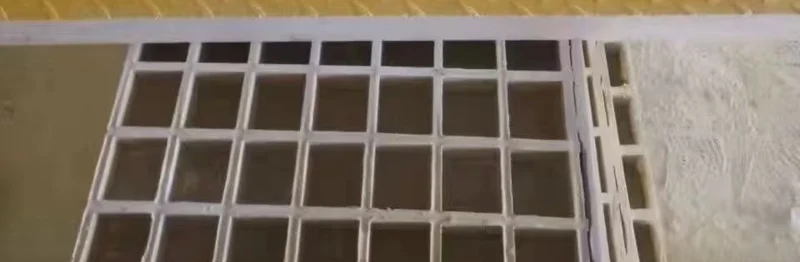
Panel-to-panel gap
State the designed gap and how the two edges align. A small gap that looks acceptable on a drawing may still catch a hard caster. The gap should remain consistent after fixing and repeated removal.
Frame transition
The grating may sit slightly below or above the surrounding floor. A difference in level creates a wheel impact even when the panel itself is continuous. Show the finished top level and any ramp or edge trim.
Cut-outs and service openings
Openings interrupt the continuous surface. Mark their position relative to the wheel route and provide an edge treatment that gives predictable contact. A cut edge sealed against moisture is not necessarily rounded or profiled for wheels.
Separate Passage From Structural Capacity
The fact that a wheel does not fall into an opening does not prove that the panel can carry it.
A structural review needs:
- maximum individual wheel load;
- contact patch;
- position between supports;
- direction and length of the route;
- dynamic or impact condition;
- support layout and bearing direction;
- permitted deflection;
- complete cover-interface-base construction.
A uniform pedestrian load does not approve a caster. The covered grating load guide explains why a complete assembly needs its own basis.
Record Wheel Load Properly
Do not automatically divide the trolley mass by four. Load distribution changes with:
- centre of gravity;
- load position;
- acceleration and braking;
- turning;
- casters that share load differently;
- an uneven or deflecting route.
Ask the trolley or equipment supplier for individual wheel or axle loads where possible. If only total mass is available, state that distribution is unknown so the project can decide how to resolve it.
Consider Texture and Rolling Resistance
Texture choices that improve grip can change how a trolley feels.
- A raised chequer may create repeated small impacts under a hard caster.
- Grit can add vibration or resistance on a soft wheel.
- A milled or flat surface may be easier to roll but still needs slip review.
- Wet films, oil and debris can change both grip and cleaning effort.
There is no universal texture that satisfies grip, cleaning, rolling and wear equally. Compare a sample with the real wheel before approving a long route.
Test the Route Loaded
A useful route trial uses the actual trolley or a representative load. Test:
- the smallest wheel;
- straight travel at normal speed;
- a turn in both directions;
- stopping and starting;
- crossing each joint type;
- a ramp or threshold if present;
- repeated passes over the same line;
- the worst-loaded wheel position.
Observe:
- jamming or sudden drops;
- vibration and noise;
- unintended steering;
- visible panel movement;
- gap changes;
- local wear;
- effort to push the loaded trolley.
Where structural acceptance requires deflection measurement, define the position, support condition and loading method before the test.
Swipe horizontally to view all columns.
| Wheel / trolley | Wheel load | Route condition | Observation | Decision |
|---|---|---|---|---|
| Smallest wheel | Measured or unknown | Straight, turn and joint | Jam, impact, vibration or passage | Accept / hold / revise |
| Worst-loaded wheel | Maximum individual value | Worst support and load position | Deflection, movement or local damage | Accept / test / revise |
| Wheel at reversed direction | Same representative load | Push and pull through the route | Steering, catching or rolling resistance | Accept / revise route |
The record should identify the product revision, joint width, support span, test date and the person accepting the result. A pass that lists only “trolley works” cannot be reproduced.

Review an Existing Route Before Replacing the Grating
A replacement order that copies only the old panel size can miss why the route worked—or why it failed.
Before replacement, measure:
- clear opening and both mesh pitches or solid-top construction;
- finished panel dimensions and squareness;
- every panel gap and frame bearing width;
- support positions, direction and condition;
- top-level steps at doors, curbs and adjacent floors;
- the smallest wheel and its path;
- turning points and service openings;
- drainage falls, outlets and removable pieces.
If the existing product is a covered assembly, inspect the cover attachment, joint condition, edge wear and underside before reordering. If bars, supports or the frame are damaged, a new cover may hide rather than solve the route problem.
Consider Drainage, Cleaning and Access
A solid top can block the route for debris and water that previously passed below. Confirm:
- where wash water and spillage go;
- how debris carried by wheels is removed;
- whether grit or pattern traps residue;
- whether the trolley route crosses a drainage slope;
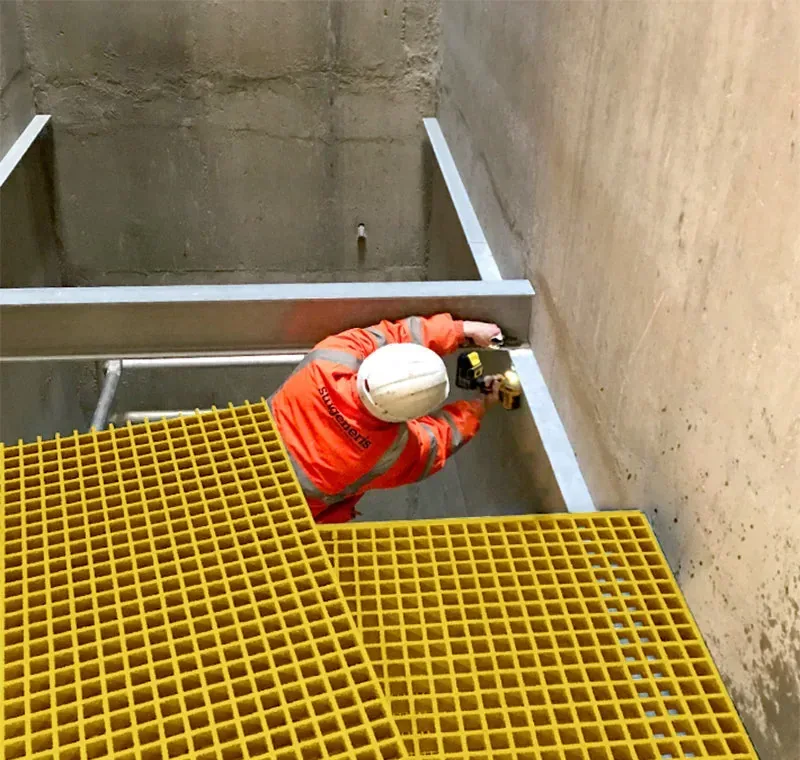
- how panels are lifted without moving the frame.
The joint and drainage guide connects the wheel route to joints and outlets.
How Our Factory Reviews a Trolley Route
The factory can review a complete covered assembly over moulded, mini-mesh or pultruded bases and can supply cut-to-size pieces, openings, edge treatment and fixings from an approved drawing.
The quotation is not treated as a trolley certification. We need the wheel geometry, route, support, load and evidence requirement because those are the facts that decide whether the offered construction is suitable.
What to Send With a Trolley Route Inquiry
Send:
- trolley drawing and loaded mass;
- wheel diameter, width, material and arrangement;
- fixed or swivel action;
- maximum individual wheel load or unknown status;
- route plan with all joints, turns and openings;
- support layout and clear span;
- open, mini-mesh or solid-top preference;
- chequered or gritted surface if relevant;
- drainage, cleaning and environment;
- required deflection and acceptance evidence;
- loading, speed and frequency.
A route plan with five marked joints is more useful than a paragraph saying “used with a trolley.”
Acceptance Checklist
Before approving a trolley route, confirm:
- the smallest wheel is identified;
- the route includes joints and transitions;
- the maximum wheel load basis is stated;
- the complete grating assembly is identified;
- support and deflection are checked;
- the surface texture suits grip and rolling;
- a loaded trial is completed where required;
- drainage and cleaning remain workable;
- one named owner accepts the route and its evidence.
A route that passes only in the middle of an ideal panel is not yet an installed-route approval.
Final Decision Rule
Use open grating when the wheel geometry is controlled and through-flow is essential.
Use mini mesh when a reduced upper opening improves the route while keeping the surface open.
Use a solid-top covered grating when the closed panel field solves a direct wheel or dropped-object problem and the joints, texture, load and drainage are also defined.
The right answer is the smallest combination that satisfies the whole route, not the most closed surface in the catalogue.
Route schedule
Inputs for a Trolley Grating Review
These nine items prevent a panel-only answer to a route-level question.
- Trolley and load — Loaded mass, payload distribution, centre of gravity, number of wheels and the maximum individual wheel load.
- Smallest wheel — Diameter, width, tread, hardness and whether it is fixed or swivelling.
- Route geometry — Straight runs, turns, ramps, crossings, stopping points and the direction relative to panel joints.
- Joint and transition — Panel gaps, frame bearing, edge trim, steps, thresholds and adjacent floor surfaces.
- Surface — Open, mini mesh, solid top, chequered pattern or grit, including the required grip and cleaning.
- Structure — Support layout, clear span, base type, complete assembly and permitted deflection.
- Service — Frequency, speed, braking, impact, chemicals, temperature and cleaning method.
- Acceptance — Trial route, visual checks, measured deflection where required, acceptance owner and final decision.
- Decision owner — Name the person or party accepting the wheel, joint, deflection, drainage and evidence criteria.
Send the route
Show Us the Smallest Wheel and Every Joint
A loaded trolley and a marked route are more useful than a panel size alone.
- Molded and pultruded grating produced in house
- Full panels or factory cut-to-size pieces
- No fixed minimum order quantity
Solid-Top Grating and Trolley Questions
Is solid-top grating always best for trolleys?
Does mini mesh prevent small wheels from falling through?
Can I use a pedestrian load table for a trolley?
Which surface reduces rolling resistance?
Do all wheels carry the same load?
What should a trolley route trial record?
What must be measured when replacing an existing grating route?
This content was prepared and reviewed by Dengtai Industry’s technical and production team using the project conditions, available product data and applicable documents. Limits that require design, testing or approval are identified in the content. Content last checked: