GRP stair nosing selection
Separate GRP Stair Nosing or an Integral Tread Edge?
Start with the tread or cover that carries the front edge. Then choose whether the nosing is formed with that product, applied as a separate profile or used only as a visible band, and record how it is attached.
Prepared by
Dengtai Industry
Published
·
Reviewed

The contrasting edge is visible; the drawing still has to explain how the edge is formed, attached and supported. Photo: Dengtai Industry.
Nosing construction
Integral Edge, Applied Profile and Contrast Band Are Different
Identify which part forms the edge and which part only makes it visible.
- Separate GRP stair nosing
- A distinct fiberglass profile or strip supplied to be bonded, mechanically fixed or otherwise attached to an existing tread or cover. Its geometry, substrate and attachment are separate from the tread support.
- Integral tread edge
- A nosing formed as part of the molded, pultruded or fabricated tread. The front-edge construction and the tread body are produced as one defined assembly.
- Cover return
- A cover layer turned or finished over the front edge of a base. It may create a continuous visible edge, but the underlying structural base, backing and support still have to be defined.
- Contrasting visibility band
- A colour, texture or surface marking used to identify the front edge. It may be part of an integral edge, applied profile or a separate visual feature.
- Nosing face width
- The visible dimension across the front-edge feature, measured on the approved plan or section. It is not the tread depth and not the full stair width.
- Nosing projection
- The finished distance the front edge extends beyond a named riser, substrate edge or other datum. It must be checked against the completed stair section.
- Return or leg
- The part of a profile or cover that turns over the front edge or down toward the riser. Its depth, thickness and fit must be dimensioned rather than assumed.
- Attachment
- Adhesive, mechanical fasteners, a combined system or a formed connection that keeps the nosing in its designed position. Attachment does not replace missing bearing or structural support.
Route decision
When a Separate GRP Nosing Fits the Stair
A separate detail works only when the base, attachment and finished geometry all remain valid.
Specify this if…
- The base tread or cover and the front-edge construction are identified separately.
- The profile can be installed on the real substrate with a defined preparation and attachment.
- The nosing face width, return, projection and finished geometry are dimensioned.
- The left and right tread supports remain part of the structural review.
- Any required slip, fire or visibility performance is tied to the actual product and evidence.
Look elsewhere if…
- “GRP nosing” is used without saying whether it is integral, applied or only a colour band.
- A separate strip is expected to repair a broken tread edge or create missing support.
- The attachment is unspecified or the substrate is not suitable for the proposed adhesive or fastener.
- The profile change is checked without reviewing the finished rise, going and landing transitions.
- A yellow or luminous appearance is treated as proof of slip, fire or egress performance.
Same-duty comparison
Integral Tread Edge or Separate GRP Nosing?
Compare construction, attachment, support, geometry and inspection rather than appearance alone.
Swipe horizontally to view all columns.
| Decision | Integral / formed edge | Separate applied nosing |
|---|---|---|
| Base construction | Front edge is part of the supplied tread or cover assembly | Existing tread or cover remains a separate base |
| Primary use | New or custom tread where the edge can be formed with the product | Renew or redefine a front edge on a suitable existing base |
| Main geometry | Molded edge, pultruded end detail, fabrication return or covered return | Profile face, return leg, length, thickness and end treatment |
| Attachment | Formed into the product; any field fixing follows the tread drawing | Adhesive, mechanical fasteners or another approved attachment |
| Support question | Does the tread or covered base still reach both end supports? | Does the strip create a safe edge without pretending to repair the base? |
| Local edge demand | Front-edge construction and its connection into the supported tread or cover | Local foot contact, prying, peel and pull-off at the attachment |
| Finished geometry | Finished edge and tread section are defined together | Added profile may change projection, height and clearance |
| Inspection | Edge construction, support, orientation and finished section | Substrate preparation, seating, bond, fasteners and rocking |
| Documentation | Tread assembly and relevant product evidence | Profile, attachment, substrate and separate performance evidence |
Edge drawing
GRP Stair Nosing Geometry and Fixing Fields
A profile description needs dimensions, ends, attachment and evidence.
Request a Project Quote| Specification | Value |
|---|---|
| Nosing route | Integral, separate, cover return or visual band Use a construction name, not only a colour or “anti-slip nosing.” |
| Base | Tread or existing step Define material, condition, flatness and structural role. |
| Nosing face | Width and visible finish Show whether it includes a return, insert or contrasting layer. |
| Projection | Dimension from a named datum Check against the riser, going, landing and trip edge. |
| Return / leg | Depth, thickness and fit Record any relief, gap or corner treatment. |
| Local edge demand | Contact, peel and pull-off condition Define the substrate and fixing basis for loads at the projecting front edge. |
| Attachment | Adhesive, fastener or combined method Include substrate preparation, quantity, spacing and access. |
| Length and ends | Finished cut and end treatment Define stop positions, end caps, mitres and edge sealing. |
| Evidence | Product and performance requirement State the actual test method and result when performance is required. |
“GRP Stair Nosing” Can Mean Several Products
A stair nosing can be a formed part of a new tread, a distinct profile bonded to an existing step, a return in a cover or simply a visible band. These details may look similar in a photograph, but they do not have the same base, attachment or support path.
The first useful question is therefore not “Which nosing is best?” It is:
What forms the base of the front edge, and how does the proposed nosing connect to it?
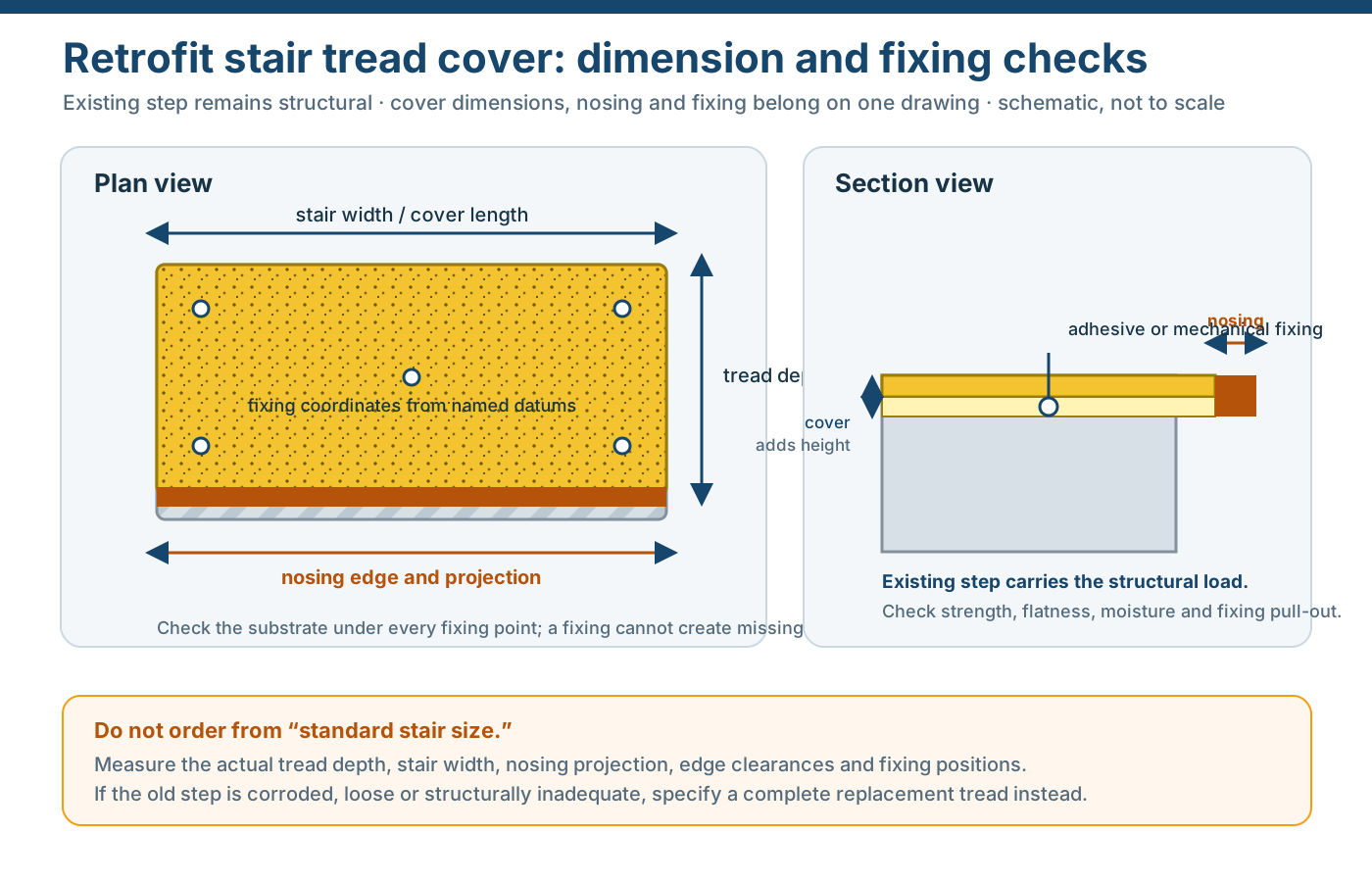
For a complete load-bearing tread, the structural base is the molded, pultruded or covered grating assembly. For a retrofit cover, the existing step remains structural and the cover changes the walking face. A separate profile can be used with either route only when its substrate and attachment suit that assembly.
In this guide
- Identify the nosing construction
- Compare both routes on the same stair duty
- Review the local edge load and attachment
- Choose grit, colour and maintenance separately
- Draw the nosing in plan, section and end view
- Check the factory supply boundary
- Prepare the RFQ package

Identify the Product Before Comparing It
Formed or integral tread edge
An integral edge is produced with the tread or cover. For molded grating, it can follow a formed panel edge. For a pultruded tread, it can relate to the front end of the bearing bars or a controlled fabrication detail. A covered tread can also return the cover around the front edge.
The important point is not the marketing word “integral.” It is the section. Show the bar, return, cover layer or profile that forms the edge and how that region reaches a support.
Separate applied profile
A separate profile is a distinct item. It may be bonded, screwed or fixed with a combined method to the front of an existing tread. The base may be steel checker plate, concrete, timber, FRP cover material or an existing FRP tread.
The base condition now matters. A profile cannot be specified from its own section alone. The design must also show substrate preparation, adhesive or fastener type, fixing pattern, edge distance, tool access and the condition beneath the attachment.
Cover return
A covered grating tread can use the cover layer to turn over the front edge. That return can create a continuous visible edge, but the structural base still has to land on both tread supports. The return is part of a complete covered assembly, not a loose strip.
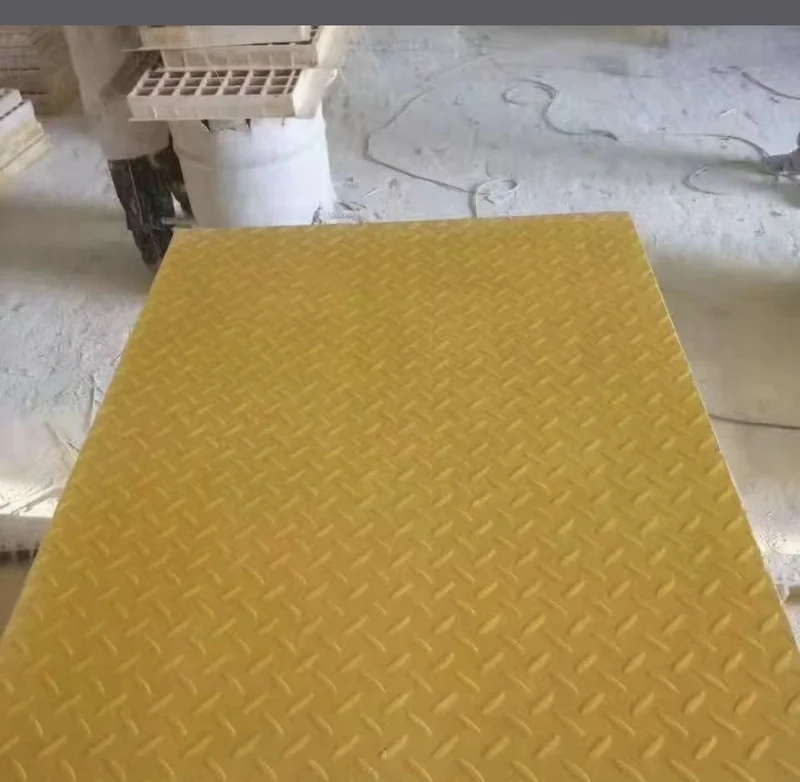
Contrast band
A contrasting colour can identify the edge without creating a separate structural nosing. It may be part of the tread, part of the cover or an applied marking. Record the band separately from the structural or applied profile.
Compare the Stair Duty, Not the Appearance
The comparison becomes useful when the same stair duty is used for both routes:
- same base condition;
- same front-edge location;
- same overall tread depth;
- same finished projection;
- same end supports and bearing;
- same fixing access;
- same load, deflection and removal requirement;
- same slip, fire or visibility evidence.
If one quote includes a complete tread and another includes only an applied strip, the difference is not a nosing comparison. It is a comparison between different supply scopes.
Our factory review asks whether a proposed nose can be formed or attached to the actual construction. We do not convert a generic flat strip into an engineered stair nosing merely because it is made from FRP.
When a Separate Nosing Is the Better Route
A separate profile can be useful when:
- the existing tread or cover remains structurally suitable;
- the project wants to renew or change only the front-edge detail;
- a local wear or visibility improvement is the main objective;
- the existing base can be prepared and hold the proposed bond or fasteners;
- the profile can fit without creating an unsafe projection or trip edge.
It can also be useful where the original tread is sound but the front edge is worn, difficult to see or needs a replaceable surface. The decision still depends on the finished section and support review.
When an Integral Edge Is the Better Route
An integral or formed edge is generally the clearer starting point when:
- the tread is being replaced as a complete load-bearing component;
- the front edge must be produced with the selected molded, pultruded or covered construction;
- the project needs one controlled assembly rather than an existing base plus an applied part;
- the carrier and nosing geometry can be coordinated in one drawing;
- the finished edge and load path need to be reviewed together.
This does not make every integral edge structurally better. A thin fabricated return can still need support, and a separate profile can perform its intended role. The comparison must use the actual section and evidence.
Measure the Separate Profile as a Product
A two-dimensional description such as “100 mm GRP nosing” is not enough. Record the front-edge component in plan and section:
- overall length and end treatment;
- face width across the walking side;
- return or leg depth over the stair edge;
- material thickness;
- finished projection beyond a named riser or substrate datum;
- corner, mitre or stop position;
- hole positions, diameter and edge distance where mechanically fixed;
- adhesive contact area and preparation where bonded;
- finish and any visible colour band.
The profile can be dimensionally correct and still fit badly if the existing edge is not straight, the return is obstructed by a weld or the required fixing lies in a weak substrate.
Check the finished geometry
A separate profile can add height and forward projection. It can also create a gap beneath the return, reduce clearance to the riser or interfere with a landing transition.
Do not approve the profile from a short sample alone. Bring the section into the actual stair drawing. The responsible access designer confirms the acceptable finished geometry; the factory fabricates what the drawing defines.
Evaluate the Local Nosing Load and Attachment
The nosing is the part of the stair most likely to take direct foot contact. It therefore has a local edge question in addition to the tread-span question. Even when both end supports are correct, repeated contact near a projecting nose can flex the edge, work an adhesive bond or load a short fixing line.
The local review should ask:
- how far the fitted edge projects beyond the riser, base or support;
- whether the profile is fixed only to a horizontal face or also has a return over the front edge;
- whether the base material behind the nose is sound and stiff enough to receive the fixing or bond;
- whether the profile can rock, lift or peel under contact;
- whether fasteners clamp the profile against the base without crushing it or creating a crack;
- whether the ends, joints and corners have a defined stop or termination.
An adhesive bond is not automatically equivalent to a mechanical clamp. A flat strip fixed only on top of a tread can be more sensitive to peeling when its leading edge is lifted or repeatedly loaded. A returned leg changes the attachment geometry, but it only helps when that leg contacts a suitable substrate and the approved adhesive or fixing reaches it.
Mechanical fixing also needs a load path into the base. Pre-drill where required, control the hole size and edge distance, use the specified washer or fastener and seal holes where the environment requires it. Tightening until the profile distorts is not a substitute for a suitable attachment.
No universal nose force or fixing pattern can be selected from the phrase “GRP nosing.” The project’s actual geometry, traffic, substrate and required evidence define the local detail.
Define the Attachment and the Receiving Surface
Bonded attachment
A bonded profile requires a compatible substrate, clean preparation, suitable adhesive and controlled installation. The method should state the actual materials, surface preparation, adhesive quantity or coverage, open time, working time, clamping and cure.
More adhesive is not automatically better. Excess material can create a raised edge, block drainage or prevent the return from sitting down. A visible bead is not proof of continuous contact.
Mechanical fixing
A mechanically fixed profile needs the right fastener, washer, hole size and interval for the actual product. Check edge distance and the material behind each hole. A screw into a hollow section, a loose cover or a corroded plate may look fixed while providing little reliable restraint.
For a tread with both end carriers, use the clip and fixing guide to separate restraint from support. A fixing in the nose area is not interchangeable with the two structural end bearings.
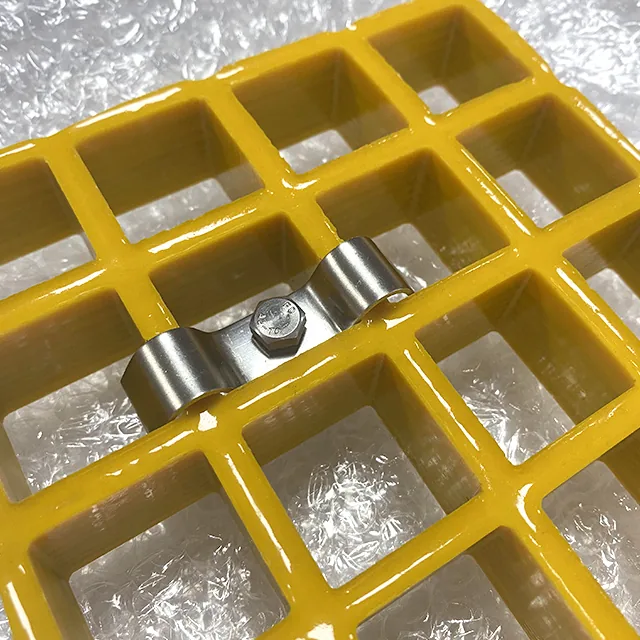
Combined attachment
Some details use adhesive plus mechanical fasteners. The sequence and purpose should be stated. If the fasteners are intended to hold the profile while the adhesive cures, that temporary role is part of the method. It is not proof that the final structural connection has been verified.
Keep the Nosing Separate From the End-Support Question
People stand near the front edge, but the main span of a complete tread runs between its left and right ends. The front nosing and the tread ends have different jobs.
For a pultruded tread, the bearing bars need effective support at both ends. For a molded tread, the actual support and panel arrangement still require review. For a covered tread, the structural base remains underneath the cover. For a retrofit cover, the existing step carries the load.
The nosing and end-detail guide expands the plan, section, carrier and fixing checks. Keep those details out of the colour discussion.

Do Not Use Colour as the Whole Specification
Colour contrast helps people see the edge. It does not establish:
- slip resistance;
- fire performance;
- electrical or anti-static performance;
- photoluminescent duration;
- structural capacity;
- compatibility with the substrate.
Ask for the actual product, construction and applicable evidence. If the project requires a luminous edge, identify the product, attachment, charging and afterglow basis and any standard or approval condition. Do not assume that every yellow, bright or glow-in-dark strip performs the same function.
Use the surface and treatment guide to separate grit, pattern and edge visibility. A visible band can be useful even when it is not a structural nosing, provided its role is written clearly.
Choose Grit, Colour and Maintenance as Product Fields
Grit is part of the walking surface, not proof that the nosing is structural. Specify the actual grit process, texture or grade offered for the product, its coverage, the substrate and the intended traffic. A coarse surface can suit an oily industrial route but may retain debris or be harsh underfoot; a finer surface may be preferred where barefoot use or cleaning matters. These are selection questions, not universal claims about the whole GRP category.
Record colour and visibility as separate requirements:
- solid, two-tone or contrasting face;
- whether the band is part of the profile or an applied marking;
- any required photoluminescent product and its documented performance;
- the relationship between the visible edge and the structural attachment.
Maintenance should also be designed into the choice. Confirm how grit loss, edge chipping, lifted adhesive, loose fasteners and trapped debris will be inspected. The cleaning method must suit the resin, grit bond and surrounding substrate. Use the product-specific method rather than assuming that a stronger jet, abrasive pad or aggressive solvent is acceptable.
For performance evidence, state the test method, tested product, condition and result. A gritted photograph, a bright colour or a luminous appearance is not a test report.
Draw the Nosing in Three Views
A reliable nosing detail agrees in plan, section and end view:
| View | What it should establish |
|---|---|
| Plan | Nosing edge, length, face width, joints, ends and piece mark |
| Section | Base, profile or return, projection, thickness and attachment |
| End view | End condition, fixing positions and relationship to the support |
The section is especially important for a separate profile. It shows whether the return sits against the tread edge, whether an adhesive layer is visible, where a fastener passes and how far the finished edge projects.
Add the direction of travel and top-face arrow. A symmetrical strip can be installed on the wrong edge if the drawing never defines which edge is the front.
Check a Sample Before Releasing the Order
A sample can confirm the visible colour, surface texture and approximate profile. It does not prove that the production piece will fit every stair or that the substrate will accept the attachment.
Use the sample with the approved drawing and measure the same fields that matter in production: face width, return, thickness, projection and end finish. If the sample is a generic strip, do not let it substitute for the custom section.
For a retrofit cover, review the fiberglass stair tread cover guide and the substrate survey before choosing a nose profile. The front edge is only one part of the cover installation.
Check the Factory Supply Boundary Before Promising a Profile
Our quotation is tied to a defined product section, base and attachment. We review the nosing as part of the tread or cover drawing, or as a separate detail only when its section, length, return, substrate, fixing and end treatment are provided. A shape that resembles another supplier’s catalogue item is not proof that the same profile is available from our factory.
This boundary is deliberate. If the requested profile cannot be produced or supplied in the proposed construction, mark it open and agree an alternative before the customer approves the stair. Do not substitute a flat strip, change the return or move a fixing simply to make the line item look complete.
That is also why this page does not publish a universal “standard GRP nosing size.” Actual profiles, lengths, colours, grit options, fixing accessories and documents must be confirmed against the current product and drawing.
Common Nosing Selection Errors
- Buying by colour: a bright band is not a structural or performance classification.
- Calling every strip integral: the base and attachment are left undefined.
- Treating a separate nose as repair: the strip is expected to replace a damaged edge or missing support.
- Measuring only face width: return depth, thickness, length and projection are omitted.
- Ignoring the substrate: the adhesive or fastener is chosen without checking what it connects to.
- Treating the strip as a beam only: local foot contact, peeling and pull-off at the front edge are forgotten.
- Forcing the profile: screws or adhesive pull an unsuitable profile onto a curved, loose or uneven base.
- Ignoring the riser: the added projection creates a trip edge or interferes with the next step.
- Assuming luminous means compliant: no product identity, test basis or approval is supplied.
What Our Factory Needs to Quote
Send:
- whether the base is a new tread, covered tread or existing step;
- molded, pultruded, covered or retrofit construction;
- plan, section and end view of the proposed nosing;
- face width, return, thickness and projection;
- stair width, tread depth and both-end support;
- substrate condition and repair status;
- adhesive, mechanical fixing or combined method;
- end treatment, finish, colour and quantity;
- any slip, fire, visibility or documentation requirement.
If the requested profile is not available in the proposed construction, the item should remain open until the detail is resolved. A nosing quotation should identify the actual product, not only a colour and length.
Final Nosing Check
Before release, confirm:
- the base tread or cover is named;
- the nosing is integral, separate, a cover return or a visibility band;
- the profile or return has a complete section;
- the projection and finished stair geometry are checked;
- the attachment and substrate are compatible;
- the left and right supports remain separate from the nose;
- colour and performance evidence are not confused;
- the drawing includes direction, ends, fixing and piece mark.
That is the difference between a visible edge and a nosing that can be manufactured, installed and inspected.
Send the edge
Show the Base and the Complete Nosing Section
Attach the plan, section, substrate condition and fixing requirement in one inquiry.
- Molded and pultruded grating produced in house
- Full panels or factory cut-to-size pieces
- No fixed minimum order quantity
Separate and Integral GRP Stair Nosing FAQs
What is a separate GRP stair nosing?
What is an integral stair nosing?
Is a separate nosing as strong as an integral tread edge?
Can a GRP nosing repair a broken concrete or steel stair edge?
Can a separate nosing be fitted over an existing stair cover?
Does a yellow GRP nosing guarantee slip resistance?
Does a luminous or photoluminescent nosing meet an emergency requirement?
What load does a separate stair nosing need to resist?
What should be included in a GRP nosing inquiry?
This content was prepared and reviewed by Dengtai Industry’s technical and production team using the project conditions, available product data and applicable documents. Limits that require design, testing or approval are identified in the content. Content last checked: