Stair quotation structure
A Piece List for FRP Stair Treads, Covers and Fixings
Price each finished tread, cover, nosing, edge treatment, fixing and fabrication line against the same piece mark and drawing revision. A mixed stair quotation should expose scope, not hide it inside one “set.”
Prepared by
Dengtai Industry
Published
·
Reviewed

Each stair item should carry the same identity into quotation, production, inspection and packing. Photo: Dengtai Industry.
Quotation vocabulary
A Stair Set Is Not a Sufficient Piece List
Products, fixing schedules and responsibilities must remain visible by item and by mark.
- Stair quotation piece list
- A line-item schedule covering each different finished tread, cover, nose, edge, fixing and related supplied item, with quantity, configuration and drawing revision.
- Mixed stair scope
- One stair project may combine new load-bearing treads, retrofit covers, separate noses, clips and different fixing or documentation requirements. The products should remain separately identifiable.
- Piece mark
- A unique identifier connecting a product line to its stair, level, step, handedness, orientation, drawing, inspection and packing record.
- Fabrication operation
- A cut, hole, opening, edge treatment, drilling operation, mark or assembly step that changes the supplied item and should not be assumed to be included in a generic product rate.
- Fixing line
- The named clip, bolt, screw, adhesive, anchor, washer or combined system, including material, quantity and relationship to the support or substrate.
- Alternate
- A proposed replacement product or detail that must be accepted before substitution. It is not the same as the originally specified item.
- Excluded scope
- Work or responsibility not included in the offer, such as steelwork, installation, site repair, testing or delivery costs not expressly included.
- Revision
- The controlled issue of the stair drawing or piece list. Quantity, dimensions and marks from different revisions should not be mixed without reconciliation.
Quote release
When a Mixed Stair Quotation Is Ready to Compare
The schedule needs quantities, piece identity, supply scope, exclusions and a current revision.
Specify this if…
- Each unique tread, cover, nose and edge condition has its own mark.
- Quantities use clear units and repeated pieces are proven interchangeable.
- Fixings, fabrication, documents, packing and freight are visible as separate scope.
- The drawing revision, top face, handedness and support conditions are listed.
- Alternates and excluded work can be identified without reading the whole proposal.
Look elsewhere if…
- A single “stair set” price does not show product, piece and fixing quantities.
- Treads and covers are mixed without saying which one carries the load.
- Nose, clips, adhesive, holes and edge sealing appear only as vague inclusions.
- Opposite-hand or mirrored pieces share a quantity without orientation control.
- The offer does not identify its drawing revision or commercial scope.
Product groups
What Each Stair Quotation Line Must Expose
Separate structural role, finished product, connection, fabrication and documentation.
Swipe horizontally to view all columns.
| Product family | What the line must identify | What should not be hidden |
|---|---|---|
| Load-bearing tread | Construction, width, depth, span, direction and both supports | Load or test basis, carrier detail and finished orientation |
| Retrofit cover | Substrate, cover size, finished build-up and nosing | Adhesive or fixing method and finished stair transition |
| Nose / edge | Integral, separate, return, profile, width and projection | Attachment, ends, sealing and required evidence |
| Fixing | Type, material, quantity, hole and access | Clips do not include missing carriers or structural support |
| Fabrication | Cutting, drilling, opening, edge treatment and marking | Source-panel loss, kerf, orientation and inspection |
| Documents | Drawing, certificate, record, test scope and revision | A visual check is not automatically a test report |
| Packing | Bundle, protection, marks, labels and freight scope | Packing method and delivery cost are not assumed |
Scope map
Stair Products, Fixings and Included Work
Group the offer by item type so one package rate cannot hide missing scope.
Swipe horizontally to view all columns.
| Supply group | Typical quotation lines | Common reconciliation point |
|---|---|---|
| Treads and covers | Molded, pultruded, covered tread or retrofit cover by piece type | Different construction and support role must not share one ambiguous description |
| Nosing and edge | Integral edge, applied profile, edge seal, cap, trim or return | Nose and support remain separate responsibilities |
| Fixings and carriers | Clips, bolts, washers, adhesive and agreed carrier plates | Item, material, quantity, supply owner and installation access |
| Fabrication | Cutting, holes, openings, sealing, assembly and piece marking | Unit basis, scope and which drawing controls the operation |
| Documents and packing | Certificate, inspection record, report, labels and export packing | Scope, standard, language, delivery responsibility and revision |
BOQ fields
Fields for an FRP Stair Piece List
Each line should be traceable from inquiry through production and delivery.
Request a Project Quote| Specification | Value |
|---|---|
| Item ID | Unique quote and piece mark Reuse the same ID on drawing, production, packing and inspection. |
| Product | Tread, cover, nose, edge or fixing State the structural role and complete construction. |
| Location | Stair, level and step Separate repeated, left-hand, right-hand and special pieces. |
| Geometry | Finished width, depth and relevant span Use named datums and current drawing revision. |
| Orientation | Top face, travel, bar run and handedness A matching rectangle is not automatically interchangeable. |
| Finish and nose | Surface, colour and edge detail Keep visibility, slip evidence and structural nose separate. |
| Fixing | Type, material, quantity and holes Identify supply and installation responsibility. |
| Scope | Fabrication, document, packing and freight Show alternates and exclusions explicitly. |
A Stair “Set” Can Hide Several Different Products
One stair package may contain molded treads, pultruded treads, covered grating treads, retrofit covers, separate noses, edge trims, clips, bolts, adhesive and documents. These items do not have the same structural role or cost driver.
The quotation should therefore identify each supplied item. A line that says “12 stair sets” without a nested, auditable specification is not a piece list. It makes the buyer compare a single price against another supplier who has itemized the treads and left the fixings, holes, marks or packing out.
The complete fiberglass stair tread guide defines molded, pultruded and covered load-bearing treads. The cover guide defines retrofit covers that rely on the existing step. Keep those two product families separate before comparing a package.

In this guide
- Define the mixed product families
- Use one row for each distinct item
- Control orientation, handedness and repeat pieces
- Keep fabrication and fixing visible
- Compare two quotations on the same scope
- Prepare the RFQ and revision
Define the Mixed Product Families
Load-bearing treads
A load-bearing molded, pultruded or covered tread spans between stair supports. Its line should identify:
- tread construction and profile or mesh;
- finished width and walking depth;
- support span, end bearing and carrier;
- main bearing direction;
- nosing and edge treatment;
- fixing, cutouts and required load or evidence.
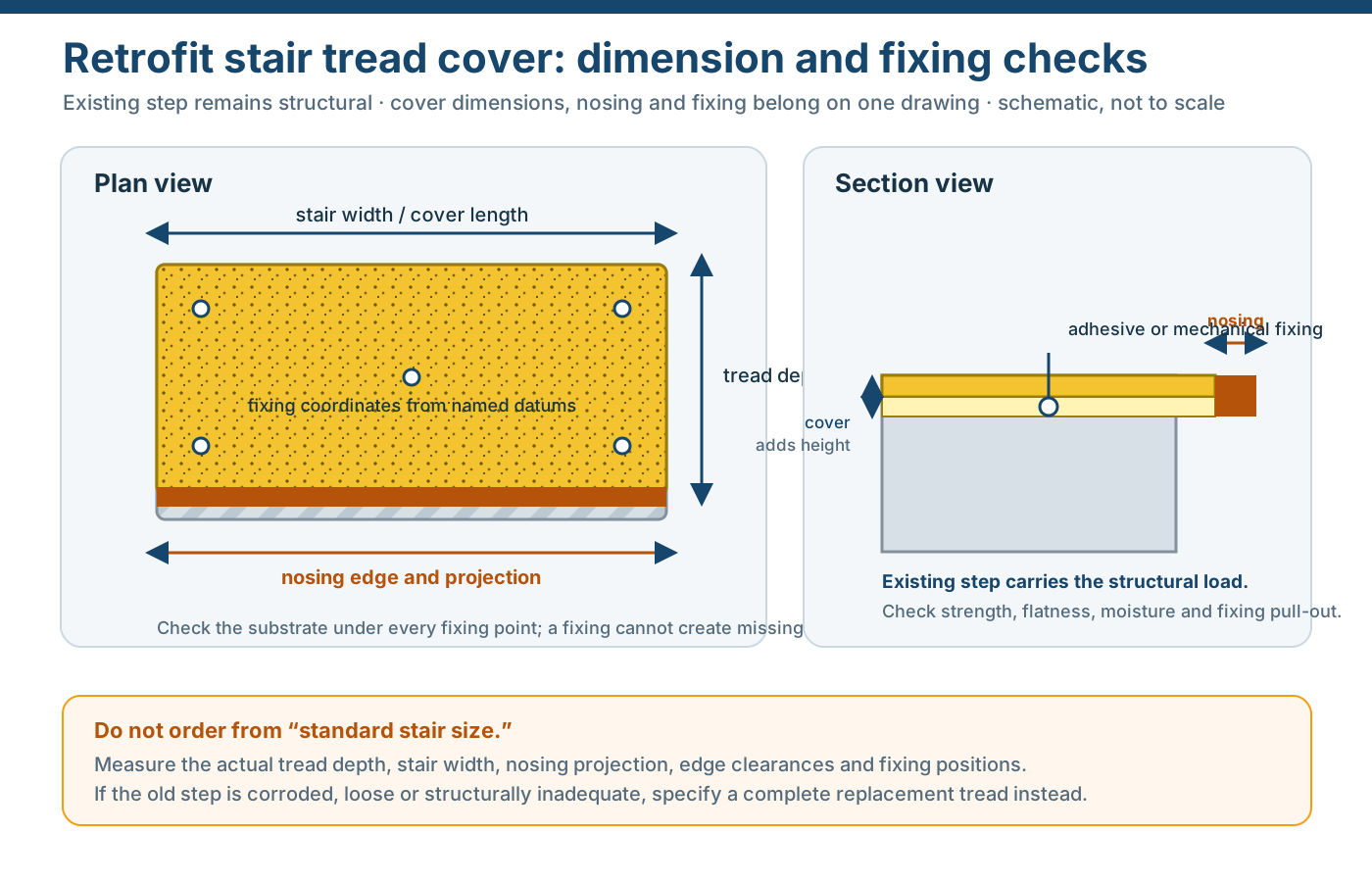
Retrofit covers
A retrofit cover changes the walking surface of an existing structural step. Its line should identify:
- existing substrate and whether repair is by others;
- cover format, dimensions and finished build-up;
- nosing, edge return and fixing method;
- first and last transition constraints;
- finished height and joint requirements.
Separate noses and edge details
An applied nose, edge cap, trim or sealing operation may be a separate product or operation. List the profile, material, length, face width, return, projection, finish, attachment and end treatment. An integral nosing belongs inside the tread or cover line instead.
Fixings, carriers and adhesives
A fixing line is not solved by the word “included.” State the type, material, hardware, quantity, hole or attachment method and who installs it. For load-bearing treads, distinguish the support carrier from the hold-down clip. For covers, distinguish adhesive or fasteners from substrate repair.
Use One Row for Each Distinct Item
The counting unit must follow the thing supplied. A tread is normally counted as a finished piece. A nose or trim may be counted by piece or length. A clip is counted by piece and hardware set. Adhesive may be counted by kit or stated quantity. A document and packing scope may be included or by others.
One practical commercial rule is:
If two items have a different piece mark, product construction, orientation, fixing pattern, unit or responsibility, give them different quotation lines.
Use the same piece mark on the drawing, quotation, production record and packing list. The quality and documentation guide explains how identifiers connect manufacturing and inspection records.
Illustrative mixed-piece structure
The table below is a format example, not a product specification or price.
| Line | Item | Location | Qty | Configuration basis | Scope |
|---|---|---|---|---|---|
| T-01 | Molded load-bearing tread | Stair 1 / steps 1–8 | 8 | Current stair drawing | Finished tread, nose, holes, edge treatment |
| T-02L | Pultruded left-hand tread | Stair 1 / step 9 | 1 | Current stair drawing | Direction, carrier end and mark controlled |
| C-01 | Retrofit cover | Stair 2 / steps 1–6 | 6 | Approved substrate survey | Cover, fixing method and finished edge |
| N-01 | Applied nose detail | Stair 2 / front edge | 6 | Approved nose section | Profile, attachment and end finish |
| F-01 | M clip and hardware | Stair 1 | By layout | Support-layout count | Type, material and fixing position |
| F-02 | Adhesive | Stair 2 | By method | Product-specific coverage | Supply owner and application responsibility |
| DOC-01 | Inspection record | Both stairs | By lot | Agreed inspection plan | Fields, sign-off and revision |
| PKG-01 | Marked export packing | Both stairs | By bundle | Approved packing plan | Protection, marks, labels and freight scope |
The final quantities must come from the actual drawing, support layout, fixing plan and approved package. Nothing in this example should be copied to a project as a standard.
Control Orientation, Handedness and Repeat Pieces
Two treads with the same outer dimensions can differ by:
- nose edge;
- top face;
- left and right hand;
- molded mesh direction;
- pultruded bearing-bar direction;
- fixing-hole positions;
- support or carrier offset;
- surface pattern orientation;
- finished edge treatment.
Do not use one generic row for a mixed left/right set unless the quotation clearly states that the pieces are symmetrical and interchangeable. Where each piece must be handed, use separate marks and quantities.
The FRP stair tread measurement guide turns the field survey into a piece schedule. The bearing-bar direction guide explains why directional pieces need more than an outline dimension.
Keep Fabrication and Fixing Visible
A finished stair quote can contain work that a simple panel rate does not show:
- cutting a source panel into the required piece shape;
- holes or slots for the specified fixing;
- openings, notches and supported cutouts;
- edge sealing or closing;
- forming or attaching the nose;
- applying holes, drilling or assembly;
- marking each piece for orientation and packing;
- checking dimensions, surface or documents.
These items belong in the quotation as included scope, a separate fabrication line or a clearly stated exclusion. The cutting and edge-sealing guide covers why a cut plan can consume more material than the sum of finished areas.

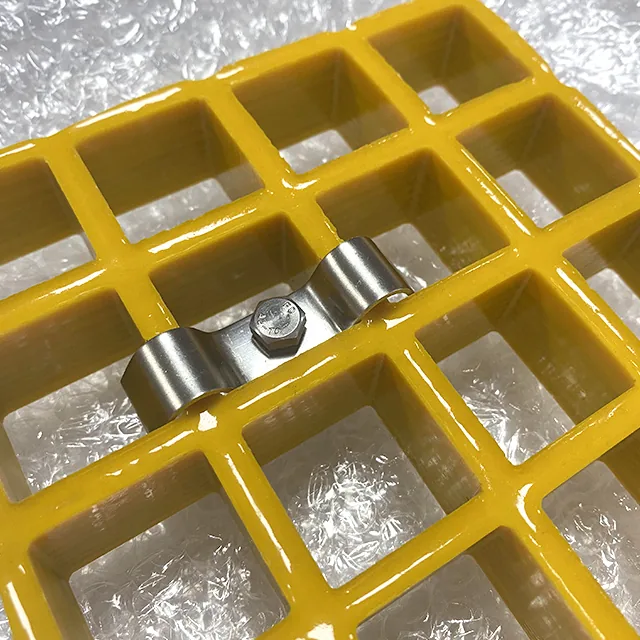
For clips, use the grating clips and fixings guide to match the type and panel geometry. The clip material guide separates the clip body from bolts, washers and support contact, while the clip layout guide turns support crossings, tread joints and removable pieces into numbered positions. A clip count is derived from that restraint layout; it is not a generic count per panel or per stair.
Separate Documents, Packing and Freight
The quote should state which documents are included:
- drawing revision and approved piece list;
- certificate of conformity;
- regular factory inspection record;
- requested dimensional or surface record;
- test method and report scope, where required;
- packing list and label format.
If a document is not agreed, do not treat it as present because the product is inspected visually. A factory appearance check is not automatically a slip, load or fire test.
Packing and freight can also change the delivered comparison. State bundle limits, piece protection, labels, pallet method, destination, delivery term and who accepts customs or site-handling responsibility. The packing guide explains why a mixed piece set needs a packing logic rather than one generic package.
Keep the commercial terms with the itemized scope
A complete quotation comparison also needs:
- currency and price basis;
- quotation validity;
- payment schedule;
- delivery term and named port or place;
- production and delivery lead time;
- freight, packing and insurance responsibility;
- approved sample or first-piece acceptance, where required;
- warranty terms applicable to the proposed product and scope;
- validity of alternates and exclusions;
- how taxes, duties or destination charges are treated.
An approved sample may control colour, surface texture, nosing and workmanship, but it does not replace dimensional or load evidence. A first-piece approval can also check the drawing, handedness and fixing layout before a repeated run proceeds. State whether either approval is included and what it will cover.
No universal commercial term or warranty period should be inferred from another supplier’s quote. Put these fields beside the piece list so a lower material subtotal cannot be mistaken for a lower delivered cost or a different support obligation.
Compare Two Quotations on the Same Scope
Before comparing totals, align the offers by piece and group:
- Match drawing revisions and quantities.
- Match product construction and dimensions.
- Match nosing, edge and surface details.
- Match fixing and carrier scope.
- Match fabrication and inspection.
- Match documents, packing and freight.
- List alternates and exclusions.
A cheaper offer may leave clips, drilling, edge sealing or packing out. A more expensive offer may include a carrier detail or document that the project has not asked to compare. Neither is a like-for-like price until the line scopes are reconciled.
Create a column in the comparison sheet for every required line:
| Required line | Supplier A | Supplier B | Resolution |
|---|---|---|---|
| Tread / cover price | Per piece or stated unit | Per piece or stated unit | Align unit and quantity |
| Nose / edge | Product and attachment | Product and attachment | Confirm equal section |
| Fixings | Type, material, quantity | Type, material, quantity | Confirm supply owner |
| Fabrication | Cuts, holes, sealing, marks | Cuts, holes, sealing, marks | Name omitted operations |
| Documents | Named scope | Named scope | Match method and revision |
| Packing / freight | Included or excluded | Included or excluded | Align delivery term |
This process is slow only once. It prevents a late purchase of omitted clips, holes or documents when the stair is already needed on site.
Common Mixed-Stair Quotation Errors
- One “stair set” hides different products: molded treads, covers and noses are not interchangeable.
- No piece mark: similar sizes are mixed during production and installation.
- Handedness omitted: opposite pieces are quoted as one undifferentiated quantity.
- Clip count guessed: the fixing schedule is not tied to the support layout.
- Adhesive assumed included: the substrate method and responsibility are unclear.
- Nose treated as a colour: the profile, attachment and structural role are missing.
- Fabrication buried in a panel rate: holes, edge sealing and marking are not visible.
- Document scope assumed: a regular inspection record is mistaken for a test report.
- Different revisions compared: quantities and dimensions come from different drawings.
- Freight omitted: a low material total becomes a more expensive delivered package.
Prepare the RFQ and Revision
Send:
- the current stair drawing and revision;
- a piece list grouped by tread, cover, nose, fixing and document;
- unique marks, quantities and units;
- support and carrier details for load-bearing treads;
- substrate and finished-height details for covers;
- orientation and left/right-hand requirements;
- requested surface, nose and edge treatment;
- fixing scope and who supplies or installs each item;
- required documents and packing;
- destination, delivery term and target date.
The finished-height guide is the companion for cover installation geometry. The nosing and end details covers the front-edge section and support boundary, while the stair landing layout guide separates landing panels, final treads, post bases and finished-piece marks.
Final Quotation Check
Before accepting a stair quote, confirm:
- each unique tread, cover, nose and edge has a mark;
- left/right-hand and orientation requirements are explicit;
- each fixing and carrier line has type, material and quantity;
- cutting, drilling, sealing and marking are included or excluded;
- documents, packing and freight use the same revision and delivery terms;
- the total can be reconciled to the stair drawing without guessing;
- the quotation and production schedule use one current piece list.
That is the difference between buying a complete set of identified stair components and buying a package whose missing details only appear after production.
Comparison rules
Five Rules for a Usable Stair Quotation
A complete line is more useful than a low total that hides critical scope.
- Every product stands on its own line — The quotation should separate load-bearing treads, retrofit covers, noses, carriers, clips and adhesives when their product or responsibility differs.
- Every distinct piece has a mark — Similar outlines can have different substrate, nose, hole or handedness requirements. Use piece marks instead of a single average description.
- Quantity uses a stated unit — State pieces, sets, pairs, linear length, boxes or assemblies. A count without its unit is not a reliable commercial quantity.
- Fabrication is not invisible — Cuts, holes, edge treatment, sealing, marking and assembly are scope items and can affect material use and production time.
- Exclusions are part of the comparison — Steelwork, installation, site repair, testing and freight remain outside the product unless the written quotation includes them.
Send the list
Send the Drawing, Piece Marks and Quantities
Group mixed treads, covers, noses and fixings without losing their individual roles.
- Molded and pultruded grating produced in house
- Full panels or factory cut-to-size pieces
- No fixed minimum order quantity
FRP Stair Tread Quotation FAQs
What is an FRP stair tread quotation list?
Why not quote the stair by square metre only?
How should mixed treads and covers be listed?
How should left-hand and right-hand pieces be recorded?
Are clips included with the tread?
Should adhesive and fasteners be on the quotation list?
How can I compare two stair quotations?
What should I send with a mixed stair piece list?
This content was prepared and reviewed by Dengtai Industry’s technical and production team using the project conditions, available product data and applicable documents. Limits that require design, testing or approval are identified in the content. Content last checked: