Timber stair substrate review
FRP Covers for Timber Stairs: Moisture and Fixing
Confirm that the timber tread and support remain sound before adding a non-load-bearing cover. Record moisture, movement, rot, fixing pull-out, drying path and finished stair geometry before attachment.
Prepared by
Dengtai Industry
Published
·
Reviewed

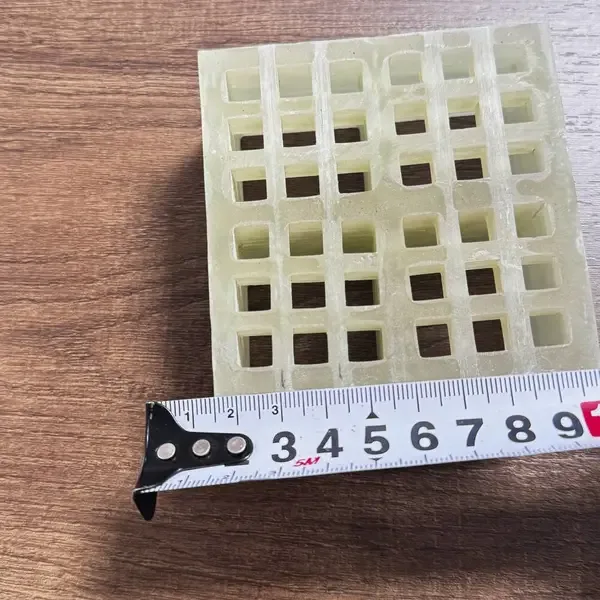
FRP tread-cover application reference. This photograph does not establish the timber substrate, moisture condition or fixing suitability. Photo: Dengtai Industry.
An FRP cover can improve the walking surface of a timber stair only when the existing tread remains structurally sound and can accept the fixing. This page treats the cover as a non-load-bearing surface layer; the timber tread and supports remain structural. Timber is not a uniform substrate: old boards can vary in moisture, hardness, grain, support and condition within one flight. The cover selection must follow the actual timber and the actual fixing locations.
If the timber cannot remain in service, the next route is repair, replacement or a complete load-bearing tread with its own support design. The cover-versus-load-bearing-tread guide explains that scope change. The general tread-cover guide explains the cover format, while the stair nosing comparison helps decide whether a full cover or only an edge repair is justified.

Record Moisture and What Is Moving
Wood changes dimension with moisture, but that general behavior does not excuse a moving stair or establish a safe tolerance. Record moisture at several points where the meter can reach, plus visible leaks, damp patches, recent weather and changes in heating or ventilation.
Observe the movement safely. Is there a sound, a visible gap, a springy tread or a changed joint at the wall or support? Look for the location and time of occurrence. Senmit’s movement guide correctly treats sound, finish seam, tread-to-support separation and surrounding construction as different symptoms. Do not force or repeatedly load a stair that appears loose.
If the project repairs or replaces timber boards, allow the new timber to reach the service condition required by the repair specification before final measurement and fixing. The acclimatisation advice in general timber guides is useful for that new material, but a local domestic moisture range is not a universal acceptance value for every species, finish, project or climate.
Check Rot, Splits and Actual Board Support
Inspect every board and the fixing area. Record rot, splitting, major knots, gaps, delamination, soft spots and board ends that are unsupported. Check whether the tread bears on sound members and whether the side or front edge can accept the specified cover detail.
Do not push a screw or adhesive into a gap and assume the cover is fixed. Every fixing must reach sound timber, and the approved attachment must allow for the timber and cover movement without forcing distortion. A moving or damaged tread belongs in repair review, not a cosmetic cover order.
Choose the Attachment From the Actual Timber
Adhesive can distribute contact over a prepared surface, but compatibility, moisture, movement and cure must be right. Mechanical fixing can provide accessible fasteners, but the screws need adequate timber thickness and edge distance, with tested pull-out behavior and protected holes. The manufacturer’s attachment detail applies to its product; a generic statement to “screw or glue” is not a specification.
The Stairs Guide’s timber article explains that moisture and grain movement are normal material behavior but depend on the environment and construction. We use that to reject the idea of a universal moisture value or generic fixing rule. The selected cover system and the project’s structural review define the requirement.
Dry-fit the covers before final fixing. Mark the piece boundaries and fixing locations, confirm every fastening reaches sound timber, and check movement allowance, edge gaps, moisture escape, finished rise and landings. After installation, inspect fixing condition, seals, rocking or spring and the drying path. Record the acceptance owner and any item that must be rechecked after a heating, wetting or seasonal cycle.


Do Not Let the Cover Create a Damp Trap
A continuous cover changes where water can evaporate. Edges, joints, cleaning methods and inspections should let moisture escape rather than collect against timber. This is especially important outdoors, near doorways, under drip lines and where the stair has had previous water damage.
The cover should be fully supported without crushing the timber, trapping debris or hiding a soft patch. If a design requires open drainage slots or removable sections, those details must come from the product and project, not from site improvisation.
Approve the surface and nosing as physical samples. Wet, mossy, oily or regularly cleaned timber stairs need slip evidence that matches those conditions; texture appearance alone is not enough. A high-contrast or luminous nosing can improve edge visibility, but it does not establish slip, fire or egress performance. The surface guide and nosing-detail guide keep texture, visibility, fixing and evidence separate.
Confirm Fire, Exposure and Movement Duty
An indoor timber stair may form part of an escape route; an exterior stair also needs UV, rain, cleaning and freeze-thaw inputs. Record the required fire and smoke basis, chemical cleaning, expected thermal and moisture movement and whether static-sensitive equipment is nearby. These duties may change the resin, surface, fixing, isolation and documents.
Use the fire-rating guide, resin-selection guide, thermal-movement guide and anti-static guide where applicable. A product name does not prove the fire, slip or electrical performance of the completed stair.
Measure the Individual Tread and Finished Stair
Old timber stairs often vary in width, tread depth, board layout and nose profile. Measure the actual treads rather than extrapolating from one step. Then add the cover thickness and nose projection to the section and compare the finished rise, headroom, first and last landings, door clearance and adjacent trim.
The cover’s thickness and fixing detail are not interchangeable with a generic stair board. A cover that restores grip can still cause a new trip if its front edge, side gaps or added height do not fit the stair. Keep the structural base and finished geometry in the same approval.
Our Factory View: We Need the Timber Facts, Not Just Measurements
We can produce factory-cut FRP covers to measured tread sizes, approved nosing, holes and piece IDs. Before quotation, we need photographs of the tread and fixing area, moisture notes, evidence of movement or repair, the proposed fixing detail and the finished landing geometry.
When the timber condition is uncertain, the correct output is a marked hold point rather than a plausible adhesive sentence. We would rather keep the cover scope separate from repair and replacement than imply that a new surface has fixed the timber below it.
Survey vocabulary
Timber Stair Cover Inputs
- Moisture content
- The water held in the timber at the time of survey. Readings vary by location, product, finish and service environment, so they are project inputs rather than a universal acceptance value.
- Movement
- A change in gap, sound, position or shape under use or changing moisture. The observed symptom does not by itself establish whether the cause is finish, tread, support or surrounding construction.
- Rot
- Biological deterioration of the timber, often associated with moisture, poor drying or trapped water. It reduces the material available for load and fixing.
- Fixing pull-out
- The loss of fastener retention in the timber. A screw does not become sound by tightening it into a void, split or decayed patch.
- Moisture path
- The route by which water or vapour can leave the finished cover and timber rather than collect at an edge, joint or fixing.
- Movement allowance
- The detail that allows the cover, timber and fixing to behave as the project and manufacturer require without forcing distortion.
Before design
When a Timber Stair Is Ready for a Cover Review
Specify this if…
- The timber tread and supports remain structurally serviceable.
- Moisture readings and recent leaks can be recorded.
- Rot, splits and board gaps have been mapped.
- Every proposed fixing reaches sound timber.
- The cover and attachment detail permit drying and inspection.
- Finished rise, nosing, landings and clearances can be checked.
Look elsewhere if…
- The tread is soft, split through, loose or visibly deflecting.
- A fixing lands in rot, a gap, a knot or a damp patch.
- A generic adhesive is being used without a compatible product detail.
- The cover would trap water against the timber.
- The finished height would create an unacceptable stair transition.
- The entire timber structure needs repair or replacement.
Decision boundary
Surface Cover, Repair or Replacement
| Route | When it may fit | Required evidence |
|---|---|---|
| FRP tread cover over sound timber | The substrate is dry enough, sound and able to receive the fixing | Product-specific attachment, movement allowance and drying path |
| Repair of local timber damage | A limited area can be repaired without changing the structural duty | Repair method, cured condition and ability to hold the cover |
| Mechanical fixing | Accessible timber of suitable thickness and condition | Hole preparation, edge distance, pull-out and sealing |
| Adhesive fixing | A compatible product, substrate condition and cure environment | Surface preparation, moisture, movement and cleaning access |
| Replace the timber tread | The existing member is rotten, loose or otherwise unsuitable | New structural member, support and complete stair geometry |
Field record
Fields for a Timber Stair Cover Survey
| Survey field | What to record | Why it matters |
|---|---|---|
| Stair and step ID | Flight, step, room or exposure side and drawing revision | Each differing piece and moisture condition remains traceable |
| Timber construction | Species if known, board construction, grain and support arrangement | Attachment and movement behavior depend on the real member |
| Moisture | Readings at several points, meter method, leaks and damp marks | Identifies active moisture and areas needing repair or drying |
| Soundness | Rot, splits, knots, delamination, loose boards and support gaps | Shows where fixing or load capacity may be absent |
| Movement | Creak, spring, visible gap, seasonal change and recent renovation | Prevents a loose connection from being treated as cosmetic |
| Fixing points | Sound timber, pilot hole, edge distance, pull-out and access | The cover must remain attached to a suitable substrate |
| Attachment system | Product-specific adhesive, mechanical or combined detail | A generic strip or screw cannot be assumed to suit the assembly |
| Moisture escape | Edges, joints, ventilation, drainage and cleaning | Reduces trapped moisture and timber deterioration |
| Finished geometry | Cover thickness, nose, rise, landing and clearance | Completes the stair retrofit review |
Seven-step check
How to Record Moisture and Fixing on a Timber Stair
Look for rot, splits, loose boards, movement and any recent water damage.
Note left, centre and right values plus the meter method and recent weather.
Confirm that every fastening area reaches sound timber.
Record width, depth, nose, rise, board gaps and variations.
Use a product-specific adhesive, mechanical or combined method compatible with moisture and movement.
Detail edges, joints and cleaning so the cover does not trap moisture.
Include cover thickness, nose, rise, landings, door and headroom clearances.
Before release
Timber Stair Cover Checklist
- Timber structure accepted — A responsible party confirms that the tread and support remain serviceable.
- Moisture recorded — Multiple readings, leaks and the meter method are documented.
- Rot and splits mapped — Unsound material and gaps are marked at every fixing zone.
- Movement observed safely — Symptom, location and timing are recorded without unsafe testing.
- Every tread measured — Width, depth, nose, rise and variations are listed.
- Fixing reaches sound timber — The exact attachment detail suits the substrate and access.
- Movement allowance confirmed — The product detail accommodates timber and assembly movement.
- Moisture escape defined — Edges, joints, cleaning and inspection allow drying.
- Project service duty defined — Egress, fire, chemical, movement and static requirements are recorded.
- Finished geometry checked — Cover thickness, rise and landing transitions are reviewed.
- Repair and supply separated — Timber repair, cover fabrication, fixing and installation scope are explicit.
Structural boundary
What the Cover Must Not Hide

A cover is not timber repair
It does not restore rotted timber, close a structural split or repair a loose support.
A screw is not a moisture solution
Fastener selection must follow the timber, cover and environment; sealing and drainage must be explicit.
A flat cover is not a vapour strategy
The project must explain how moisture can leave the assembly and how it will be inspected.
A moving tread is not automatically the cover's fault
Movement can come from the timber, support, fixing or surrounding construction and needs the correct owner.
Show the base and fixing
Send the Timber Stair and Moisture Record
- Molded and pultruded grating produced in house
- Full panels or factory cut-to-size pieces
- No fixed minimum order quantity
Timber Stair Cover Questions
Can an FRP cover carry the load of a failed timber tread?
Can FRP covers be installed over timber stairs?
What moisture reading is acceptable?
Can I screw an FRP cover to timber?
Is adhesive better than screws on timber?
What causes a timber tread to move or creak?
Does a solid cover trap moisture?
This content was prepared and reviewed by Dengtai Industry’s technical and production team using the project conditions, available product data and applicable documents. Limits that require design, testing or approval are identified in the content. Content last checked: