Cut-to-size ordering
Ordering Cut-to-Size FRP Grating from a Piece List
A dimensioned sketch is not yet a production list. Tie each finished piece to one drawing revision, direction, opening, edge treatment, tolerance and mark so the factory and installer are checking the same object.
Prepared by
Dengtai Industry
Published
·
Reviewed

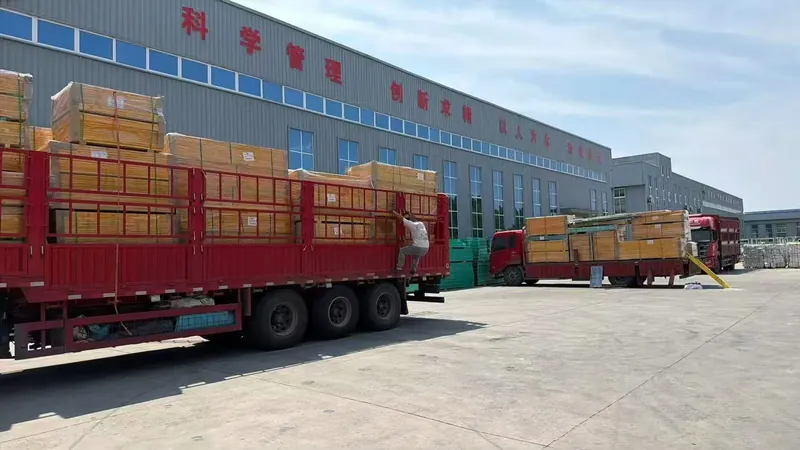
Factory-cut pieces can be checked and packed by piece identity; the drawing alone does not provide that control. Photo: Dengtai Industry.
Ordering terms
What Makes an FRP Grating Piece List Production-Ready?
The list must control identity and production decisions as well as dimensions.
- Piece list
- The controlled production list of every finished grating piece, its mark, quantity, product configuration, dimensions, orientation, openings, edge treatment, tolerance and packing identity.
- Drawing datum
- The fixed point or line from which dimensions and opening positions are measured. Every critical dimension should refer to it rather than an arbitrary nearest edge.
- Production basis
- The evidence used to freeze dimensions, such as a controlled design drawing, a measured as-built record or a declared combination of both with the approving reference identified.
- Piece mark
- A unique identifier such as P-03A that connects the piece list, drawing, inspection, label and installation location.
- Finished size
- The required delivered dimension after cutting and edge preparation. It is not the nominal full-panel size and is not the cutting-stock size used before blade kerf is removed.
- Orientation
- The top face, mesh direction, handedness or pultruded bearing-bar direction of a piece. Two pieces with equal outlines can still be different when orientation differs.
- Edge treatment
- The requested finish to a cut or drilled face, such as edge sealing. It protects the exposed face; it does not restore bars removed by an opening.
When to use it
When Cut-to-Size Grating Needs a Controlled Piece List
Use one when several pieces, openings or direction-sensitive panels must arrive ready to identify.
Specify this if…
- The platform, walkway or cover has more than a simple rectangle and needs several finished pieces.
- Pipe, column, equipment or access openings have to be formed at controlled positions.
- Pultruded grating requires bearing-bar direction to remain visible through fabrication and packing.
- The site should receive checked, marked pieces rather than full panels for local cutting.
- A repeat order or replacement piece needs to match an existing drawing and product configuration.
- An existing frame, support arrangement, pipe or opening must be measured before the production dimensions can be frozen.
Look elsewhere if…
- Only a generic full-panel price is being requested and no finished layout exists.
- The drawing contains dimensions without a datum, revision or quantity.
- An opening is being treated as a shape-only cut while its support path is unknown.
- The buyer expects factory cutting to correct an unmeasured structure after the panels are made.
Documents
Layout Sketch, Drawing and Production Piece List Compared
Each has a different job; none should be mistaken for the next.
Swipe horizontally to view all columns.
| Document | What it can show | What it still leaves unresolved |
|---|---|---|
| Layout sketch | Approximate arrangement, piece outlines and relationships | Scale, revision, units, exact opening coordinates, support extent and cut scope |
| Dimensioned drawing | Finished geometry and dimension chains | Piece-level quantities, orientation notes, edge faces, tolerances or packing identity |
| Production piece list | Every unique piece, quantity, configuration, datum, direction, opening, edge, tolerance and mark | Items outside the approved supply scope are stated as exclusions instead of assumed |
Build sequence
Turn a Grating Layout into an Approved Piece List
Resolve the drawing basis first, then build identity, geometry, openings and release control.
Freeze the revision, panel schedule, support layout and datum before adding the piece list.
Give every different outline, orientation, opening or edge condition its own piece mark.
Record size, quantity, unit, top face, handedness and bearing-bar direction where relevant.
Position every opening from the datum and identify which faces require sealing or another agreed finish.
State tolerance, first-piece check, marks, labels, packing method and the records that travel with delivery.
A Piece List Is More Than a List of Sizes
Cut-to-size FRP grating begins with a layout, but production needs a different level of detail. A line saying “600 × 1000 mm, 8 pieces” does not say which product row is being cut, which face is up, whether the pieces are handed, where an opening sits, which face is sealed or what mark the installer should see on arrival. Those decisions can exist elsewhere on the drawing, but they become fragile when the order moves between estimating, fabrication, inspection and packing.
The useful piece list is the bridge between design and production. It uses one drawing revision, one datum and one identifier per unique piece. It turns the geometry on the drawing into an object with a quantity, orientation, opening, edge and acceptance condition. The factory can then cut, check and pack against the same record rather than interpreting the drawing repeatedly.
This page focuses on the ordering document. The cutting and edge-sealing guide explains how to cut and seal; the fiberglass grating panel guide explains full-panel configurations; and the factory-cut versus site-cut comparison uses the finished job to evaluate where fabrication should happen.

Start With the Drawing Revision and Datum
Before adding piece numbers, establish which drawing is being quoted. The panel layout, support plan and opening positions should have the same revision. If the drawing has been updated but the cut list has not, the apparent dimension conflict is not a factory problem; it is an unresolved order.
Measure every critical dimension from a defined datum. The nearest panel edge is not reliable when several pieces are nested or when a frame has a tolerance. An opening may be shown 350 mm from the left side, but production needs to know which left side, which drawing view and which finished-piece mark. The same applies to notches around columns and cuts relative to bearing bars.
Use stated units throughout. Mixing millimetres and inches, decimal inches and fractions, or finished size and nominal size creates preventable errors. Convert all project inputs to one controlled list, then show the original unit where the buyer needs it for cross-checking.
Establish a verified as-built basis for retrofits
A new installation can usually start from an approved design drawing. A retrofit around an existing frame, pipe, column, machine or support must start from what is actually present. The drawing may show the intended condition, but it does not prove that the steel is square, the pipe is where the survey says, or the available bearing is what the original design assumed.
Before freezing a retrofit piece list, re-establish the datum and record the measurements that control fit. These commonly include the frame opening, support positions, pipe or equipment centres, obstructions, out-of-square condition and changes in elevation. Photographs support the record, but a dimensioned measured sketch or approved template is what production can check.
State the production basis on the order. If the buyer is supplying a drawing-only dimension, record that assumption rather than presenting it as an as-built measurement. If factory cutting is released from measured data, identify who measured it and which record was approved. This keeps responsibility visible when the structure and drawing disagree.
Every unique piece needs a unique mark
Two pieces can have equal outside dimensions and still be different. One can be the top face opposite the other, one can have an opening on the opposite corner, or one can carry a bearing-bar direction that must not be rotated. They should not share one generic mark.
Use a short identifier such as P-01, P-02A or R-03. Keep the mark visible in the drawing, cut list, first-piece inspection, label and packing list. If the site layout uses its own piece numbers, translate them once and keep the mapping controlled rather than using two identities that can drift apart.
Control Product Configuration and Direction
The grating product row is part of the finished piece. Record molded, pultruded or mini-mesh construction; height or bearing-bar section; mesh or bar spacing; resin; surface; colour; and the source-panel format where it affects nesting. A cut list that names only dimensions can be technically complete while still producing the wrong piece.
Direction is especially important for pultruded grating. The bearing bars run in one direction and the ends must reach the supports. Mark that direction against a project datum on every affected piece and preserve the mark through cutting and packing. A pultruded panel that is rotated after fabrication can lose the support condition the layout assumed.
Molded and mini-mesh panels do not have the same single bearing-bar direction, but top face, surface pattern, joint layout and handedness can still matter. The pultruded cut-end guide and mini-mesh cutting guide show the additional checks for those structures.
Keep finished size separate from cutting stock
The piece list should normally show the finished size that must arrive on site. The factory then plans source-panel nesting, blade allowance and edge trim around that controlled dimension. If the buyer adds an allowance to every finished size, production can remove it twice, including when the allowance differs between blades or cut routes.
Use a cutting-stock size only when the order is genuinely for supplied material that will later be finished to a different dimension. In that case, show both the stock size and the final size, state who owns the remaining cut and record the point at which the finished dimension is checked. Never use one dimension field for both conditions.
Show Openings, Notches and Their Support
An opening is more than a shape on a panel. Mark the opening’s size, shape and coordinate from the datum, the object it has to clear, and the support that will exist around the finished cut. A round hole drawn over a panel does not reveal which bars are cut, how much bearing remains or whether a frame is required.
For columns and equipment legs, show clearance on all sides and the actual centre position. For pipes, use the measured outside diameter or the project-required clear opening rather than the nominal pipe size alone. Note any notch that has to fit over a support, together with the edge or bearing condition that remains.
The factory can form the agreed geometry; the project must approve the support path. When a cut removes bars, the piece may need a different panel split, additional framing or a support under the opening. The molded cutout and support guide explains why edge sealing cannot replace that review.
When an opening size follows equipment operation, lifting or withdrawal rather than a static pipe outline, use the equipment-opening and finished-piece schedule guide before releasing the piece list.
Define Edge Treatment Across Every Exposed Face
The cut list should say which faces are treated: the full perimeter, selected cut edges, drilled hole walls, notch faces or a combination. It should also identify the sealer requirement, application stage and inspection record. “Sealed edges” without a face list can mean three different scopes.
Sealing protects exposed laminate from moisture, chemical contact and handling damage. It does not reproduce the untouched factory surface, reconnect a bar cut by an opening or restore capacity. A piece requiring immersion or severe chemical service may need a project-approved coating or fabrication method beyond a generic field sealer.
The edge-sealing section on the cutting guide sets out the clean–apply–cure–inspect sequence and the record fields. Keep the sealer batch, cure conditions and inspection result attached to the relevant piece marks.

Tolerance, First Piece and Packing Are Part of the List
The buyer and factory should agree which dimensions are controlled and what acceptance condition applies. Do not copy one supplier’s field tolerance into every project. Shop equipment, field access, opening size, frame clearance and installation method all affect what is practical and necessary.
The first piece is a valuable control when a run repeats or a shape is new. It allows production, the buyer and the inspector to check the piece against the approved list before the same interpretation is repeated. The first-piece record should show dimensions, orientation, opening, edge condition, seal coverage and marking.
Packing completes the identity chain. If the factory is asked to produce marked packets or labels, that method should be confirmed and quoted. Otherwise, bulk packing may be correct for a controlled workshop but unsuitable when similar pieces arrive at a remote site. The full-panel versus cut-piece quotation guide explains how nesting, piece marks and packing affect the delivered comparison.
Revise the List Before Cutting, Not by Fitting on Site
Late changes need a controlled route. A changed opening position or piece width may look like a small site adjustment, but it can alter which bars remain, how the piece nests, which faces need sealing and whether the packing label still matches the installed location.
When a dimension changes, identify the affected piece marks and stop the relevant production or packing operation. Issue a revised line or piece drawing, show what superseded the previous value and identify every quantity affected. Do not let a site team trim pieces to a new measurement while the original packing list remains in circulation.
A simple rule helps: every post-approval change returns to the piece record, even when the outside size stays the same. Changing the top face, opening centre, bearing direction, sealer, tolerance or label can make the delivered object different even if its length and width do not change.
For an as-built difference discovered after delivery, record the measured condition, affected mark and proposed correction. The correction may be a controlled site cut or a replacement piece. Either route needs the support, edge protection and identification checks repeated.
A Practical Piece-List Workflow
Start with the installation layout and mark the support lines. Add the actual panel edges and opening coordinates. Split the area into unique pieces using geometry and direction, not equal areas. Assign marks only after the splits are stable.
When the marks are set, add the product configuration and quantity. For each line, show the finished dimensions and orientation. Add every opening and notch, with its datum and clearance. Define edge treatment and tolerance, then state whether a first-piece inspection, dimensional record, label or marked packet is required.
Finally, compare the production list with the packing list. Every installed piece mark should be traceable to a delivered piece or an explicitly agreed substitute. A missing mark should stop the receiving check rather than force the installer to identify the piece from shape.
The aim is not to create paperwork for its own sake. It is to ensure that one drawing, one piece mark and one acceptance record survive through nesting, cutting, sealing, inspection and installation.
Required fields
Fields a Cut-to-Size FRP Grating Order Must Expose
These fields let production and the receiving team check the same item.
Request a Project Quote| Specification | Value |
|---|---|
| Drawing revision | Unique revision and date The quotation, piece list, first-piece check and packing list should refer to the same document. |
| Dimension basis | Drawing or verified as-built Identify who measured or approved the basis and which recorded survey, template or marked-up drawing supports it. |
| Product configuration | Molded, pultruded or mini-mesh Include height or bar section, mesh, resin, surface, colour and source-panel format. |
| Finished piece | Mark, quantity, length × width, unit Use the delivered finished size. Do not add blade kerf unless a cutting-stock dimension is expressly requested. |
| Direction | Top face and bearing direction For pultruded grating, show the bearing-bar direction against a project datum. |
| Openings | Shape, size, coordinates and object cleared Show the pipe or column clearance and the support reviewed around the opening. |
| Edge treatment | Faces, sealer requirement and application stage State the full perimeter, cut edges, drilled walls or agreed combination. |
| Tolerance | Project-required acceptance Do not assume that another supplier’s tolerance applies to the ordered pieces. |
| Packing identity | Piece mark, label and package method Confirm any marked packet or numbering method in the packing scope. |
Production planning
What Changes Nesting, Handling and Cut-Piece Identity
Small layout changes can create a different production and packing problem.
Swipe horizontally to view all columns.
| Piece-list condition | What changes production | What the list must expose |
|---|---|---|
| Repeated identical pieces | Nesting can improve and a single approved first-piece check can control the run | One representative piece, quantity and first-piece acceptance |
| Small changes to width or opening position | Pieces may no longer share a source-panel layout or cut setup | Separate marks and the dimension that creates the distinction |
| Handed or rotated pieces | A visually similar outline can be installed the wrong way | Top face, direction, left/right or rotation note on the drawing and piece line |
| Large or shaped opening | The panel split, remaining bars and support may change | Opening coordinate, bars crossed, support frame and approval reference |
| Sealing before packing | Cutting and sealing become a linked production route with cure and handling steps | Named faces, sealer, cure instruction and inspection record |
| Project-marked packing | Labels and payload must match the piece list rather than a bulk panel count | Confirmed packet method, label content and packing list |
Order types
Cut-to-Size Piece Lists in Real Grating Work
The outline may match while direction, opening support and edge treatment do not.
Retrofitting a tower or vessel opening
Openings still need a structural and field-support review; the list controls the shape and clearance but not the missing support.
Pultruded walkway with directional panels
The bearing-bar direction and both end supports belong on each relevant piece, not only in a general note.
Mini-mesh platform with small openings
Smaller mesh creates more edge detail and tighter cutting checks; the upper and lower mesh should remain identifiable.
Trench covers with lifting access
Cover dimensions, lifting points, frame bearing and removable-piece identity should survive into the cut list.
Replacement piece from an earlier order
Match the previous product row, edge treatment and orientation before pricing the replacement; outer dimensions alone may be insufficient.
Factory-cut versus site-cut evaluation
If the making location is still undecided, compare the completed route rather than the cutting line alone.
Before approval
What to Send With a Cut-to-Size FRP Grating Inquiry
A complete package removes assumptions before the first cut.
- Drawing and revision — Current layout, product schedule, support plan and a unique revision that every later check can reference.
- Datum and units — One fixed measurement origin, all dimensions in stated units, and no conflicting dimension chains.
- Piece register — Unique mark, quantity, product family, thickness or bar section, mesh, resin, surface and colour.
- Geometry and orientation — Finished length × width, top face, handedness, rotation and pultruded bearing-bar direction.
- Openings and notches — Shape, coordinates, clearance, interrupted bars, remaining continuous bars and support around the opening.
- Edge and tolerance — Faces to be sealed, sealer requirement, cutting quality, first-piece check and dimensional acceptance.
- Identification and packing — Piece marks, label content, requested packet method, edge protection and packing list.
- Documents and exclusions — Required inspection, certificate, drawing issue, trade term and supply items outside the order.
Factory rule
Approve the Piece, Then Approve the Production Run
The first piece proves the list, method and inspection refer to the same object.

A sketch can start the conversation
It becomes a production list only after datum, revision, piece marks, quantities and orientation are resolved.
A clean cut is not an approval
The finished piece still needs the correct support, sealed faces and accepted dimensions.
The packing list must match the drawing
Site value comes from receiving identifiable pieces whose marks agree with the approved layout.
Order route
From Marked Layout to Packed Cut-to-Size Pieces
Missing or conflicting inputs are returned before production rather than corrected after cutting.
Provide the current drawing, support plan, cut list and opening positions with all dimensions from a stated datum.
The review checks product configuration, orientation, units, piece marks, openings, edge faces and tolerances.
The source-panel layout and loss are reviewed before the finished-piece price and scope are confirmed.
The agreed first-piece check verifies dimensions, orientation, opening, edge condition and marking against the list.
Agreed faces are treated, cured where required and packed with the matching drawing revision and packing list.
Request a review
Send the Drawing, Piece List and Edge Scope
Include the support plan and opening datum so the cutting review can start from the real installation.
- Molded and pultruded grating produced in house
- Full panels or factory cut-to-size pieces
- No fixed minimum order quantity
Cut-to-Size FRP Grating Piece-List Questions
What should a cut-to-size piece list contain?
Can I send a sketch instead of a dimensioned drawing?
Should I add blade kerf to the cutting list?
What is the difference between a cut list and a packing list?
Can you quote from nominal panel sizes?
Does edge sealing make a cut panel structurally equivalent to an uncut panel?
This content was prepared and reviewed by Dengtai Industry’s technical and production team using the project conditions, available product data and applicable documents. Limits that require design, testing or approval are identified in the content. Content last checked: