Molded grating receiving guide
Receiving Molded FRP Grating: Dimensions, Finish and Identification
Inspect the consignment as an ordered product before it enters storage. Confirm identity, quantity, dimensions, condition, cuts, edge treatment, piece marks, packing and agreed documents.
Prepared by
Dengtai Industry
Published
·
Reviewed

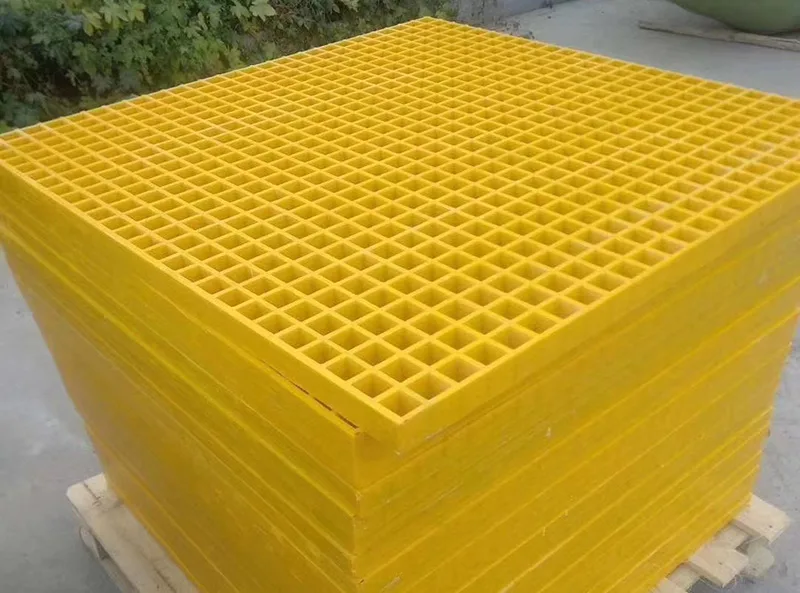
Inspect the package and its identification before pieces are moved or mixed into site storage. Photo: Dengtai Industry.
Inspection terms
Receiving Check, Acceptance and Performance Test Are Different
Use separate criteria for what arrived, whether it matches and what performance it has been shown to provide.
- Receiving inspection
- The checks performed when a consignment arrives, before acceptance into storage, construction or installation. It compares the delivered item with the order and agreed acceptance criteria.
- Product identity
- The connection between the delivered piece and the purchase order, product row, drawing revision, piece mark and packing entry.
- Actual dimension
- The measured length, width, depth, mesh or opening recorded with the instrument and datum. It is distinct from a nominal product description.
- Appearance condition
- Visible observations such as cracks, chips, voids, delamination, exposed fibers, surface finish and color. The acceptance criterion should come from the order or project specification.
- Transit damage
- Damage occurring after release and during handling or transport. It should be recorded separately from a manufacturing nonconformity so responsibility can be investigated.
- Hold
- A controlled status for an item whose identity, condition or evidence cannot yet be accepted. The item should be isolated and preserved while the issue is reviewed.
- Acceptance criterion
- The stated requirement against which a receiving observation is judged. If no measurable criterion exists, record the condition and request a disposition rather than inventing tolerance.
Receiving map
What to Inspect on a Molded Grating Delivery
The visible item, physical measurements and documents support different parts of the decision.
Swipe horizontally to view all columns.
| Check | What to verify | Why it matters |
|---|---|---|
| Identity | Purchase order, product row, drawing revision, piece mark and packing entry. | A similar-looking panel is not proof that the correct item arrived. |
| Quantity | Count bundles, panels or pieces and compare the packing list. | A shortage must not be hidden by a mixed or incomplete package count. |
| Dimensions | Length, width, depth, mesh and finished-piece dimensions using the agreed datum. | A nominal label does not replace measured values. |
| Appearance | Cracks, chips, voids, delamination, exposed fibers and overall visible condition. | Surface observations help identify damage but do not prove structural capacity. |
| Surface and color | Grit, concave finish, color reference and other agreed visible fields. | Appearance approval needs the agreed lighting, sample or color reference. |
| Fabrication | Cut sizes, openings, piece marks and sealed edges against the approved schedule. | A correct panel with the wrong cut or orientation is still a wrong delivered piece. |
Release decision
When to Accept, Hold or Report a Grating Consignment
A clear receiving record keeps an unresolved item out of installation stock.
Specify this if…
- Use this checklist before any full panels, factory-cut pieces or mixed delivery is moved into general storage.
- Use it when multiple sizes, openings, surfaces or piece marks are present in one shipment.
- Use it when the purchase order specifies dimensional records, edge sealing or document requirements.
- Use it when the consignment shows damage, shortage or unclear identification.
Look elsewhere if…
- Do not accept the order from the invoice alone without checking the physical pieces.
- Do not judge dimensions from a photograph.
- Do not treat color mismatch as a defect until it is compared with the agreed sample and lighting.
- Do not mix a held item into the installation stock.
- Do not assume a visual appearance check is a load, fire, slip or chemical test.
Checklist
Eight Checks for Received Molded FRP Grating
Record the observation and its source rather than relying on a general impression.
Swipe horizontally to view all columns.
| Receiving field | What to check | Record |
|---|---|---|
| Order identity | PO, supplier order, packing-list reference and drawing revision. | The identifiers that were actually compared. |
| Quantity | Bundles, pallets, full panels and finished pieces. | Expected and received quantities with shortage or excess. |
| Configuration | Construction, depth, mesh, resin basis, surface and color reference. | The confirmed product basis or any discrepancy. |
| Dimensions | Panel or piece dimensions plus the specified inspection points. | Instrument, datum and measured values. |
| Mesh and opening | Pitch, bar size where specified, clear opening and orientation. | Actual observations against the approved drawing. |
| Condition | Flatness, cracks, chips, voids, delamination and exposed fibers. | Location, size or other agreed classification; photographs as support. |
| Fabrication | Cuts, openings, edge treatment, piece marks and top face. | Pass, hold or report against the piece schedule. |
| Documents | Packing list, conformity document, inspection records and applicable test reports. | Received, missing or scope mismatch. |
A molded FRP grating receiving inspection should verify the delivered item against the order before it enters storage or installation. Check identity, quantity, configuration, dimensions, mesh, condition, surface, cuts, edge treatment, piece marks, packing and agreed documents.
Inspect the external package and labels before unloading where practical. Then inspect the individual pieces while they can still be connected to their bundle, labels and packing list.

Start With the Order, Not the Stack
Before inspecting the panels, have:
- purchase order;
- supplier order or quotation reference;
- approved drawing revision;
- product specification;
- packing list and piece schedule;
- required inspection and document list.
A pile of similar grating pieces cannot be accepted as the order simply because the color and mesh look familiar. Match the physical item to the controlled documents.
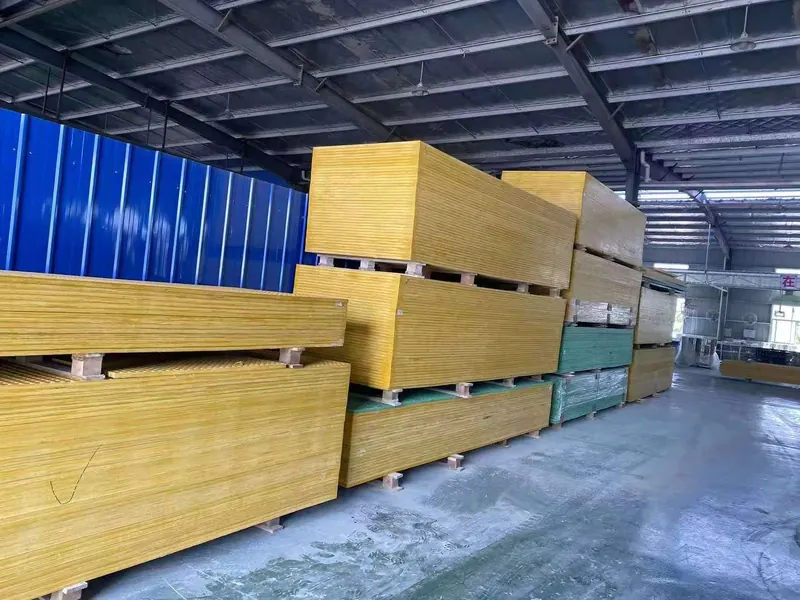
Check Identity and Quantity
Compare:
- PO and supplier order;
- product row or configuration;
- drawing revision;
- panel or finished-piece marks;
- quantities by size;
- bundle and package identifiers;
- packing-list remarks.
Count the delivered pieces, not only the bundles. If a bundle contains mixed piece marks, record the actual quantity by mark. Do not record a shortage as “package not checked.”
Inspect the Product Configuration
Confirm the fields that the order actually specifies:
- molded construction and mesh type;
- depth;
- pitch and clear opening;
- resin basis or grade reference;
- surface type;
- color reference;
- full-panel or finished-piece size.
If a field is absent from the approved ordering record, mark it as unverified rather than inventing a value. The molded product page and size definitions guide explain the terminology.
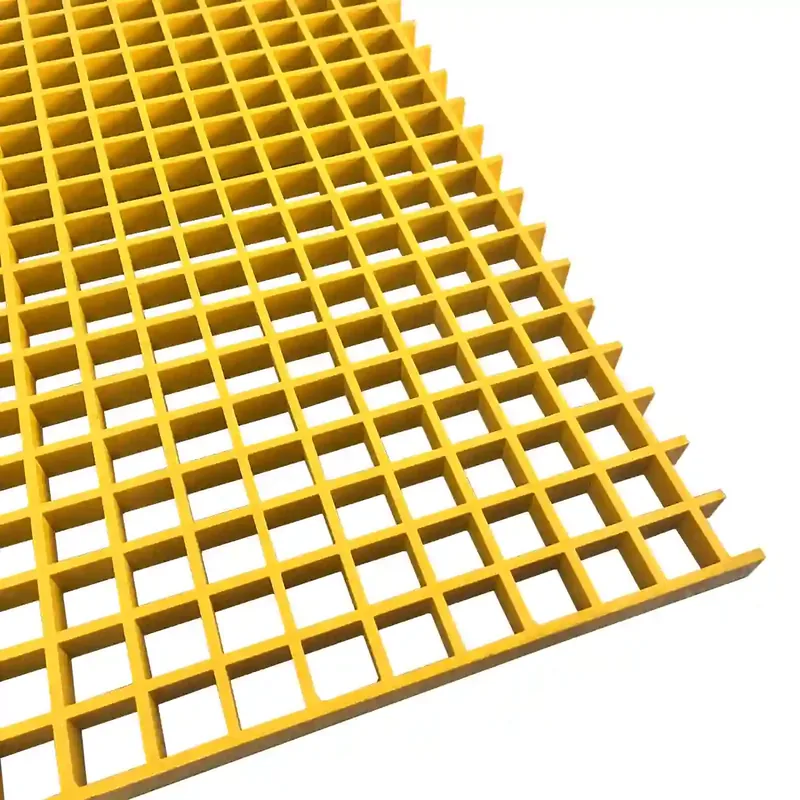
Measure Actual Dimensions
Record:
- length;
- width;
- depth;
- finished-piece dimensions where applicable;
- mesh pitch or clear opening where specified;
- flatness and squareness where a criterion exists.
State the instrument, measuring points and datum. If the specification gives tolerances, apply them. If none are given, record actual values and request an acceptance decision. Do not substitute a nominal catalog dimension for a delivered-piece measurement.
Inspect Visible Condition
Look for:
- cracks;
- chips;
- voids or blowholes;
- delamination;
- loose or exposed fibers;
- severe warping;
- damaged edges;
- missing or incomplete surface treatment.
Classify the location and extent according to the agreed inspection requirement. Photographs support the record but do not replace the description.
Check Surface, Grit and Color
Compare the walking surface and color with the order reference:
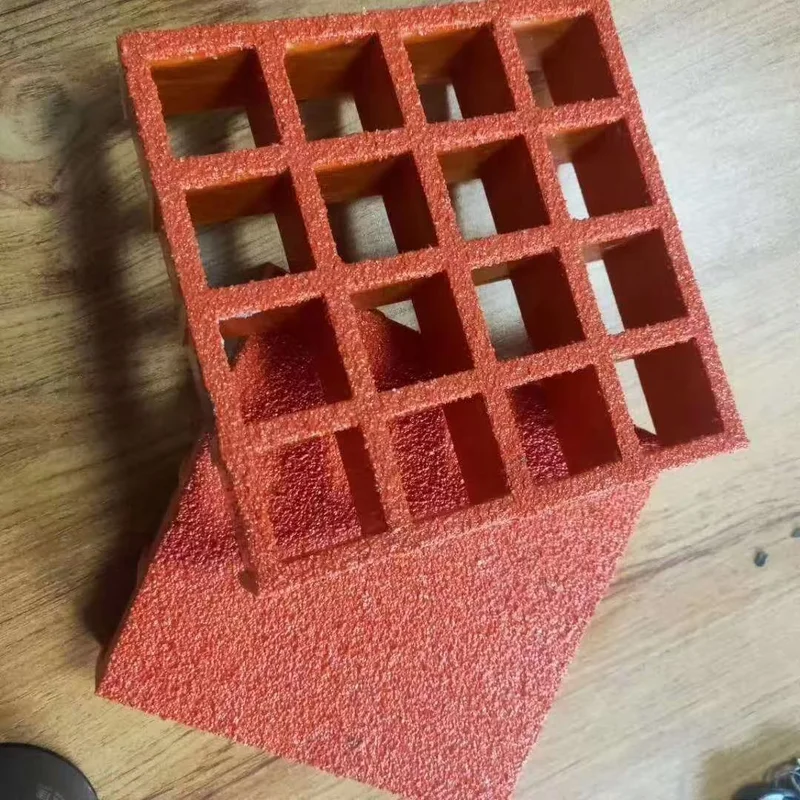
- concave or specified top profile;
- grit type or texture;
- milled or other finish;
- color sample and agreed lighting;
- surface coverage at edges and cuts.
Natural batch variation may exist. The acceptance criterion should come from the approved sample, color reference and project specification rather than a casual comparison with a screen image.
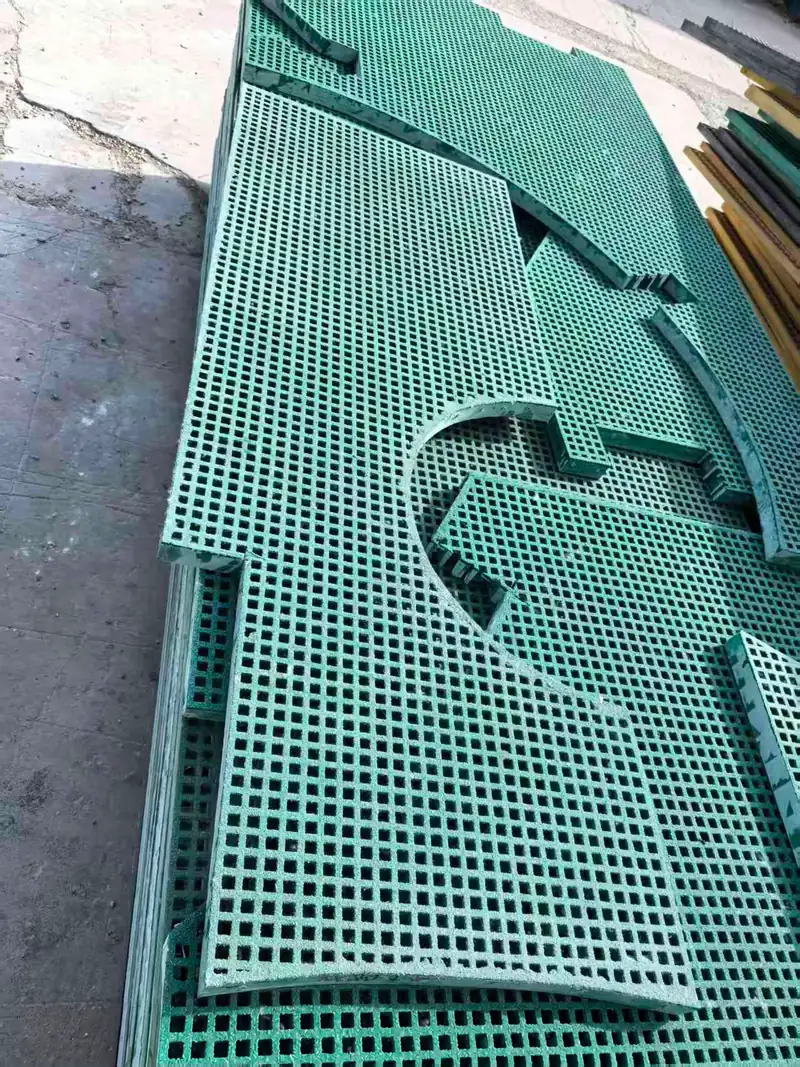
Inspect Cuts, Openings and Sealed Edges
For fabricated pieces, check:
- piece mark and quantity;
- finished outline;
- opening size and position;
- top face and orientation;
- remaining support or frame where applicable;
- cut-edge condition;
- coverage of the specified edge sealer.
An opening can be visually clean and still be wrong for the support condition. Use the fabrication record guide and cutout guide for the corresponding production checks.
Check Piece Marks and Packing
Confirm that:
- piece marks on the grating match the packing list;
- bundle labels are legible;
- mixed sizes are not packed under one unidentified label;
- protective packing remains intact where required;
- lifting and handling details are visible;
- the package can be connected to the delivery documents.
Keep the packing material until the inspection is complete. Discarding labels before checking the pieces can remove the easiest evidence of what was shipped.
Check the Documents
Depending on the order, verify receipt of:
- packing list;
- certificate of conformity or factory declaration;
- agreed dimensions or appearance record;
- fabrication or edge-treatment record;
- applicable test report;
- photographs or release note;
- shipping and customs documents.
Check that the document names the relevant product or order scope. A report cannot be accepted only because it was supplied with the shipment. The quality and documentation guide explains document scope.
Decide the Sample Before the Delivery Arrives
The receiving plan should state whether each check is performed on:
- every package;
- every panel or finished piece;
- one sample per bundle;
- a defined sample from a homogeneous production lot;
- all pieces carrying a unique mark, opening or orientation.
A mixed bundle is not one homogeneous lot. Panels with different piece marks, dimensions, orientation or cutting geometry need enough separate identification and inspection to avoid accepting one type by looking at another.
For dimensions or appearance, the order or project quality plan should define sample size, acceptance limit and critical defects. Do not apply an AQL table, zero-defect rule or percentage sample without confirming that it is the agreed basis for this product and inspection.
When 100% measurement is not practical, record what was sampled and what conclusion the sample supports. A photograph of one representative-looking piece does not prove the identity or dimension of every piece in the consignment.
Are Receiving Checks Performance Tests?
No. Receiving inspection identifies the product and records visible or dimensional condition. It does not establish:
- load capacity for a different span or support;
- chemical compatibility;
- fire or smoke classification;
- slip resistance;
- anti-static performance;
- installed-system compliance.
Those claims require matched tables, calculations, tests or approvals.
Accept, Hold or Report
Use three outcomes:
Accept when identity, quantity, measured condition and documents meet the agreed criteria.
Hold when identity, dimension, surface, edge condition or documentation is unresolved. Keep the piece isolated and traceable.
Report when there is a shortage, transit damage or confirmed nonconformity. Follow the order’s problem route with the order reference, piece marks, quantities, photographs and inspection record.
Do not release a held piece into installation stock because it is needed on site. Resolve the disposition first.
Receiving Record Example
Use a single record for each inspected package or piece group. The following is a DEMO format, not an actual delivery:
| Record field | Demonstration entry |
|---|---|
| Record status | DEMO — not a real receipt |
| Receiving record | DEMO-MG-RCV-1031 |
| PO / drawing reference | Demonstration references only |
| Package and piece marks | Enter actual packing-list identifiers |
| Quantity expected / received | Enter counts by panel or piece mark |
| Product configuration | Molded; enter actual depth, mesh, resin, surface and color references |
| Dimensions and instrument | Enter actual measured values and measuring tool |
| Appearance / surface | Record actual observations and location |
| Cuts and edge treatment | Record actual piece result against the approved schedule |
| Documents received | Packing list, conformity document, inspection record or applicable report |
| Photos | Link to package, labels and affected-piece images |
| Disposition | ACCEPT, HOLD or REPORT with reason and signature |
The demo values describe the fields, not a product release. A real receiving record should never use another project’s dimensions, piece marks or photographs as evidence.
What to Do When the Result Is Unclear
An unclear result should not become informal acceptance.
Use a hold when:
- the product row or drawing revision cannot be confirmed;
- a piece mark is missing or unreadable;
- the measuring method or acceptance tolerance is undefined;
- surface, color or edge condition needs comparison with the approved reference;
- a required document is missing or cannot be tied to the order.
Keep the held item in its original bundle where possible. Add a hold label that does not cover the original identification. Photograph the condition and notify the responsible party.
If the item must be moved for safety or storage, record its new location and keep it physically separated from accepted stock.
How to Handle Packaging and Accessories
Check whether the shipment includes:
- clips or fixing accessories;
- lifting or handling devices;
- spare pieces;
- labels and installation drawings;
- protection for sealed edges;
- only the packing materials or accessories included in the commercial scope.
Do not assume that fixing hardware is included because clips appear in a project photograph. The packing list and quotation define what should be in the shipment.
When the Inspection Differs From the Agreed Criteria
Record the actual observation first, then compare it with the approved requirement. Do not change the measurement to match the drawing or use a different datum after the result is known.
If the result is outside the agreed criterion, follow the problem route. Include:
- order and consignment reference;
- product configuration;
- affected piece marks and quantities;
- the measured or observed value;
- the agreed criterion;
- photographs that show the condition and identification;
- packaging condition;
- required action or clarification.
The supplier can then compare the report with the fabrication record and determine whether the issue involves production, packing, transport or the receiving method.
Record and Communicate the Result
The inspection record should include:
- order and drawing references;
- package and piece marks;
- expected and delivered quantities;
- measured values and instruments;
- observed defects or discrepancies;
- document status;
- photographs;
- accept, hold or report decision;
- inspector and date;
- person notified and next action.
Send the original labels and photographs with a discrepancy. A message saying “the panels are wrong” cannot be checked as efficiently as a record tied to the affected pieces.
The Manufacturer Rule for Receiving Inspection
Inspect the physical item against the same order and drawing used to make it. Measure actual values, separate condition from performance, and release only the pieces that meet the agreed criteria.
This molded-panel checklist does not identify a pultruded I, T or WT row by depth alone. When the delivery contains directional bearing bars, use the pultruded receiving inspection guide for the full profile, bar, cross-rod and report checks.
The packing list identifies the shipment. The inspection record establishes what the receiver accepted.
Receiving process
From Delivery Vehicle to Accepted Stock
Preserve package identity first, then inspect physical items and documents before release.
Photograph the vehicle, bundles, labels and visible external damage before pieces are separated.
Compare PO, packing list, product row, drawing revision and piece marks.
Count the ordered items and keep held pieces separate from accepted stock.
Record actual dimensions, condition, surfaces, cuts and edge treatment.
Match received records to the order and record missing or non-applicable evidence.
Accept the verified items, isolate holds and report discrepancies through the agreed route.
Factory documents
What the Factory Can Provide and What the Receiver Must Check
Documents support the review only when they match the product and the order.

Match the order
The product configuration, drawing revision and piece marks must connect to the delivered items.
Record actual measurements
The record identifies the instrument, datum and measured value instead of relying on a nominal label.
Separate condition types
Manufacturing observations, transit damage and missing documents are recorded separately.
Preserve the evidence
Package labels, piece marks, photos and inspection notes remain attached to the held or accepted item.
Respect document scope
A report is reviewed against the tested sample and conditions before it supports the consignment.
Make a clear decision
Each inspected item is accepted, held or reported through the agreed problem route.
Before delivery
What to Prepare for a Useful Receiving Inspection
Have the order basis, drawing, packing list and acceptance route available before the shipment arrives.
- Purchase order — The order reference and agreed delivered-item schedule.
- Approved drawing — Revision, piece marks, openings, dimensions and orientation.
- Product specification — Construction, depth, mesh, resin basis, surface and color reference.
- Packing list — Pieces, quantities, bundles, labels and package identification.
- Inspection criteria — Required dimensions, appearance classification and acceptance limits.
- Document list — Conformity document, inspection record, reports and other agreed evidence.
- Receiving tools — Tape or ruler, suitable depth gauge, agreed datum and camera.
- Problem route — Who to notify, required photographs, hold location and contractual response time.
Order requirements
Define Receiving Records With the Grating Order
Confirm the delivered-item schedule, inspection scope and documents before production.
- Physical item linked to the order
- Measurements recorded with datum
- Hold and reporting route defined
Molded Grating Receiving Inspection Questions
What should I inspect when molded grating arrives?
Should receiving inspection happen before unloading?
What if the specification does not state tolerances?
Does a visual check prove the grating load capacity?
Are transit damage and manufacturing defects different?
What documents should arrive with molded grating?
What should I do with a nonconforming piece?
Can a color shade difference be accepted?
This content was prepared and reviewed by Dengtai Industry’s technical and production team using the project conditions, available product data and applicable documents. Limits that require design, testing or approval are identified in the content. Content last checked: