Pultruded grating weight guide
Checking Pultruded Grating Weight by Profile and Finished Size
Weight starts with the exact profile, pitch, resin and surface, then follows the finished projected area. Keep panel mass, piece handling weight, accessory weight and gross package weight in separate fields.
Prepared by
Dengtai Industry
Published
·
Reviewed

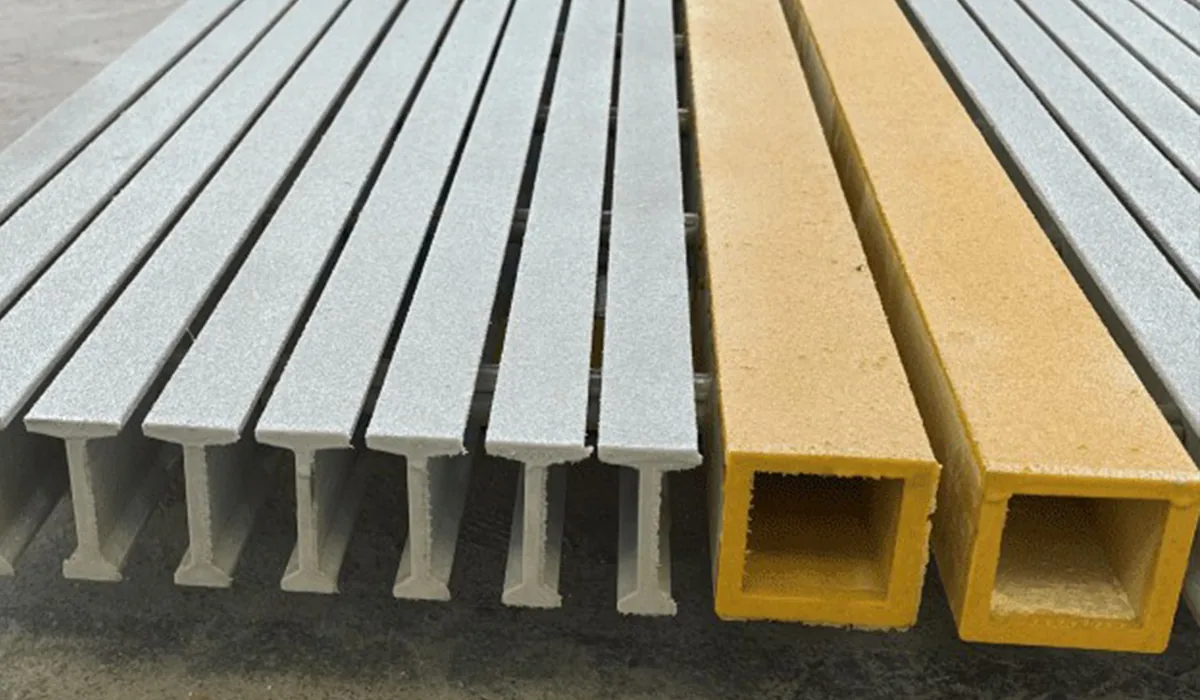
Profile, pitch and surface belong to the nominal mass. Photo: Dengtai Industry.
Weight vocabulary
Six Weight Figures Used in a Pultruded Grating Order
The correct value depends on whether the question concerns material, lifting, structure or freight.
- Nominal mass per unit area
- The reference mass of a defined product row per square metre. It is used for early estimates and must be tied to the exact profile, pitch, resin and surface stated with it.
- Panel net weight
- The estimated or measured mass of a full panel at its ordered size. It changes when the panel outline, cutouts, surface or accessories change.
- Finished-piece weight
- The mass of each cut and fabricated item that will be lifted, packed and installed. It is the basis for the handling plan, not the area price alone.
- Structural self-weight
- The panel mass expressed as a permanent load on the supports. It is a load on the structure, not the allowable load that the grating can carry.
- Gross package weight
- The mass of the panels plus pallet, crate, wrapping, markings and any packed accessories. This is normally the relevant figure for freight and receiving equipment.
- Load rating
- The performance of a specific configuration under a stated span, support, load pattern and deflection criterion. Mass does not establish this value.
Current product schedule
Nominal Pultruded Grating Mass by Profile
Use the full row. The nominal value belongs to its profile, depth, pitch and surface basis.
Swipe horizontally to view all columns.
| Series | Depth × pitch (mm) | Open area | Mass (kg/m²) | Mass (lb/ft²) |
|---|---|---|---|---|
| I25-40 | 25 × 25 | 40% | 16.5 | 3.38 |
| I25-50 | 25 × 30 | 50% | 14.5 | 2.97 |
| I25-60 | 25 × 38 | 60% | 12.5 | 2.56 |
| I38-40 | 38 × 25 | 40% | 23.0 | 4.71 |
| I38-50 | 38 × 30 | 50% | 20.0 | 4.10 |
| I38-60 | 38 × 38 | 60% | 18.5 | 3.79 |
| T38-33 | 38 × 38 | 33% | 15.5 | 3.17 |
| T38-50 | 38 × 50 | 50% | 12.0 | 2.46 |
| WT38-12 | 38 × 43.5 | 12% | 19.5 | 3.99 |
| WT38-25 | 38 × 50 | 25% | 17.5 | 3.58 |
| T50-33 | 50 × 38 | 33% | 20.5 | 4.20 |
| T50-50 | 50 × 50 | 50% | 16.5 | 3.38 |
Unit and use
Compare Panel, Piece, Load and Package Figures Correctly
Similar-looking numbers can represent mass, pressure or a packed consignment.
Swipe horizontally to view all columns.
| Figure | Unit or scale | Decision it supports |
|---|---|---|
| Product mass | kg/m² or lb/ft² | Early self-weight and panel-mass estimate. |
| Piece mass | kg or lb per finished item | Lift planning, manual handling and packing sequence. |
| Surface load | kPa, kN/m², lbf/ft² or psf | Structural load-case input; not interchangeable with mass. |
| Gross package | kg or lb per packed unit | Freight, unloading and receiving. |
| Structural capacity | Value with span, support, load pattern and deflection basis | Product suitability; never inferred from mass. |
Recalculation screen
When a Pultruded Grating Weight Estimate Must Be Rebuilt
A changed profile, finished area, surface or packing scope can invalidate the previous estimate.
Specify this if…
- Recalculate whenever the profile, pitch, panel outline or finished opening changes from the row used for the estimate.
- Recalculate when the resin, color, grit or another surface changes the actual ordered mass.
- Use finished-piece weight when planning a lift, temporary handling or a panel split.
- Use gross package weight when selecting transport, unloading equipment or container loading.
Look elsewhere if…
- Do not use one generic kg/m² figure for every pultruded profile.
- Do not use mass as proof of strength or load capacity.
- Do not compare kg/m² with kPa as though they were the same unit.
- Do not treat the source-panel area as the installed-piece area.
- Do not assume the calculated panel mass is the weighed gross shipment weight.
Calculation sheet
Eight Inputs for a Usable Weight Estimate
Tie the nominal row to the exact finished pieces and the handling or freight decision.
Swipe horizontally to view all columns.
| Calculation field | How to record it | Why it matters |
|---|---|---|
| Exact profile | I, T or WT series and plain depth; copy the full row. | Different geometry and pitch can change mass. |
| Dimensions | Width and length in the same unit, converted to metres before area. | Unit errors create large mass and freight errors. |
| Projected area | Finished width × length, with separate areas for each different piece. | The installed area drives the estimate. |
| Openings | Record area removed by large cutouts and any added edge bars or frames. | Nominal panel area is not always delivered-piece area. |
| Resin and surface | Confirm the ordered finish and whether the nominal mass includes it. | Surface additions can change the measured weight. |
| Piece count | Calculate each item and subtotal by piece mark and package. | Average area can hide an item that exceeds the handling limit. |
| Accessories | List clips, fixings, lifting devices and separately packed parts. | Decide whether they belong to net product or gross package scope. |
| Packing | Record pallet, crate, wrapping and piece arrangement. | Freight follows gross rather than panel mass alone. |
To estimate pultruded grating weight, identify the exact I, T or WT row, calculate each finished projected area and multiply by that row’s nominal mass per square metre. Then check the actual resin, surface, accessories, handling limit and packing scope.
Mass is useful for structural self-weight and lifting. It does not establish the grating’s load capacity.

Start With the Exact Profile Row
Our pultruded schedule has different mass values for different sections and pitches. I25-40 is listed at 16.5 kg/m², while I25-60 is listed at 12.5 kg/m². Both use a nominal 25 mm panel depth.
The same point appears at 38 mm: I38-40 is listed at 23.0 kg/m², I38-60 at 18.5 kg/m² and T38-33 at 15.5 kg/m². Their geometry and repeat pattern differ.
The published values are nominal series reference masses. The current source does not establish a separate figure for every resin, color, grit or other surface combination. Use them to identify and estimate the row, then confirm the ordered net weight when the finish or handling decision depends on it.
Do not start with:
- “25 mm grating weighs…”
- “38 mm pultruded weighs…”
- “pultruded FRP is lighter than…”
Start with the complete row. The product table identifies profile, depth, top width, pitch, open area and nominal mass. The section guide explains why the profile letter alone is not enough.
Confirm the ordered resin and surface through the pultruded resin-name resolution section, because the nominal schedule is not a substitute for the actual product configuration.
Calculate the Finished Projected Area
Use one consistent unit. The practical calculation is:
width (m) × bearing-bar length (m) = projected area (m²)
Then:
projected area × nominal mass (kg/m²) = nominal piece mass (kg)
For a T38-33 piece measuring 1.20 m by 2.40 m:
1.20 × 2.40 = 2.88 m²2.88 × 15.5 = 44.64 kg
For a 1.00 m by 3.00 m I38-60 piece:
1.00 × 3.00 = 3.00 m²3.00 × 18.5 = 55.50 kg
These are nominal estimates for the listed row and outside dimensions.
Work Through a Mixed Piece List
Real orders often contain several different pieces. The following is only an arithmetic example, not a factory order or weighing record:
| Piece | Product row and size | Projected area | Estimated mass |
|---|---|---|---|
| A01 | T38-33 · 1.20 × 2.40 m | 2.88 m² | 44.64 kg |
| A02 | I38-60 · 0.90 × 2.00 m | 1.80 m² | 33.30 kg |
| A03 | I38-40 · 0.60 × 1.00 m | 0.60 m² | 13.80 kg |
| Subtotal | — | 5.28 m² | 91.74 kg |
The multiplication uses each piece’s matching row mass: 15.5, 18.5 and 23.0 kg/m². Packing and accessories remain “confirm by order” and are not assigned a number on this page.
The subtotal does not become the gross package weight until the pallet, crate, wrapping, fixings and any separately packed components are confirmed.
Use the Finished Shape, Not Only the Source Panel
Our pultruded panels are made to the required width and bearing-bar length rather than supplied in one fixed standard panel format. The installed piece may include openings, notches, edge bars or other fabrication details.
For each finished piece, calculate its projected area and subtract large cutouts where that is the agreed estimating method. Add separately identified edge bars, frames or components where they materially change the delivered item.
The cutting and sealing guide explains the fabrication review. A clean cutout still needs a structural check when it removes a bearing bar, and sealing the edge does not restore the bar.
Panel Mass Is Not Load Capacity
Mass per square metre describes how much product is present per unit area. It is used to:
- estimate the permanent load on the supporting structure;
- estimate panel and piece handling weight;
- compare packing and transport scenarios; and
- cross-check a quotation or consignment record.
It does not describe:
- allowable load;
- maximum span;
- permitted deflection;
- wheel or point-load capacity; or
- slip, fire or chemical performance.
A surface or added layer can increase mass without adding structural depth. A different profile can be lighter while having a different section geometry. The pultruded span and deflection guide explains the structural review.
Weight as a Structural Load
For early structural coordination, the panel mass becomes a permanent load on its supports. Convert it consistently with the project units and confirm whether other finishes or accessories are included.
For example:
1 kg/m² = 9.81 N/m² ≈ 0.00981 kN/m²
That conversion turns the product mass into a structural load per area. It still does not state the allowable imposed load.
Where panels are permanent, supported at different elevations or exposed to wet and contaminated service, describe the support and environment. The temperature and creep guide covers long-term structural effects separately.
Finished-Piece Handling Weight
Handling decisions need individual piece mass, not only total order mass. A 250 kg consignment can be easy to handle if it is divided into ten pieces, while one 60 kg piece may exceed a two-person site lift.
Define the handling basis before choosing panel splits:
- maximum mass per manual lift;
- lifting equipment and available access;
- aisle, door, stair and platform restrictions;
- temporary lifting points;
- whether the panel must be removable;
- the minimum structural panel size allowed by the support and joint design.
Do not split a pultruded panel purely by weight if the split changes bearing direction, creates an unsupported edge or conflicts with the required joint detail. The selection guide connects handling geometry to the support layout.

What Can Change the Actual Weight
The nominal row is the starting point. Confirm the ordered configuration when weight affects a lifting plan or freight limit.
Potential changes include:
- the selected resin and resultant laminate density;
- grit or another surface applied to the product;
- custom color or functional additives where they change the system;
- edge sealing and added fabrication materials;
- extra edge bars, frames, lifters or other components;
- packing materials and pallet construction; and
- moisture or contamination after delivery.
Not every item changes mass significantly. The point is to keep the estimating basis visible rather than presenting a nominal value as a weighed delivery record.
Gross Package Weight and Freight
Freight is normally planned from the gross package and consignment weight, not the net panel calculation.
Record:
- panel and piece net weight;
- number of pieces per bundle or crate;
- pallet and crate materials;
- wrapping, spacers and edge protection;
- separately packed clips or accessories;
- package marks and dimensions; and
- measured gross weight where required.
The FRP grating weight guide explains the wider unit definitions. Use the size and weight guide when nominal dimensions and exact converted dimensions also need to be separated.
Common Unit Mistakes
kg/m² versus lbf/ft²
Both can describe mass per unit area:
1 kg/m² ≈ 0.2048 lb/ft²1 lb/ft² ≈ 4.8824 kg/m²
For example, I38-60 at 18.5 kg/m² is approximately 3.79 lb/ft².
lbf/ft² versus psf
These are commonly the same pressure unit: pounds-force per square foot. They describe a load, not the panel’s mass.
kPa versus kN/m²
A pressure of 1 kPa equals 1 kN/m². It can describe a load case, but not a product mass.
Square feet versus square metres
One square foot is about 0.092903 m². Convert the area and the unit mass consistently. Multiplying an imperial area by a metric mass rate produces an invalid result.
Why Different Pieces Need Separate Estimates
An average panel area can hide risks in a mixed order. A large cover and several small infill pieces may have the same total area as uniform panels but very different handling, packing and installation needs.
Prepare one row per piece mark:
| Field | Record |
|---|---|
| Piece mark | Unique ID from the drawing |
| Profile row | I, T or WT series and exact pitch |
| Width | Required finished dimension |
| Bearing-bar length | Required dimension along the bars |
| Area | Calculated projected area |
| Openings | Area and support implications |
| Nominal mass | Matching row value |
| Estimated piece mass | Area × nominal mass |
| Handling result | Accept, split or engineering review |
This schedule supports both the quotation and the later packing review.
Use the pultruded packing guide to carry the piece marks and handling weights into bundle support, gross package weight and shipment release.
Record the Actual Weight
For lifting, freight or acceptance, a calculated estimate should be linked to a measured record rather than overwriting the calculation.
| Record field | What belongs there |
|---|---|
| Identity | Order, quotation or drawing revision and package ID |
| Product | Exact I/T/WT row, pitch, resin, color and surface |
| Pieces | Piece marks, quantities and finished dimensions |
| Measurement | Scale or weighing method, date and measured value |
| Basis | Net piece, full package or another stated scope |
| Additions | Pallet, crate, wrapping, clips or separately packed parts |
| Comparison | Estimated value and difference, with units |
| Disposition | Accepted against the agreed requirement or held for review |
Do not insert a generic percentage tolerance into this page. The applicable requirement may be project-specific or confirmed for the order. Where no criterion is stated, record the measured result and ask for disposition before using it in a lift or freight calculation.
Our Factory Weight Workflow
Our current product schedule provides nominal mass per square metre for each pultruded row. For a custom panel order, we start with the ordered width and bearing-bar length rather than assuming a fixed sheet.
The quotation and fabrication review should confirm:
- the complete profile and pitch;
- resin, color and surface;
- finished piece dimensions and quantities;
- openings and added fabrication;
- handling splits;
- fixing and accessory scope;
- packing method; and
- whether the project requires recorded net or gross weights.
The nominal calculation is useful early, but a project with a tight crane limit or manual-handling constraint may need an actual order record. State that requirement before production so the appropriate piece and package plan can be used.

Common Weight-Calculation Errors
- using one mass value for every depth;
- ignoring profile and pitch;
- using outside panel area after large cutouts;
- mixing feet and metres;
- multiplying an imperial area by kg/m²;
- treating kg/m² as kPa;
- treating gross package weight as panel weight;
- assuming nominal mass is a weighed value;
- omitting the scale, package or piece basis from a measured record;
- applying an unverified weight tolerance to an order;
- splitting panels only by handling without checking structure; and
- treating weight as load capacity.
The Weight Rule
Select the exact product row. Calculate each finished projected area in consistent units. Multiply by the matching nominal mass. Check surface, openings, accessories and handling. Then separate the calculated net estimate from actual per-piece and gross package records.
That produces a usable weight estimate without confusing mass with structural capability.
Calculation sequence
From Product Row to Actual Package Record
Calculate the panel estimate, check each piece, then separate the gross shipment value.
Match profile, depth, pitch, resin and surface before reading the nominal mass.
Convert every width and length to a consistent unit and separate unique pieces.
Multiply width by length for each piece and subtract significant openings.
Multiply finished area by the matching nominal mass per square metre.
Review piece size, local extras, lifting points, accessories and any panel split.
Keep calculated net values separate from measured gross shipping records.
Traceability
What a Pultruded Grating Weight Record Must Separate
Keep the product basis, finished geometry, estimate and measured package facts visible.

Complete product identity
The nominal mass is tied to the exact I, T or WT row rather than a generic depth.
Finished geometry
Each piece area and significant opening is reflected in the estimate.
Surface scope
Resin, grit or other finish is named so the nominal and actual bases can be compared.
Handling record
Piece mass is checked against the agreed lifting and packing plan.
Gross scope
Pallets, wrapping, accessories and packed piece count are separated from panel mass.
Measured vs calculated
Planning estimates are clearly distinguished from actual weights recorded for the order.
RFQ checklist
What to Send With a Pultruded Weight Question
Include the profile, piece list, cutouts, handling limit and packing requirements.
- Full product row — I, T or WT series, depth, pitch, open area basis, resin, color and surface.
- Piece schedule — Piece marks, width, bearing-bar length, quantity and installed location.
- Cutouts — Dimensions and positions of large openings, plus any added bars or edge frames.
- Handling limit — Maximum weight per lift, number of people or lifting equipment, and site access limits.
- Packing plan — Pieces per bundle or crate, pallet type, wrapping and marking requirements.
- Accessories — Clips, fasteners and separately shipped components that affect net or gross scope.
- Weighing requirement — State when actual net and gross weights must be recorded rather than estimated.
- Destination and freight method — Port, transport mode and receiving equipment where the package weight affects feasibility.
Request a quote
Send Your Pultruded Piece and Weight Data
Share the drawing or piece list and identify the maximum mass per lift or package.
- Exact profile and surface connected to the estimate
- Finished pieces separated from panel area
- Calculated and gross weights kept distinct
Pultruded Grating Weight Questions
How do I calculate pultruded grating weight?
Does the published series mass include every resin and surface?
Is pultruded grating weight the same for every 38 mm profile?
Do I use panel area or finished-piece area?
What about openings in the panel?
Does a grit surface change the weight?
Is kg/m² the same as a load in kPa?
How do I convert kg/m² to lb/ft²?
Is gross package weight the same as panel net weight?
How should an actual finished-piece weight be recorded?
Can heavy panels be split into smaller pieces?
Does a heavier pultruded panel carry more load?
This content was prepared and reviewed by Dengtai Industry’s technical and production team using the project conditions, available product data and applicable documents. Limits that require design, testing or approval are identified in the content. Content last checked: