Molded grating weight guide
Molded Grating Weight: Unit Area, Full Panel and Finished Piece
Start with the unit mass of the exact molded row, multiply by the actual area, then separate the panel estimate from finished pieces, handling, accessories and packing. These figures answer different questions and should not share one label.
Prepared by
Dengtai Industry
Published
·
Reviewed

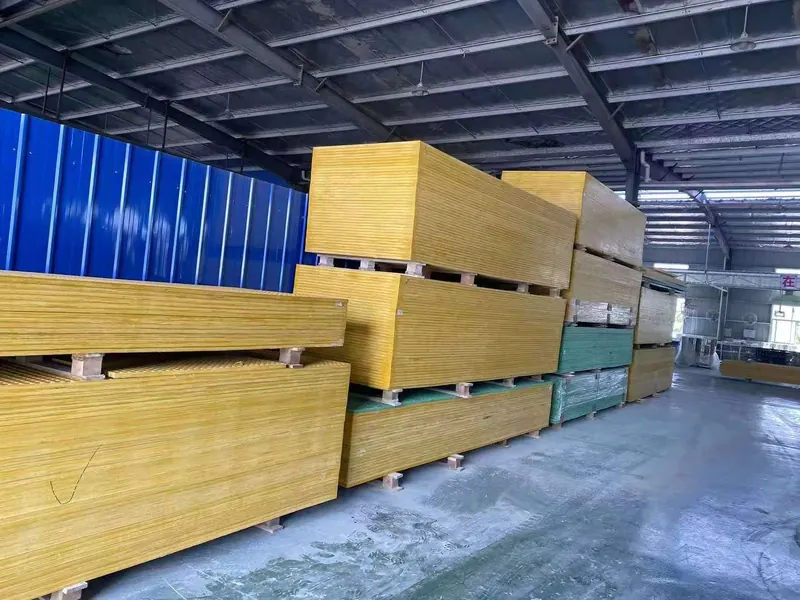
Packed grating at our factory. Packing and freight weight are confirmed separately from finished-panel net weight. Photo: Dengtai Industry.
Weight definitions
Unit Mass, Panel Weight, Piece Weight and Package Weight
Each figure answers a different handling, structural or freight question.
- Unit mass
- The mass of one square metre of a defined grating row, expressed in kg/m². It belongs to one depth, pitch, reinforcement and resin configuration.
- Panel net weight
- The calculated or measured mass of one complete panel, excluding pallet, packing, loose hardware and freight equipment.
- Finished-piece weight
- The mass of each cut and fabricated piece that will be lifted on site. It may differ from a simple outline-area calculation when surface or edge additions are included.
- Installed assembly weight
- Panels plus clips, bolts, edge profiles, covers and any other fixed items. It is not equal to the grating panel weight.
- Gross package weight
- Finished pieces plus pallets, protections, bundling and packing. This is the figure used for freight and shipping documentation.
- Self-weight load
- The panel mass expressed as a load added to the supporting structure. It is a permanent load, not an allowable live load or load capacity.
Factory worksheet
Verified Molded Grating Rows and Estimated Panel Weight
Panel mass is calculated from the listed unit mass and a nominal 1220 × 3660 mm area; the actual order size and surface must be confirmed.
Swipe horizontally to view all columns.
| Factory row | Unit mass | Estimated 1220 × 3660 mm panel | Handling signal |
|---|---|---|---|
| 25 mm · 38 × 38 mm | 12.5 kg/m² | About 55.8 kg | Single-panel handling still needs an agreed method. |
| 30 mm · 38 × 38 mm | 16.5 kg/m² | About 73.7 kg | Check access and crew before using a full panel. |
| 38 mm · 38 × 38 mm | 19.5 kg/m² | About 87.1 kg | Full panel may need lifting equipment or planned splits. |
| 50 mm · 50 × 50 mm | 21.5 kg/m² | About 96.0 kg | Different product from the 25 × 50 heavy-duty row. |
| 50 mm · 25 × 50 mm heavy duty | 45.0 kg/m² | About 200.9 kg | Lifting plan and finished-piece split need early review. |
| 63 mm · 38 × 38 mm | 52.5 kg/m² | About 234.4 kg | Confirm actual panel size and handling equipment. |
Calculation map
Which Weight Formula Matches the Question
Start from the exact quantity being calculated, then add only the scope that belongs to it.
Swipe horizontally to view all columns.
| Quantity being calculated | Formula or source | What it answers | What it does not include |
|---|---|---|---|
| Unit mass | Product-table value for the exact row | kg per square metre provided by the configuration | Finished-piece fabrication or packing |
| Panel net weight | Unit mass × actual panel area | Estimated mass of one full or finished rectangle | Accessories, pallet or freight packaging |
| Finished-piece total | Sum of each piece area × unit mass | Net material mass represented by the fabricated piece list | Source-panel scrap, saw loss or packing |
| Installed assembly | Finished pieces + fixed accessories and cover items | What the structure must carry permanently | Site personnel, equipment or live loads |
| Gross package | Finished pieces + packing and pallet weight | Shipping and freight calculation | Load capacity or installed service load |
Calculation check
When a Molded Grating Weight Estimate Is Usable
A useful estimate identifies the product row, actual area, surface scope and intended handling or freight purpose.
Specify this if…
- The unit mass is taken from the exact depth, pitch, resin and surface configuration.
- The actual length and width are known, including whether the dimensions are nominal or finished.
- Each finished piece is listed with quantity so handling can be checked.
- Surface additions, covers, clips and edge details are identified separately.
- Packing type and pallet weight can be confirmed when gross freight weight is needed.
Look elsewhere if…
- A kilogram-per-square-metre figure is being used as a load rating.
- The panel weight is calculated from a nominal area when the frame requires another finished size.
- A grit, cover, conductive layer or accessory scope is silently omitted.
- A full-panel estimate is used to decide whether a person can lift a cut piece.
- The gross package weight is replaced with an unverified pallet count.
Molded FRP grating weight must be calculated from the exact product row and the actual area. The resulting figure can then be used for a full panel, a finished piece, an installed assembly or a package. Those are related calculations, but they are not the same weight.
Our published molded rows range from 6.5 kg/m² for a 15 mm, 50 × 50 mm configuration to 52.5 kg/m² for a 63 mm, 38 × 38 mm configuration. The spread shows why a generic “fiberglass grating weight” cannot be used for handling or structural planning.

Start With the Exact Unit Mass
Unit mass is the product row’s approximate mass per square metre. It is not a rule for all molded grating and not a load rating.
From our current configuration table:
| Molded row | Unit mass | Estimated 1220 × 3660 mm panel |
|---|---|---|
| 25 mm, 38 × 38 mm | 12.5 kg/m² | about 55.8 kg |
| 30 mm, 38 × 38 mm | 16.5 kg/m² | about 73.7 kg |
| 38 mm, 38 × 38 mm | 19.5 kg/m² | about 87.1 kg |
| 50 mm, 50 × 50 mm | 21.5 kg/m² | about 96.0 kg |
| 50 mm heavy duty, 25 × 50 mm | 45.0 kg/m² | about 200.9 kg |
| 63 mm, 38 × 38 mm | 52.5 kg/m² | about 234.4 kg |
These are calculations from the listed unit mass and nominal full-panel area. They are not individual weighing records.
Use the Actual Area
The nominal 1220 × 3660 mm panel has an area of:
1.220 × 3.660 = 4.4652 m²
At 19.5 kg/m², the estimate is:
4.4652 × 19.5 = 87.0714 kg
For a finished piece 400 × 2000 mm:
0.400 × 2.000 = 0.8 m²
At 12.5 kg/m², the net panel mass is about 10 kg before any surface or edge additions. This smaller figure is the one to compare with manual handling.
The formula only works if the unit and configuration match. Use the actual length and width, not a nominal panel name, when lifting a delivered piece.
Do Not Use Nominal and Finished Size as the Same Area
A 4 × 12 ft request converts exactly to 1219.2 × 3657.6 mm, an area of 4.4597 m². A 1220 × 3660 mm product has an area of 4.4652 m². The difference is small, but the size basis is still different.
More important differences appear when cutting. Several finished pieces may total less area than the source panel because saw kerf, edge trim and unusable offcuts remain. For purchasing and material yield, keep:
- source-panel area;
- finished-piece area;
- installed coverage;
- cutting loss.
The imperial-size conversion guide explains how to record the exact offered size.
Add Surface and Cover Weight Only When Known
The listed unit mass belongs to the stated product row. Grit, inlaid grit, a bonded top, a cover plate or a chequered layer can change the delivered mass.
Do not assume the change is zero. Also do not invent a generic percentage. Request the mass for the exact surface and cover construction, or confirm the order weight before lifting and shipping.
For a continuous covered assembly, the cover and fixing method may also change the structural section and the support review. Weight and load are separate consequences of that change.
Separate Panels From Accessories
M, L and C clips, bolts, washers, edge profiles and other accessories may be supplied with the grating but are not part of the panel unit mass.
For the installed assembly:
panel or piece mass + accessory mass + fixed cover items = assembly mass
Use this figure when the supporting structure has to carry the permanent installation load. Use the independent design load when checking the grating’s structural duty.
Handle Weight Per Piece, Not Per Square Metre
Unit mass is useful for estimating order quantity. It cannot tell whether one finished piece is safe to lift by hand.
Record:
- finished-piece length and width;
- net piece weight;
- lifting points;
- site access and turning space;
- number of people or equipment available;
- temporary attachments;
- any maximum weight set by the project.
For long narrow pieces, weight is not the only handling issue. Length, flexibility and wind can change the lifting method.
Narrow solar walkway strips are a practical example of why piece weight and cutting yield must be checked together; use the solar strip sizing guide for the finished-piece and sheet-consumption calculation.
Estimate Gross Package Weight Separately
A freight weight includes the grating plus packing. The exact gross weight depends on:
- pallet or crate construction;
- spacers and edge protection;
- wrapping;
- bundle configuration;
- steel lifting supports;
- number of pieces per package.
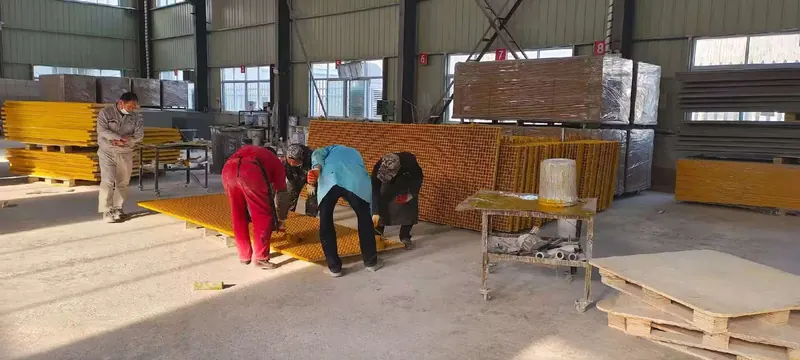
The panel calculation cannot predict those additions. When weight is needed for a shipping document, confirm the package count and weighing method. The general FRP grating weight guide explains the difference between unit mass, net panel and gross package weight.
Weight Is Not Load Capacity
A heavier panel is not automatically stronger. Mass can increase because of a deeper structure, more bars, denser mesh, grit, a cover or another non-structural layer.
A load table describes what a specific construction can carry under stated supports and deflection limits. The panel’s own mass contributes a permanent load to the structure; the external live load is a different input.
Do not use kg/m² from the configuration table as a load capacity. For that decision, use the molded grating load-table guide.
A Worked Finished-Piece Schedule
Suppose an order contains three finished pieces, each 1000 × 2000 mm, from a 38 mm, 38 × 38 mm molded row at 19.5 kg/m².
Each piece area:
1.0 × 2.0 = 2.0 m²
Each estimated net piece mass:
2.0 × 19.5 = 39 kg
Three pieces:
3 × 39 = 117 kg
The source panel arrangement, cutting loss, surface additions, clips and package weight are still separate. The 39 kg figure is estimated net mass for handling, not a load rating or a verified weighing record.
Converting Pounds and Square Feet
Imperial product pages often state mass in pounds per square foot. Convert before comparing it with our kg/m² rows:
- 1 lb = 0.45359237 kg;
- 1 ft² = 0.09290304 m²;
- 1 lb/ft² = 4.88243 kg/m².
A catalog figure of 2.5 lb/ft² is therefore about 12.21 kg/m². It still belongs to that supplier’s exact depth, pitch, reinforcement and surface. The converted number does not prove an equivalent product or load rating.
For panel weight, convert the dimensions first:
length in ft × width in ft × lb/ft² = lb per panel
Then convert pounds to kilograms if the quotation uses metric units. For total weights, do not round each piece so aggressively that the quantity error becomes significant in a lifting plan.
Three Weight Labels That Should Never Be Interchanged
The first is unit mass, such as 19.5 kg/m². It describes one product row and supports area estimates.
The second is piece mass, such as 39 kg for a particular cut rectangle. It is the figure to compare with a handling limit or lifting plan.
The third is gross package mass, which includes packing. It is the figure used for freight. A panel that weighs 87 kg does not necessarily form an 87 kg package; the pallet and protections are additional.
Keeping these labels separate also prevents two different questions from receiving the same answer. A shipping coordinator and an installer may both ask “How much does it weigh?” while needing different values.
How We Check Weight at the Factory
Our review links the weight estimate to the same configuration and cut list used for quotation:
- select the exact product row;
- calculate nominal full-panel area;
- convert each finished-piece area;
- keep surface and cover scope visible;
- sum pieces by quantity;
- compare against handling limits;
- identify clips and packing as separate scope;
- confirm gross weight when freight requires it.
For repeated orders, the same dimensions, resin, surface and packing arrangement should be repeated. A similar panel name is not enough to assume the same weight.
What to Ask For in the Quotation
Ask the supplier to state:
- The row and unit mass used.
- The actual full-panel dimensions.
- The finished-piece sizes and quantities.
- Whether surface or cover additions are included.
- Whether accessories and packing are included.
- The calculated net and gross figures.
- Any weighed value, if available.
That level of clarity serves engineering, purchasing and logistics without turning one number into a claim it cannot support.
The Manufacturer Rule for Grating Weight
The most useful weight statement is not a single average. It names the product row, the area basis and the scope.
Use kg/m² to identify the configuration, use the calculated panel or piece weight for planning, use the finished-piece mass for handling and use the confirmed package weight for freight. Keeping those four figures separate prevents most weight-related order errors.
For the rest of the ordered panel record, use the molded grating datasheet match to keep the mass basis beside the exact row, resin, surface, structural evidence and approved fabrication revision.
Factory review
How We Reconcile a Panel Weight With Finished Pieces
The calculation follows the same dimensions and configuration fields as the quotation and cut list.
We confirm depth, pitch, resin and surface before using a kg/m² value.
Nominal and finished lengths and widths are converted consistently into square metres.
Each piece mark and quantity receives its own area and estimated net mass.
Grit, covers, clips and edge items are identified when they change panel or installed weight.
Piece mass, length, access and lifting method are compared before full-panel splits are approved.
Pallet, protection, bundling and package count are added only when a gross freight figure is required.
Manufacturing experience
Where Weight Estimates Usually Go Wrong
Most errors come from mixing product rows, nominal sizes and shipped weight rather than from the multiplication itself.

Unit mass belongs to one row
The value is tied to depth, pitch, resin and surface. It is not a family-wide average for molded grating.
Nominal size and finished size are separate
A full panel and a cut piece have different areas and handling weights even when made from the same product.
Surface additions need confirmation
Grit, bonded layers and covers can add mass; no generic allowance is invented where the exact value is unknown.
Accessories are separate
Clips, bolts and edge profiles can enter the installed assembly weight without being part of the panel net weight.
Packing is a freight figure
Pallets, protection and bundle construction change gross weight and must be confirmed for dispatch.
Mass is not capacity
kg/m² describes product mass, not the allowable live load at a project span.
RFQ checklist
What to Send for a Molded Grating Weight Check
Give the intended use of the number as well as the dimensions, so handling and packing scope can be separated correctly.
- Product row — Depth, pitch, resin, surface and any cover configuration.
- Actual panel size — Full-panel dimensions or each finished-piece length and width, with units.
- Quantity by piece mark — Number of identical pieces and total delivery quantity.
- Purpose of the weight — Structural self-weight, manual handling, lifting plan, packing, freight or a combination.
- Surface and accessories — Grit or cover additions, clips, bolts, edge profiles and other fixed items.
- Handling constraint — Site access, crew number, lifting equipment and any maximum weight per piece.
- Packing requirement — Pallet, crate, bundle, protection and maximum package dimensions or weight.
- Verification needed — Whether the response needs an estimate or a weighed record.
Request a quote
Send Your Panel and Finished-Piece Schedule
Tell us whether the weight is needed for design, lifting, packing or freight and attach the current piece list.
- Unit mass and actual area used
- Finished-piece handling reviewed
- Packing weight kept separate
Molded FRP Grating Weight Questions
How much does a 1220 × 3660 mm molded grating panel weigh?
Can I calculate panel weight from kg/m²?
Is the panel weight the load it can carry?
Why are two 50 mm panels different in weight?
Does grit change the weight?
Does a covered grating weigh the same as an open panel?
Is the gross package weight the same as the grating weight?
How do I choose finished-piece sizes for safe handling?
This content was prepared and reviewed by Dengtai Industry’s technical and production team using the project conditions, available product data and applicable documents. Limits that require design, testing or approval are identified in the content. Content last checked: