Imperial-to-metric order guide
Imperial Molded Grating Orders: From Nominal Size to Actual Panel
“4 × 8 ft” or “4 × 12 ft” is a request, not a completed specification. Convert it to exact metric values, then confirm the actual product size, full-panel basis, finished cut dimensions, tolerance and quantity before ordering.
Prepared by
Dengtai Industry
Published
·
Reviewed

A sample measured against a rule. The delivered panel or cut piece is manufactured to the approved dimension and tolerance. Photo: Dengtai Industry.
Dimensions and order basis
Imperial Size, Metric Product and Finished Piece
These terms stop a unit conversion from being mistaken for a manufacturing commitment.
- Imperial nominal size
- A familiar name such as 4 × 8 ft or 4 × 12 ft. It may describe a trade size, panel family, installation module or plate area, but it does not by itself prove the exact supplied dimensions.
- Exact conversion
- The arithmetic result of converting every imperial dimension to millimetres using 1 in = 25.4 mm. A 4 × 12 ft rectangle converts exactly to 1219.2 × 3657.6 mm.
- Actual product size
- The full-panel size that can be made from the selected mold or product row. It may be 1220 × 3660 mm, another metric size or a project-specific piece, but it should not be inferred from the imperial name alone.
- Finished cut size
- The final dimensions of each delivered piece after trimming, cutting and opening work. This is the controlling size for site fit, joins and piece identification.
- Tolerance
- The permitted difference between the required dimension and the delivered dimension. A separate line for fit-critical dimensions belongs on the drawing or inquiry.
- Area basis
- Whether the quantity and price are calculated on nominal panel area, purchased source-panel area or finished-piece area. A square-foot conversion does not remove cut loss or edge trim.
Conversion worksheet
Common Imperial Molded Grating Requests in Metric
Exact arithmetic values are shown beside selected factory metric references; the quotation still confirms which panel size is available.
Swipe horizontally to view all columns.
| Imperial request | Exact conversion | Close factory metric reference | Exact-area calculation |
|---|---|---|---|
| 3 × 10 ft | 914.4 × 3048 mm | 915 × 3050 mm appears in factory rows where listed | 2.7871 m² exact rectangle |
| 4 × 8 ft | 1219.2 × 2438.4 mm | Actual offered panel must be confirmed | 2.9730 m² exact rectangle |
| 4 × 12 ft | 1219.2 × 3657.6 mm | 1220 × 3660 mm appears in selected factory rows | 4.4597 m² exact rectangle |
Fields to separate
What an Imperial Grating Size Name Does Not Tell You
Each expression must be resolved into a product size, a drawing size and an order quantity.
Swipe horizontally to view all columns.
| Imperial expression | Exact metric rectangle | What it usually means | What still must be confirmed |
|---|---|---|---|
| 1 in | 25.4 mm | A unit conversion, not an available molded depth. | Whether a close 25 mm product is accepted as a nominal equivalent. |
| 1-1/2 in | 38.1 mm | Often used as the imperial name for a nominal 38 mm product family. | Exact depth, pitch, bar structure and whether the metric product is accepted. |
| 2 in | 50.8 mm | Often used near a nominal 50 mm molded depth. | The actual row, including standard or heavy-duty construction. |
| 36 × 120 in | 914.4 × 3048 mm | A machine or access-panel footprint. | Whether a 915 × 3050 mm product is equivalent and what finished tolerance applies. |
| 48 × 96 in | 1219.2 × 2438.4 mm | A common 4 × 8 ft nominal panel request. | Actual mold/panel size, thickness, mesh and whether factory cutting is required. |
| 48 × 144 in | 1219.2 × 3657.6 mm | A common 4 × 12 ft nominal panel request. | Whether a 1220 × 3660 mm product is offered and accepted as the metric equivalent. |
| 1 ft² | 0.09290304 m² | Area conversion for quantities, coating coverage or price comparison. | Which area basis the supplier used and whether waste/cut loss is included. |
Order check
When an Imperial Molded Grating Request Is Ready to Quote
A complete order identifies one controlling size and makes any accepted metric substitution explicit.
Specify this if…
- The buyer supplies an exact required finished dimension or marked drawing rather than only “4 × 8.”
- The quote states the actual full-panel size, finished piece size and tolerance basis.
- A close metric size is explicitly accepted by the project where exact imperial dimensions are impossible or impractical.
- Thickness, mesh, panel orientation and quantity use consistent units.
- Area, weight, cutting loss and packing basis are kept separate.
Look elsewhere if…
- The order assumes 4 × 8 ft automatically means 1220 × 2440 mm stock.
- The inches are converted but the drawing still lacks a tolerance for fit-critical edges.
- A panel is treated as a finished piece without identifying cuts, openings or direction.
- Weight and load are compared using mixed kg, lb, kPa and lbf/ft² without conversion.
- The quotation does not state whether full-panel or delivered-piece area controls the price.
An imperial molded grating request must be converted into two different things: the exact metric requirement and the product size that will actually be supplied. “4 × 8 ft” is useful shorthand, but it is not a complete order until the panel, finished pieces, tolerance and area basis are confirmed.
The exact conversion of a 4 × 12 ft rectangle is 1219.2 × 3657.6 mm. A close metric product in our selected factory rows is 1220 × 3660 mm. They are not the same rectangle. That difference may be acceptable, but acceptance has to be recorded rather than assumed.

Exact Conversion Values
The basic multipliers are fixed:
- 1 in = 25.4 mm;
- 1 ft = 304.8 mm;
- 1 ft² = 0.09290304 m²;
- 1 lb = 0.45359237 kg.
Common exact rectangles are:
| Imperial request | Exact metric rectangle |
|---|---|
| 36 × 120 in | 914.4 × 3048 mm |
| 48 × 96 in | 1219.2 × 2438.4 mm |
| 48 × 144 in | 1219.2 × 3657.6 mm |
The next sentence cannot be “therefore this panel is in stock.” The numerical conversion does not know which mold, manufacturing tolerance or available product row the factory uses.
Nominal Name, Product Size and Cut Size
There are three levels of dimension:
- Project/request size: the footprint the buyer describes, often in inches or feet.
- Product size: the full panel that can be manufactured from the selected mold.
- Finished-piece size: the delivered rectangle after cutting and fabrication.
The buyer must state which level controls the order. If the frame opening has to receive a piece with a tight tolerance, the finished-piece size controls. If the buyer needs a full sheet for site fabrication, the available full-panel size controls the purchase.
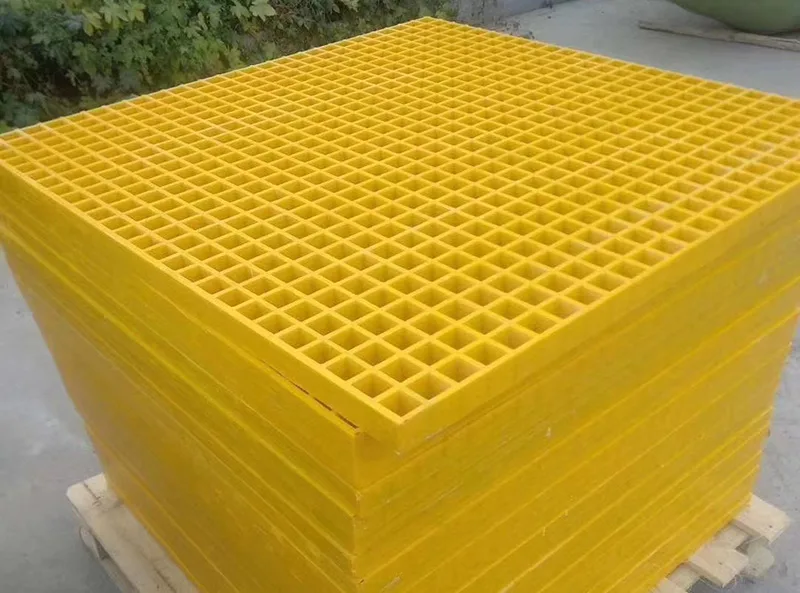
For cut-to-size work, use the fiberglass grating panels guide to separate full-panel and finished-piece scope.
Why “4 × 8 ft” Can Be Ambiguous
The expression may mean:
- an exact fabricated 1219.2 × 2438.4 mm outline;
- an industry nominal sheet, made to a nearby metric dimension;
- a panel footprint set by a support frame;
- a purchased area used in a price comparison;
- a chain of finished pieces cut from a larger source panel.
Those are not interchangeable. Ask the buyer whether a nearby metric size is acceptable, what the fit-critical edges are and what tolerance the frame can absorb.
Metric Depth Is Also a Nominal Product Class
An imperial request such as 1-1/2 in converts to 38.1 mm. The product may be described by its metric row at 38 mm. That does not prove a 38.1 mm exact delivered depth, nor does it identify the mesh or bar structure.
Record the product name and the measured/specified value separately. This is why our molded grating thickness guide treats 38 mm as one part of the configuration.
The same applies to mesh pitch. A nominal imperial mesh label can be converted to its exact inch value, but the actual metric product row and clear opening must still be confirmed.
Convert the Control Dimension, Not Every Informal Word
A practical order does not need a page of conversions. It needs one clear dimension table. Mark the dimensions that control:
- overall length and width;
- cut opening position;
- bearing span;
- frame opening;
- mesh pitch, when the project controls it;
- depth;
- finished thickness of a covered assembly.
Convert those values exactly. “Width” and “length” should refer to a diagram because suppliers sometimes use them differently.
A Worked 4 × 8 ft Conversion
For a nominal 4 × 8 ft request:
- exact rectangle: 1219.2 × 2438.4 mm;
- exact area: 2.9730 m².
If a supplier offers a nearby 1220 × 2440 mm panel, that is a different metric rectangle. It may be acceptable, but it should appear in the quotation as the offered product size.
If the project instead requires a finished piece of exactly 1218 × 2438 mm to fit a frame, work from that controlling dimension and state the tolerance. The common nominal name is not the manufacturing dimension.
A Worked 4 × 12 ft Conversion
For a nominal 4 × 12 ft request:
- exact rectangle: 1219.2 × 3657.6 mm;
- exact area: 4.4597 m²;
- 1220 × 3660 mm nominal area: 4.4652 m².
The difference in area is small, but the panel is not the same outline. In a non-critical layout, the metric equivalent may be accepted. At a tight end clearance or interface, the 2.4 mm length difference may still need review.
The same thinking applies to a 36 × 120 in request: 914.4 × 3048 mm exact, with a close 915 × 3050 mm product reference where that row is offered.
Keep Area, Weight and Price Units Consistent
An imperial area can be converted exactly for comparison, but weight and price need a common basis.
Use:
- kg/m² when using metric product mass;
- lb/ft² only when the source and area are both imperial;
- m² for a metric area rate;
- ft² for an imperial rate, converted before comparison if necessary.
Do not compare a per-square-foot quantity with a per-square-metre rate without carrying the conversion through. The FRP grating weight guide gives the unit conversions.
Make the Conversion Survive Cutting
Assume a nominal 1220 × 3660 mm panel is cut into several pieces. The finished-piece list may total less than the source-panel area because of kerf, edge trim and unusable offcuts.
The quotation should say whether price and quantity are based on:
- purchased source-panel area;
- sum of finished-piece area;
- theoretical installed coverage;
- material with cutting loss included.
Two quotes can have the same total finished area and different work because the cut nests differently. Include the cut list and accepted panel size so the comparison uses the same source.

Preserve Orientation and Piece Identity
The unit conversion does not remove LWO, bearing direction or top-face requirements. A rectangular molded panel rotated by 90° can keep the metric outline and change the product direction.
For each piece, record:
- mark or piece ID;
- exact finished size;
- accepted tolerance;
- orientation arrow;
- top face;
- opening datum;
- edge treatment;
- quantity.
This is especially important when several near-identical rectangles are produced from one full panel.
How We Handle an Imperial Inquiry in the Factory
Our working product rows use metric dimensions. An imperial inquiry is converted and then reconciled with an offered product size.
The review separates:
- the buyer’s stated imperial or metric requirement;
- the exact converted value;
- the available full-panel size;
- the final cut-piece size;
- drawing revision and piece marks;
- quantity or area basis;
- panel mass and packing.
We do not silently replace an exact dimensional requirement with the nearest catalog number. Where a close metric panel is accepted, that acceptance is written into the quotation and drawing.
A Simple Imperial-Size Order Checklist
Before quotation, confirm:
- The exact project dimension.
- The measuring datum.
- Whether a metric equivalent is acceptable.
- The offered full-panel size.
- The finished-piece dimensions and tolerance.
- Panel depth, mesh and resin.
- Direction and top-face requirements.
- Quantity and area basis.
- Cutting, openings and edge treatment.
- Required documents and packing identification.
If the request is only “four by twelve,” the first useful answer is the exact conversion plus a question: is a close metric panel acceptable, or is the stated rectangle controlling?
Five Conversion Mistakes We See in Inquiries
Treating a common metric panel as the exact imperial rectangle
A 1220 × 3660 mm product is not exactly 48 × 144 in. If the drawing really requires the imperial rectangle, the difference has to be evaluated rather than erased by rounding.
Copying inches into a field that expects millimetres
A 48 × 144 value entered into a millimetre field could become a 48 × 144 mm piece. State the unit in every field and use a dimensioned drawing where possible.
Converting the length but leaving the depth nominal
A 1-1/2 in depth request is not a completed product specification after conversion to 38.1 mm. The factory may supply a nominal 38 mm row. Which basis controls must be confirmed.
Converting the panel but not the load or span
An imperial span of 36 in is 914.4 mm. If the load table uses metric clear span, the project dimension and table dimension still need the same span definition. A unit conversion does not resolve support geometry.
Changing the outside size without updating the cut list
If 4 × 8 ft is accepted as a nearby metric full panel, all finished pieces and opening positions must be rechecked against that source. A panel substitution can change nesting, edge allowance and the delivered piece schedule.
The Manufacturer Rule for Imperial Orders
A reliable imperial order does not hide the conversion. It shows it.
The drawing should make the requested dimension, the available product dimension and the delivered finished dimension visible. The quote should state the accepted substitute, tolerance, area basis and fabrication scope. That turns feet and inches from a conversational shorthand into a production instruction.
Order conversion
How We Convert an Imperial Grating Request
The review moves from the request to the product and finally to the delivered pieces.
We retain the feet and inches exactly as written, then convert the controlling dimensions to millimetres and square metres.
The project opening, offered full panel and finished cut pieces are listed separately so a nominal name cannot silently become the order size.
A nearby factory size is accepted only when the buyer or drawing permits it; exact dimensions and tolerances take priority at fit-critical interfaces.
Depth, pitch, mesh orientation, resin, surface and panel form are confirmed in the same schedule.
Full-panel area, finished-piece area, cut loss and approximate weight remain visible in the quotation.
Piece marks, orientation, openings and edge treatment follow the approved metric dimensions through fabrication and packing.
Manufacturing view
What Changes When the Inquiry Uses Inches
The arithmetic is simple; the risk comes from mixing nominal names, product sizes and finished-piece dimensions.

Imperial name kept beside metric value
We preserve the original request while recording its exact metric conversion, so later reviewers can see how the order was interpreted.
Offered panel size stated explicitly
A 1220 × 3660 mm product is not presented as identical to an exact 4 × 12 ft rectangle; the accepted substitution is recorded.
Finished-piece list controls fabrication
The dimensions after cutting, opening and edge treatment are the dimensions used for the fabricated pieces and inspection.
Cut loss is not hidden
Source-panel area, finished-piece area and cutting loss can be different quantities. The quotation identifies the commercial basis.
Orientation survives conversion
LWO, bearing direction, top face and opening datums remain tied to each metric piece mark.
Packing is not part of net size
Finished piece identification remains separate from pallet dimensions, package mass and freight calculation.
RFQ checklist
What to Send for a Molded Grating Imperial-Size Quote
Send a dimensioned sketch or schedule, even if the original project is described in feet and inches.
- Original imperial dimensions — Give feet, inches or fractions plus a dimensioned sketch or CAD/DWG where available.
- Accepted metric conversion — State whether exact converted dimensions are required or a close metric product size is acceptable.
- Full panel or finished pieces — Identify whether the order is a full molded panel, factory-cut pieces or a mixed source-panel schedule.
- Finished size and tolerance — Mark fit-critical lengths, widths, opening positions and the permitted dimensional tolerance.
- Product configuration — Provide depth, pitch, mesh orientation, resin, surface, color and panel format.
- Quantity and area basis — Give pieces by mark, total quantity and whether pricing or comparison uses panel area or finished-piece area.
- Cutting and edge treatment — Show openings, drilled holes, edge sealing and any removable or handle-ready pieces.
- Documents and packing — State piece-mark, inspection record, certificate, drawing and packing requirements.
Request a quote
Send Your Imperial Grating Drawing
Include exact inches or metres, the accepted conversion, panel configuration and finished-piece details.
- Requested and offered sizes both stated
- Close metric substitution confirmed
- Cut pieces and area basis reconciled
Molded Grating Imperial-Size Questions
Is a 4 × 8 ft molded grating panel exactly 1220 × 2440 mm?
Is a 4 × 12 ft panel exactly 1220 × 3660 mm?
Can I order using only feet and inches?
Is 1-1/2 inch grating the same as 38 mm grating?
How do I compare a square-foot price with a square-metre price?
Why is the finished-piece size different from the full-panel size?
Will rotating an imperial-sized piece change the order?
This content was prepared and reviewed by Dengtai Industry’s technical and production team using the project conditions, available product data and applicable documents. Limits that require design, testing or approval are identified in the content. Content last checked: