Dock and marina specification guide
Fiberglass Dock Grating Specification: Salt Spray, Fixings and Maintenance
Specify the whole marine walking deck: panel construction, resin and cut-edge protection, support and movement, stainless fixing details, open drainage, walking surface and a maintenance plan that can actually be carried out in salt air.
Prepared by
Dengtai Industry
Published
·
Reviewed

An open FRP dock walkway from our image library. Final details depend on the supporting structure, exposure and fixing design. Photo: Dengtai Industry.
Dock specification terms
Ten Terms Behind a Useful Marine Grating Specification
Exposure, movement, bearing, fixing and maintenance need separate definitions.
- Fiberglass dock grating
- An FRP walking panel used for a floating pontoon, fixed pier, marina walkway or landing. It may be molded with bars in two directions or pultruded with a dominant bearing direction.
- Marine exposure schedule
- A record of where the deck contacts salt spray, splash, tidal water, permanent immersion, fresh-water washdown or cleaning chemicals, including frequency and temperature.
- Cut-edge sealing
- Treatment that protects an exposed composite cut. It does not restore a cut bearing bar, provide bearing under an opening or replace a resin system appropriate to the exposure.
- Hold-down node
- The complete connection between a panel and its support: clip or bracket, bolt, washer, isolation detail, hole clearance, bearing surface and inspection access.
- Floating movement
- Relative movement caused by waves, wind, pontoon deflection, gangway action, temperature or module connections. It affects gaps, hold-downs and the transition between deck sections.
- Concave surface
- The shallow moulded trough that runs along a grating top bar. It drains water and creates a shaped walking texture, but the finished slip performance needs product-specific evidence.
- Grit surface
- A granular top texture added to improve grip. It can change barefoot comfort, cleaning, wear and the handling of the panel, so sample approval may be appropriate.
- Open mesh and mini mesh
- Open mesh provides a relatively large passage for water and debris. Mini mesh adds a finer upper grid to reduce dropped-object openings, usually with less open area and more mass.
- Maintenance route
- The safe position and access needed to wash the deck, remove debris, inspect fasteners, lift panels and replace an edge or transition detail.
- Marine-grade evidence
- Product-specific information that connects the proposed resin, construction, surface, hardware and installation to the actual exposure and project acceptance criteria.
Dock types
Four Waterfront Settings With Different Design Inputs
A floating pontoon, fixed pier, gangway landing and pool deck do not share one default.

Floating marina pontoon
Review wave and wind uplift, float and frame deflection, module movement, panel retention, utility cutouts and the moving gangway landing. A fixed-pier load table does not cover all floating conditions.
Send float spacing, frame plan, expected movement, wave/wake exposure and hold-down concept.
Fixed pier and waterfront walkway
The existing timber, steel or concrete structure sets the support grid. Check bearing width, top elevation, member condition and every transition to stairs, ramps and edges.
Send joist or beam spacing, elevations, bearing condition and access route.
Gangway landing
Hinges, wheels, moving frames and slope transfers introduce a changing point load and relative movement. Define the landing panel, gap, bearing and fixing separately.
Mark hinge or wheel path, landing movement, approach slope and pedestrian or trolley traffic.
Poolside and leisure-water deck
Chlorine, fresh water and frequent barefoot use are different from seawater. Surface comfort, dropped objects, splash and cleaning products are decided with the owner.
State footwear, barefoot use, chlorine, washdown, solar exposure and object retention.
Panel construction
Molded and Pultruded Dock Grating Solve Different Layouts
Start with support direction, span, openings and handling rather than a general performance claim.
| Decision | Molded grating | Pultruded grating |
|---|---|---|
| Load direction | Load can distribute through a two-way grid | Primary load path follows the pultruded bearing bars |
| Layout fit | Useful for repeated utility cuts and changing walkway direction | Useful for a clear one-way span and repeated parallel supports |
| Support dependency | Span and bearing still govern the actual configuration | Bar direction must remain correct through the whole panel layout |
| Openings | A cut interrupts the two-way mesh and local support may change | A cut through a bearing bar interrupts the main load path |
| Surface choice | Concave or grit surfaces may be available | Concave or grit surfaces may be available |
| Final selection | Match the proposed construction and span to project evidence | Match the exact I, T or hollow section and support to project evidence |
Movement control
How Dock Movement Changes the Restraint and Interface
Floating, fixed and moving landing conditions require different joint and fixing questions.
| Deck condition | Movement to accommodate | Restraint or interface to define | What the project must confirm |
|---|---|---|---|
| Fixed pier or waterfront edge | Structural deflection, moisture and possible thermal movement | Bearing position, clip or bolt layout and edge transition | Support condition, corrosion exposure and whether panels need release for service |
| Floating pontoon module | Wave, wake, wind uplift, float deflection and module movement | Relative gaps, hold-down pattern and resisting or sliding detail where designed | Actual movement range, fixing capacity, hole clearance and inspectability |
| Gangway landing | Hinge or wheel travel, changing slope and point load | Landing bearing, gap, edge protection and connection to moving parts | Movement envelope, traffic, handrail and fall-protection interfaces |
| Utility or fuel bay | Frequent release, storage, reinstatement and possible equipment movement | Removable panel ID, lift point, fixing family and component packet | Maximum handling mass, access direction and refit check |
| Long continuous run | Thermal change and cumulative joint movement | Controlled panel joints, support lines and edge restraint | Gap and fixing basis supplied by the project rather than guessed on site |
Specification matrix
The Inputs a Fiberglass Dock Grating Quote Needs
Eight fields connect the actual marine route to the panel and fixing package.
| Specification field | Required project information | Why it changes the delivered deck |
|---|---|---|
| Exposure map | Spray, splash, immersion, dry cycle, UV and cleaning chemistry | Sets the resin, surface and cut-edge review |
| Structure | Supports, clear spans, bearing, elevations and connection points | Defines panel construction and whether added supports are needed |
| Movement | Floating motion, gangway action, thermal gap and module interface | Determines clearance, restraint and slip accommodation |
| Fixing nodes | Clip or bracket, bolt, washer, isolation, hole and support material | Prevents an incompatible or inaccessible connection |
| Walking duty | Pedestrian, trolley, maintenance equipment, footwear and traffic frequency | Sets load, mesh, surface and sample review |
| Drainage | Water path, debris, pooling and cleaning method | Balances open area with dropped-object control |
| Maintenance access | Which panels lift, how often and from where | Controls piece size, mass, handles, hinges and reinstatement |
| Evidence | Required standard, test, load basis, sample and inspection record | Connects the offer to the actual product and project requirement |
Specification readiness
When a Dock Grating Brief Is Ready for Review
Use these gates to separate a real specification from a marine-grade label.
Specify this if…
- The dock type, support structure and clear spans are known.
- Spray, splash and immersion are recorded by area.
- Floating or gangway movement is shown rather than described as “normal.”
- The fastener node can name the clip, bolt, isolation and access method.
- Walking surface and maintenance cleaning are considered together.
- The required product evidence and acceptance criteria are stated.
Look elsewhere if…
- The only requirement is “marine grade.”
- A land-based load table is applied without checking the dock structure and movement.
- Stainless is specified without grade, support material or connection detail.
- Cut edges and drilled holes have no treatment requirement.
- Grit is assumed to provide a slip class without a test result.
- A panel is expected to solve drainage, fall protection and structural design on its own.
Example only
How a Dock Grating Specification Can Be Split Into Pieces
The rows organise route, movement, fixing and evidence; they do not invent a load rating.
| Dock piece ID | Route section and duty | Panel and surface | Movement and fixing input | Evidence to match |
|---|---|---|---|---|
| DK-01 | Shore approach, public pedestrian route | Construction, mesh, depth and preferred walking surface | Fixed support condition, edge trim and interface to the ramp | Pedestrian load, wet surface and project installation basis |
| DK-02 | Main floating pontoon | Molded or pultruded construction after span review | Module movement, gap, hold-down and support contact | Floating structure, fixing and corrosion evidence |
| DK-03 | Moving gangway landing | Panel direction and surface selected for foot or trolley traffic | Hinge or wheel envelope, landing gap and local bearing | Point load, movement and handrail/guard interface |
| DK-04 | Removable utility or service bay | Manageable panel and removable cover set | Piece mark, lift point, fixing release and reinstatement | Service access and component schedule |
A Dock Is a Route, Not One Repeated Panel
A marina access route changes as it moves from shore. A fixed ramp may lead to a moving gangway, then a main pontoon, then a narrower finger pier. Each section can have different support spacing, relative movement, edge conditions, drainage and maintenance access. Copying the same panel size from the main deck to the narrow branch is not a specification.
Start by dividing the route into sections. For each, mark the support frame, clear spans, panel joints, walking direction, utility cutouts, gangway or hinge interface and the place where cleaning equipment can stand. Show the edge and guardrail interfaces too. The finishing subcontractor may install these elements, but the grating must still connect to them without unplanned gaps or point loads.
The route view also exposes where water goes after it passes through the mesh. Open grating removes the immediate pooling surface, but debris can collect at supports, and adjacent solid deck may discharge across the panel. Slope, edge drainage and cleaning access belong in the same layout.

Map Salt Spray, Splash and Immersion Separately
“Marine environment” can describe locations with very different demands. A covered equipment platform under a roof but near the coast sees windborne chloride and condensation. A fixed pier edge sees repeated splash and dry cycles. A pontoon underside may be continuously wet or immersed. A poolside deck has fresh water and chlorine; a fish-landing area may have organic residue, washdown chemicals and abrasion.
For each route section, record:
- the type and frequency of salt or chemical contact;
- whether the panel is sprayed, splashed, wet continuously or immersed;
- cleaning chemicals, concentration and temperature;
- UV and sun exposure;
- expected abrasion from footwear, carts or equipment; and
- the surrounding metals and materials at each connecting node.
The resin and surface are then reviewed against that information. Isophthalic polyester may be considered for less demanding exposure; vinyl ester is often evaluated where splash, immersion or more aggressive chemistry warrants it. The final grade and product evidence still need to be confirmed. The resin selection guide explains why one resin family name does not identify a complete formulation or exposure rating.
Cut edges and drilled holes deserve their own specification. Factory cutting and edge treatment can reduce variability, but site cuts may still be required around services. Both have to be listed. Edge sealing protects exposed glass and resin at the cut; it does not restore a severed structural bar or turn an unsuitable resin into a marine grade. The cutting and sealing guide covers the fabrication sequence.
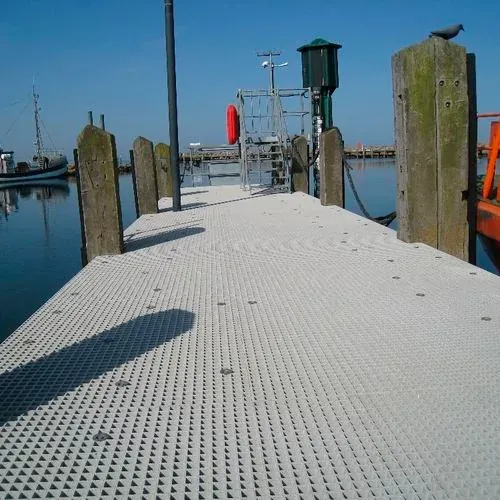
Resolve Floating Movement Before the Panel Is Selected
A floating pontoon is not a rigid building floor. Waves, wake, wind, people, equipment, float deflection and module connections produce movement. The deck panel has to remain seated while the structure below moves within the expected range.
Important inputs include float spacing, the deck frame, expected wave and wake exposure, pontoon module joints, potential uplift, gangway hinge or wheel action and the clearance around utilities and edges. Thermal movement can also change gaps between long panel runs. A panel that is tightly restrained in every direction may create local stress or damage its fixing holes; a panel that is too free can move, rattle or lift.
The fixing layout should respond to the actual movement. State whether a clip is intended to hold the panel down, connect two panel edges, locate the panel laterally or permit release for service. These are not interchangeable jobs. The anti-lift fixing guide covers the restraint and reinstatement logic for exposed panels.
For a fixed pier, the movement question may be smaller, but the structure can still deflect and the existing timber or steel joists may not be flat. Measure the bearing surface and clear span. A new panel cannot correct a missing joist or a narrow high point merely because it has clips.
Set Gaps and Restraint Together
A float moves; a rigidly fastened panel does not have unlimited tolerance. The useful drawing therefore connects the panel layout to the expected movement range rather than showing clips without gaps or holes without clearances.
For each fixing position, state whether the intended job is to hold the panel down, locate it laterally, join two edges, permit thermal movement or allow deliberate release. The project engineer can then define whether a fixed, slotted, oversize or other compatible hole and washer arrangement is acceptable. Do not copy a detail from a fixed pier into a floating module without checking the new movement direction.
The same discipline applies at module joints and long deck runs. A narrow gap can close under movement; an oversized gap can create a trip or point-load condition. The dimensions and acceptance tolerances belong to the project design. We can fabricate the agreed hole or slot pattern and identify the components, but we do not select a movement allowance from a generic catalogue photograph.
Coordinate the Objects Attached to the Deck
The grating is rarely the only thing crossing the dock. Cleats, fenders, service pedestals, handrails, gangway hinges, lighting and utility covers can all introduce supports, anchors, point loads or maintenance access requirements. Show each on the deck plan even when another supplier installs it.
Check the following interfaces:
- whether a cleat or fender anchor passes through or beside the grating;
- whether a handrail post lands on the deck frame or only on a panel;
- whether the gangway hinge or wheel needs a larger opening, local bearing or removable piece;
- whether power, water and fuel pedestals need a service cutout and cable or hose access; and
- whether an edge trim or toe board conflicts with a clip, hole or panel release direction.
This is where a dock article becomes genuinely project-specific. A clean panel schedule can still fail if a later supplier drills the only unclipped edge, cuts a bearing bar for a pedestal or places a gangway reaction outside the supporting frame.
Define the Stainless Fixing as a Node
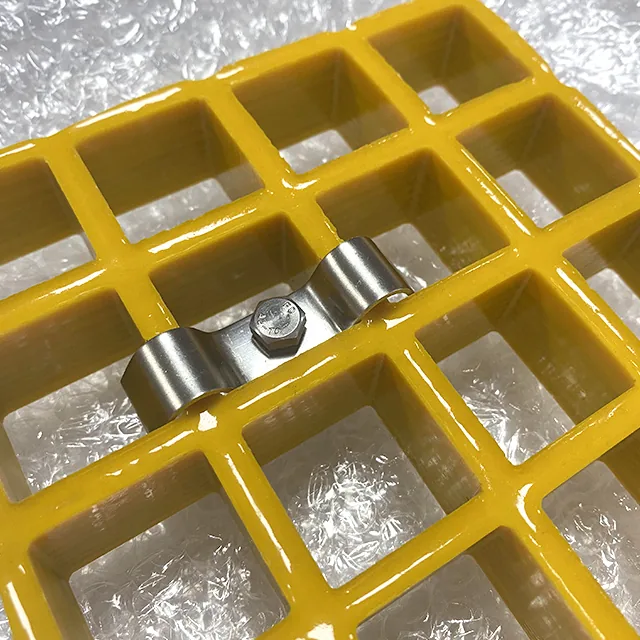
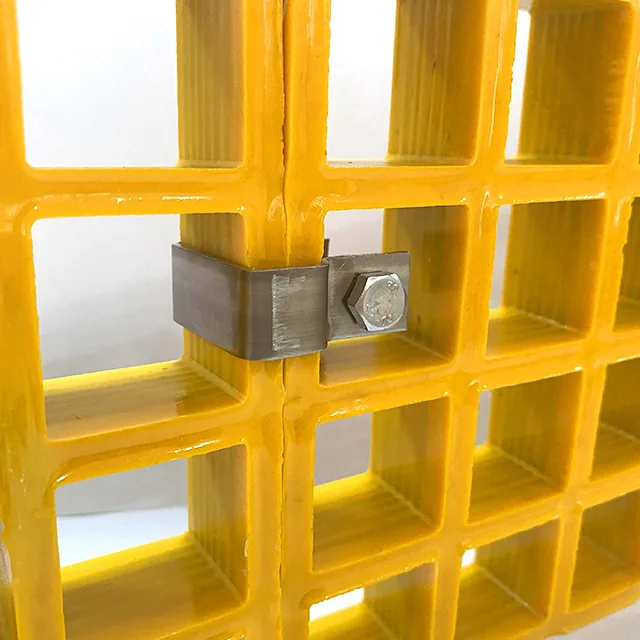
“Stainless fixings” is not a complete specification. A useful fixing node describes:
- the clip or bracket and how it fits the grating bar or panel edge;
- the bolt, screw or anchor and its grade;
- the washer and any isolation layer between dissimilar metals;
- the hole diameter and position in the panel;
- the support material, wall thickness or embed condition;
- the removal or hinge method where applicable; and
- access for inspection and re-tightening.
Austenitic stainless grades such as 304 and 316 are not interchangeable in every coastal application. The actual chloride exposure, cleaning chemistry, crevice conditions and manufacturer documentation should decide the grade. Galvanic interaction between the stainless fastener, aluminium frame, carbon steel or other metal is a separate question. An isolation pad or washer may be appropriate, but the complete detail still needs to suit the loads and movement.
We prefer to quote a fixing set rather than a bag of clips. The drawing should show which clip is used at a perimeter, internal support, panel joint, removable section and edge transition. This avoids an installation where many visible clips are present but one critical interface is missing.
Select the Walking Surface With the User in Mind
A dock may be walked on in heavy boots, wet trainers or bare feet. Grit that is helpful under a work boot can be uncomfortable or abrasive at a pool. A concave top can drain and feel smoother, but its grip and cleaning characteristics vary with bar spacing, wear and contamination. Product-specific slip evidence should be requested when slips are a material concern.
If small objects must not fall through, mini mesh can reduce the upper opening. The finer grid may also hold more debris and reduce open area, so the cleaning plan becomes more important. A covered format closes the walking surface but introduces joints, mass and additional interfaces. It should not be added simply as a universal “safer” option.
Surface approval may benefit from a sample. Use the actual footwear, wet condition and cleaning routine. A photograph is not enough to judge grit feel, colour movement, barefoot comfort or edge handling.
The walking surfaces and treatments guide explains the product fields behind those choices. Panel size and handling should be checked with the sizes and weight guide rather than inferred from the hero photograph.

Write a Maintenance Plan That Fits the Dock
FRP resists rust, but a dock still collects salt crystals, sand, mud, leaves and biological growth. Fasteners can trap debris, cut edges can be damaged, and a panel can be dropped or abraded. “Low maintenance” should mean the required work is simple and scheduled, not that the deck can be ignored.
A practical plan includes:
- regular removal of trapped debris;
- washing of the mesh and support gaps using an approved method;
- inspection of cut edges, chips, surface wear and loose material;
- checking the clips, bolts, washers, isolation details and frame contact;
- confirming removable panels are returned to the correct ID and fully seated; and
- recording damage or missing hardware before the next busy period.
Freshwater washing after heavy salt exposure can be appropriate, but the method must respect the resin, surface and nearby environment. High-pressure equipment can damage edges or force water into places it cannot drain. The cleaning contractor should know the permitted chemical and pressure limits.
The maintenance and service-life guide provides a wider inspection framework. It is better to design for access than to assume a future crew can remove a heavy, seized panel from below.
Plan the Removable Pieces as Factory Kits
Dock grating often includes panels that lift for utilities, fuel equipment, floats or service connections. These pieces need an ID, a maximum mass that the site can handle and a clear lift direction. If the fixing is a bolt-and-clip pattern, the reinstatement sequence should be repeatable without interpreting a generic drawing.
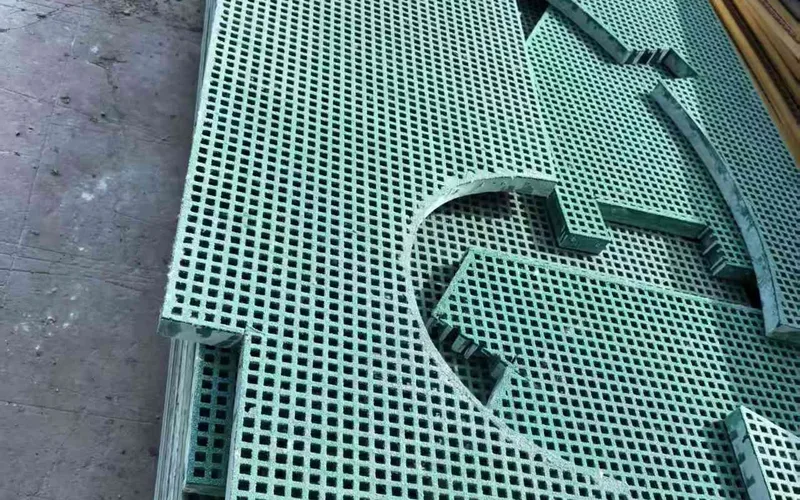
Factory-cut pieces and a piece schedule help keep panel direction, surface and edge treatment consistent. The packing list can identify which set belongs to each pontoon module. Spare clips, washers and cut-edge repair material should be considered in the operation and maintenance plan.
What Strong Marine Pages Add
Fibergrate’s FRP decking guide usefully frames the coastal problem as saltwater, UV, freeze-thaw and mechanical load acting together. Its maintenance discussion keeps inspection and washing in view. Unicomposite’s dock grating framework separates molded and pultruded load paths and links that choice to support and application. F1 Composite’s marine page is especially strong on the boundaries between deck panel, framing, gangway, service pedestal and actual exposure.
We have absorbed those useful perspectives, but avoid turning broad properties into guaranteed service life or universal “maintenance-free” claims. Our factory view is that docks fail commercially when the interfaces remain vague: a panel is quoted but the stainless bolt is not, the pontoon moves but the gap is not drawn, or a cut edge has no treatment scope.
The specification we prefer is therefore modular and explicit. It lets a buyer compare an entire panel-and-fixing package, not just a price per square metre. It also makes later maintenance possible because the same piece IDs, edge treatment and fixing families are recorded at delivery.
The Specification Review We Can Perform
We can review the proposed panel layout, construction direction, cut pieces, openings, edge treatment, selected resin direction, surface and agreed fixing family. We can flag information that is missing, such as an undefined support span, a mobile landing with no movement clearance or a removable panel that appears too large for the available access.
We do not approve floating stability, structural framing, handrails, gangway engineering, installation, site safety or complete marina compliance unless the written scope includes those services. Keeping that boundary clear lets both the factory and the project engineer work from the same facts.
Specification sequence
From Waterfront Route to a Quoted Dock Grating Package
Seven steps keep exposure, structure, movement, panel, fastener and maintenance aligned.
Mark pontoon, fixed pier, gangway landing, edge and utility areas that see different movement and exposure.
Record salt spray, splash, immersion, sun, cleaning chemicals and the materials around each fixings node.
Draw supports, bearing, elevations, clear spans and every transition before selecting the panel.
Compare molded and pultruded construction, mesh, depth, resin and walking texture against the route duty.
Match clip, bolt, washer, isolation, hole and release method to the panel and support material.
Show access, removable pieces, lift method, spare-part identity and inspection sequence.
Check that the load, material, surface and corrosion documents apply to the exact delivered configuration.
Project checklist
What to Send With a Fiberglass Dock Grating Enquiry
Ten items remove the assumptions that make two dock quotations incomparable.
- Dock and route plan — Floating, fixed, gangway, edge, ramp and utility areas with dimensional relationships.
- Structure — Joist or beam spacing, bearing width, clear span, elevations and support condition.
- Movement — Pontoon motion, gangway hinge or wheel path, module gaps and expected relative movement.
- Exposure — Salt spray, splash, immersion, UV, chlorine, fuel, cleaning chemicals and temperature.
- Traffic — Pedestrian, barefoot, trolley, maintenance equipment, point loads and frequency.
- Panel — Molded or pultruded construction, depth, mesh, bar direction, resin and color.
- Surface — Concave or grit preference, footwear, barefoot comfort, cleaning and sample requirement.
- Fixings — Clip or bracket type, bolt and washer grade, isolation, anchor, release and quantity.
- Handling — Removable panels, maximum mass, lift points, storage and reinstatement sequence.
- Evidence — Required load, material, slip, fire, inspection or conformity documents and their scope.
Product boundaries
Four Things a Marine Grating Panel Cannot Prove by Itself
A good product decision still leaves structural, drainage and operational responsibilities.
- A panel is not automatically a marine-grade system — The resin, reinforcement, construction, surface, cut edges, fixings and support all contribute. Ask what the evidence covers rather than accepting the label alone.
- A clip is not the whole fixing node — The clip must fit the bar, height and support. The bolt, washer, isolation, hole size and service access also belong to the design.
- Open mesh is not a complete drainage design — Water can pass through the deck, but pooling, debris accumulation, slope and edge drainage still need a route.
- Material resistance is not a service-life guarantee — Load, UV, cleaning, abrasion, damage and inspection affect service life. FRP does not make every marine deck maintenance-free.
Specification schedule
Dock Grating Fields That Must Stay Together
Each row should follow the exact panel, support and fixing package.
Request a Project Quote| Specification | Value |
|---|---|
| Construction | Molded or pultruded Exact mesh, depth or bearing-bar section and direction must match the support layout. |
| Resin direction | Isophthalic or vinyl ester Select against actual spray, splash, immersion and cleaning exposure, not a generic marine label. |
| Cut edge | Specify treatment Factory-cut and site-cut pieces both need the agreed edge condition. |
| Fixing node | Clip or bracket + stainless bolt + interface Grade and isolation depend on the surrounding metal and chloride exposure. |
| Walking surface | Concave, grit or covered Confirm barefoot use, debris, cleaning and product-specific slip evidence. |
| Drainage | Open or mini mesh Balance hydraulic area, dropped-object control and debris cleaning. |
| Maintenance | Removable pieces and inspection access Define panel mass, hardware and reinstatement rather than assuming site can lift it. |
| Evidence | Product and project specific Load, material, surface and conformity documents must describe the offered assembly. |
Request a review
Send the Dock Plan, Exposure and Fixing Interfaces
Show where the deck is wet, where it moves and how it can be maintained.
- State spray, splash and immersion separately
- Show every floating and gangway movement
- Define the full stainless fixing node
Fiberglass Dock Grating Specification Questions
What makes fiberglass dock grating “marine grade”?
Should I always choose vinyl ester for a dock?
Are stainless clips enough for a floating dock?
Can a standard FRP load table be used for a pontoon?
Is grit better than a concave top?
How should dock grating be cleaned?
Do fasteners need to be removable?
Can FRP decking be used around a gangway?
Does open mesh guarantee no standing water?
Can you approve the entire marina structure?
This content was prepared and reviewed by Dengtai Industry’s technical and production team using the project conditions, available product data and applicable documents. Limits that require design, testing or approval are identified in the content. Content last checked: